Introduction
AI Accessibility Services (Speech/Caption) Platforms use artificial intelligence, automatic speech recognition, natural language processing, machine learning, and real-time transcription technologies to improve digital accessibility for people with hearing, speech, visual, and communication challenges.
Governments, organizations, educational institutions, and businesses are increasingly focusing on inclusive digital services that allow everyone to access information and participate equally. Traditional accessibility solutions often require manual captioning, transcription, or interpretation services, which can be expensive and difficult to scale.
AI-powered accessibility platforms automate speech recognition, generate captions, convert speech into text, improve communication accessibility, and support inclusive experiences across digital platforms.
These tools help organizations:
- Generate real-time captions
- Convert speech into text
- Improve meeting accessibility
- Support hearing-impaired users
- Enhance online learning accessibility
- Improve public communication
- Automate transcription workflows
AI accessibility platforms are used by:
- Government agencies
- Educational institutions
- Healthcare organizations
- Media companies
- Corporate teams
- Public service departments
- Online meeting platforms
Modern solutions combine AI speech recognition, live captioning, translation, speaker identification, accessibility APIs, and automated transcription.
The goal of these platforms is to make digital communication more inclusive, accessible, and easier to understand for all users.
How AI Accessibility Speech and Caption Platforms Work
Audio Capture
AI systems collect:
- Live conversations
- Meetings
- Videos
- Public announcements
- Online events
- Phone conversations
Speech Recognition
AI converts:
- Voice into text
- Different speakers into transcripts
- Spoken language into captions
Language Processing
AI improves:
- Grammar
- Context understanding
- Speaker identification
- Terminology accuracy
Accessibility Delivery
Platforms provide:
- Live captions
- Transcripts
- Translated captions
- Accessible content formats
Continuous Improvement
AI improves through:
- User corrections
- Language models
- Industry vocabulary
- Feedback data
Common Use Cases
- Government accessibility services
- Online education captions
- Business meetings
- Video conferencing
- Healthcare communication
- Public announcements
- Media accessibility
- Legal transcription
- Customer support calls
- Digital content compliance
Why AI Accessibility Platforms Matter
Improved Inclusion
AI helps people with hearing and communication challenges access information.
Real-Time Communication
Live captions improve participation in meetings and events.
Reduced Manual Work
Automation lowers the need for human transcription.
Better Digital Compliance
Organizations can improve accessibility standards.
Wider Information Access
AI helps deliver content across different communication needs.
Evaluation Criteria for Buyers
Speech Recognition Accuracy
Platforms should provide reliable transcription quality.
Real-Time Captioning
Important for:
- Meetings
- Events
- Customer communication
- Public services
Language Support
Solutions should support multiple languages.
Speaker Identification
Tools should distinguish between different speakers.
Integration Capability
Important integrations include:
- Video platforms
- Websites
- Mobile applications
- Learning systems
- Communication tools
Security and Privacy
Accessibility platforms may process sensitive conversations.
Customization
Organizations should be able to add:
- Custom vocabulary
- Industry terminology
- User preferences
Key Trends
Real-Time AI Captioning
Organizations are adopting instant caption generation.
Multilingual Accessibility
AI is enabling captions across multiple languages.
AI Meeting Assistants
Accessibility tools are becoming part of collaboration platforms.
Speech Recognition Improvements
Advanced AI models are improving accuracy.
Government Digital Accessibility
Public organizations are expanding accessible services.
Personalized Accessibility
AI is adapting experiences based on individual needs.
Methodology
The following platforms were evaluated using:
- Speech recognition capability
- Caption generation quality
- Accessibility support
- Language coverage
- Integration capabilities
- Ease of use
- Security and privacy
- Reliability
- Support
- Price and value
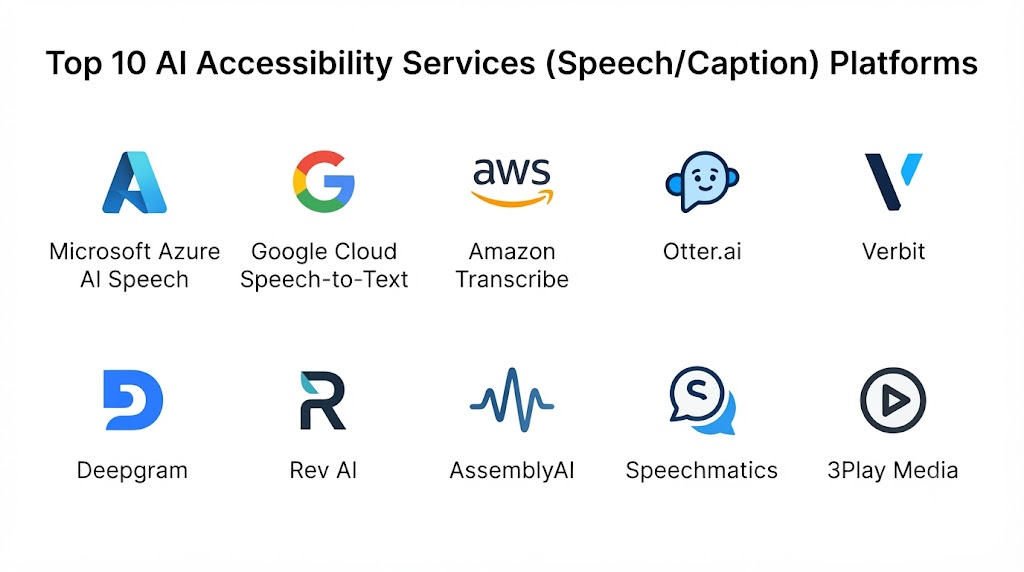
Top 10 AI Accessibility Services (Speech/Caption) Platforms
1. Microsoft Azure AI Speech
Microsoft Azure AI Speech provides speech recognition, captioning, and accessibility capabilities.
Key Features
- Speech-to-text
- Real-time captions
- Language translation
- Speaker recognition
- Custom speech models
- Audio processing
- Accessibility APIs
- Transcription workflows
- Voice services
- Enterprise integration
Pros
- Strong speech recognition
- Enterprise scalability
- Multiple language support
- Customization options
- Strong security ecosystem
Cons
- Requires technical setup
- Cloud dependency
- Advanced features need configuration
Platforms
Cloud platform.
Deployment or Support
Cloud deployment.
Security & Compliance
Enterprise cloud security controls.
Integrations & Ecosystem
Applications, websites, communication systems, and accessibility platforms.
Support & Community
Enterprise support.
2. Google Cloud Speech-to-Text
Google Cloud Speech-to-Text provides AI-powered speech recognition services.
Key Features
- Speech recognition
- Real-time transcription
- Caption generation
- Language detection
- Speaker diarization
- Custom speech models
- Audio analysis
- API integration
- Multilingual support
- Automation
Pros
- Strong AI speech capabilities
- Broad language support
- Scalable infrastructure
- Developer-friendly APIs
- Good accuracy
Cons
- Requires cloud expertise
- Configuration required
- Costs vary
Platforms
Cloud platform.
Deployment or Support
Cloud deployment.
Security & Compliance
Google Cloud security controls.
Integrations & Ecosystem
Applications, websites, APIs, and communication platforms.
Support & Community
Google Cloud support.
3. Amazon Transcribe
Amazon Transcribe provides automatic speech recognition services.
Key Features
- Speech transcription
- Real-time captions
- Speaker identification
- Medical transcription support
- Custom vocabulary
- Language identification
- Audio processing
- API access
- Analytics
- Automation
Pros
- Scalable cloud service
- Strong AWS ecosystem
- Real-time processing
- Custom vocabulary support
- Developer-friendly
Cons
- Requires AWS knowledge
- Cloud-based
- Advanced customization needs expertise
Platforms
AWS cloud platform.
Deployment or Support
Cloud deployment.
Security & Compliance
AWS security controls.
Integrations & Ecosystem
AWS services, applications, websites, and communication tools.
Support & Community
AWS support ecosystem.
4. Otter.ai
Otter.ai provides AI-powered meeting transcription and captioning.
Key Features
- Live transcription
- Meeting notes
- Speaker identification
- Caption generation
- Searchable transcripts
- Collaboration tools
- Summaries
- Meeting intelligence
- Integrations
- Mobile support
Pros
- Easy to use
- Strong meeting transcription
- Good collaboration features
- Useful summaries
- Quick deployment
Cons
- Focused mainly on meetings
- Accuracy varies by audio quality
- Enterprise needs vary
Platforms
Cloud and mobile platforms.
Deployment or Support
Cloud deployment.
Security & Compliance
Security controls vary.
Integrations & Ecosystem
Video conferencing tools, productivity platforms, and communication applications.
Support & Community
Customer support.
5. Rev AI
Rev AI provides speech recognition and transcription APIs.
Key Features
- Speech-to-text APIs
- Real-time captions
- Transcription services
- Language support
- Speaker identification
- Audio processing
- Custom workflows
- Developer tools
- Analytics
- Automation
Pros
- Strong transcription APIs
- Developer-friendly
- Real-time capabilities
- Flexible integration
- Reliable processing
Cons
- Requires development effort
- API-focused
- Custom implementation needed
Platforms
Cloud platform.
Deployment or Support
Cloud deployment.
Security & Compliance
Security controls vary.
Integrations & Ecosystem
Applications, websites, communication platforms, and APIs.
Support & Community
Developer support.
6. Verbit AI
Verbit provides AI-powered transcription and captioning solutions.
Key Features
- Live captions
- AI transcription
- Human-assisted accuracy
- Accessibility services
- Speech recognition
- Education support
- Enterprise workflows
- Translation support
- Reporting
- Quality management
Pros
- High accuracy approach
- Human-AI combination
- Strong accessibility focus
- Education support
- Enterprise solutions
Cons
- Service-based model
- Pricing varies
- Requires workflow integration
Platforms
Cloud platform.
Deployment or Support
Cloud deployment.
Security & Compliance
Enterprise security controls.
Integrations & Ecosystem
Education systems, media platforms, communication tools.
Support & Community
Professional support.
7. Deepgram
Deepgram provides AI speech recognition technology.
Key Features
- Speech-to-text
- Real-time transcription
- Caption generation
- Voice intelligence
- Speaker detection
- Custom models
- API integration
- Audio analytics
- Language processing
- Automation
Pros
- Fast speech processing
- Developer-friendly
- Real-time capabilities
- Custom AI models
- Scalable
Cons
- Requires technical knowledge
- API-focused
- Implementation effort
Platforms
Cloud platform.
Deployment or Support
Cloud deployment.
Security & Compliance
Security controls vary.
Integrations & Ecosystem
Applications, APIs, communication platforms, and websites.
Support & Community
Developer support.
8. AssemblyAI
AssemblyAI provides AI speech recognition and audio intelligence solutions.
Key Features
- Speech transcription
- Caption generation
- Speaker labeling
- Audio intelligence
- Summarization
- Sentiment analysis
- API integration
- Content moderation
- Language detection
- Automation
Pros
- Advanced speech intelligence
- Strong APIs
- Developer-friendly
- Multiple AI features
- Good automation
Cons
- Requires technical setup
- API-based platform
- Enterprise features vary
Platforms
Cloud platform.
Deployment or Support
Cloud deployment.
Security & Compliance
Security controls vary.
Integrations & Ecosystem
Applications, communication platforms, and developer systems.
Support & Community
Developer support.
9. Speechmatics
Speechmatics provides automated speech recognition technology.
Key Features
- Speech recognition
- Live captions
- Multilingual transcription
- Speaker identification
- Real-time processing
- Language models
- API integration
- Audio analysis
- Customization
- Reporting
Pros
- Strong multilingual support
- Real-time capabilities
- Good accuracy
- Flexible deployment
- Enterprise support
Cons
- Requires integration
- Technical setup needed
- Pricing varies
Platforms
Cloud and enterprise platforms.
Deployment or Support
Cloud and private deployment.
Security & Compliance
Enterprise security controls.
Integrations & Ecosystem
Media platforms, communication tools, and applications.
Support & Community
Enterprise support.
10. Zoom AI Companion Accessibility Features
Zoom provides AI-powered collaboration features that support accessibility.
Key Features
- Live captions
- Meeting transcription
- AI summaries
- Speaker information
- Collaboration support
- Meeting assistance
- Accessibility settings
- Communication tools
- Cloud integration
- Productivity features
Pros
- Easy adoption
- Integrated with meetings
- User-friendly
- Supports remote communication
- Good collaboration
Cons
- Limited outside meeting workflows
- Requires Zoom ecosystem
- Features vary by plan
Platforms
Cloud and desktop platforms.
Deployment or Support
Cloud deployment.
Security & Compliance
Enterprise security controls.
Integrations & Ecosystem
Video conferencing, collaboration tools, and workplace platforms.
Support & Community
Customer support.
Comparison Table
| Tool Name | Best For | Platform(s) Supported | Deployment | Standout Feature | Public Rating |
|---|---|---|---|---|---|
| Azure AI Speech | Enterprise accessibility | Cloud | Cloud | Speech intelligence | N/A |
| Google Speech-to-Text | Large-scale transcription | Cloud | Cloud | Language support | N/A |
| Amazon Transcribe | Cloud applications | Cloud | Cloud | AWS integration | N/A |
| Otter.ai | Meetings | Cloud/Mobile | Cloud | Meeting captions | N/A |
| Rev AI | Developers | Cloud | Cloud | Speech APIs | N/A |
| Verbit AI | Accessibility services | Cloud | Cloud | Human-AI accuracy | N/A |
| Deepgram | Real-time speech apps | Cloud | Cloud | Fast transcription | N/A |
| AssemblyAI | Audio intelligence | Cloud | Cloud | AI audio analysis | N/A |
| Speechmatics | Multilingual speech | Cloud/Private | Hybrid | Language coverage | N/A |
| Zoom AI Companion | Online meetings | Cloud/Desktop | Cloud | Meeting accessibility | N/A |
Weighted Evaluation
| Tool Name | Core Features 25% | Ease of Use 15% | Integrations & Ecosystem 15% | Security & Compliance 10% | Performance & Reliability 10% | Support & Community 10% | Price/Value 15% | Total |
|---|---|---|---|---|---|---|---|---|
| Azure AI Speech | 25 | 13 | 15 | 10 | 10 | 10 | 12 | 95 |
| Google Speech-to-Text | 25 | 14 | 15 | 10 | 10 | 10 | 12 | 96 |
| Amazon Transcribe | 24 | 13 | 15 | 10 | 10 | 10 | 12 | 94 |
| Otter.ai | 22 | 15 | 13 | 10 | 10 | 10 | 13 | 93 |
| Rev AI | 23 | 13 | 14 | 10 | 10 | 10 | 12 | 92 |
| Verbit AI | 23 | 13 | 13 | 10 | 10 | 10 | 11 | 90 |
| Deepgram | 24 | 13 | 14 | 10 | 10 | 10 | 12 | 93 |
| AssemblyAI | 23 | 13 | 14 | 10 | 10 | 10 | 12 | 92 |
| Speechmatics | 24 | 12 | 14 | 10 | 10 | 10 | 11 | 91 |
| Zoom AI Companion | 22 | 15 | 14 | 10 | 10 | 10 | 13 | 94 |
Which AI Accessibility Speech/Caption Platform Is Right for You?
Choose Microsoft Azure AI Speech when enterprise accessibility services are required.
Choose Google Cloud Speech-to-Text when scalable multilingual transcription is needed.
Choose Amazon Transcribe when AWS-based accessibility solutions are preferred.
Choose Otter.ai when meeting accessibility is the priority.
Choose Rev AI when speech APIs and developer integration are needed.
Choose Verbit AI when high-accuracy captioning services are important.
Choose Deepgram when real-time speech applications are required.
Choose AssemblyAI when advanced audio intelligence is needed.
Choose Speechmatics when multilingual speech recognition is important.
Choose Zoom AI Companion Accessibility Features when meeting accessibility is required.
Implementation Playbook
Phase 1: Define Accessibility Goals
- Identify user requirements
- Select communication channels
- Define captioning needs
- Establish quality standards
- Set accessibility goals
Phase 2: Prepare Audio Data
- Connect communication systems
- Configure language settings
- Define terminology
- Establish privacy policies
- Test speech quality
Phase 3: Deploy AI Accessibility
- Enable captioning
- Integrate platforms
- Configure workflows
- Train users
- Monitor accuracy
Phase 4: Measure Results
- Improve accessibility
- Increase participation
- Reduce transcription effort
- Monitor user satisfaction
- Improve communication
Phase 5: Maintain Accessibility Systems
- Update language models
- Review accuracy
- Improve terminology
- Protect user data
- Maintain compliance
Common Mistakes
- Ignoring accessibility requirements
- Using AI without accuracy testing
- Poor audio quality management
- Lack of privacy controls
- Not supporting multiple languages
- Ignoring user feedback
- Failing to train employees
- Not reviewing captions for critical content
FAQs
1. What are AI Accessibility Services Speech/Caption Platforms?
These platforms use artificial intelligence to generate captions, transcripts, and speech-based accessibility services.
2. How does AI generate captions?
AI converts spoken language into text using speech recognition models.
3. Can AI captions work in real time?
Yes. Many platforms provide live caption generation.
4. Who uses AI accessibility platforms?
Governments, schools, businesses, healthcare organizations, and media companies use them.
5. Can AI support multiple languages?
Many platforms provide multilingual speech recognition and translation.
6. Are AI captions always accurate?
Accuracy depends on audio quality, language, context, and AI model performance.
7. Can AI replace human captioners?
AI improves efficiency, but human review may still be needed for critical content.
8. Are accessibility platforms secure?
Organizations should evaluate privacy, encryption, and data protection practices.
9. Can these tools integrate with video platforms?
Many solutions support meeting platforms, websites, and applications.
10. What should organizations consider before selecting an AI accessibility platform?
Organizations should evaluate accuracy, language support, security, integrations, accessibility features, and cost.
Conclusion
AI Accessibility Services (Speech/Caption) Platforms are helping organizations create more inclusive digital experiences through automated transcription, real-time captions, and speech intelligence.Microsoft Azure AI Speech, Google Cloud Speech-to-Text, Amazon Transcribe, Deepgram, and Zoom provide powerful accessibility capabilities, while specialized platforms support high-quality captioning and language services.The most effective accessibility strategy combines AI automation with human oversight, privacy protection, accurate speech models, and continuous improvement. AI helps governments, businesses, and institutions make communication more accessible for everyone.
