Introduction
Blockchain platforms provide the infrastructure needed to build, deploy, and operate decentralized applications, digital assets, smart contracts, and distributed networks. They act as the foundation layer for cryptocurrency ecosystems, decentralized finance, enterprise blockchain initiatives, supply chain solutions, identity management systems, and many other digital transformation projects.
As organizations continue exploring decentralized technologies, blockchain platforms have evolved far beyond cryptocurrency use cases. Modern platforms focus on scalability, interoperability, security, compliance, developer experience, and enterprise adoption. Businesses increasingly evaluate blockchain technology for transparency, automation, trust minimization, and operational efficiency.
Real-World Use Cases
- Decentralized Finance (DeFi) applications
- Supply chain tracking and provenance management
- Digital identity and credential verification
- Asset tokenization and NFT marketplaces
- Cross-border payments and settlements
What Buyers Should Evaluate
- Scalability and transaction throughput
- Security and network resilience
- Smart contract capabilities
- Developer ecosystem maturity
- Enterprise adoption and support
- Governance mechanisms
- Interoperability features
- Compliance and regulatory readiness
- Cost efficiency
- Community and ecosystem growth
Best for: Enterprises, startups, financial institutions, developers, government agencies, and organizations exploring decentralized infrastructure and digital transformation initiatives.
Not ideal for: Small projects without decentralization requirements, organizations with limited blockchain expertise, or businesses that can achieve goals more efficiently through traditional databases and cloud platforms.
Key Trends in Blockchain Platforms
- AI-powered smart contract auditing and monitoring are becoming mainstream.
- Layer-2 scaling technologies continue reducing transaction costs.
- Cross-chain interoperability is improving blockchain connectivity.
- Enterprise blockchain adoption focuses on compliance and governance.
- Real-world asset tokenization is expanding rapidly across industries.
- Zero-knowledge proofs are enhancing privacy and scalability.
- Hybrid blockchain architectures are gaining popularity.
- Sustainability initiatives are driving energy-efficient consensus models.
- Regulatory compliance frameworks are becoming more integrated.
- Blockchain-as-a-Service offerings simplify deployment and management.
How We Selected These Tools (Methodology)
- Evaluated overall market adoption and ecosystem maturity.
- Assessed smart contract and application development capabilities.
- Considered scalability and transaction performance.
- Reviewed enterprise adoption and production deployments.
- Examined security track records and network resilience.
- Evaluated developer tooling and documentation quality.
- Considered interoperability and ecosystem integrations.
- Assessed community strength and long-term sustainability.
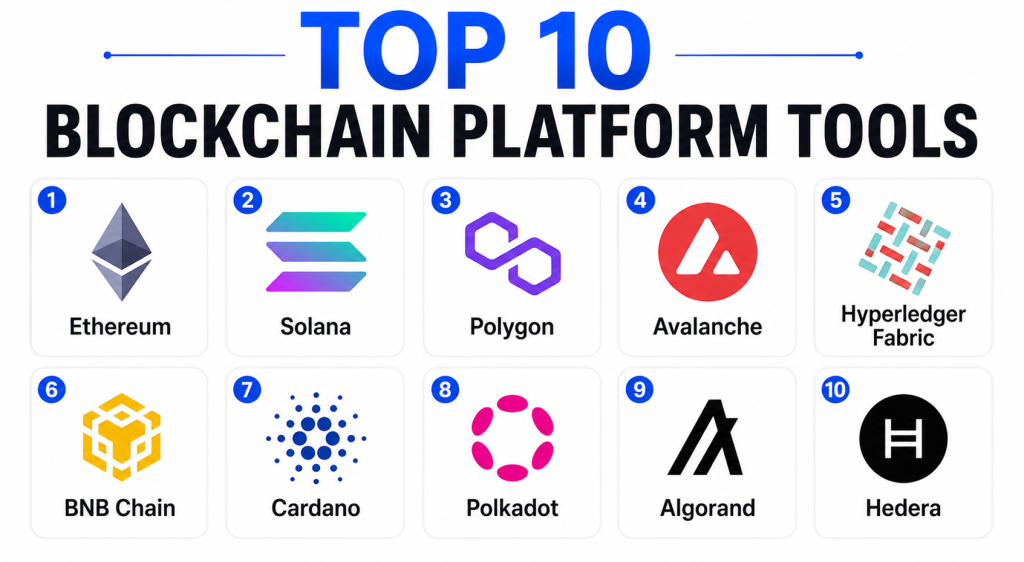
Top 10 Blockchain Platform Tools
1- Ethereum
Short description:
Ethereum remains the most influential smart contract platform in the blockchain industry. It powers a vast ecosystem of decentralized applications, decentralized finance solutions, NFT marketplaces, and enterprise projects. Its mature developer community, extensive tooling, and large ecosystem make it a leading choice for innovation. Organizations seeking flexibility and ecosystem access often prioritize Ethereum. Despite scalability challenges, ongoing upgrades continue improving efficiency and performance.
Key Features
- Smart contract execution
- Extensive developer ecosystem
- ERC token standards
- Decentralized application support
- Layer-2 ecosystem
- Enterprise integrations
- Strong community governance
Pros
- Largest blockchain developer ecosystem
- Extensive third-party tooling
- Strong innovation pipeline
Cons
- Network congestion can occur
- Transaction fees may fluctuate
- Complexity for beginners
Platforms / Deployment
- Web
- Cloud
- Self-hosted
- Hybrid
Security & Compliance
- MFA support through connected services
- Encryption
- Auditability
- Not publicly stated regarding platform-wide compliance certifications
Integrations & Ecosystem
Ethereum supports one of the largest blockchain ecosystems available today.
- Wallet integrations
- Oracle providers
- DeFi platforms
- NFT marketplaces
- Developer APIs
- Layer-2 networks
Support & Community
Exceptional community support, extensive documentation, tutorials, developer resources, and global ecosystem participation.
2- Solana
Short description:
Solana is known for high transaction throughput and low fees. It targets applications requiring speed and scalability, including DeFi, gaming, NFT platforms, and consumer-facing blockchain applications. Its architecture emphasizes performance while maintaining decentralization. Developers frequently choose Solana for large-scale user applications.
Key Features
- High throughput architecture
- Low transaction costs
- Fast settlement
- Smart contracts
- Developer SDKs
- NFT ecosystem
- DeFi support
Pros
- Fast transactions
- Cost-efficient operations
- Growing ecosystem
Cons
- Ecosystem still maturing
- Historical network outages
- Learning curve for developers
Platforms / Deployment
- Web
- Cloud
- Self-hosted
Security & Compliance
- Cryptographic security
- Network validation
- Not publicly stated compliance certifications
Integrations & Ecosystem
- Wallet providers
- NFT marketplaces
- DeFi protocols
- Developer frameworks
- Analytics tools
Support & Community
Strong and rapidly growing developer community with extensive educational resources.
3- Polygon
Short description:
Polygon provides scaling solutions for Ethereum and enables faster, lower-cost blockchain operations. Organizations benefit from Ethereum compatibility while reducing transaction costs. It has become popular for enterprise projects, gaming, NFTs, and decentralized applications.
Key Features
- Ethereum compatibility
- Layer-2 scaling
- Developer-friendly infrastructure
- Low transaction fees
- Multi-chain support
- Enterprise solutions
Pros
- Lower costs
- Strong Ethereum integration
- Large ecosystem
Cons
- Depends on broader Ethereum ecosystem
- Layer complexity
- Competitive market
Platforms / Deployment
- Cloud
- Hybrid
- Self-hosted
Security & Compliance
- Encryption
- Blockchain security mechanisms
- Not publicly stated certifications
Integrations & Ecosystem
- Ethereum tools
- Wallet providers
- Enterprise solutions
- Developer APIs
- NFT ecosystems
Support & Community
Strong community backed by significant enterprise adoption.
4- Avalanche
Short description:
Avalanche offers high-performance blockchain infrastructure designed for enterprise applications, decentralized finance, and custom blockchain deployments. Its subnet architecture enables organizations to create specialized blockchain environments.
Key Features
- Subnet architecture
- Fast finality
- Enterprise support
- Smart contracts
- High scalability
- Flexible deployment
Pros
- Enterprise-friendly
- Fast transactions
- Custom blockchain support
Cons
- Smaller ecosystem than Ethereum
- Complex architecture
- Developer learning curve
Platforms / Deployment
- Cloud
- Hybrid
- Self-hosted
Security & Compliance
- Network validation
- Cryptographic security
- Not publicly stated certifications
Integrations & Ecosystem
- Wallets
- Developer frameworks
- Enterprise tools
- DeFi integrations
Support & Community
Growing enterprise-focused ecosystem and active community.
5- Hyperledger Fabric
Short description:
Hyperledger Fabric is a permissioned blockchain framework widely used in enterprise environments. Organizations requiring privacy, governance, and regulatory control often select Fabric for production deployments.
Key Features
- Permissioned blockchain
- Modular architecture
- Private channels
- Identity management
- Enterprise governance
- Smart contracts
Pros
- Enterprise-ready
- Strong privacy controls
- Flexible governance
Cons
- Higher deployment complexity
- Smaller public ecosystem
- Requires specialized expertise
Platforms / Deployment
- Cloud
- Self-hosted
- Hybrid
Security & Compliance
- RBAC
- Identity management
- Audit capabilities
- Enterprise security controls
Integrations & Ecosystem
- Enterprise applications
- ERP systems
- APIs
- Cloud platforms
- Identity systems
Support & Community
Strong enterprise support and active open-source community.
6- BNB Chain
Short description:
BNB Chain provides scalable blockchain infrastructure with strong support for decentralized applications and smart contracts. It offers compatibility with Ethereum development tools and supports a broad ecosystem of applications.
Key Features
- Smart contracts
- EVM compatibility
- Low fees
- Developer tools
- DeFi ecosystem
- Cross-chain capabilities
Pros
- Cost-efficient
- Easy migration from Ethereum
- Large user base
Cons
- Governance concerns
- Competitive ecosystem
- Centralization discussions
Platforms / Deployment
- Cloud
- Self-hosted
Security & Compliance
- Network validation
- Cryptographic security
- Not publicly stated certifications
Integrations & Ecosystem
- Wallets
- Exchanges
- APIs
- DeFi protocols
- Analytics tools
Support & Community
Large ecosystem with extensive community resources.
7- Cardano
Short description:
Cardano focuses on research-driven blockchain development and emphasizes security, sustainability, and formal verification. It appeals to organizations seeking a methodical approach to blockchain infrastructure.
Key Features
- Proof-of-stake consensus
- Formal verification
- Smart contracts
- Sustainability focus
- Governance framework
- Research-based development
Pros
- Energy efficient
- Security-focused
- Strong academic foundation
Cons
- Slower feature rollout
- Smaller ecosystem
- Lower adoption than leaders
Platforms / Deployment
- Cloud
- Self-hosted
Security & Compliance
- Cryptographic security
- Peer-reviewed protocols
- Not publicly stated certifications
Integrations & Ecosystem
- Wallets
- Smart contract tools
- Developer frameworks
- Governance tools
Support & Community
Active global community with strong educational resources.
8- Polkadot
Short description:
Polkadot enables interoperability between multiple blockchains. Its architecture supports specialized chains that can communicate and exchange data efficiently.
Key Features
- Interoperability
- Parachains
- Shared security
- Governance system
- Scalability
- Cross-chain communication
Pros
- Strong interoperability
- Flexible architecture
- Innovative governance
Cons
- Technical complexity
- Adoption challenges
- Learning curve
Platforms / Deployment
- Cloud
- Self-hosted
- Hybrid
Security & Compliance
- Shared security model
- Network validation
- Not publicly stated certifications
Integrations & Ecosystem
- Parachains
- Developer frameworks
- Cross-chain tools
- Wallet integrations
Support & Community
Strong developer community and active ecosystem growth.
9- Algorand
Short description:
Algorand focuses on scalability, sustainability, and enterprise blockchain adoption. It supports payments, tokenization, decentralized applications, and government initiatives.
Key Features
- Pure proof-of-stake
- Fast transactions
- Smart contracts
- Asset tokenization
- Low fees
- Sustainability focus
Pros
- Efficient performance
- Environmentally friendly
- Enterprise readiness
Cons
- Smaller ecosystem
- Lower visibility
- Limited developer adoption
Platforms / Deployment
- Cloud
- Self-hosted
Security & Compliance
- Cryptographic security
- Consensus validation
- Not publicly stated certifications
Integrations & Ecosystem
- Financial services
- Wallet providers
- Developer tools
- Enterprise applications
Support & Community
Growing ecosystem with strong institutional interest.
10- Hedera
Short description:
Hedera utilizes a hashgraph consensus model rather than a traditional blockchain structure. It focuses on enterprise adoption, governance, and high-performance distributed ledger technology.
Key Features
- Hashgraph technology
- Fast transactions
- Enterprise governance
- Token services
- Smart contracts
- Sustainability focus
Pros
- High performance
- Enterprise governance
- Predictable fees
Cons
- Different architecture
- Smaller ecosystem
- Limited decentralization debates
Platforms / Deployment
- Cloud
- Hybrid
Security & Compliance
- Enterprise-grade security controls
- Auditability
- Not publicly stated certifications
Integrations & Ecosystem
- Enterprise systems
- Developer APIs
- Token services
- Wallet providers
Support & Community
Supported by a strong governing council and growing developer ecosystem.
Comparison Table (Top 10)
| Tool Name | Best For | Platform(s) Supported | Deployment | Standout Feature | Public Rating |
|---|---|---|---|---|---|
| Ethereum | Smart Contracts | Web, Cloud | Hybrid | Largest ecosystem | N/A |
| Solana | High-Speed Apps | Web, Cloud | Cloud | High throughput | N/A |
| Polygon | Ethereum Scaling | Web, Cloud | Hybrid | Low-cost scaling | N/A |
| Avalanche | Enterprise Apps | Cloud | Hybrid | Subnets | N/A |
| Hyperledger Fabric | Enterprises | Cloud | Hybrid | Permissioned networks | N/A |
| BNB Chain | Cost Efficiency | Cloud | Cloud | EVM compatibility | N/A |
| Cardano | Secure Deployments | Cloud | Self-hosted | Research-driven design | N/A |
| Polkadot | Interoperability | Cloud | Hybrid | Parachains | N/A |
| Algorand | Payments & Assets | Cloud | Self-hosted | Efficient consensus | N/A |
| Hedera | Enterprise Governance | Cloud | Hybrid | Hashgraph technology | N/A |
Evaluation & Scoring of Blockchain Platforms
| Tool | Core | Ease | Integrations | Security | Performance | Support | Value | Weighted Total |
|---|---|---|---|---|---|---|---|---|
| Ethereum | 10 | 8 | 10 | 9 | 8 | 10 | 8 | 9.0 |
| Solana | 9 | 8 | 8 | 8 | 10 | 8 | 9 | 8.7 |
| Polygon | 9 | 9 | 9 | 8 | 9 | 8 | 9 | 8.8 |
| Avalanche | 9 | 8 | 8 | 9 | 9 | 8 | 8 | 8.5 |
| Hyperledger Fabric | 9 | 7 | 8 | 10 | 8 | 9 | 7 | 8.4 |
| BNB Chain | 8 | 9 | 8 | 7 | 9 | 8 | 9 | 8.3 |
| Cardano | 8 | 7 | 7 | 9 | 8 | 8 | 8 | 7.9 |
| Polkadot | 8 | 7 | 9 | 8 | 8 | 8 | 8 | 8.0 |
| Algorand | 8 | 8 | 7 | 8 | 9 | 7 | 8 | 8.0 |
| Hedera | 8 | 8 | 7 | 9 | 9 | 7 | 8 | 8.1 |
These scores provide a comparative view rather than an absolute ranking. Organizations should prioritize criteria aligned with their objectives. Enterprise users may place greater emphasis on governance and security, while startups may focus on ecosystem growth and developer experience. Performance-sensitive applications may prioritize throughput and scalability. Always validate requirements through pilots and proof-of-concept deployments.
Which Blockchain Platform Is Right for You?
Solo / Freelancer
Ethereum and Polygon offer strong developer resources, learning materials, and community support for independent developers building decentralized applications.
SMB
Polygon, Solana, and BNB Chain provide strong scalability while maintaining cost efficiency, making them attractive for growing businesses.
Mid-Market
Avalanche, Cardano, and Algorand balance scalability, governance, and enterprise readiness for expanding organizations.
Enterprise
Hyperledger Fabric, Ethereum, Hedera, and Avalanche offer governance controls, security features, and enterprise deployment flexibility.
Budget vs Premium
Budget-conscious projects may prefer Polygon, Solana, or BNB Chain. Enterprises seeking advanced governance and compliance controls may consider Hyperledger Fabric or Hedera.
Feature Depth vs Ease of Use
Ethereum offers unmatched functionality, while Polygon and BNB Chain often provide easier onboarding and operational simplicity.
Integrations & Scalability
Ethereum leads in ecosystem integrations. Polkadot excels in interoperability, while Avalanche offers flexible scalability through subnets.
Security & Compliance Needs
Hyperledger Fabric, Cardano, Hedera, and Ethereum are strong candidates for organizations prioritizing governance, security, and auditability.
Frequently Asked Questions (FAQs)
1- What is a blockchain platform?
A blockchain platform provides infrastructure for building decentralized applications, managing digital assets, and executing smart contracts. It serves as the foundation for distributed networks and blockchain-based services.
2- Which blockchain platform is best for enterprises?
Hyperledger Fabric, Ethereum, Avalanche, and Hedera are commonly evaluated by enterprises because of governance, scalability, and security capabilities.
3- Are blockchain platforms secure?
Most leading platforms employ cryptographic security, consensus mechanisms, and decentralized validation. Security also depends on implementation quality and operational practices.
4- How much does blockchain deployment cost?
Costs vary significantly based on infrastructure, transaction volume, development complexity, and operational requirements. Pricing models differ across platforms.
5- What is the difference between public and private blockchains?
Public blockchains allow open participation, while private blockchains restrict access and provide greater governance control for organizations.
6- Can blockchain platforms integrate with enterprise software?
Yes. Many platforms provide APIs, SDKs, and integration capabilities for ERP systems, CRMs, identity systems, and cloud infrastructure.
7- Which platform offers the fastest transactions?
Solana, Avalanche, Algorand, and Hedera are known for high transaction throughput and low latency compared to many traditional blockchain networks.
8- Is Ethereum still relevant?
Yes. Ethereum continues to lead in smart contract innovation, developer adoption, ecosystem size, and decentralized application deployment.
9- How difficult is migration between blockchain platforms?
Migration complexity depends on application architecture, smart contracts, data models, and integration requirements. Proper planning is essential.
10- What should organizations evaluate before selecting a platform?
Organizations should assess scalability, security, governance, ecosystem maturity, interoperability, compliance requirements, developer availability, and long-term sustainability.
Conclusion
Blockchain platforms have matured significantly and now support everything from decentralized finance and digital identity to enterprise automation and asset tokenization. Ethereum remains the ecosystem leader, while Polygon, Solana, and Avalanche continue advancing scalability and user adoption. Hyperledger Fabric and Hedera serve enterprise-focused requirements, while Polkadot and Algorand offer unique approaches to interoperability and performance. The right platform depends on your organization’s goals, technical expertise, governance requirements, security expectations, and scalability needs. Rather than searching for a universal winner, organizations should identify their primary use cases, shortlist two or three platforms, conduct proof-of-concept testing, and validate integration, security, and operational requirements before committing to long-term adoption.
