Introduction
Behavioral Biometrics Protection Tools help businesses identify users based on how they behave during digital interactions. Instead of relying only on passwords, OTPs, device fingerprints, or face scans, these tools analyze patterns such as typing rhythm, mouse movement, swipe behavior, touch pressure, navigation flow, device handling, hesitation, copy-paste actions, and session behavior. In simple words, they help detect whether the person using an account behaves like the real user or like a fraudster, bot, mule, scam victim, or attacker.
These tools matter now because account takeover, social engineering scams, remote access fraud, bot attacks, synthetic identity abuse, and credential-based attacks are increasing. Behavioral biometrics can help detect suspicious activity silently in the background without adding friction for genuine users.
Real-world use cases include:
- Account takeover detection
- Banking and fintech fraud prevention
- Bot and credential stuffing detection
- Remote access scam detection
- Continuous user authentication
What buyers should evaluate:
- Behavioral signal coverage
- Fraud detection accuracy
- Real-time decisioning
- Integration with login and transaction flows
- Device and session intelligence
- Privacy and consent controls
- False positive management
- Reporting and investigation tools
- API and SDK flexibility
- Compliance and audit readiness
Best for: Behavioral biometrics tools are best for banks, fintech companies, payment providers, e-commerce platforms, insurance companies, telecom providers, digital marketplaces, identity teams, fraud teams, cybersecurity teams, and enterprises that need invisible fraud detection without creating unnecessary customer friction.
Not ideal for: These tools may not be ideal for very small websites, low-risk internal applications, companies that only need basic MFA, or businesses without enough digital interaction volume to build useful behavioral patterns. In those cases, simpler MFA, bot protection, or risk-based authentication may be enough.
Key Trends in Behavioral Biometrics Protection Tools
- AI-powered fraud detection is becoming central: Behavioral biometrics platforms increasingly use machine learning to identify unusual user behavior, bot activity, social engineering patterns, and session-level fraud signals.
- Continuous authentication is replacing one-time checks: Instead of verifying users only at login, modern tools monitor behavior throughout the session, especially during payments, profile changes, password resets, and high-risk transactions.
- Scam detection is becoming a major use case: Banks and fintechs are using behavioral signals to detect when a genuine user may be manipulated by a fraudster through remote access tools, phone scams, or social engineering.
- Device intelligence is merging with behavioral biometrics: Many tools now combine device fingerprinting, IP risk, browser signals, location, session history, and behavioral patterns for stronger risk scoring.
- Privacy-aware behavioral analytics is gaining importance: Buyers want fraud detection without storing unnecessary personal biometric data, especially in regions with strict data protection laws.
- Bot detection and human intent analysis are converging: Behavioral biometrics helps separate real human behavior from scripted automation, bot farms, malware-driven sessions, and emulator-based attacks.
- Low-friction security is now a business requirement: Customer-facing businesses want strong fraud protection without adding too many OTPs, CAPTCHAs, or manual reviews that reduce conversion.
- Real-time transaction risk scoring is expanding: Behavioral signals are increasingly used during money transfers, checkout, account recovery, loan applications, and identity verification workflows.
- Integration with fraud operations is improving: Tools are becoming more connected with case management, SIEM, identity platforms, payment risk engines, and fraud analyst dashboards.
- Regulated industries are demanding explainability: Fraud and security teams need risk scores, reason codes, audit trails, and investigation evidence to explain why a session was challenged or blocked.
How We Selected These Tools
- Selected tools with strong recognition in behavioral biometrics, digital fraud prevention, identity protection, or real-time risk analytics.
- Prioritized platforms that analyze user behavior during login, navigation, account activity, or transaction workflows.
- Considered relevance for banks, fintechs, e-commerce platforms, enterprises, marketplaces, and high-risk digital services.
- Evaluated feature depth across behavioral analytics, device intelligence, bot detection, scam detection, and account takeover protection.
- Considered integration options such as APIs, SDKs, web applications, mobile apps, fraud platforms, and identity systems.
- Reviewed practical buyer fit across enterprise, mid-market, developer-first, and specialized fraud prevention use cases.
- Avoided guessing ratings, certifications, prices, or compliance claims where details are not clearly known.
- Balanced specialist behavioral biometrics vendors with broader fraud prevention platforms that include behavioral intelligence.
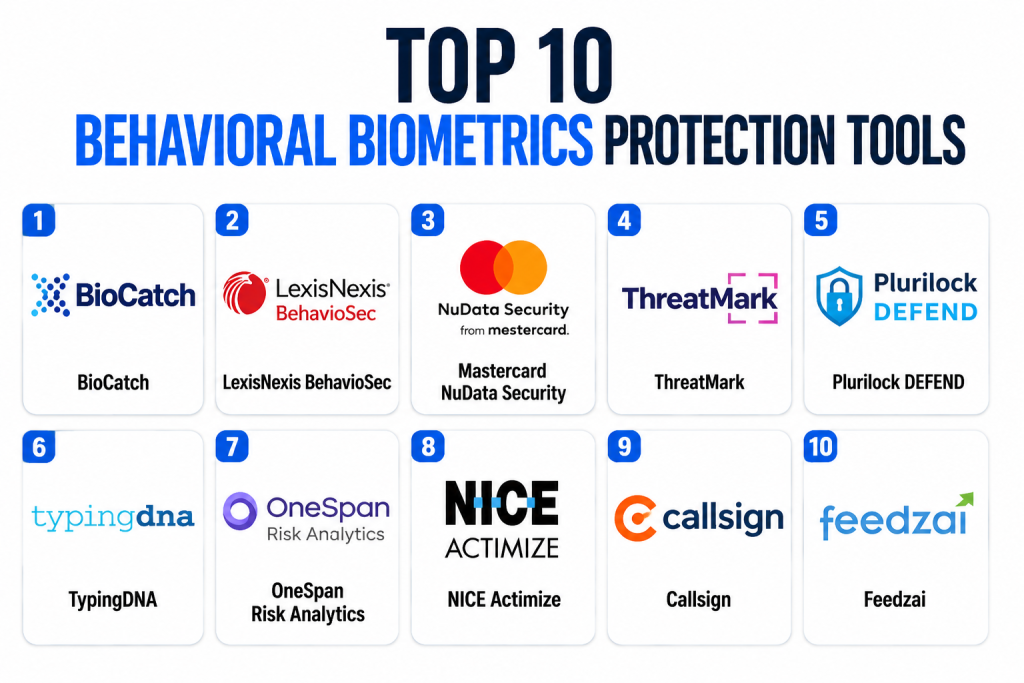
Top 10 Behavioral Biometrics Protection Tools
1 — BioCatch
Short description: BioCatch is one of the most recognized behavioral biometrics and digital fraud detection platforms, especially in banking, fintech, and financial services. It analyzes how users interact with websites and mobile apps to detect account takeover, scams, bots, mule activity, and suspicious session behavior. The platform focuses on behavioral intelligence, device insights, and real-time risk scoring. BioCatch is especially useful for organizations that need to detect fraud after login, during transactions, and across digital banking journeys. It helps reduce friction for trusted users while flagging unusual behavior that may indicate criminal activity. It is best suited for enterprises and financial institutions with high digital transaction volume.
Key Features
- Behavioral biometrics for web and mobile sessions
- Account takeover and scam detection
- Device and session intelligence
- Real-time risk scoring
- Bot and automation detection support
- Fraud analyst insights and investigation support
- Digital banking and financial crime prevention use cases
Pros
- Strong fit for banks, fintechs, and financial institutions.
- Useful for detecting fraud silently without adding customer friction.
- Combines behavioral signals with device and session context.
Cons
- May be more advanced than needed for small businesses.
- Implementation requires careful integration with digital journeys.
- Pricing and deployment details are usually enterprise-specific.
Platforms / Deployment
Web / iOS / Android / Cloud / Hybrid
Security & Compliance
BioCatch focuses on fraud prevention and behavioral intelligence for digital interactions. Specific controls such as SSO, audit logs, encryption, certifications, and compliance documentation should be verified directly during procurement.
Integrations & Ecosystem
BioCatch typically integrates into digital banking apps, web portals, fraud systems, risk engines, and transaction monitoring workflows. Its ecosystem is strongest in financial services and fraud operations.
- Web and mobile banking platforms
- Fraud case management systems
- Transaction monitoring tools
- Risk decisioning engines
- Identity and access systems
- Security operations workflows
Support & Community
BioCatch provides enterprise-focused documentation, onboarding, fraud expertise, and customer support. Community strength is more industry and enterprise-led than open-source developer-led.
2 — LexisNexis BehavioSec
Short description: LexisNexis BehavioSec is a behavioral and device intelligence solution designed to distinguish trusted users from risky interactions. It analyzes behavior from login to logout, including typing patterns, mouse movements, touch behavior, device signals, and session activity. The product is especially relevant for banks, fintechs, payment companies, and digital businesses that already use LexisNexis Risk Solutions or ThreatMetrix-style identity intelligence. BehavioSec helps detect account takeover, automated attacks, stolen credentials, and suspicious session behavior. It is useful when behavioral biometrics needs to work alongside broader digital identity risk data. It is best for organizations that want behavioral analytics plus identity intelligence in one risk ecosystem.
Key Features
- Behavioral biometrics and device intelligence
- Real-time trust and risk analysis
- Login-to-logout session monitoring
- Account takeover detection
- Bot and automation risk signals
- Integration with LexisNexis digital identity ecosystem
- Risk scoring for fraud and identity teams
Pros
- Strong combination of behavioral analytics and identity intelligence.
- Useful for financial institutions and high-risk digital platforms.
- Can support real-time fraud detection across the session lifecycle.
Cons
- Best value may come when used with the broader LexisNexis ecosystem.
- Enterprise implementation can require fraud and identity expertise.
- Public pricing and packaging details are not always simple.
Platforms / Deployment
Web / iOS / Android / Cloud / Hybrid
Security & Compliance
LexisNexis BehavioSec is designed for fraud and identity risk workflows. Specific security controls, certifications, encryption details, access controls, and compliance coverage should be verified directly with the vendor.
Integrations & Ecosystem
BehavioSec integrates with fraud detection systems, identity verification tools, digital journey platforms, device intelligence, and risk engines. Its ecosystem is especially relevant for organizations using LexisNexis Risk Solutions.
- Digital identity platforms
- Fraud risk engines
- Device intelligence systems
- Web and mobile applications
- Banking and payment systems
- Case management tools
Support & Community
LexisNexis provides enterprise support, implementation assistance, product documentation, and customer success resources. Community strength is primarily enterprise and fraud-industry focused.
3 — Mastercard NuData Security
Short description: Mastercard NuData Security helps businesses detect fraud using passive behavioral biometrics, device intelligence, and risk analytics. It is commonly used to identify account takeover, bot attacks, credential stuffing, payment fraud, and suspicious login behavior. NuData focuses on understanding whether digital interactions look human, trusted, risky, automated, or abnormal. It is especially relevant for financial services, e-commerce, marketplaces, payment providers, and high-volume consumer platforms. The platform works quietly in the background to reduce unnecessary friction for legitimate users. It is best suited for organizations that need behavioral risk intelligence connected to broader payment and fraud prevention workflows.
Key Features
- Passive behavioral biometrics
- Device and session intelligence
- Account takeover and bot detection
- Risk scoring for login and transaction flows
- Credential stuffing and automation detection
- Fraud analytics for high-volume digital businesses
- Integration with payment and security ecosystems
Pros
- Strong fit for e-commerce, payments, and digital financial services.
- Passive analysis can reduce customer friction.
- Useful for detecting automated and credential-based attacks.
Cons
- May require tuning for specific business risk patterns.
- Advanced value depends on integration quality and data volume.
- Public details on packaging and pricing are limited.
Platforms / Deployment
Web / iOS / Android / Cloud
Security & Compliance
NuData operates in fraud prevention and digital identity risk. Specific certifications, encryption, access controls, SSO, and compliance details should be verified directly during vendor evaluation.
Integrations & Ecosystem
NuData integrates with login flows, payment workflows, fraud systems, e-commerce platforms, and risk engines. Its value is strongest when behavioral signals are combined with transaction and identity risk data.
- E-commerce platforms
- Payment systems
- Fraud prevention tools
- Identity verification workflows
- Mobile and web applications
- Risk decisioning platforms
Support & Community
Support is generally enterprise and business focused. Documentation, onboarding, and support depth may vary by customer size, use case, and contract.
4 — ThreatMark
Short description: ThreatMark is a digital fraud prevention platform that uses behavioral intelligence, device intelligence, malware detection, and transaction monitoring to detect suspicious user activity. It is especially relevant for banks, fintechs, and financial institutions that need protection against account takeover, scams, mule activity, remote access fraud, and online banking attacks. ThreatMark analyzes session behavior to identify whether an interaction appears legitimate, automated, manipulated, or criminal. It can help fraud teams detect high-risk activity before financial loss occurs. The platform is well suited for organizations that need behavioral biometrics as part of a broader fraud defense system. It is most valuable in high-risk digital banking and transaction environments.
Key Features
- Behavioral intelligence and session analytics
- Account takeover and scam detection
- Device fingerprinting and malware-related signals
- Transaction monitoring support
- Remote access and manipulation detection
- Fraud investigation insights
- Risk scoring for digital banking journeys
Pros
- Strong fit for banks and digital financial services.
- Useful for detecting scams and manipulated user behavior.
- Combines behavioral, device, and transaction risk signals.
Cons
- May be too specialized for low-risk websites.
- Implementation requires close alignment with fraud workflows.
- Public pricing and packaging information is limited.
Platforms / Deployment
Web / iOS / Android / Cloud / Hybrid
Security & Compliance
ThreatMark is built for fraud prevention and digital risk monitoring. Specific certifications, access controls, audit logs, encryption, and compliance coverage should be confirmed directly with the vendor.
Integrations & Ecosystem
ThreatMark integrates with banking platforms, mobile apps, web applications, fraud operations, transaction monitoring tools, and security systems. Its ecosystem is strongest in financial crime prevention.
- Digital banking systems
- Mobile banking applications
- Fraud case management tools
- Transaction monitoring platforms
- Security operations systems
- Risk decisioning engines
Support & Community
ThreatMark offers enterprise-focused onboarding, documentation, and fraud expertise. Support availability may vary by region, product scope, and commercial agreement.
5 — Plurilock DEFEND
Short description: Plurilock DEFEND is a behavioral biometrics and continuous authentication solution focused on workforce identity security. It helps organizations verify users based on behavioral patterns such as keyboard and mouse behavior during active sessions. The tool is especially relevant for enterprises, government organizations, regulated businesses, and security teams that need continuous identity assurance after login. Unlike tools focused mainly on customer fraud, Plurilock is often positioned around workforce access, insider threat reduction, and endpoint session security. It can help detect when a logged-in session may no longer belong to the expected user. It is best suited for organizations that need strong identity assurance for employees, contractors, and privileged users.
Key Features
- Continuous authentication based on user behavior
- Keyboard and mouse behavior analysis
- Workforce identity assurance
- Insider threat and session takeover detection support
- Endpoint and access security use cases
- Risk-based identity monitoring
- Security team visibility into user behavior anomalies
Pros
- Strong fit for workforce and enterprise identity protection.
- Useful for continuous authentication after initial login.
- Can support insider threat and session integrity use cases.
Cons
- Less focused on consumer banking fraud than some alternatives.
- May require endpoint or workforce integration planning.
- Behavioral model accuracy depends on usage patterns and deployment quality.
Platforms / Deployment
Windows / macOS / Web / Cloud / Hybrid
Security & Compliance
Plurilock DEFEND focuses on continuous authentication and identity assurance. Specific certifications, encryption, audit logs, SSO, and compliance coverage should be verified directly with the vendor.
Integrations & Ecosystem
Plurilock can fit into workforce identity, endpoint security, privileged access, and security operations environments. It is most relevant where organizations need ongoing confidence that the active user is still the right user.
- Endpoint security systems
- Identity and access management tools
- Privileged access workflows
- Security operations tools
- Enterprise applications
- Workforce authentication systems
Support & Community
Plurilock provides enterprise support, documentation, and deployment resources. Community strength is more specialized and enterprise-focused than broad developer community-driven.
6 — TypingDNA
Short description: TypingDNA is a behavioral biometrics platform focused on typing pattern recognition. It analyzes how users type, including rhythm, timing, and keystroke dynamics, to help verify identity. TypingDNA is useful for authentication, step-up verification, fraud prevention, online education, workforce access, and digital identity workflows where typing behavior can provide an additional trust signal. It is more focused than full fraud platforms because its primary behavioral signal is typing biometrics. This makes it attractive for developer teams, SaaS platforms, education platforms, and identity products that need lightweight behavioral verification. It is best for use cases where typing activity is consistent and meaningful.
Key Features
- Typing pattern biometric analysis
- Keystroke dynamics-based verification
- API-first integration approach
- Support for step-up authentication use cases
- Useful for web apps, SaaS, and online education
- Passive or active typing verification options depending on implementation
- Developer-friendly behavioral identity signal
Pros
- Focused and developer-friendly behavioral biometric capability.
- Useful for adding an extra identity signal without hardware.
- Practical for SaaS, education, and authentication workflows.
Cons
- Limited compared with platforms that analyze full session behavior.
- Less useful for apps with little typing activity.
- May need careful UX design to avoid user friction.
Platforms / Deployment
Web / API / Cloud
Security & Compliance
TypingDNA focuses on keystroke dynamics and behavioral authentication. Specific encryption, access controls, certifications, SSO, and compliance details should be confirmed directly during evaluation.
Integrations & Ecosystem
TypingDNA integrates through APIs into web applications, authentication flows, education platforms, identity tools, and custom software. It is useful when teams want a focused typing biometrics layer.
- SaaS applications
- Online learning platforms
- Identity verification flows
- Login and MFA workflows
- Developer-built applications
- Fraud prevention systems
Support & Community
TypingDNA provides developer documentation and API resources. Support and onboarding depth may vary by plan and business use case.
7 — OneSpan Risk Analytics
Short description: OneSpan Risk Analytics helps organizations assess digital transaction and authentication risk using behavioral analysis, device intelligence, transaction context, and fraud signals. It is especially relevant for banks, financial institutions, and regulated businesses that need secure digital banking, transaction signing, and fraud prevention. OneSpan has a broader identity and digital agreement security portfolio, making Risk Analytics useful for organizations that need authentication, transaction protection, and fraud prevention together. The platform helps identify suspicious behavior and support risk-based decisions during sensitive actions. It is best suited for financial services and enterprises with strict authentication and transaction security requirements. Buyers should validate how behavioral analytics fits into their existing OneSpan or identity stack.
Key Features
- Risk analytics for authentication and transactions
- Behavioral and device intelligence signals
- Fraud detection for digital banking journeys
- Transaction context analysis
- Risk-based decisioning support
- Integration with authentication and signing workflows
- Financial services and regulated industry focus
Pros
- Strong fit for banks and regulated digital services.
- Useful for transaction-level risk scoring.
- Can align with broader authentication and digital security workflows.
Cons
- May be too specialized for general SMB authentication needs.
- Best value may come when paired with other OneSpan capabilities.
- Implementation can require fraud and identity expertise.
Platforms / Deployment
Web / iOS / Android / Cloud / Hybrid
Security & Compliance
OneSpan solutions are used in regulated digital security contexts. Specific certifications, encryption, audit logs, SSO, and compliance coverage should be verified directly based on product and deployment.
Integrations & Ecosystem
OneSpan Risk Analytics integrates with banking apps, authentication systems, transaction workflows, fraud platforms, and digital agreement ecosystems. It is useful for organizations needing strong security around digital financial actions.
- Digital banking platforms
- Authentication systems
- Transaction signing workflows
- Fraud detection platforms
- Risk engines
- Enterprise security systems
Support & Community
OneSpan provides enterprise documentation, implementation support, and customer success resources. Community strength is strongest in banking, digital identity, and regulated security environments.
8 — NICE Actimize
Short description: NICE Actimize is a financial crime, fraud prevention, and risk management platform used by banks, financial institutions, and payment organizations. While it is broader than behavioral biometrics alone, it can incorporate behavioral and transaction signals into fraud detection workflows. It is especially relevant for enterprises that need fraud analytics, case management, anti-money laundering workflows, transaction monitoring, and digital fraud detection. NICE Actimize is best suited for large financial organizations that require end-to-end fraud operations rather than a standalone behavioral biometrics SDK. It can help detect suspicious patterns across users, accounts, payments, and channels. Buyers should evaluate whether they need a full fraud platform or a focused behavioral biometrics tool.
Key Features
- Financial crime and fraud management
- Digital fraud detection support
- Transaction and account risk analytics
- Case management workflows
- Risk scoring and investigation tools
- Enterprise financial services focus
- Support for cross-channel fraud operations
Pros
- Strong fit for large financial institutions.
- Useful when behavioral risk must connect with broader fraud operations.
- Supports investigation, case management, and enterprise risk workflows.
Cons
- More complex than standalone behavioral biometrics tools.
- May be excessive for small or mid-sized digital businesses.
- Implementation may require significant fraud operations planning.
Platforms / Deployment
Web / Cloud / Hybrid / Varies / N/A
Security & Compliance
NICE Actimize is used in financial crime and fraud management environments. Specific security controls, compliance certifications, access controls, encryption, and audit capabilities should be verified directly during procurement.
Integrations & Ecosystem
NICE Actimize integrates with banking systems, transaction platforms, fraud operations, AML workflows, case management systems, and enterprise data sources. It is best suited for complex financial crime programs.
- Core banking systems
- Payment platforms
- AML systems
- Fraud case management
- Data warehouses
- Security and risk analytics tools
Support & Community
NICE provides enterprise support, professional services, product documentation, and implementation resources. Community strength is enterprise and financial-services focused.
9 — Callsign
Short description: Callsign is an identity and authentication platform that uses signals such as behavioral patterns, device intelligence, location, and context to support risk-based identity decisions. It is especially relevant for banks, fintechs, and digital businesses that need secure but low-friction customer authentication. Callsign focuses on helping organizations understand whether a user interaction is trustworthy without relying only on passwords or static credentials. The platform can support authentication, fraud detection, and identity assurance use cases. It is useful when businesses want behavioral and contextual signals to improve customer login experiences. Buyers should validate product availability, integration scope, and fit with their existing identity stack.
Key Features
- Behavioral and contextual identity signals
- Risk-based authentication support
- Device and location intelligence
- Customer identity protection use cases
- Fraud and account takeover risk detection
- Low-friction login journey support
- API and integration-oriented identity workflows
Pros
- Strong fit for customer-facing authentication journeys.
- Useful for reducing friction while improving identity assurance.
- Relevant for banks and fintechs needing behavioral risk signals.
Cons
- Public product packaging details may be limited.
- Buyers should validate current regional and ecosystem support.
- May require identity architecture planning for best results.
Platforms / Deployment
Web / iOS / Android / Cloud / Varies / N/A
Security & Compliance
Callsign operates in identity and authentication risk. Specific certifications, audit logs, encryption, SSO, MFA support, and compliance coverage should be verified directly with the vendor.
Integrations & Ecosystem
Callsign can integrate with digital identity platforms, mobile apps, web applications, fraud systems, and authentication journeys. It is most useful where risk-based identity decisions are needed during customer access.
- Customer identity platforms
- Mobile banking apps
- Web login flows
- Fraud risk systems
- Authentication workflows
- Digital service platforms
Support & Community
Support and documentation availability may vary by product scope and commercial relationship. Buyers should confirm onboarding, technical support, and implementation assistance during evaluation.
10 — Feedzai
Short description: Feedzai is a financial crime and fraud prevention platform that uses machine learning, transaction analytics, risk scoring, and behavioral signals to detect fraud across payments, banking, and digital channels. While it is not only a behavioral biometrics product, it is relevant for organizations that want behavioral and transactional intelligence combined in a broader fraud prevention platform. Feedzai is especially useful for banks, payment processors, fintechs, and enterprises that need real-time fraud decisioning. It can help detect account takeover, payment fraud, scams, mule activity, and suspicious transaction patterns. The platform is best for organizations that need enterprise fraud analytics rather than a narrow biometric signal. Buyers should evaluate integration complexity and data requirements before implementation.
Key Features
- AI and machine learning-based fraud detection
- Transaction and behavior-based risk scoring
- Account takeover and payment fraud detection support
- Financial crime analytics
- Real-time decisioning workflows
- Case management and investigation support
- Banking, payments, and fintech focus
Pros
- Strong fit for enterprise fraud prevention.
- Combines behavioral, transaction, and financial crime signals.
- Useful for high-volume payment and banking environments.
Cons
- Broader fraud platform, not purely behavioral biometrics.
- May require significant data integration and tuning.
- More suitable for mature fraud teams than small businesses.
Platforms / Deployment
Web / Cloud / Hybrid / Varies / N/A
Security & Compliance
Feedzai is used in fraud and financial crime prevention environments. Specific certifications, access controls, encryption, audit logs, and compliance coverage should be verified directly during procurement.
Integrations & Ecosystem
Feedzai integrates with banking systems, payment platforms, fraud operations, transaction monitoring, case management, and data environments. Its ecosystem is strongest in financial services and payments.
- Payment systems
- Core banking platforms
- Fraud case management
- Transaction monitoring tools
- Data warehouses
- Risk operations workflows
Support & Community
Feedzai provides enterprise onboarding, documentation, support, and fraud expertise. Support depth may vary by customer size, deployment model, and commercial agreement.
Comparison Table
| Tool Name | Best For | Platform(s) Supported | Deployment | Standout Feature | Public Rating |
|---|---|---|---|---|---|
| BioCatch | Banking and fintech fraud prevention | Web / iOS / Android | Cloud / Hybrid | Behavioral intelligence for digital fraud and scams | N/A |
| LexisNexis BehavioSec | Behavioral and device intelligence | Web / iOS / Android | Cloud / Hybrid | Login-to-logout behavioral risk analysis | N/A |
| Mastercard NuData Security | E-commerce, payments, and ATO protection | Web / iOS / Android | Cloud | Passive behavioral biometrics and device intelligence | N/A |
| ThreatMark | Digital banking fraud and scam detection | Web / iOS / Android | Cloud / Hybrid | Behavioral intelligence with transaction and scam signals | N/A |
| Plurilock DEFEND | Workforce continuous authentication | Windows / macOS / Web | Cloud / Hybrid | Continuous user verification based on behavior | N/A |
| TypingDNA | Typing biometrics and step-up verification | Web / API | Cloud | Keystroke dynamics-based identity verification | N/A |
| OneSpan Risk Analytics | Transaction and authentication risk | Web / iOS / Android | Cloud / Hybrid | Risk analytics for financial transactions | N/A |
| NICE Actimize | Enterprise financial crime operations | Web | Cloud / Hybrid / Varies | Fraud operations and case management depth | N/A |
| Callsign | Customer identity and risk-based authentication | Web / iOS / Android | Cloud / Varies | Behavioral and contextual identity assurance | N/A |
| Feedzai | Enterprise fraud and financial crime prevention | Web | Cloud / Hybrid / Varies | ML-based fraud decisioning with behavioral signals | N/A |
Evaluation & Scoring of Behavioral Biometrics Protection Tools
| Tool Name | Core (25%) | Ease (15%) | Integrations (15%) | Security (10%) | Performance (10%) | Support (10%) | Value (15%) | Weighted Total (0–10) |
| BioCatch | 9.4 | 8.0 | 8.8 | 8.8 | 9.0 | 8.5 | 8.0 | 8.73 |
| LexisNexis BehavioSec | 9.0 | 7.8 | 9.0 | 8.8 | 8.8 | 8.4 | 7.8 | 8.55 |
| Mastercard NuData Security | 8.8 | 8.0 | 8.7 | 8.6 | 8.7 | 8.2 | 8.0 | 8.48 |
| ThreatMark | 8.7 | 7.8 | 8.4 | 8.5 | 8.6 | 8.2 | 7.8 | 8.35 |
| Plurilock DEFEND | 8.2 | 7.8 | 7.8 | 8.5 | 8.2 | 7.8 | 7.6 | 8.00 |
| TypingDNA | 7.8 | 8.5 | 8.0 | 8.0 | 8.0 | 7.8 | 8.5 | 8.07 |
| OneSpan Risk Analytics | 8.4 | 7.6 | 8.3 | 8.7 | 8.5 | 8.3 | 7.6 | 8.24 |
| NICE Actimize | 8.6 | 7.0 | 8.8 | 8.8 | 8.7 | 8.5 | 7.4 | 8.24 |
| Callsign | 8.0 | 7.7 | 7.8 | 8.3 | 8.0 | 7.5 | 7.5 | 7.85 |
| Feedzai | 8.8 | 7.4 | 8.7 | 8.8 | 8.8 | 8.4 | 7.6 | 8.34 |
These scores are comparative, not official product ratings. A higher score means the tool is broadly strong across the selected criteria, but the right choice depends on use case, industry, fraud maturity, user volume, and integration requirements. BioCatch, BehavioSec, NuData, and ThreatMark are strong behavioral biometrics-focused options for customer fraud protection. Plurilock is stronger for workforce continuous authentication, while NICE Actimize and Feedzai are broader fraud platforms where behavioral signals are part of a larger risk program.
Which Behavioral Biometrics Protection Tool Is Right for You?
Solo / Freelancer
Solo professionals usually do not need an enterprise behavioral biometrics platform. If the goal is only to secure personal accounts, basic MFA, password managers, device security, and risk-based login alerts are usually enough. However, independent developers building authentication products, online learning tools, or SaaS platforms may consider TypingDNA because it offers a focused behavioral signal through typing pattern verification.
For solo founders building fintech or identity products, it is better to start with a narrow use case and validate whether behavioral biometrics improves fraud detection or user experience before investing in a full enterprise platform.
SMB
SMBs should choose tools based on risk level and customer interaction volume. For general SaaS or education platforms, TypingDNA may be useful if typing behavior is part of the user journey. For e-commerce and payment fraud, NuData-style behavioral intelligence or broader fraud tools may be more relevant. For workforce identity, Plurilock DEFEND may be considered if continuous authentication is important.
SMBs should avoid overbuying enterprise fraud platforms unless they face real fraud losses, account takeover risk, or compliance pressure. A phased approach works best: start with MFA, bot detection, device intelligence, then add behavioral biometrics where risk is highest.
Mid-Market
Mid-market companies usually need better fraud visibility, more integrations, and stronger risk scoring. BioCatch, LexisNexis BehavioSec, Mastercard NuData Security, ThreatMark, and OneSpan Risk Analytics are strong candidates depending on whether the main risk is account takeover, payment fraud, scams, or transaction abuse. For customer-facing apps, passive behavioral biometrics can reduce friction while improving detection.
Mid-market buyers should test false positives, fraud analyst workflows, mobile SDK impact, reporting quality, and integration with existing authentication and fraud systems. Behavioral biometrics should support business growth without slowing down legitimate users.
Enterprise
Enterprises should evaluate behavioral biometrics as part of a larger fraud, identity, and security strategy. Banks and financial institutions may shortlist BioCatch, BehavioSec, ThreatMark, OneSpan, NICE Actimize, and Feedzai. Large e-commerce or payment platforms may evaluate NuData, Feedzai, and broader fraud solutions. Workforce-heavy enterprises may consider Plurilock for continuous authentication.
Enterprise buyers should involve fraud operations, cybersecurity, compliance, legal, data privacy, customer experience, and engineering teams. The best solution must fit both technical architecture and operational response workflows.
Budget vs Premium
Budget-focused buyers should start with tools that solve a specific problem, such as typing biometrics, bot detection, or account takeover prevention. TypingDNA may offer a more focused entry point for certain use cases. Premium platforms such as BioCatch, BehavioSec, ThreatMark, NICE Actimize, Feedzai, and OneSpan are better suited when fraud volume, transaction value, and regulatory pressure justify deeper investment.
The cheapest option is not always the best value. Fraud loss reduction, reduced manual reviews, fewer false positives, and better customer conversion should be part of the business case.
Feature Depth vs Ease of Use
TypingDNA is easier to understand because it focuses on typing behavior. Plurilock is focused on workforce continuous authentication. BioCatch, BehavioSec, NuData, and ThreatMark provide deeper behavioral and fraud intelligence but require more integration planning. NICE Actimize and Feedzai provide broader financial crime depth but may be more complex.
Choose ease of use when you need a focused signal. Choose feature depth when fraud patterns are complex, multi-channel, high-volume, or financially significant.
Integrations & Scalability
Behavioral biometrics tools must integrate smoothly with web apps, mobile apps, login flows, transaction pages, fraud engines, case management systems, identity platforms, and security monitoring tools. Scalability depends on real-time scoring, low-latency SDKs, large session volumes, stable APIs, and operational reporting.
Banks, fintechs, and marketplaces should test performance under real traffic conditions. The tool should not slow down checkout, banking, or login experiences.
Security & Compliance Needs
Security and compliance teams should evaluate data collection, consent, privacy controls, encryption, access management, audit logs, retention policies, and regional regulations. Behavioral biometrics can involve sensitive behavioral data, so buyers must understand what is collected, how it is processed, and how risk decisions are explained.
For regulated industries, ask vendors for documentation on privacy, model governance, security controls, and audit support before production deployment.
Frequently Asked Questions
1- What are behavioral biometrics tools?
Behavioral biometrics tools analyze how users behave during digital interactions. They may study typing rhythm, mouse movement, swipe behavior, device handling, navigation patterns, and session activity. These patterns help detect fraud, account takeover, bots, and unusual user behavior.
2- How are behavioral biometrics different from physical biometrics?
Physical biometrics identify users by body characteristics such as face, fingerprint, iris, or voice. Behavioral biometrics identify users by interaction patterns, such as how they type, swipe, move a mouse, or navigate an app. Behavioral biometrics often work silently in the background.
3- Are behavioral biometrics tools only for banks?
No. Banks and fintechs are major users, but these tools are also useful for e-commerce, marketplaces, insurance, telecom, education, workforce security, gaming, and SaaS platforms. Any business facing account takeover, fraud, bots, or identity abuse may benefit.
4- What pricing models do these tools use?
Pricing varies by vendor and use case. Common models may include enterprise contracts, usage-based pricing, transaction volume, protected user count, application count, or custom commercial agreements. Buyers should request full pricing details including implementation and support costs.
5- How long does implementation take?
Implementation time depends on web or mobile SDKs, app complexity, transaction flows, data access, fraud team readiness, and policy design. A focused typing biometrics integration may be faster, while enterprise banking fraud deployments can take longer. Pilot testing is recommended before full rollout.
6- What are common mistakes when adopting behavioral biometrics?
Common mistakes include deploying without a clear fraud use case, ignoring privacy reviews, failing to tune false positives, not involving fraud analysts, and treating behavioral biometrics as a replacement for all security controls. It should be part of a layered fraud and identity strategy.
7- Are behavioral biometrics tools secure?
They can improve security, but safety depends on implementation, data handling, vendor controls, and privacy practices. Buyers should evaluate encryption, access controls, audit logs, retention, consent, and compliance documentation. Security teams should review the vendor before production use.
8- Can behavioral biometrics reduce user friction?
Yes. Because many tools work passively in the background, they can help identify trusted users without forcing extra authentication every time. Risky sessions can be challenged or reviewed, while normal sessions remain smooth. This balance is one of the main benefits.
9- What integrations are important?
Important integrations include web apps, mobile apps, login systems, MFA tools, fraud engines, payment platforms, transaction monitoring, case management, SIEM, identity providers, and data warehouses. Strong integrations help fraud teams act on behavioral risk signals quickly.
10- When should a company switch behavioral biometrics tools?
A company may switch if the current tool has weak detection, too many false positives, poor mobile support, limited integrations, high latency, weak reporting, or poor fraud analyst usability. Switching should be planned carefully because models, signals, and fraud workflows may need rebuilding.
Conclusion
Behavioral Biometrics Protection Tools help organizations detect fraud and identity abuse by analyzing how users interact with digital systems. They are especially valuable because they can work silently in the background, reducing friction for legitimate users while identifying risky behavior. BioCatch, LexisNexis BehavioSec, Mastercard NuData Security, and ThreatMark are strong choices for customer fraud and financial services use cases. Plurilock DEFEND is better aligned with workforce continuous authentication, while TypingDNA offers a focused keystroke biometrics option. OneSpan, NICE Actimize, Callsign, and Feedzai provide broader identity, transaction, or fraud intelligence capabilities. The best tool depends on your industry, fraud risk, user volume, digital channels, and compliance needs. is to shortlist two or three tools, run a pilot on real login or transaction flows, validate privacy and security requirements, measure false positives, and confirm that your fraud team can act on the results.
