Introduction
Agent Memory Stores have become a foundational component of modern AI agent architectures. While large language models excel at reasoning and generating responses, they have limited context windows and no persistent memory by default. Agent Memory Stores solve this challenge by enabling AI agents to retain information across conversations, tasks, workflows, and sessions.
As organizations deploy increasingly sophisticated AI agents for customer service, research, software development, sales automation, IT operations, and business process automation, persistent memory becomes essential. Memory stores allow agents to remember user preferences, retrieve historical interactions, maintain long-term context, learn from prior actions, and coordinate across multiple workflows.
Modern memory systems extend far beyond simple vector databases. They combine semantic memory, episodic memory, procedural memory, knowledge graphs, metadata storage, retrieval optimization, and agent-specific memory management. The result is more personalized, accurate, and capable AI agents that can operate effectively over extended periods.
Real-world use cases include:
- Personalized customer support agents
- AI sales assistants maintaining account history
- Autonomous research agents tracking findings
- Software engineering agents remembering project context
- Multi-agent collaboration systems
- Enterprise knowledge assistants
- IT operations agents tracking incidents
- Long-running workflow automation
What buyers should evaluate:
- Long-term memory capabilities
- Retrieval accuracy
- Multi-agent support
- Scalability and performance
- Metadata filtering
- Security and governance
- Knowledge graph support
- Integration ecosystem
- Observability and monitoring
- Cost efficiency
Best for: AI engineers, platform teams, enterprise AI architects, developers building autonomous agents, and organizations deploying long-running AI workflows.
Not ideal for: Simple chatbots that do not require persistent context or historical memory.
What’s Changed
Agent memory systems have evolved significantly as AI applications move toward autonomous operation.
Key market trends include:
- Long-term memory architectures
- Hybrid vector and graph memory systems
- Agent-native memory frameworks
- Persistent conversation history
- Semantic retrieval optimization
- Multi-agent shared memory
- Real-time memory updates
- Governance and compliance controls
Quick Buyer Checklist
Before selecting an Agent Memory Store, ask:
- Can it store long-term memory?
- Does it support semantic search?
- Is metadata filtering available?
- Can multiple agents share memory?
- Does it scale to enterprise workloads?
- Are governance controls supported?
- Does it integrate with major agent frameworks?
- Can memory be updated dynamically?
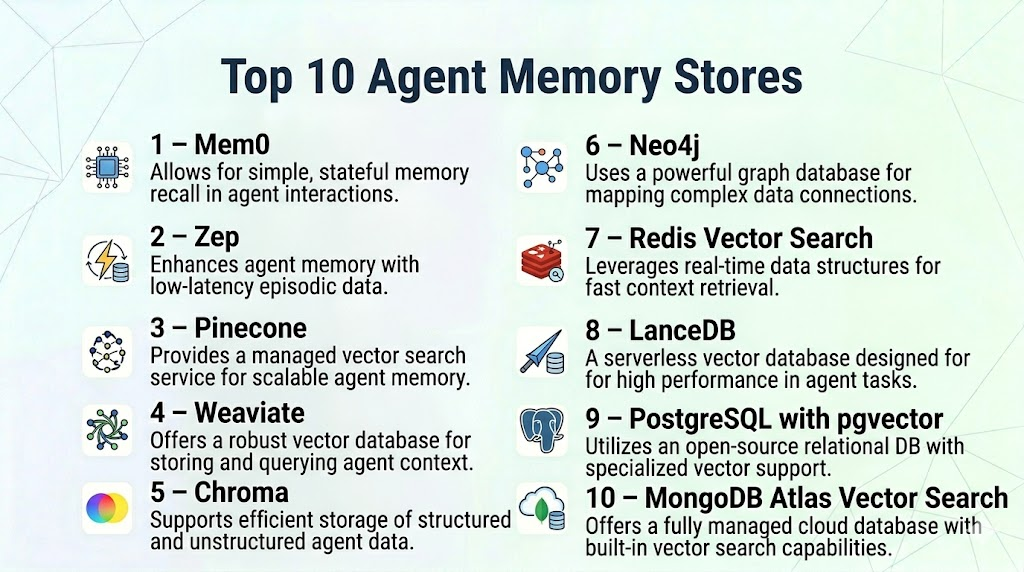
Top 10 Agent Memory Stores
1- Mem0
One-line Verdict
Best overall memory layer purpose-built for AI agents.
Short Description
Mem0 is designed specifically for AI memory management and helps agents remember user preferences, conversation history, task context, and behavioral patterns. Unlike traditional vector databases, it focuses on intelligent memory extraction and retrieval optimized for agent workflows.
Standout Capabilities
- Automatic memory extraction
- Personalized memory management
- Long-term memory retention
- Agent-specific memory
- Memory optimization
AI-Specific Depth
Built specifically for AI agents rather than generic vector search applications.
Pros
- Purpose-built for agents
- Easy integration
- Strong personalization capabilities
Cons
- Newer ecosystem
- Less mature than some database platforms
Security & Compliance
Depends on deployment configuration.
Deployment & Platforms
- Cloud
- Self-hosted
Integrations & Ecosystem
Works with major agent frameworks and LLM providers.
Pricing Model
Commercial with developer options.
Best-Fit Scenarios
- Personal AI assistants
- Customer support agents
- Long-running AI workflows
2- Zep
One-line Verdict
Best for conversational memory management.
Short Description
Zep provides long-term memory infrastructure for AI assistants and autonomous agents. It focuses on conversation persistence, semantic retrieval, and context optimization.
Standout Capabilities
- Conversation history
- Semantic memory
- Memory search
- Session persistence
- User profiling
AI-Specific Depth
Optimized for conversational AI applications and assistant platforms.
Pros
- Strong memory retrieval
- Conversation-focused design
- Easy deployment
Cons
- More specialized use case
- Smaller ecosystem
Security & Compliance
Varies by deployment.
Deployment & Platforms
- Cloud
- Self-hosted
Integrations & Ecosystem
Supports major AI frameworks.
Pricing Model
Open-source and commercial options.
Best-Fit Scenarios
- AI assistants
- Chat applications
- Customer service systems
3- Pinecone
One-line Verdict
Best enterprise vector database for agent memory.
Short Description
Pinecone is one of the most widely adopted vector databases for storing and retrieving semantic memories, embeddings, and knowledge representations used by AI agents.
Standout Capabilities
- High-performance vector search
- Metadata filtering
- Scalability
- Managed infrastructure
- Enterprise reliability
AI-Specific Depth
Excellent for semantic retrieval and memory storage at scale.
Pros
- Highly scalable
- Strong performance
- Enterprise-ready
Cons
- Not purpose-built for memory logic
- Additional memory layers often required
Security & Compliance
Enterprise controls available.
Deployment & Platforms
- Cloud
Integrations & Ecosystem
Broad AI ecosystem support.
Pricing Model
Usage-based.
Best-Fit Scenarios
- Enterprise memory infrastructure
- Large-scale retrieval systems
- Production AI applications
4- Weaviate
One-line Verdict
Best for hybrid memory and knowledge retrieval.
Short Description
Weaviate combines vector search, metadata management, and knowledge capabilities, making it a strong foundation for advanced memory architectures.
Key Features
- Vector storage
- Hybrid search
- Metadata filtering
- Multi-tenancy
- Knowledge integration
Pros
- Flexible architecture
- Open-source option
- Strong scalability
Cons
- Requires configuration expertise
- More infrastructure management
Platforms / Deployment
- Cloud
- Self-hosted
Security & Compliance
Enterprise security controls available.
Integrations & Ecosystem
Strong AI and data ecosystem.
Support & Community
Active open-source community.
5- Chroma
One-line Verdict
Best lightweight memory database for developers.
Short Description
Chroma provides simple vector storage and retrieval optimized for AI applications and agent memory implementations.
Key Features
- Vector search
- Embedding storage
- Easy setup
- Local deployment
- Open-source architecture
Pros
- Developer-friendly
- Lightweight
- Fast implementation
Cons
- Limited enterprise features
- Smaller scalability footprint
Platforms / Deployment
- Cloud
- Self-hosted
Security & Compliance
Not publicly stated.
Integrations & Ecosystem
Popular among AI developers.
Support & Community
Growing community.
6- Neo4j
One-line Verdict
Best graph-based memory store for complex reasoning.
Short Description
Neo4j enables knowledge graph memory architectures where agents can store relationships, entities, concepts, and contextual connections.
Key Features
- Knowledge graphs
- Relationship mapping
- Graph traversal
- Entity memory
- Context modeling
Pros
- Excellent relationship management
- Supports advanced reasoning
- Enterprise maturity
Cons
- More complex implementation
- Requires graph expertise
Platforms / Deployment
- Cloud
- Hybrid
- On-premises
Security & Compliance
Enterprise-grade controls.
Integrations & Ecosystem
Strong data integration ecosystem.
Support & Community
Large enterprise community.
7- Redis Vector Search
One-line Verdict
Best high-speed operational memory store.
Short Description
Redis combines traditional caching with vector search capabilities, enabling low-latency memory retrieval for AI agents.
Key Features
- In-memory performance
- Vector search
- Metadata filtering
- Real-time updates
- High availability
Pros
- Extremely fast
- Mature platform
- Flexible deployment
Cons
- Memory-intensive
- Additional architecture required
Platforms / Deployment
- Cloud
- Self-hosted
Security & Compliance
Enterprise options available.
Integrations & Ecosystem
Broad ecosystem support.
Support & Community
Large developer community.
8- LanceDB
One-line Verdict
Best open-source memory infrastructure.
Short Description
LanceDB provides efficient vector storage and retrieval optimized for AI workloads and memory-intensive applications.
Key Features
- Vector search
- Open-source architecture
- Efficient storage
- Local deployment
- Scalable retrieval
Pros
- Cost-effective
- Developer-friendly
- Growing ecosystem
Cons
- Newer platform
- Smaller enterprise footprint
Platforms / Deployment
- Self-hosted
- Cloud
Security & Compliance
Depends on deployment.
Integrations & Ecosystem
Growing AI integrations.
Support & Community
Expanding open-source community.
9- PostgreSQL with pgvector
One-line Verdict
Best for organizations leveraging existing databases.
Short Description
PostgreSQL combined with pgvector enables organizations to build agent memory systems without introducing specialized vector database platforms.
Key Features
- Vector storage
- SQL queries
- Metadata management
- Transaction support
- Enterprise reliability
Pros
- Familiar database platform
- Cost-efficient
- Strong governance
Cons
- Lower specialized performance
- Additional optimization needed
Platforms / Deployment
- Cloud
- On-premises
Security & Compliance
Enterprise database controls available.
Integrations & Ecosystem
Extensive ecosystem.
Support & Community
Massive community support.
10- MongoDB Atlas Vector Search
One-line Verdict
Best document-centric memory architecture.
Short Description
MongoDB Atlas Vector Search combines document databases and semantic search capabilities for modern AI memory systems.
Key Features
- Document storage
- Vector search
- Metadata filtering
- Scalability
- Managed infrastructure
Pros
- Unified architecture
- Enterprise-ready
- Strong scalability
Cons
- Managed service focus
- Additional costs at scale
Platforms / Deployment
- Cloud
Security & Compliance
Enterprise security controls available.
Integrations & Ecosystem
Large enterprise ecosystem.
Support & Community
Strong community support.
Comparison Table
| Tool | Best For | Memory Type | Open Source | Enterprise Ready |
|---|---|---|---|---|
| Mem0 | Agent Memory | Long-Term Agent Memory | Partial | Yes |
| Zep | Conversational Memory | Session + Long-Term | Partial | Yes |
| Pinecone | Enterprise Memory | Vector Memory | No | Yes |
| Weaviate | Hybrid Memory | Vector + Metadata | Yes | Yes |
| Chroma | Lightweight Memory | Vector Memory | Yes | Moderate |
| Neo4j | Graph Memory | Knowledge Graph | Partial | Yes |
| Redis Vector Search | Operational Memory | Real-Time Memory | Partial | Yes |
| LanceDB | Open Memory Infrastructure | Vector Memory | Yes | Moderate |
| PostgreSQL pgvector | Database Memory | Vector + Relational | Yes | Yes |
| MongoDB Atlas Vector Search | Document Memory | Vector + Documents | No | Yes |
Evaluation & Scoring Table
| Tool | Core | Ease | Integrations | Security | Performance | Support | Value | Total |
|---|---|---|---|---|---|---|---|---|
| Mem0 | 9.6 | 9.2 | 8.9 | 8.8 | 9.0 | 8.7 | 9.3 | 9.1 |
| Zep | 9.1 | 9.0 | 8.5 | 8.6 | 8.9 | 8.5 | 9.0 | 8.8 |
| Pinecone | 9.4 | 8.8 | 9.5 | 9.2 | 9.7 | 9.3 | 8.5 | 9.2 |
| Weaviate | 9.1 | 8.5 | 9.0 | 8.9 | 9.0 | 8.8 | 8.9 | 9.0 |
| Chroma | 8.5 | 9.3 | 8.2 | 8.0 | 8.4 | 8.3 | 9.4 | 8.6 |
| Neo4j | 9.2 | 7.8 | 8.8 | 9.4 | 9.1 | 9.2 | 8.4 | 8.9 |
| Redis | 9.0 | 8.7 | 9.3 | 9.0 | 9.8 | 9.4 | 8.6 | 9.1 |
| LanceDB | 8.7 | 8.9 | 8.3 | 8.2 | 8.7 | 8.2 | 9.2 | 8.7 |
| PostgreSQL pgvector | 8.8 | 8.6 | 9.4 | 9.3 | 8.6 | 9.5 | 9.0 | 8.9 |
| MongoDB Atlas Vector Search | 8.9 | 8.8 | 9.2 | 9.1 | 9.0 | 9.1 | 8.7 | 9.0 |
Which Agent Memory Store Is Right for You?
For Purpose-Built Agent Memory
Choose Mem0 or Zep if your primary goal is long-term memory management for AI agents and assistants.
For Enterprise Deployments
Choose Pinecone, Weaviate, or MongoDB Atlas Vector Search for scalability, reliability, and governance.
For Knowledge Graph Architectures
Choose Neo4j when agents need relationship-aware reasoning and contextual understanding.
For High-Speed Applications
Choose Redis Vector Search for low-latency memory retrieval and operational workloads.
For Cost-Conscious Teams
Choose Chroma, LanceDB, or PostgreSQL pgvector to leverage open-source infrastructure and existing database expertise.
Frequently Asked Questions
1- What is an Agent Memory Store?
An Agent Memory Store is a system that allows AI agents to retain, retrieve, and manage information across sessions and workflows. It helps agents maintain context, remember interactions, and improve decision-making over time.
2- Why do AI agents need memory?
Without memory, agents lose context after a conversation or workflow ends. Memory enables personalization, historical awareness, task continuity, and more effective autonomous operation.
3- What is the difference between vector memory and graph memory?
Vector memory stores semantic representations for similarity search, while graph memory stores relationships between entities and concepts, enabling more structured reasoning.
4- Is a vector database enough for agent memory?
Not always. Many advanced agent systems combine vector databases with metadata stores, graph databases, and memory management layers to support richer memory architectures.
5- Which memory store is best for conversational AI?
Mem0 and Zep are specifically designed for conversational memory and long-term user context retention.
6- Can multiple agents share the same memory store?
Yes. Many modern memory architectures support shared memory repositories that enable collaboration between multiple agents and workflows.
7- How important is metadata filtering?
Metadata filtering improves retrieval precision by allowing agents to retrieve memories based on users, projects, timestamps, topics, or business rules.
8- What role do knowledge graphs play in agent memory?
Knowledge graphs help agents understand relationships between entities, events, and concepts, enabling more sophisticated reasoning and contextual awareness.
9- Are open-source memory stores suitable for production use?
Yes. Platforms such as Weaviate, Chroma, LanceDB, and PostgreSQL with pgvector are commonly used in production environments when properly architected and managed.
10- What should organizations prioritize when selecting a memory store?
Organizations should evaluate retrieval quality, scalability, governance, integration flexibility, multi-agent support, security controls, and long-term operational costs.
Conclusion
Agent Memory Stores are becoming a critical building block for autonomous AI systems. As organizations move beyond simple chat interactions toward persistent, context-aware agents, memory infrastructure plays a central role in delivering personalization, continuity, and intelligent decision-making. Mem0 and Zep lead in purpose-built agent memory capabilities, while Pinecone and Weaviate provide scalable enterprise infrastructure. Neo4j excels for graph-based reasoning, and PostgreSQL pgvector offers a practical option for organizations leveraging existing database investments. The most effective agent architectures increasingly combine multiple memory approaches, including semantic, episodic, procedural, and graph-based memory, creating AI systems that can learn, adapt, and operate effectively over long periods while maintaining enterprise-grade governance and reliability.
#AgentMemoryStores, #AIAgents, #LLMOps, #VectorDatabases, #AgenticAI
