Introduction
Agent Safety Guardrail Layers have become a critical component of enterprise AI architectures as organizations move from simple chatbots to autonomous AI agents capable of making decisions, executing workflows, accessing enterprise systems, and interacting with customers. While modern AI agents can deliver significant productivity gains, they also introduce risks related to hallucinations, unauthorized actions, sensitive data exposure, compliance violations, harmful content generation, prompt injection attacks, and unintended business outcomes.
Safety guardrails provide the governance and control mechanisms necessary to ensure that AI agents operate within defined boundaries. These systems monitor agent behavior, validate inputs and outputs, enforce policies, restrict tool usage, manage permissions, detect risks, and maintain compliance with organizational and regulatory requirements.
Modern guardrail platforms extend beyond simple content moderation. They increasingly incorporate policy engines, security controls, risk assessment frameworks, runtime monitoring, prompt protection, agent authorization systems, and human approval workflows. As autonomous AI adoption grows, guardrail layers are becoming as important as models, memory systems, and orchestration frameworks.
Real-World Use Cases
- Customer service agent governance
- Enterprise AI compliance management
- Prompt injection prevention
- Data leakage protection
- Financial services AI controls
- Healthcare AI governance
- Autonomous workflow monitoring
- Tool execution authorization
- Multi-agent risk management
- Human-in-the-loop approvals
Evaluation Criteria for Buyers
When evaluating Agent Safety Guardrail Layers, consider:
- Policy enforcement capabilities
- Prompt injection protection
- Content moderation effectiveness
- Tool access controls
- Runtime monitoring
- Compliance support
- Human approval workflows
- Auditability and reporting
- Enterprise integrations
- Scalability and performance
Best for: Enterprises, AI governance teams, security teams, compliance officers, platform engineering teams, and organizations deploying production AI agents.
Not ideal for: Experimental projects that do not interact with sensitive data or critical business processes.
What’s Changed
The rapid growth of agentic AI has significantly expanded guardrail requirements.
Key developments include:
- Agent-specific governance frameworks
- Real-time policy enforcement
- Prompt injection detection
- Tool authorization controls
- AI risk scoring systems
- Autonomous action monitoring
- Human oversight workflows
- Regulatory compliance automation
Quick Buyer Checklist
Before selecting an Agent Safety Guardrail platform, ask:
- Does it protect against prompt injection?
- Can it control tool access?
- Are human approvals supported?
- Is real-time monitoring available?
- Does it provide audit trails?
- Can it enforce business policies?
- Does it integrate with agent frameworks?
- Is compliance reporting available?
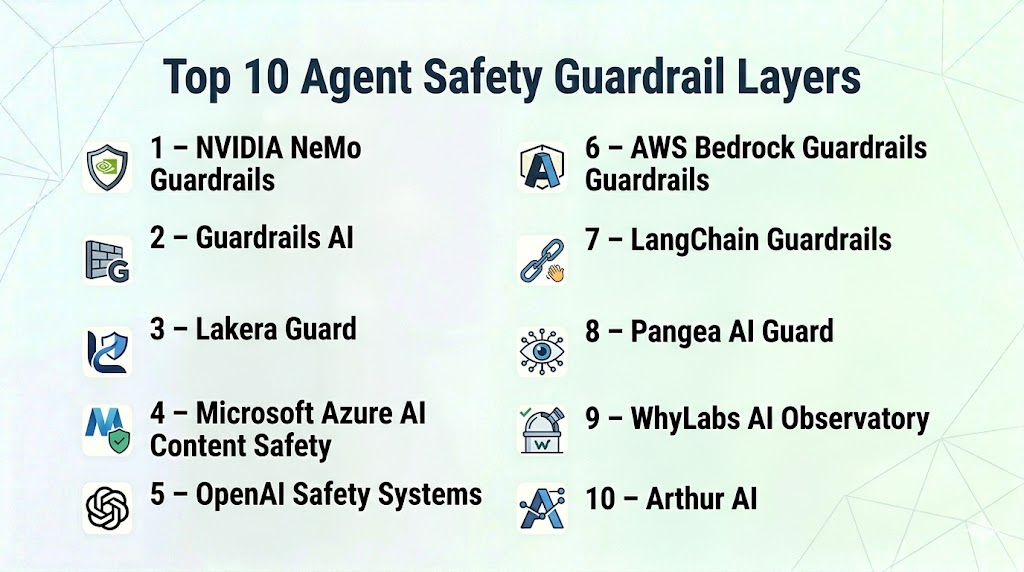
Top 10 Agent Safety Guardrail Layers
1- NVIDIA NeMo Guardrails
One-line Verdict
Best overall platform for enterprise AI guardrails and conversational safety.
Short Description
NVIDIA NeMo Guardrails provides a comprehensive framework for controlling AI agent behavior through predefined rules, conversational constraints, tool governance, policy enforcement, and runtime monitoring. It is widely adopted for enterprise-grade AI governance.
Standout Capabilities
- Conversation guardrails
- Tool usage controls
- Policy enforcement
- Safety monitoring
- Runtime governance
AI-Specific Depth
Designed specifically to manage agent actions, outputs, and interactions across complex AI workflows.
Pros
- Enterprise-focused architecture
- Strong governance capabilities
- Extensive customization options
Cons
- Implementation complexity
- Requires governance planning
Security & Compliance
Enterprise-grade controls available.
Deployment & Platforms
- Cloud
- Self-hosted
- Hybrid
Integrations & Ecosystem
Supports major AI frameworks and enterprise systems.
Pricing Model
Open-source with enterprise ecosystem support.
Best-Fit Scenarios
- Enterprise AI deployments
- Regulated industries
- Production AI agents
2- Guardrails AI
One-line Verdict
Best dedicated guardrail framework for developers.
Short Description
Guardrails AI enables developers to define validation rules, policy constraints, structured outputs, and safety controls around AI applications and autonomous agents.
Standout Capabilities
- Output validation
- Structured generation
- Policy enforcement
- Safety rules
- Hallucination reduction
AI-Specific Depth
Focuses on ensuring reliable, safe, and predictable model outputs.
Pros
- Developer-friendly
- Strong validation mechanisms
- Open architecture
Cons
- Less comprehensive governance than enterprise platforms
- Requires configuration effort
Security & Compliance
Depends on implementation.
Deployment & Platforms
- Cloud
- Self-hosted
Integrations & Ecosystem
Works with major AI frameworks.
Pricing Model
Open-source.
Best-Fit Scenarios
- AI application development
- Output validation
- Agent safety layers
3- Lakera Guard
One-line Verdict
Best for prompt injection and AI security protection.
Short Description
Lakera Guard focuses on defending AI systems against prompt injection attacks, jailbreak attempts, malicious instructions, and adversarial inputs.
Standout Capabilities
- Prompt injection detection
- Jailbreak prevention
- Threat analysis
- Input protection
- AI security monitoring
AI-Specific Depth
Specialized for AI threat detection and adversarial protection.
Pros
- Strong security focus
- Real-time protection
- Enterprise readiness
Cons
- More security-focused than governance-focused
- Additional tooling often required
Security & Compliance
Enterprise-grade security controls.
Deployment & Platforms
- Cloud
- API-based deployment
Integrations & Ecosystem
Supports major AI platforms.
Pricing Model
Commercial.
Best-Fit Scenarios
- Security-sensitive environments
- Public-facing AI systems
- Enterprise AI deployments
4- Microsoft Azure AI Content Safety
One-line Verdict
Best for enterprise content moderation and compliance.
Short Description
Azure AI Content Safety provides advanced content moderation, risk detection, harmful content filtering, and governance controls for AI applications and agents.
Standout Capabilities
- Content moderation
- Risk classification
- Harmful content detection
- Compliance controls
- Policy management
Pros
- Enterprise maturity
- Strong compliance support
- Scalable infrastructure
Cons
- Strongest within Azure ecosystem
- Less agent-specific than some competitors
Security & Compliance
Enterprise-grade controls available.
Deployment & Platforms
- Cloud
Integrations & Ecosystem
Strong Microsoft ecosystem integration.
Pricing Model
Consumption-based.
Best-Fit Scenarios
- Enterprise AI governance
- Content moderation
- Compliance-focused deployments
5- OpenAI Safety Systems
One-line Verdict
Best integrated safety controls for OpenAI-based applications.
Short Description
OpenAI provides built-in moderation, safety filtering, policy enforcement, and risk reduction mechanisms designed to improve safe AI deployment.
Standout Capabilities
- Content moderation
- Risk filtering
- Safety enforcement
- Usage monitoring
- Policy controls
Pros
- Native integration
- Easy adoption
- Continuous improvements
Cons
- Platform-specific
- Limited customization compared to dedicated platforms
Security & Compliance
Business-grade controls available.
Deployment & Platforms
- Cloud
Integrations & Ecosystem
OpenAI ecosystem.
Pricing Model
Included within platform usage.
Best-Fit Scenarios
- OpenAI-based agent systems
- Rapid deployment
- Moderation-focused environments
6- AWS Bedrock Guardrails
One-line Verdict
Best cloud-native governance layer for enterprise agents.
Short Description
AWS Bedrock Guardrails enables organizations to implement safety policies, content restrictions, topic controls, and compliance requirements across AI applications.
Standout Capabilities
- Policy controls
- Topic restrictions
- Content filtering
- Governance rules
- Enterprise scalability
Pros
- Strong AWS integration
- Enterprise governance
- Scalable deployment
Cons
- AWS ecosystem focus
- Limited portability
Security & Compliance
Enterprise-grade controls.
Deployment & Platforms
- Cloud
Integrations & Ecosystem
AWS ecosystem integration.
Pricing Model
Consumption-based.
Best-Fit Scenarios
- AWS-based AI systems
- Enterprise governance
- Compliance workloads
7- LangChain Guardrails
One-line Verdict
Best for agent workflow safety enforcement.
Short Description
LangChain provides multiple guardrail mechanisms that enable policy enforcement, output validation, tool restrictions, and workflow governance.
Standout Capabilities
- Tool restrictions
- Output validation
- Workflow controls
- Agent governance
- Runtime monitoring
Pros
- Broad ecosystem
- Agent-native architecture
- Flexible implementation
Cons
- Requires developer expertise
- Additional setup complexity
Security & Compliance
Depends on deployment.
Deployment & Platforms
- Cloud
- Self-hosted
Integrations & Ecosystem
Extensive AI ecosystem support.
Pricing Model
Open-source.
Best-Fit Scenarios
- Agent development
- Workflow governance
- Custom AI architectures
8- Pangea AI Guard
One-line Verdict
Best for security-focused AI governance.
Short Description
Pangea AI Guard combines security monitoring, policy enforcement, audit trails, and governance controls designed for production AI environments.
Standout Capabilities
- Audit logging
- Security controls
- Risk monitoring
- Compliance support
- Governance workflows
Pros
- Strong security posture
- Compliance-friendly
- Enterprise focus
Cons
- Smaller ecosystem
- Less developer adoption
Security & Compliance
Enterprise-grade controls.
Deployment & Platforms
- Cloud
Integrations & Ecosystem
Security-focused integrations.
Pricing Model
Commercial.
Best-Fit Scenarios
- Security-sensitive industries
- Governance-heavy deployments
- Regulated environments
9- WhyLabs AI Observatory
One-line Verdict
Best for AI observability and risk monitoring.
Short Description
WhyLabs provides runtime monitoring, anomaly detection, model behavior analysis, and governance capabilities that help organizations monitor agent performance and risks.
Standout Capabilities
- Runtime monitoring
- Risk detection
- AI observability
- Drift monitoring
- Governance dashboards
Pros
- Strong monitoring capabilities
- Enterprise observability
- Detailed analytics
Cons
- More monitoring-focused
- Requires complementary guardrail tools
Security & Compliance
Enterprise controls available.
Deployment & Platforms
- Cloud
Integrations & Ecosystem
Broad AI ecosystem support.
Pricing Model
Commercial.
Best-Fit Scenarios
- AI operations teams
- Monitoring-focused deployments
- Enterprise governance
10- Arthur AI
One-line Verdict
Best for enterprise AI risk management.
Short Description
Arthur AI provides AI monitoring, governance, explainability, and safety controls that help organizations manage risks associated with autonomous AI systems.
Standout Capabilities
- Risk monitoring
- Explainability
- Governance reporting
- AI observability
- Compliance workflows
Pros
- Enterprise-grade governance
- Strong reporting capabilities
- Mature monitoring framework
Cons
- Premium enterprise focus
- Higher implementation requirements
Security & Compliance
Enterprise-grade controls.
Deployment & Platforms
- Cloud
- Hybrid
Integrations & Ecosystem
Enterprise AI ecosystem support.
Pricing Model
Commercial.
Best-Fit Scenarios
- Large enterprises
- AI governance programs
- Risk management initiatives
Comparison Table
| Tool | Best For | Open Source | Agent-Specific | Enterprise Ready |
|---|---|---|---|---|
| NVIDIA NeMo Guardrails | Enterprise Governance | Yes | Yes | Yes |
| Guardrails AI | Developer Safety | Yes | Yes | Moderate |
| Lakera Guard | AI Security | No | Yes | Yes |
| Azure AI Content Safety | Compliance | No | Moderate | Yes |
| OpenAI Safety Systems | OpenAI Applications | No | Moderate | Yes |
| AWS Bedrock Guardrails | Cloud Governance | No | Moderate | Yes |
| LangChain Guardrails | Agent Workflows | Yes | Yes | Moderate |
| Pangea AI Guard | Security Governance | No | Moderate | Yes |
| WhyLabs | Observability | No | Moderate | Yes |
| Arthur AI | Risk Management | No | Moderate | Yes |
Evaluation & Scoring Table
| Tool | Core | Ease | Integrations | Security | Performance | Support | Value | Total |
|---|---|---|---|---|---|---|---|---|
| NVIDIA NeMo Guardrails | 9.7 | 8.4 | 9.2 | 9.8 | 9.2 | 9.1 | 9.2 | 9.3 |
| Guardrails AI | 9.0 | 9.0 | 8.8 | 8.9 | 8.8 | 8.7 | 9.3 | 8.9 |
| Lakera Guard | 9.1 | 8.9 | 8.5 | 9.8 | 9.0 | 8.8 | 8.7 | 9.0 |
| Azure AI Content Safety | 9.0 | 8.8 | 9.2 | 9.5 | 9.1 | 9.2 | 8.8 | 9.1 |
| OpenAI Safety Systems | 8.8 | 9.4 | 8.6 | 9.0 | 9.0 | 9.1 | 8.9 | 8.9 |
| AWS Bedrock Guardrails | 9.0 | 8.7 | 9.1 | 9.4 | 9.1 | 9.0 | 8.8 | 9.0 |
| LangChain Guardrails | 8.9 | 8.5 | 9.4 | 8.8 | 8.8 | 9.1 | 9.1 | 8.9 |
| Pangea AI Guard | 8.8 | 8.3 | 8.4 | 9.4 | 8.8 | 8.4 | 8.7 | 8.7 |
| WhyLabs | 8.9 | 8.8 | 8.9 | 9.0 | 9.1 | 8.8 | 8.8 | 8.9 |
| Arthur AI | 9.0 | 8.4 | 8.7 | 9.3 | 9.0 | 8.9 | 8.7 | 8.9 |
Which Agent Safety Guardrail Layer Is Right for You?
For Enterprise AI Governance
Choose NVIDIA NeMo Guardrails if you need comprehensive governance, policy enforcement, and agent control mechanisms across production environments.
For Developer-Centric AI Safety
Choose Guardrails AI for flexible validation, structured outputs, and customizable safety controls.
For AI Security Protection
Choose Lakera Guard when defending against prompt injection, jailbreak attacks, and adversarial inputs is a top priority.
For Cloud-Native Governance
Choose Azure AI Content Safety or AWS Bedrock Guardrails if your organization is already invested in those cloud ecosystems.
For Agent Workflow Enforcement
Choose LangChain Guardrails when building highly customized agent architectures and orchestration systems.
For AI Monitoring and Risk Management
Choose WhyLabs or Arthur AI to gain visibility into runtime behavior, compliance risks, and operational governance.
Frequently Asked Questions
1- What is an Agent Safety Guardrail Layer?
An Agent Safety Guardrail Layer is a system that enforces policies, validates behavior, monitors risks, and restricts unsafe actions performed by AI agents. It acts as a governance and control mechanism for autonomous AI systems.
2- Why are guardrails important for AI agents?
AI agents can access tools, enterprise systems, and sensitive data. Guardrails help prevent harmful outputs, unauthorized actions, compliance violations, and security threats.
3- What is prompt injection?
Prompt injection is a technique where malicious instructions attempt to manipulate an AI system into ignoring its intended rules or revealing sensitive information. Modern guardrails help detect and block these attacks.
4- Can guardrails prevent hallucinations?
Guardrails can reduce hallucinations through validation rules, retrieval checks, output constraints, and human review workflows, though they cannot eliminate hallucinations entirely.
5- What is the difference between safety and security in AI?
Safety focuses on preventing harmful or unintended outcomes, while security focuses on protecting systems from malicious attacks, unauthorized access, and exploitation.
6- Do AI agents require human approval workflows?
For many enterprise use cases, human approvals are recommended before agents perform high-risk actions involving financial transactions, customer communications, or system modifications.
7- Are cloud provider guardrails sufficient for enterprise deployments?
Cloud-native guardrails provide a strong foundation, but many organizations supplement them with dedicated governance, security, and monitoring platforms.
8- How do guardrails help with compliance?
Guardrails enforce policies related to data protection, content standards, access control, auditability, and regulatory requirements.
9- What role does observability play in AI safety?
Observability provides visibility into agent behavior, tool usage, policy violations, and performance issues, helping organizations identify and mitigate risks quickly.
10- What should organizations prioritize when selecting a guardrail solution?
Organizations should focus on policy enforcement, security controls, observability, compliance support, integration flexibility, scalability, and compatibility with their agent architecture.
Conclusion
Agent Safety Guardrail Layers are rapidly becoming a mandatory component of enterprise AI deployments. As AI agents gain the ability to reason, plan, access tools, interact with business systems, and execute autonomous actions, governance and safety controls become essential for maintaining trust, compliance, and operational reliability. NVIDIA NeMo Guardrails currently provides one of the most comprehensive governance frameworks, while Guardrails AI offers strong developer flexibility and Lakera Guard leads in AI security protection. Cloud-native options such as Azure AI Content Safety and AWS Bedrock Guardrails simplify deployment for organizations already operating within those ecosystems. The most successful AI governance strategies combine policy enforcement, security controls, observability, human oversight, and continuous monitoring to create agent systems that are not only powerful but also safe, compliant, and aligned with business objectives.
