Introduction
Agent Policy & Permission Systems have emerged as one of the most important control layers in enterprise AI architectures. As AI agents evolve from simple conversational assistants into autonomous systems capable of accessing databases, executing workflows, invoking APIs, modifying records, sending communications, and making operational decisions, organizations must establish clear rules governing what agents can and cannot do.
Without robust permission controls, AI agents can introduce security risks, compliance violations, unauthorized actions, data exposure, and operational disruptions. Agent Policy & Permission Systems provide governance mechanisms that define access rights, approval workflows, role-based controls, action restrictions, audit trails, and enforcement policies that ensure AI agents operate within approved boundaries.
Modern permission systems go beyond traditional access control. They increasingly incorporate dynamic authorization, context-aware permissions, tool governance, policy-as-code frameworks, risk-based decision making, human approvals, agent identity management, and multi-agent governance capabilities.
As organizations move toward production-scale agent deployments, policy and permission systems are becoming as essential as orchestration frameworks, memory stores, reasoning modules, and guardrail layers.
Real-World Use Cases
- Enterprise AI governance
- Agent tool authorization
- Customer data access control
- Autonomous workflow approvals
- Multi-agent security management
- Financial transaction authorization
- Healthcare compliance enforcement
- IT operations governance
- Agent identity management
- Regulatory compliance monitoring
Evaluation Criteria for Buyers
When evaluating Agent Policy & Permission Systems, consider:
- Fine-grained permissions
- Role-based access control
- Policy-as-code capabilities
- Dynamic authorization
- Human approval workflows
- Auditability and reporting
- Multi-agent governance
- Integration flexibility
- Compliance support
- Enterprise scalability
Best for: Enterprise AI teams, security teams, governance officers, compliance departments, platform engineers, and organizations deploying autonomous AI systems.
Not ideal for: Small experimental AI projects without sensitive data or operational responsibilities.
What’s Changed
The rise of autonomous AI agents has significantly expanded permission management requirements.
Key developments include:
- Agent identity systems
- Dynamic authorization frameworks
- Tool-specific permissions
- Policy-as-code adoption
- Risk-aware authorization
- Human approval integration
- Agent governance platforms
- Multi-agent access controls
Quick Buyer Checklist
Before selecting an Agent Policy & Permission platform, ask:
- Can permissions be enforced at tool level?
- Is policy-as-code supported?
- Are approval workflows available?
- Does it support multi-agent environments?
- Is audit logging comprehensive?
- Can permissions change dynamically?
- Are compliance controls available?
- Does it integrate with enterprise identity systems?
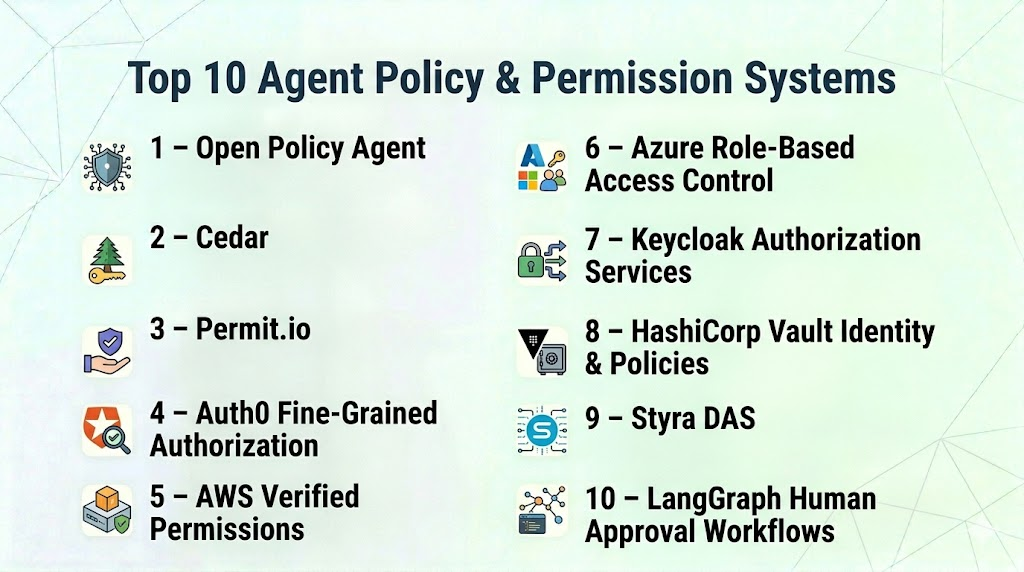
Top 10 Agent Policy & Permission Systems
1- Open Policy Agent
One-line Verdict
Best overall policy engine for AI agent authorization and governance.
Short Description
Open Policy Agent provides a powerful policy-as-code framework that enables organizations to define, enforce, and audit permissions across AI agents, tools, APIs, workflows, and enterprise systems. It has become one of the most widely adopted authorization platforms in cloud-native environments.
Standout Capabilities
- Policy as code
- Dynamic authorization
- Fine-grained permissions
- Audit controls
- Enterprise scalability
AI-Specific Depth
Can be integrated directly into agent workflows to control tool access and action execution.
Pros
- Highly flexible
- Enterprise adoption
- Strong ecosystem
Cons
- Learning curve
- Requires policy design expertise
Security & Compliance
Enterprise-grade controls available.
Deployment & Platforms
- Cloud
- Hybrid
- On-premises
Integrations & Ecosystem
Extensive cloud-native ecosystem support.
Pricing Model
Open-source.
Best-Fit Scenarios
- Enterprise AI governance
- Agent authorization
- Policy automation
2- Cedar
One-line Verdict
Best modern authorization framework for agent permissions.
Short Description
Cedar is a policy language designed for scalable authorization systems. It allows organizations to define clear and auditable permission models for AI agents and enterprise applications.
Standout Capabilities
- Fine-grained authorization
- Policy language
- Role-based controls
- Auditability
- Scalable permissions
AI-Specific Depth
Well-suited for agent action authorization and access management.
Pros
- Modern architecture
- Easy policy modeling
- Strong security focus
Cons
- Smaller ecosystem
- Newer platform maturity
Security & Compliance
Enterprise-grade authorization controls.
Deployment & Platforms
- Cloud
- Self-hosted
Integrations & Ecosystem
Growing authorization ecosystem.
Pricing Model
Open-source.
Best-Fit Scenarios
- Agent permissions
- Enterprise applications
- Security-sensitive environments
3- Permit.io
One-line Verdict
Best developer-friendly authorization platform.
Short Description
Permit.io simplifies access control implementation by providing centralized authorization management, policy enforcement, audit trails, and role management.
Standout Capabilities
- Role-based access control
- Fine-grained permissions
- Policy management
- Audit logs
- Centralized governance
AI-Specific Depth
Supports authorization for AI agents, tools, APIs, and workflows.
Pros
- Easy implementation
- Strong developer experience
- Comprehensive controls
Cons
- Commercial platform
- Advanced features may require premium tiers
Security & Compliance
Enterprise controls available.
Deployment & Platforms
- Cloud
- Hybrid
Integrations & Ecosystem
Broad application integration support.
Pricing Model
Commercial.
Best-Fit Scenarios
- Enterprise AI deployments
- Access management
- Governance programs
4- Auth0 Fine-Grained Authorization
One-line Verdict
Best identity-integrated permission management.
Short Description
Auth0 combines authentication and authorization capabilities, enabling organizations to manage agent identities and permissions through a unified platform.
Standout Capabilities
- Identity management
- Fine-grained authorization
- Role management
- Access policies
- Enterprise integration
Pros
- Mature platform
- Strong identity controls
- Enterprise adoption
Cons
- Identity-centric focus
- Premium pricing
Security & Compliance
Enterprise-grade security.
Deployment & Platforms
- Cloud
Integrations & Ecosystem
Extensive enterprise integrations.
Pricing Model
Subscription-based.
Best-Fit Scenarios
- Enterprise identity governance
- Agent authentication
- Permission management
5- AWS Verified Permissions
One-line Verdict
Best cloud-native authorization service.
Short Description
AWS Verified Permissions enables centralized policy management and authorization enforcement across applications, services, and AI agents.
Standout Capabilities
- Centralized policies
- Authorization engine
- Fine-grained permissions
- Auditability
- Cloud integration
Pros
- AWS-native
- Enterprise scalability
- Strong governance
Cons
- AWS ecosystem dependency
- Limited portability
Security & Compliance
Enterprise-grade controls.
Deployment & Platforms
- Cloud
Integrations & Ecosystem
AWS ecosystem integration.
Pricing Model
Consumption-based.
Best-Fit Scenarios
- AWS-based AI environments
- Cloud-native governance
- Enterprise authorization
6- Azure Role-Based Access Control
One-line Verdict
Best for Microsoft-centric AI ecosystems.
Short Description
Azure RBAC provides structured access control mechanisms for AI agents, workflows, enterprise resources, and cloud services.
Standout Capabilities
- Role-based controls
- Resource permissions
- Identity integration
- Governance policies
- Enterprise management
Pros
- Strong Microsoft ecosystem
- Mature controls
- Enterprise scale
Cons
- Azure-focused architecture
- Limited portability
Deployment & Platforms
- Cloud
Security & Compliance
Enterprise-grade controls available.
Integrations & Ecosystem
Microsoft ecosystem integration.
Pricing Model
Included with platform services.
Best-Fit Scenarios
- Microsoft AI deployments
- Enterprise governance
- Cloud permissions
7- Keycloak Authorization Services
One-line Verdict
Best open-source identity and permission platform.
Short Description
Keycloak provides authentication, authorization, role management, and policy enforcement capabilities suitable for AI agent ecosystems.
Standout Capabilities
- Identity management
- Policy enforcement
- Role-based controls
- Access governance
- Federation support
Pros
- Open-source
- Enterprise capabilities
- Strong identity controls
Cons
- Administrative complexity
- Learning curve
Security & Compliance
Enterprise-grade security available.
Deployment & Platforms
- Cloud
- Hybrid
- On-premises
Integrations & Ecosystem
Broad identity ecosystem support.
Pricing Model
Open-source.
Best-Fit Scenarios
- Self-hosted AI platforms
- Identity management
- Enterprise authorization
8- HashiCorp Vault Identity & Policies
One-line Verdict
Best for secret-aware agent authorization.
Short Description
Vault combines identity management, secret protection, and policy enforcement, making it useful for AI agents that interact with sensitive systems and credentials.
Standout Capabilities
- Secret management
- Identity controls
- Policy enforcement
- Credential protection
- Audit trails
Pros
- Strong security posture
- Enterprise maturity
- Extensive integrations
Cons
- More security-focused
- Higher operational complexity
Deployment & Platforms
- Cloud
- Hybrid
- On-premises
Security & Compliance
Enterprise-grade controls.
Integrations & Ecosystem
Large infrastructure ecosystem.
Pricing Model
Open-source and enterprise options.
Best-Fit Scenarios
- Sensitive environments
- Infrastructure agents
- Security-critical workloads
9- Styra DAS
One-line Verdict
Best enterprise platform built around Open Policy Agent.
Short Description
Styra DAS simplifies policy management and governance using Open Policy Agent while adding enterprise workflows, visibility, and operational controls.
Standout Capabilities
- Policy governance
- Compliance monitoring
- Audit reporting
- Centralized management
- Enterprise controls
Pros
- Enterprise-ready
- Strong governance features
- OPA compatibility
Cons
- Commercial platform
- Higher implementation costs
Deployment & Platforms
- Cloud
- Hybrid
Security & Compliance
Enterprise-grade controls.
Integrations & Ecosystem
Cloud-native ecosystem support.
Pricing Model
Commercial.
Best-Fit Scenarios
- Large enterprises
- Governance programs
- Compliance environments
10- LangGraph Human Approval Workflows
One-line Verdict
Best for human-in-the-loop permission enforcement.
Short Description
LangGraph enables organizations to implement approval checkpoints where human reviewers must authorize sensitive agent actions before execution.
Standout Capabilities
- Approval workflows
- Action checkpoints
- Workflow governance
- Agent supervision
- Runtime controls
Pros
- Agent-native design
- Strong governance support
- Workflow flexibility
Cons
- Not a complete authorization platform
- Requires broader governance architecture
Deployment & Platforms
- Cloud
- Self-hosted
Security & Compliance
Depends on deployment.
Integrations & Ecosystem
Strong AI workflow ecosystem.
Pricing Model
Open-source.
Best-Fit Scenarios
- Agent workflows
- Human oversight
- Sensitive business actions
Comparison Table
| Tool | Best For | Policy-as-Code | Enterprise Ready | Open Source |
|---|---|---|---|---|
| Open Policy Agent | Authorization | Yes | Yes | Yes |
| Cedar | Fine-Grained Permissions | Yes | Yes | Yes |
| Permit.io | Developer Governance | Yes | Yes | No |
| Auth0 Authorization | Identity + Permissions | Partial | Yes | No |
| AWS Verified Permissions | Cloud Authorization | Yes | Yes | No |
| Azure RBAC | Cloud Governance | No | Yes | No |
| Keycloak | Open Identity Management | Partial | Yes | Yes |
| Vault Policies | Secret-Aware Authorization | Yes | Yes | Partial |
| Styra DAS | Enterprise Policy Governance | Yes | Yes | No |
| LangGraph Approvals | Human Oversight | Partial | Moderate | Yes |
Evaluation & Scoring Table
| Tool | Core | Ease | Integrations | Security | Performance | Support | Value | Total |
|---|---|---|---|---|---|---|---|---|
| Open Policy Agent | 9.8 | 8.2 | 9.6 | 9.8 | 9.2 | 9.1 | 9.4 | 9.3 |
| Cedar | 9.2 | 8.8 | 8.6 | 9.5 | 9.0 | 8.6 | 9.0 | 8.9 |
| Permit.io | 9.1 | 9.2 | 9.0 | 9.2 | 8.9 | 8.8 | 8.8 | 9.0 |
| Auth0 | 9.0 | 9.0 | 9.3 | 9.5 | 9.0 | 9.2 | 8.5 | 9.0 |
| AWS Verified Permissions | 9.1 | 8.8 | 9.2 | 9.6 | 9.1 | 9.0 | 8.7 | 9.1 |
| Azure RBAC | 8.9 | 8.9 | 9.3 | 9.5 | 9.1 | 9.1 | 8.7 | 9.0 |
| Keycloak | 8.8 | 8.1 | 9.0 | 9.3 | 8.8 | 8.8 | 9.3 | 8.9 |
| Vault Policies | 9.0 | 7.9 | 9.2 | 9.8 | 9.0 | 9.1 | 8.8 | 9.0 |
| Styra DAS | 9.3 | 8.3 | 9.1 | 9.7 | 9.0 | 8.9 | 8.5 | 9.0 |
| LangGraph Approvals | 8.7 | 8.9 | 8.8 | 8.8 | 8.7 | 8.9 | 9.0 | 8.8 |
Which Agent Policy & Permission System Is Right for You?
For Enterprise Authorization
Choose Open Policy Agent if you need highly flexible, scalable, and auditable policy enforcement across agent ecosystems.
For Modern Fine-Grained Permissions
Choose Cedar when building sophisticated authorization models for agent actions and tool access.
For Developer-Friendly Governance
Choose Permit.io to simplify permission management while maintaining enterprise-grade controls.
For Identity-Centric Architectures
Choose Auth0 or Keycloak when agent identity management and authentication are central requirements.
For Cloud-Native Environments
Choose AWS Verified Permissions or Azure RBAC if your organization operates primarily within those cloud ecosystems.
For Security-Sensitive Workloads
Choose HashiCorp Vault to combine authorization, credential management, and security governance.
Frequently Asked Questions
1- What is an Agent Policy & Permission System?
An Agent Policy & Permission System defines and enforces what actions an AI agent can perform, what resources it can access, and under which conditions those actions are allowed.
2- Why do AI agents need permission controls?
AI agents often interact with enterprise systems, customer data, APIs, and operational workflows. Permission systems prevent unauthorized access, accidental actions, and compliance violations.
3- What is policy-as-code?
Policy-as-code allows organizations to define authorization and governance rules using machine-readable code that can be versioned, tested, audited, and automatically enforced.
4- What is fine-grained authorization?
Fine-grained authorization enables permissions to be defined at highly specific levels, such as individual tools, APIs, resources, actions, or business workflows.
5- How are permissions different from safety guardrails?
Permissions control what agents are allowed to do, while safety guardrails focus on preventing harmful outputs, unsafe behaviors, and policy violations.
6- Can permissions be dynamic?
Yes. Modern authorization systems can evaluate context, risk levels, user roles, time-based conditions, and workflow states to make real-time permission decisions.
7- Why are audit logs important?
Audit logs provide visibility into agent actions, permission decisions, policy violations, and compliance activities, supporting governance and regulatory requirements.
8- What role do human approvals play?
Human approval workflows add oversight for high-risk actions such as financial transactions, infrastructure changes, customer communications, or sensitive data access.
9- Are open-source permission systems suitable for enterprises?
Yes. Platforms such as Open Policy Agent, Cedar, and Keycloak are widely used in enterprise environments when properly configured and governed.
10- What should organizations prioritize when selecting a permission platform?
Organizations should evaluate authorization flexibility, auditability, governance support, scalability, security controls, identity integration, and compatibility with their AI architecture.
Conclusion
Agent Policy & Permission Systems are rapidly becoming a foundational governance layer for enterprise AI. As AI agents gain access to tools, databases, business applications, cloud infrastructure, and operational workflows, organizations need clear mechanisms to control actions, enforce policies, and maintain accountability. Open Policy Agent currently leads in flexibility and enterprise adoption, while Cedar provides modern fine-grained authorization capabilities and Permit.io simplifies implementation. Identity-focused platforms such as Auth0 and Keycloak strengthen authentication and access governance, while Vault adds critical protection for sensitive environments. The most effective AI governance strategies combine authorization, safety guardrails, observability, human approvals, and compliance controls to ensure agents remain secure, trustworthy, and aligned with business objectives as autonomy continues to increase.
