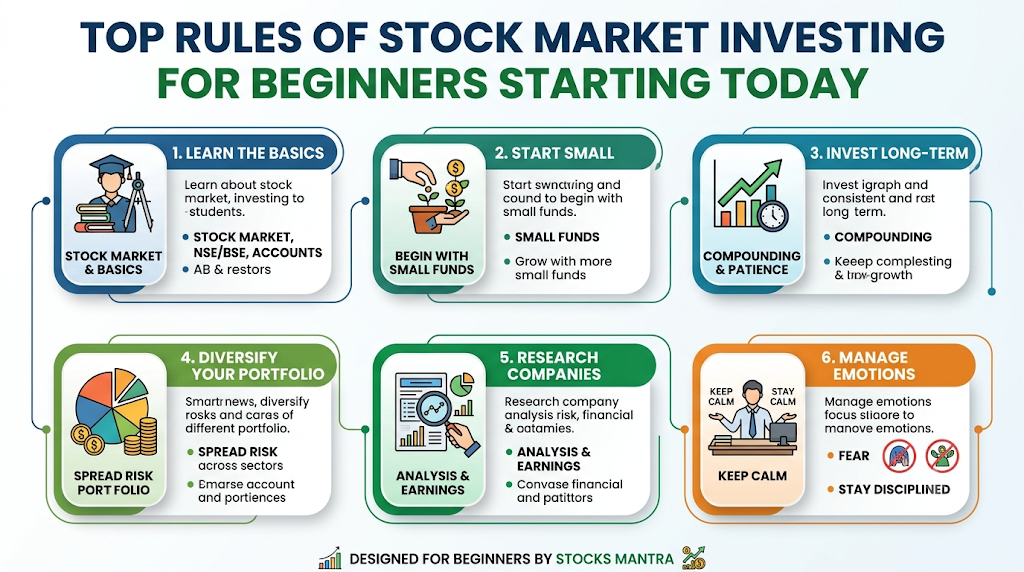
Taking your first steps into financial markets can feel like entering a country where everyone speaks a different language. Between fluctuating tickers and complex economic terms, many new retail investors feel overwhelmed before they even open an account. However, building wealth through equity investing does not require a background in rocket science. It requires structural stock market education. This comprehensive guide breaks down the core elements of the share market for beginners. By understanding how the Indian stock market functions, mastering core stock market research frameworks, and identifying your unique investing style, you can transform from a confused spectator into a confident market participant. Let us explore the fundamental rules of the road to fast-track your investment journey securely with insights inspired by platforms like Stocks Mantra.
What Is the Stock Market and How Does It Work?
At its simplest level, a stock exchange acts as a secure digital marketplace. It is a space where publicly traded corporations issue fractions of business ownership, known as shares or equities, to public buyers. In the Indian ecosystem, these financial activities happen primarily across two major exchanges: the National Stock Exchange (NSE) and the Bombay Stock Exchange (BSE).
When you buy a stock, you become a partial owner of that business. If the company increases its profits, creates revolutionary products, or expands its operational footprint, its intrinsic market value rises. Consequently, public demand for its limited shares ticks upward, pushing the overall trading price higher. Conversely, poor corporate governance, macroeconomic downturns, or falling revenues can drive asset prices downward.
Key Differences in Market Operations
Before placing your initial capital into live trades, you must clarify your operational approach. A major fork in the road for every newcomer is deciding between long-term investing and short-term trading.
Comparison Table 1: Investing vs. Trading
| Feature | Long-Term Investing | Short-Term Trading |
| Core Objective | Gradual wealth compounding over years | Generating swift profits from daily price moves |
| Primary Method | Fundamental evaluation and business health | Chart analysis, patterns, and immediate momentum |
| Risk Level | Moderate to low over long horizons | Exceptionally high due to rapid volatility |
| Time Horizon | 3 to 10+ Years | Minutes, hours, or a few weeks |
| Advantages | Low stress, benefits from compounding dividends | High liquidity, quick income generation potential |
| Limitations | Capital is locked away for long periods | Demands constant monitoring and strict mental control |
| Best For | Working professionals, retirement savers | Full-time market enthusiasts, agile risk-takers |
Two Essential Frameworks: Fundamental Analysis vs. Technical Analysis
To pick winning companies consistently, you must learn stock market analysis. Investors generally look at corporate assets using two main disciplines: fundamental analysis of stocks and technical analysis for beginners.
Fundamental Analysis of Stocks
Fundamental evaluation focuses strictly on a company’s inner financial health. It asks a foundational question: Is this business actually worth its current price tag? To find out, you look deep into official financial statements, analyzing the balance sheet, income statement, and cash flow statement. Key metrics like the Price-to-Earnings (PE) ratio, market capitalization, debt-to-equity proportions, and historical dividend payments help you determine if a stock is underpriced or overvalued.
Technical Analysis for Beginners
Technical analysis shifts the spotlight away from balance sheets and onto direct human behavior reflected in price history. Practitioners look closely at candlestick charts to map structural support and resistance levels. Instead of asking what a company makes, a technical chart analyst asks how buyers and sellers are reacting in real-time. This methodology is incredibly helpful for timing entries and exits accurately.
Comparison Table 2: Fundamental vs. Technical Analysis
| Feature | Fundamental Analysis | Technical Analysis |
| Primary Focus | Financial statements and intrinsic value | Historical price charts and trading volume |
| Core Data Sources | Balance sheets, quarterly reports, economic indicators | Candlestick patterns, moving averages, trendlines |
| Ideal Horizon | Long-term value and growth investing | Swing trading, intraday execution, short-term holding |
| Risk Level | Low to moderate | High |
| Advantages | Builds deep conviction based on physical reality | Excellent precision for timing trade execution |
| Limitations | Requires time to read dense financial data | Charts can produce false breakout signals |
| Best For | Long-term investors, wealth builders | Active day traders, momentum swing traders |
Navigating Initial Public Offerings (IPOs)
An Initial Public Offering, or IPO, is the exciting bridge where a private company transforms into a public entity listed on major exchanges like the NSE or BSE. For a retail investor, an IPO offers an early opportunity to secure shares before the general public begins trading them on the open secondary market.
However, IPO investing requires cautious, meticulous IPO analysis. Because a newly listing company lacks a public trading history, you must review its official draft prospectus document carefully. Look at what the company plans to do with the fresh capital. If they are using the funds to pay off old debts rather than fuel business expansion, it could be a warning sign.
Comparison Table 3: IPOs vs. Listed Stocks
| Feature | IPO Investing | Publicly Listed Stocks |
| Data Availability | Limited to historical regulatory filings | Years of public chart history and market reactions |
| Price Valuation | Fixed price band set by company underwriters | Driven freely by real-time supply and demand |
| Risk Level | High due to unproven open-market sentiment | Variable, depending on the chosen business sector |
| Advantages | Potential for major listing gains on day one | Deep historic transparency and regular liquidity |
| Limitations | High subscription competition; lottery allotment | Older companies can have slower growth spurts |
| Best For | Growth hunters, strategic market researchers | All investor types, from beginners to pros |
5 Common Mistakes Beginners Make
- Chasing Hype and Tips: Relying blindly on unverified social media chatter or family tips instead of conducting objective investment research.
- Ignoring Risk Management: Investing emergency money or essential savings that you might need back at short notice.
- Over-diversification: Buying fractions of 50 different stocks at once, which waters down your compounding gains.
- Lack of Portfolio Diversification: Putting all your capital into a single volatile sector, such as technology or pharmaceutical setups.
- Panic Selling: Selling your high-quality shares at a steep loss during normal, temporary market corrections.
Actionable Best Practices for New Investors
To protect your capital and build sustainable, lifelong wealth, make these core habits a standard part of your routine:
- Start Small and Scale: Begin your journey with small amounts of capital while you learn stock market rules. Treat your early portfolio as a real-world training ground.
- Commit to Financial Planning: Define clear, specific goals before purchasing an asset. Are you saving for a house down payment in ten years, or building an emergency nest egg?
- Harness Rupee Cost Averaging: Invest a fixed sum regularly, regardless of whether the market goes up or down. This systematic approach reduces your average cost per share over time.
- Reinvest Your Dividends: Accelerate the compounding process by automatically reinvesting corporate payouts back into buying more stock.
Expert Tips for Developing a Market Edge
- Focus on the Circle of Competence: Stick to business sectors you naturally understand from your daily life, such as consumer goods, banking, or automobiles, before branching into complex industries.
- Keep an Emotional Journal: Document your thoughts whenever you buy or sell an asset. Tracking your emotions helps you spot cognitive biases and prevents impulsive, panic-driven trading decisions.
- Prioritize Education Over Software: Avoid spending money on expensive automated scanning tools early on. Instead, invest your time in learning how to read structural financial statements manually.
Why Structured Education Matters with Stocks Mantra
Navigating financial markets alone without a roadmap is like sailing a ship without a compass. While free fragments of information are scattered across the web, true clarity comes from a structured, step-by-step learning journey.
Focusing on deep stock market education helps you cut through the noise. It empowers you to understand complex corporate announcements, evaluate corporate governance, and manage portfolio risks effectively. Prioritizing structured learning positions you well ahead of casual speculators, ensuring you treat the market like a professional business rather than a casino.
Frequently Asked Questions (FAQ)
How much money do I need to start investing in the stock market?
There is no mandatory minimum amount required to start your journey. In the modern digital era, you can begin by buying a single share of a company, which might cost less than a few hundred rupees. Starting small allows you to learn market dynamics safely without risking significant capital.
What is the difference between the NSE and the BSE?
The Bombay Stock Exchange (BSE) is Asia’s oldest exchange and features the Sensex index. The National Stock Exchange (NSE) is highly liquid, modern, and features the popular Nifty 50 index. Both serve as regulated, transparent secondary marketplaces under federal oversight for buying and selling corporate equities.
What is a PE ratio and why does it matter?
The Price-to-Earnings (PE) ratio measures a company’s current share price relative to its per-share earnings. It shows how much investors are willing to pay for every rupee of profit. A high PE ratio might suggest a stock is overvalued, while a lower PE could indicate a value opportunity.
Can I lose all my money in stock market investing?
While it is theoretically possible if a company goes entirely bankrupt, you can significantly reduce this risk through portfolio diversification. By spreading your capital across multiple high-quality businesses and sectors, a decline in one asset will not wipe out your entire hard-earned financial nest egg.
How do dividends work in equity investing?
Dividends are regular cash rewards that a highly profitable corporation distributes to its shareholders out of its earnings. When a company declares a dividend, the money is deposited directly into your linked bank account based on the total number of stock shares you currently own.
What does clearing the neighborhood mean for a planet like Pluto?
In astronomy, clearing its neighborhood means an object is gravitationally dominant enough to consume or displace other large space debris nearby. Pluto fails this criterion because its orbit intersects with the Kuiper Belt, meaning it shares its celestial path with thousands of other icy cosmic objects.
Is technical analysis useful for long-term equity investors?
While fundamental analysis forms the core bedrock of long-term wealth creation, technical analysis provides great value by helping you optimize your entry points. Looking at support and resistance lines allows long-term buyers to accumulate high-quality businesses during temporary price pullbacks or deep corrections.
What is market capitalization?
Market capitalization represents the total dollar value of a company’s outstanding shares of stock. It is calculated by multiplying a company’s total shares by the current market price of a single share. This metric categorizes companies into large-cap, mid-cap, and small-cap segments.
How often do companies release financial statements?
Publicly listed companies are legally required to report their financial statements every quarter. These quarterly updates reveal net profits, total revenue, operational expenses, and updated debt burdens, giving retail investors a regular opportunity to re-evaluate their long-term investment theories.
What is a candlestick chart?
A candlestick chart is a specialized visual tool that displays the high, low, opening, and closing prices of a security for a specific time frame. Widely used in technical analysis for beginners, these visual charts make it easy to spot shifting patterns and market sentiment trends quickly.
What are support and resistance levels?
Support represents a lower price level where buying interest historically becomes strong enough to overcome selling pressure, stopping a downward trend. Resistance is an upper price ceiling where selling interest typically increases, preventing the stock price from climbing higher in the short term.
Why do companies choose to issue an IPO?
Corporations launch an Initial Public Offering primarily to raise large amounts of equity capital from the public. These funds are usually channeled into expanding business operations, building new infrastructure, funding research and development, or paying off existing high-interest institutional debt.
What is the difference between growth stocks and value stocks?
Growth stocks belong to expanding companies expected to grow revenues at an above-average rate, often reinvesting all profits rather than paying dividends. Value stocks are stable, established companies currently trading at a discount relative to their intrinsic financial metrics.
What is portfolio diversification?
Portfolio diversification is the risk management practice of spreading your investments across various industries, asset classes, and companies. This approach ensures that a sudden downturn in a specific sector won’t heavily impact the overall performance of your entire investment portfolio.
How do economic indicators affect stock prices?
Economic indicators like inflation rates, GDP growth, and central bank interest decisions impact corporate profitability and consumer spending. Positive economic updates boost investor confidence and drive stock values up, while rising inflation can squeeze profit margins and lower market prices.
Conclusion
Mastering the stock market is a continuous journey that rewards patience, discipline, and structured education over short-term speculation. By learning to balance fundamental analysis of stocks with practical risk management strategies, you can confidently navigate market volatility. True wealth building is not about timing the market perfectly; it is about time in the market with an educated mind. Commit to sharpening your analytical skills consistently, stay grounded in objective data, and let your knowledge form the bedrock of your long-term financial freedom.
