Introduction
Model explainability platforms help organizations understand why an artificial intelligence or machine learning system produced a particular prediction, recommendation, classification, or response. Instead of treating a model as an unexplained black box, these platforms provide feature attribution, local and global explanations, counterfactual analysis, bias insights, error analysis, decision lineage, and production monitoring.
Explainability is becoming more important as organizations deploy AI in lending, insurance, healthcare, fraud detection, recruitment, manufacturing, customer service, cybersecurity, and public-sector workflows. The rise of generative AI and autonomous agents has also expanded explainability beyond traditional feature importance. Teams now need to understand prompts, retrieval results, tool calls, agent decisions, model routing, policy violations, hallucinations, latency, and cost.
Buyers should evaluate explanation quality, supported model types, local and global analysis, bias detection, production monitoring, evaluation workflows, governance controls, integrations, deployment flexibility, security, scalability, and total operating cost.
Best for: Data scientists, machine learning engineers, AI governance teams, risk leaders, compliance teams, product managers, financial institutions, healthcare organizations, government agencies, insurers, and enterprises operating high-impact AI systems.
Not ideal for: Small teams running low-risk prototypes, basic rule-based automation, or applications where model decisions have little business or human impact. In these situations, lightweight open-source libraries such as SHAP or built-in cloud diagnostics may be sufficient.
What’s Changed in Model Explainability Platforms
- Explainability now includes AI agents: Platforms increasingly trace agent plans, tool calls, retrieved documents, intermediate steps, and final responses rather than examining only one model prediction.
- Generative AI requires different explanations: Feature attribution alone cannot explain why a language model generated a response. Teams need prompt tracing, retrieval analysis, evaluation scores, context inspection, and response-quality diagnostics.
- Multimodal systems create broader requirements: Explainability tools must increasingly support combinations of text, images, audio, video, structured data, and sensor information.
- Evaluation and explainability are converging: Buyers expect platforms to combine model explanations with hallucination testing, groundedness checks, human review, regression evaluation, and failure analysis.
- Production monitoring is essential: One-time explanations during development are no longer enough. Organizations need continuous monitoring for drift, bias, unusual behavior, policy violations, and changing feature influence.
- Human-readable evidence is becoming important: Risk and compliance teams need reports, reason codes, scorecards, audit trails, and explanations that non-technical stakeholders can understand.
- Prompt-injection and agent security are new concerns: Explainability platforms are expanding toward security monitoring, including suspicious prompts, unsafe tool usage, data leakage, jailbreak attempts, and abnormal agent behavior.
- Privacy-preserving telemetry is a buying priority: Organizations want configurable retention, data minimization, masking, private networking, self-hosting, regional storage, and controlled access to prompts and outputs.
- Model-agnostic support matters more: Enterprises rarely use only one model provider. Platforms must work with proprietary models, open-source models, externally trained models, APIs, and cloud-hosted services.
- Cost and latency are now diagnostic signals: Teams increasingly connect explainability with token consumption, inference cost, retrieval latency, model routing, and slow tool execution.
- Explanation quality is being questioned more carefully: Feature attribution does not prove causality, fairness, or correctness. Mature teams validate explanation stability, fidelity, and usefulness before relying on results.
- Governance expectations are increasing: Organizations expect model inventories, approval workflows, documentation, ownership, incident management, policy controls, and evidence collection alongside technical explainability.
Quick Buyer Checklist
Use this checklist to shortlist model explainability platforms quickly:
- Does the platform support your model types, including tabular, text, vision, time-series, generative AI, and agents?
- Can it explain both individual predictions and overall model behavior?
- Does it support proprietary, open-source, hosted, and bring-your-own models?
- Can it monitor changes in feature influence, bias, drift, and performance?
- Does it provide evaluation workflows for hallucinations, groundedness, safety, and reliability?
- Can it trace prompts, retrieval steps, tool calls, agent decisions, and model responses?
- Are guardrails available for prompt injection, jailbreaks, sensitive data, and policy violations?
- Can sensitive prompts, outputs, and personal information be masked or excluded?
- Are data-retention settings, residency options, and private deployment choices available?
- Does it integrate with your MLOps, data, cloud, observability, and model-serving stack?
- Can business, risk, and compliance users understand the reports?
- Are explanations exportable for audits, reviews, or customer communication?
- Does the platform support role-based access, SSO, audit logs, and approval workflows?
- Can it measure token usage, latency, infrastructure consumption, and inference cost?
- Is there a practical migration path if you later change models or vendors?
- Can explanation methods be independently validated?
- Does the platform create unacceptable performance overhead?
- Is self-hosting necessary, or is a managed cloud service acceptable?
- Does the pricing model remain manageable as inference volume grows?
- Can the vendor support regulated or high-risk use cases?
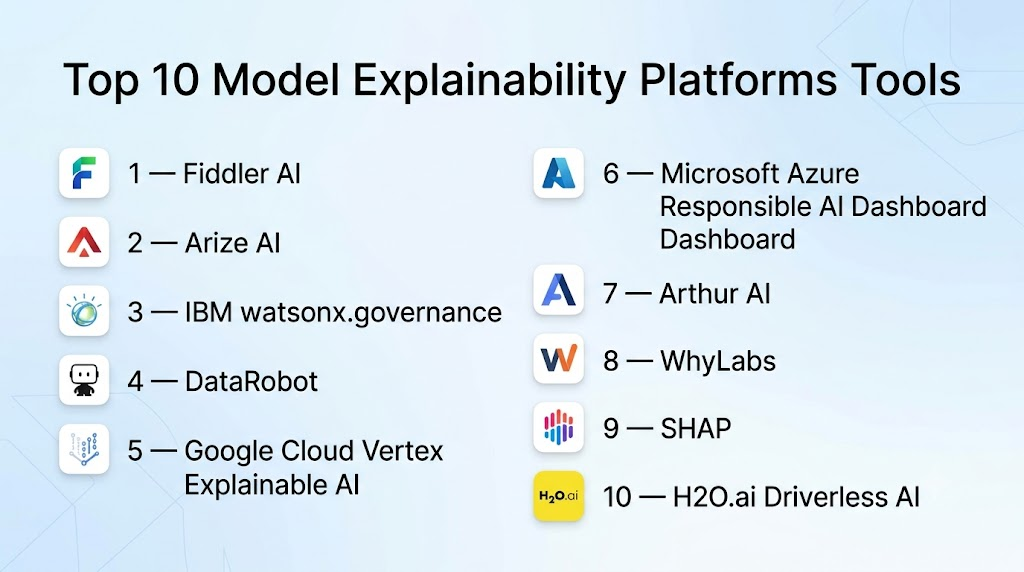
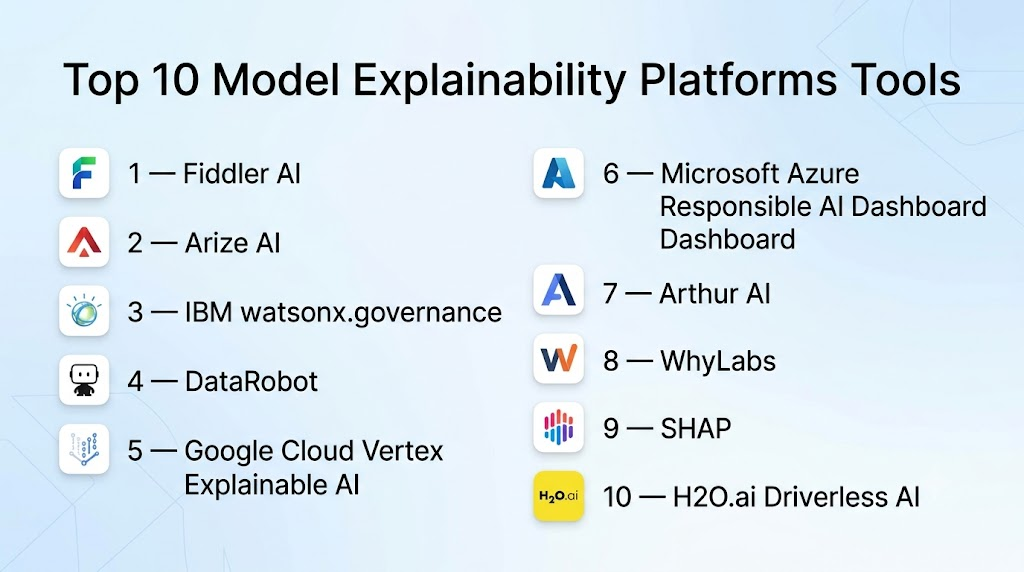
Top 10 Model Explainability Platforms Tools
1 — Fiddler AI
One-line verdict: Best for enterprises requiring combined explainability, observability, governance, and control across predictive and generative AI.
Short description:
Fiddler AI is an enterprise platform for monitoring, explaining, evaluating, and governing machine learning models, generative AI applications, and agentic systems. It is commonly considered by organizations that need production visibility and risk controls across complex AI environments.
Standout Capabilities
- Local and global model explanations
- Feature attribution and root-cause analysis
- Monitoring for model, data, and prediction drift
- Support for predictive and generative AI use cases
- Agent and application observability
- Bias and performance analysis
- Configurable alerts and operational dashboards
- Governance-oriented monitoring and documentation
AI-Specific Depth
- Model support: Proprietary models, custom models, externally hosted models, and multiple AI application types
- RAG / knowledge integration: Supports monitoring of generative AI and retrieval-based workflows; connector coverage varies
- Evaluation: Model evaluation, generative AI quality assessment, experiments, and configurable metrics
- Guardrails: Policy and safety controls are available for supported generative AI and agent workflows
- Observability: Traces, model behavior, drift, performance, latency, application metrics, and root-cause analysis
Pros
- Combines explainability with production monitoring and governance
- Suitable for high-impact and regulated AI deployments
- Covers both traditional machine learning and newer generative AI systems
Cons
- May be more platform than small teams need
- Enterprise implementation can require substantial configuration
- Pricing is not fully standardized publicly
Security & Compliance
Enterprise access controls, security capabilities, and deployment protections are available. Support for SSO, role-based permissions, auditability, encryption, retention configuration, and private deployment varies by plan and implementation.
Certifications: Not publicly stated for every product edition and deployment model.
Deployment & Platforms
- Web-based platform
- Cloud deployment
- Private or enterprise deployment options may be available
- Self-hosted and hybrid availability: Varies by agreement
- Windows, macOS, and Linux access through supported browsers and APIs
Integrations & Ecosystem
Fiddler is designed to connect with production model endpoints, data pipelines, model-development environments, and enterprise AI infrastructure.
- Python integrations
- APIs and SDKs
- Cloud model platforms
- MLOps systems
- Data platforms
- Custom model endpoints
- Generative AI applications
Pricing Model
Typically enterprise-oriented and tiered according to deployment, usage, models, data volume, and support requirements. Exact pricing is not publicly stated.
Best-Fit Scenarios
- A bank needs prediction explanations and ongoing fairness monitoring
- An enterprise is deploying AI agents across multiple departments
- A risk team needs centralized visibility into production AI behavior
2 — Arize AI
One-line verdict: Best for AI engineering teams that need deep observability, evaluation, tracing, and explainability across production systems.
Short description:
Arize AI provides machine learning and generative AI observability capabilities for diagnosing model behavior, evaluating applications, tracing workflows, and identifying performance problems. Its ecosystem also includes Phoenix, an open-source observability and evaluation platform.
Standout Capabilities
- Machine learning observability
- Model explainability and feature-level analysis
- Drift and performance monitoring
- Generative AI tracing
- Experiments and evaluation workflows
- Embedding and retrieval diagnostics
- Open-source Phoenix ecosystem
- Root-cause and cohort analysis
AI-Specific Depth
- Model support: Proprietary, open-source, custom, hosted, and bring-your-own models
- RAG / knowledge integration: Retrieval tracing, embedding analysis, document relevance, and RAG diagnostics
- Evaluation: Offline and online evaluations, experiments, evaluators, human review workflows, and regression testing
- Guardrails: Evaluation and monitoring can identify unsafe or low-quality behavior; dedicated enforcement varies
- Observability: Traces, spans, latency, tokens, errors, evaluations, model metrics, and application behavior
Pros
- Strong support for both machine learning and generative AI observability
- Useful open-source entry point through Phoenix
- Detailed troubleshooting for RAG systems and AI agents
Cons
- Full platform adoption may require instrumentation work
- Extensive capabilities can create a learning curve
- Governance workflow depth may differ from governance-first platforms
Security & Compliance
Enterprise security capabilities may include SSO, role-based controls, data management, encryption, and private connectivity. Exact availability depends on the selected edition.
Certifications: Not publicly stated here.
Deployment & Platforms
- Managed cloud platform
- Phoenix can be self-hosted
- Hybrid patterns are possible
- Browser-based interface
- SDK support for common development environments
Integrations & Ecosystem
Arize integrates with AI frameworks, model providers, tracing standards, cloud environments, and data science tools.
- OpenTelemetry-compatible workflows
- Python SDKs
- LLM frameworks
- Model APIs
- Vector databases
- Cloud AI services
- Notebook environments
Pricing Model
Open-source Phoenix is available without platform licensing fees. Commercial Arize offerings generally use tiered or enterprise pricing based on scale, features, data, and support.
Best-Fit Scenarios
- An AI team needs to debug poor RAG responses
- Developers want open-source tracing before moving to a managed platform
- An enterprise needs production monitoring across predictive and generative models
3 — IBM watsonx.governance
One-line verdict: Best for large organizations prioritizing explainability, governance, model risk management, and auditable AI oversight.
Short description:
IBM watsonx.governance provides capabilities for governing, evaluating, monitoring, documenting, and explaining machine learning and generative AI systems. It is designed for organizations that need structured risk management across internal and externally developed models.
Standout Capabilities
- Model and AI use-case governance
- Explainability for supported prediction models
- Bias and fairness monitoring
- Model-risk documentation
- Workflow and approval support
- Generative AI quality evaluation
- Model inventory and lifecycle oversight
- Governance of externally hosted models
AI-Specific Depth
- Model support: IBM models, custom models, external models, and supported third-party foundation models
- RAG / knowledge integration: Available within the broader watsonx ecosystem; exact support depends on architecture
- Evaluation: Predictive-model metrics and generative AI quality evaluations
- Guardrails: Governance policies and risk controls; real-time enforcement varies by configuration
- Observability: Performance, fairness, drift, quality metrics, risk status, and governance evidence
Pros
- Strong alignment with enterprise risk and governance programs
- Supports oversight of models developed outside IBM environments
- Useful for regulated and documentation-heavy organizations
Cons
- Implementation may require governance maturity and dedicated ownership
- Can be complex for smaller organizations
- Broader platform adoption may increase dependency on IBM services
Security & Compliance
Enterprise identity, access, audit, encryption, and governance controls are available within supported IBM deployments. Residency, retention, and private deployment options vary by region and contract.
Certifications: Not publicly stated for every configuration.
Deployment & Platforms
- Cloud deployment
- Software and private deployment options may be available
- Hybrid enterprise configurations
- Web interface
- API and integration access
Integrations & Ecosystem
The platform fits within IBM’s data, AI, governance, and hybrid-cloud ecosystem while supporting external models and selected third-party services.
- IBM watsonx services
- Model registries
- External model endpoints
- Data governance tools
- Cloud environments
- APIs
- Enterprise workflow systems
Pricing Model
Enterprise subscription or consumption-based arrangements may apply. Exact pricing depends on deployment, capacity, services, and contract terms.
Best-Fit Scenarios
- A financial institution needs formal model-risk governance
- A multinational needs one inventory for internal and external AI
- A compliance team needs explainability evidence and approval workflows
4 — DataRobot
One-line verdict: Best for organizations wanting automated model development, prediction explanations, monitoring, and governance in one platform.
Short description:
DataRobot provides an enterprise AI platform that combines automated machine learning, model deployment, monitoring, prediction explanations, governance, and generative AI capabilities. It is aimed at teams seeking a broad platform rather than a standalone explanation library.
Standout Capabilities
- Row-level prediction explanations
- SHAP-based feature attribution
- Automated model comparison
- Model monitoring and drift analysis
- Bias and fairness assessment
- Model registry and governance workflows
- Support for external models
- Automated documentation and deployment management
AI-Specific Depth
- Model support: DataRobot models, custom models, external models, proprietary APIs, and selected open-source models
- RAG / knowledge integration: Supported through generative AI application capabilities; details vary
- Evaluation: Model validation, monitoring, generative AI evaluation, and comparison workflows
- Guardrails: Governance and application-level controls; coverage varies
- Observability: Accuracy, drift, service health, prediction behavior, latency, and deployment metrics
Pros
- Broad end-to-end AI lifecycle coverage
- Accessible explanation tools for technical and business users
- Strong option for organizations using automated machine learning
Cons
- Can be expensive or excessive for teams needing only explainability
- Some advanced features depend on broader platform adoption
- Self-managed deployments require operational resources
Security & Compliance
DataRobot provides enterprise controls such as role-based access, governance permissions, auditability, and deployment controls. Specific security capabilities depend on cloud or self-managed deployment.
Certifications: Not publicly stated for every edition.
Deployment & Platforms
- Managed cloud
- Self-managed deployment
- Hybrid implementation patterns
- Browser interface
- APIs and SDKs
Integrations & Ecosystem
DataRobot supports common data platforms, cloud services, model-development tools, deployment environments, and enterprise applications.
- Data warehouses
- Cloud platforms
- Python and APIs
- Model registries
- Business intelligence tools
- Custom model environments
- CI/CD systems
Pricing Model
Typically enterprise, tiered, or contract-based. Pricing may depend on users, platform modules, compute, deployments, and consumption.
Best-Fit Scenarios
- A company wants AutoML and explainability in one environment
- A team needs governance for DataRobot and externally trained models
- Business analysts need accessible prediction-level explanations
5 — Amazon SageMaker Clarify
One-line verdict: Best for AWS-centered teams needing integrated bias detection, SHAP explanations, and production attribution monitoring.
Short description:
Amazon SageMaker Clarify is a collection of explainability and bias-analysis capabilities within Amazon SageMaker AI. It helps teams examine feature attribution, pre-training bias, post-training bias, individual predictions, and changes in production model behavior.
Standout Capabilities
- SHAP-based feature attribution
- Pre-training bias analysis
- Post-training bias analysis
- Online model explanations
- Feature-attribution drift monitoring
- Integration with SageMaker endpoints
- Reports and visualizations
- Support for multiple machine learning data types
AI-Specific Depth
- Model support: SageMaker-hosted and compatible custom machine learning models
- RAG / knowledge integration: N/A as a primary capability
- Evaluation: Bias metrics, explainability analysis, model-quality workflows, and monitoring
- Guardrails: N/A as a dedicated runtime guardrail system
- Observability: Feature-attribution drift, bias drift, endpoint analysis, and model-monitoring integration
Pros
- Native integration with the AWS machine learning ecosystem
- Supports offline and online explanation workflows
- Useful for teams already operating SageMaker endpoints
Cons
- Best experience is tied closely to AWS and SageMaker
- Configuration can be technical and infrastructure-oriented
- Not a complete agent or generative AI explainability platform by itself
Security & Compliance
Security is inherited from configured AWS services and can include identity policies, encryption, logging, private networking, and regional deployment. The customer remains responsible for correct configuration.
Certifications: Depend on the AWS services and region being used.
Deployment & Platforms
- AWS cloud
- Processing jobs and managed services
- API, SDK, notebook, and console access
- No conventional desktop or mobile application
- Self-hosted deployment: N/A
Integrations & Ecosystem
SageMaker Clarify works most naturally with SageMaker training, processing, deployment, and monitoring services.
- SageMaker endpoints
- SageMaker Model Monitor
- Amazon storage services
- AWS identity and logging services
- Python SDK
- Notebook environments
- Custom model containers
Pricing Model
Usage-based cloud pricing generally applies to the compute, storage, endpoints, monitoring, and processing resources consumed.
Best-Fit Scenarios
- An AWS team needs feature-attribution drift monitoring
- A data science group needs bias reports before deployment
- A regulated workload already runs on SageMaker
6 — Google Cloud Vertex Explainable AI
One-line verdict: Best for Google Cloud users needing managed feature-based and example-based explanations within machine learning workflows.
Short description:
Vertex Explainable AI provides explanation capabilities for supported models running in Google Cloud’s machine learning ecosystem. It helps teams understand which features influenced predictions and, for supported scenarios, identify examples related to model behavior.
Standout Capabilities
- Feature-attribution explanations
- Example-based explanations
- Integration with managed prediction workflows
- Support for selected tabular, image, and custom-model scenarios
- Visualization of explanation results
- Batch and online prediction integration
- Model debugging support
- Google Cloud data and machine learning integration
AI-Specific Depth
- Model support: Supported Vertex AI and custom models
- RAG / knowledge integration: N/A as a core explainability feature
- Evaluation: Model evaluation is available through the wider platform; explanation-specific evaluation is limited
- Guardrails: N/A as a dedicated explainability feature
- Observability: Attribution analysis and wider platform monitoring; agent tracing depends on separate services
Pros
- Convenient for organizations standardized on Google Cloud
- Supports feature and example-oriented explanation approaches
- Integrates with managed prediction infrastructure
Cons
- Supported explanation methods vary by model and architecture
- Explanations do not establish fairness or causality
- Cross-cloud use may require additional engineering
Security & Compliance
Security controls are provided through Google Cloud identity, encryption, logging, networking, and regional service configuration. Availability varies by service and region.
Certifications: Depend on the Google Cloud services and deployment used.
Deployment & Platforms
- Google Cloud
- Managed service
- Browser console
- APIs, SDKs, and notebooks
- Self-hosted deployment: N/A
Integrations & Ecosystem
Vertex Explainable AI is designed to operate with Google Cloud model training, deployment, data, and monitoring services.
- Vertex AI
- BigQuery
- Cloud storage
- Model endpoints
- Python SDK
- Notebook environments
- Google Cloud logging and monitoring
Pricing Model
Usage-based pricing generally depends on prediction, explanation, compute, storage, and related cloud services.
Best-Fit Scenarios
- A Google Cloud team needs managed feature attribution
- A computer-vision team needs explanation visualizations
- A data team uses BigQuery and Vertex AI together
7 — Microsoft Azure Responsible AI Dashboard
One-line verdict: Best for Azure teams combining interpretability, fairness, counterfactual analysis, causal analysis, and error investigation.
Short description:
The Azure Responsible AI Dashboard brings together multiple responsible AI capabilities in a unified interface. It supports model interpretability, fairness analysis, error analysis, counterfactual examples, causal analysis, and shareable scorecards for supported machine learning models.
Standout Capabilities
- Local and global model explanations
- Error trees and error heat maps
- Counterfactual what-if analysis
- Fairness assessment
- Causal analysis
- Data exploration
- Responsible AI scorecards
- Azure Machine Learning integration
AI-Specific Depth
- Model support: Supported Azure Machine Learning models, with technical limitations depending on model format
- RAG / knowledge integration: N/A
- Evaluation: Error analysis, fairness assessment, performance analysis, and model debugging
- Guardrails: N/A as a runtime guardrail platform
- Observability: Primarily development and assessment insights; production monitoring requires additional Azure services
Pros
- Combines several responsible AI methods in one interface
- Useful for investigating model failure across cohorts
- Counterfactual and causal tools go beyond basic feature importance
Cons
- Model and dataset limitations must be reviewed carefully
- Primarily focused on supported Azure Machine Learning workflows
- Not a standalone generative AI or agent observability platform
Security & Compliance
Azure identity, role controls, networking, encryption, logging, and workspace-level policies can support secure implementation. Exact controls depend on the Azure architecture.
Certifications: Depend on the Azure services and region used.
Deployment & Platforms
- Microsoft Azure
- Azure Machine Learning workspace
- Browser interface
- Python SDK and command-line tools
- Self-hosting: Limited to open-source components rather than the full managed dashboard
Integrations & Ecosystem
The dashboard works with Azure Machine Learning and several open-source responsible AI technologies.
- Azure Machine Learning
- MLflow-compatible registered models
- InterpretML
- Fairlearn
- DiCE
- EconML
- Python development workflows
Pricing Model
The responsible AI components are used within Azure Machine Learning. Costs generally relate to compute, storage, workspace resources, and connected Azure services.
Best-Fit Scenarios
- An Azure team needs cohort-based error analysis
- A model-risk team needs counterfactual explanations
- Data scientists need shareable responsible AI scorecards
8 — Arthur AI
One-line verdict: Best for teams needing centralized monitoring, evaluation, policy controls, and governance across diverse AI systems.
Short description:
Arthur AI is a platform for observing, evaluating, and governing predictive models, language models, and AI applications. It collects inference information, applies metrics and policies, identifies problems, and supports human oversight.
Standout Capabilities
- Monitoring across tabular, text, vision, and language models
- Explainability for supported machine learning systems
- Generative AI evaluation
- Configurable metrics and policies
- Alerting and issue detection
- AI governance workflows
- Human-in-the-loop oversight
- Production performance monitoring
AI-Specific Depth
- Model support: Custom, proprietary, open-source, and externally hosted models
- RAG / knowledge integration: Evaluation of RAG workflows is supported; exact connector coverage varies
- Evaluation: Configurable evaluations, quality metrics, experiments, and human review
- Guardrails: Policy evaluation and controls for supported AI applications
- Observability: Inference data, model performance, traces, alerts, quality metrics, and system behavior
Pros
- Broad coverage across predictive and generative AI
- Combines technical monitoring with governance workflows
- Supports configurable organizational policies and metrics
Cons
- Enterprise setup may require instrumentation and process design
- Public pricing information is limited
- Feature depth may vary across model types
Security & Compliance
Enterprise security and access-management capabilities are available. SSO, permissions, auditability, retention, private deployment, and regional options should be verified during procurement.
Certifications: Not publicly stated here.
Deployment & Platforms
- Managed cloud
- Private or self-hosted options may be available
- Browser interface
- APIs and SDKs
- Hybrid availability varies
Integrations & Ecosystem
Arthur connects with model endpoints, data pipelines, AI development frameworks, and enterprise systems.
- APIs
- Python tools
- Cloud platforms
- Model-serving systems
- LLM applications
- Custom metrics
- Enterprise data infrastructure
Pricing Model
Generally enterprise and contract-based. Pricing details are not publicly stated.
Best-Fit Scenarios
- A company needs oversight across many model types
- An AI product team wants configurable policy evaluation
- A governance team needs human review and production alerts
9 — WhyLabs
One-line verdict: Best for privacy-conscious teams that need efficient data, model, and AI application monitoring at production scale.
Short description:
WhyLabs provides an AI control and observability platform for monitoring data quality, model performance, drift, language-model behavior, and security signals. It uses statistical profiling techniques that can reduce the need to move raw data into the monitoring platform.
Standout Capabilities
- Data and model monitoring
- Statistical data profiling
- Explainability-based monitoring
- Model and dataset health alerts
- Language-model telemetry
- Drift and performance analysis
- Privacy-conscious monitoring architecture
- Open-source whylogs and LangKit ecosystem
AI-Specific Depth
- Model support: Custom models, machine learning models, language models, and externally hosted systems
- RAG / knowledge integration: LLM and RAG telemetry is supported through language-model monitoring components
- Evaluation: Monitoring metrics and configurable assessments; full experiment management varies
- Guardrails: Security and policy monitoring capabilities are available; enforcement depth varies
- Observability: Data profiles, model metrics, language signals, drift, attacks, behavior changes, and alerts
Pros
- Privacy-focused approach can reduce raw-data exposure
- Open-source instrumentation options
- Useful for monitoring large or distributed data pipelines
Cons
- Explainability features may require feature-weight instrumentation
- Less focused on executive governance workflows than governance-first suites
- Advanced implementation may require engineering expertise
Security & Compliance
WhyLabs emphasizes privacy-preserving telemetry and controlled data monitoring. Enterprise identity, access, retention, and deployment options should be confirmed for the selected plan.
Certifications: Not publicly stated here.
Deployment & Platforms
- Managed cloud platform
- Open-source logging and profiling components
- API and SDK access
- Self-hosted instrumentation
- Full platform deployment options: Varies
Integrations & Ecosystem
WhyLabs integrates through profiling libraries, APIs, data pipelines, model services, and language-model telemetry.
- whylogs
- LangKit
- Python
- Data pipelines
- Model endpoints
- Cloud environments
- Custom APIs
Pricing Model
Open-source components are available. Commercial platform pricing is typically tiered or enterprise-based according to monitoring volume, features, and support.
Best-Fit Scenarios
- A team cannot send raw production data to an external monitoring service
- A company needs drift monitoring across many data pipelines
- Developers want open-source telemetry with managed observability
10 — SHAP
One-line verdict: Best for developers needing flexible, open-source feature attribution without purchasing a full enterprise platform.
Short description:
SHAP is an open-source explainability library based on Shapley-value concepts. It helps developers estimate how individual features contribute to model predictions and provides visualization tools for local, global, tabular, text, and image explanations.
Standout Capabilities
- Model-agnostic explanation interface
- Optimized explainers for supported model families
- Local prediction explanations
- Global feature-importance analysis
- Dependence and interaction visualizations
- Support for tabular, text, and image inputs
- Broad Python ecosystem adoption
- No commercial platform license required
AI-Specific Depth
- Model support: Open-source, custom, and proprietary models accessible through supported interfaces
- RAG / knowledge integration: N/A
- Evaluation: N/A as a complete evaluation platform
- Guardrails: N/A
- Observability: N/A without custom engineering and external monitoring tools
Pros
- Open source and highly flexible
- Strong ecosystem and broad community familiarity
- Useful foundation for custom explainability workflows
Cons
- Not a complete monitoring or governance platform
- Some explanation methods can be computationally expensive
- Results require careful interpretation and do not establish causality
Security & Compliance
Security, privacy, access control, and compliance are determined by the environment in which SHAP is deployed.
Certifications: N/A.
Deployment & Platforms
- Python library
- Windows, macOS, and Linux
- Notebook and server environments
- Cloud or self-hosted
- No managed user interface by default
Integrations & Ecosystem
SHAP works with popular Python machine learning frameworks and can be incorporated into custom applications, reports, notebooks, and monitoring pipelines.
- Scikit-learn
- XGBoost
- LightGBM
- Tree-based models
- Deep-learning workflows
- Pandas and NumPy
- Custom prediction functions
Pricing Model
Open source. Infrastructure, engineering, support, and maintenance costs remain the responsibility of the user.
Best-Fit Scenarios
- A developer needs feature attribution in a notebook
- A startup wants explainability without enterprise software
- A research team needs customizable explanation experiments
Comparison Table
| Tool Name | Best For | Deployment | Model Flexibility | Strength | Watch-Out | Public Rating |
|---|---|---|---|---|---|---|
| Fiddler AI | Enterprise AI control | Cloud/Hybrid | BYO/Multi-model | Explainability plus governance | Enterprise complexity | N/A |
| Arize AI | AI engineering and observability | Cloud/Self-hosted/Hybrid | BYO/Multi-model/Open-source | Deep tracing and evaluation | Instrumentation effort | N/A |
| IBM watsonx.governance | Regulated enterprise governance | Cloud/Hybrid | Hosted/BYO/Multi-model | Risk and governance workflows | Complex implementation | N/A |
| DataRobot | End-to-end enterprise AI | Cloud/Self-hosted/Hybrid | Hosted/BYO/Multi-model | AutoML plus explainability | Broad platform commitment | N/A |
| SageMaker Clarify | AWS machine learning teams | Cloud | Hosted/BYO | Native bias and SHAP analysis | AWS dependency | N/A |
| Vertex Explainable AI | Google Cloud ML teams | Cloud | Hosted/BYO | Managed cloud explanations | Model limitations | N/A |
| Azure Responsible AI Dashboard | Azure responsible AI assessment | Cloud | Hosted/BYO | Counterfactual and error analysis | Supported-model limits | N/A |
| Arthur AI | Cross-model enterprise monitoring | Cloud/Hybrid | BYO/Multi-model | Policies and human oversight | Limited public pricing | N/A |
| WhyLabs | Privacy-conscious observability | Cloud/Hybrid | BYO/Multi-model/Open-source | Privacy-preserving telemetry | Engineering setup | N/A |
| SHAP | Developers and researchers | Self-hosted | BYO/Open-source | Flexible feature attribution | No governance platform | N/A |
Scoring & Evaluation
The following scoring is comparative rather than absolute. A score of 9 does not mean a platform is universally better than one scoring 8; it indicates stronger alignment with the criteria used in this guide. Scores reflect category breadth, explainability depth, evaluation capabilities, safety controls, ecosystem maturity, usability, production efficiency, administrative controls, and community or support. Organizations should adjust the weights for their own risk level, architecture, budget, and deployment requirements. Open-source tools are not penalized for lacking enterprise features when those features can reasonably be built, but the operational effort is considered.
| Tool | Core | Reliability/Eval | Guardrails | Integrations | Ease | Perf/Cost | Security/Admin | Support | Weighted Total |
|---|---|---|---|---|---|---|---|---|---|
| Fiddler AI | 9.2 | 9.0 | 8.8 | 8.7 | 8.0 | 8.1 | 9.1 | 8.6 | 8.7 |
| Arize AI | 9.1 | 9.4 | 7.8 | 9.2 | 8.3 | 8.5 | 8.5 | 9.0 | 8.8 |
| IBM watsonx.governance | 9.0 | 8.8 | 8.7 | 8.5 | 7.5 | 7.7 | 9.5 | 8.8 | 8.5 |
| DataRobot | 9.0 | 8.7 | 8.0 | 9.0 | 8.6 | 7.8 | 9.0 | 8.7 | 8.5 |
| SageMaker Clarify | 8.3 | 7.8 | 5.5 | 8.8 | 7.6 | 8.2 | 9.0 | 8.5 | 7.9 |
| Vertex Explainable AI | 8.0 | 7.4 | 5.3 | 8.6 | 8.2 | 8.0 | 8.9 | 8.4 | 7.7 |
| Azure Responsible AI Dashboard | 8.7 | 8.3 | 5.8 | 8.5 | 8.0 | 7.8 | 9.0 | 8.5 | 8.0 |
| Arthur AI | 8.8 | 8.8 | 8.6 | 8.4 | 7.9 | 7.9 | 8.8 | 8.3 | 8.4 |
| WhyLabs | 8.3 | 8.0 | 7.8 | 8.7 | 7.8 | 8.8 | 8.5 | 8.2 | 8.2 |
| SHAP | 8.5 | 6.5 | 2.0 | 8.0 | 7.2 | 8.5 | 4.0 | 8.8 | 6.8 |
Which Model Explainability Platform Is Right for You?
Solo / Freelancer
Independent developers usually do not need a large governance suite. SHAP is the most practical starting point for feature attribution, model debugging, and explainability visualizations.
Arize Phoenix is a stronger choice for developers building RAG applications, language-model workflows, or AI agents because it adds tracing and evaluation. Cloud-native tools are also reasonable when the entire project already runs on one cloud provider.
SMB
Small and medium-sized businesses should prioritize fast implementation, manageable pricing, and coverage of their most important production risks.
WhyLabs can suit teams focused on monitoring and privacy-conscious telemetry. Arize Phoenix provides a strong open-source route for generative AI tracing and evaluation. A managed commercial platform becomes more attractive when the business lacks internal observability expertise.
Mid-Market
Mid-market organizations often need a combination of model monitoring, explainability, alerts, evaluation, and access controls without the administrative burden of a large governance transformation.
Arize AI, Fiddler AI, Arthur AI, and WhyLabs are practical options. The best choice depends on whether the organization prioritizes engineering diagnostics, formal governance, AI security, privacy, or broad model coverage.
Enterprise
Large enterprises should evaluate explainability as part of an AI control framework rather than as an isolated technical feature.
Fiddler AI is suitable for cross-model observability and explainability. IBM watsonx.governance is strong for formal governance and model-risk oversight. DataRobot can fit organizations that want development, deployment, monitoring, and governance in one platform. Arthur AI is relevant when configurable policies and human oversight are central requirements.
Regulated Industries: Finance, Healthcare, and Public Sector
Regulated organizations should prioritize:
- Clear local and global explanations
- Bias and fairness monitoring
- Model inventories
- Approval workflows
- Audit logs
- Reason codes
- Documentation
- Data-retention controls
- Human review
- Incident management
- Independent validation
IBM watsonx.governance, Fiddler AI, DataRobot, and Arthur AI are appropriate candidates for detailed evaluation. Cloud-native services may also fit when the organization already has a mature governance framework around the cloud platform.
Budget vs Premium
For limited budgets, SHAP and Arize Phoenix provide strong open-source foundations. WhyLabs’ open-source components can reduce instrumentation costs, although managed monitoring may still require a commercial plan.
Premium platforms are more appropriate when an organization needs support, governance workflows, administrative controls, enterprise deployment, regulatory evidence, and centralized oversight.
The real cost comparison should include engineering time, infrastructure, validation, support, incident response, and maintenance—not only license fees.
Build vs Buy: When to DIY
Build a custom explainability stack when:
- Your model portfolio is small
- Your team has strong machine learning expertise
- Requirements are highly specialized
- You can maintain validation and monitoring pipelines
- Regulatory reporting is limited
- Open-source techniques cover the use case
Common Mistakes & How to Avoid Them
- Treating feature importance as causality: Attribution shows model influence, not real-world cause. Use causal analysis when causal conclusions are required.
- Explaining only during development: Production data changes. Monitor explanations, drift, and feature influence continuously.
- Ignoring explanation fidelity: An explanation can appear convincing while poorly representing the model. Validate explanations against controlled tests.
- Using one method for every model: SHAP, surrogate models, counterfactuals, example-based explanations, and attention visualizations have different limitations.
- Skipping human review: High-impact decisions should include domain experts who can determine whether explanations are meaningful.
- Collecting sensitive prompts without controls: Apply masking, minimization, retention limits, and access policies before storing AI telemetry.
- Leaving RAG components unobserved: Trace document retrieval, ranking, context construction, citations, and final response behavior.
- Ignoring prompt injection: Test malicious instructions, retrieved-content attacks, unsafe tool calls, and data-exfiltration attempts.
- Running no regression evaluation: Every model, prompt, tool, or retrieval change should be tested against a stable evaluation dataset.
- Over-automating decisions: Keep human review for high-risk, ambiguous, or irreversible outcomes.
- Failing to track cost and latency: Explanation jobs and full trace collection can increase compute, storage, and response time.
- Assuming explanations prove fairness: Fairness must be measured separately across relevant groups and decision outcomes.
- Choosing a tool only for attractive dashboards: Test APIs, data pipelines, alert quality, deployment constraints, and operational workflows.
- Accepting vendor lock-in without abstraction: Keep portable telemetry, evaluation datasets, model metadata, and exportable reports.
FAQs
What is a model explainability platform?
A model explainability platform helps users understand how an AI or machine learning system reached an output. It may provide feature attribution, prediction-level explanations, counterfactuals, error analysis, bias insights, traces, monitoring, and governance evidence.
What is the difference between explainability and interpretability?
Interpretability often describes models whose behavior can be understood directly, such as a small decision tree. Explainability commonly refers to methods used to clarify the behavior of complex or opaque models after they have been trained.
The terms are frequently used interchangeably.
Can explainability platforms work with proprietary models?
Many commercial platforms can monitor externally hosted or proprietary models when the application provides inputs, outputs, metadata, traces, or evaluation results.
The level of explanation may be limited when the provider does not expose internal model information.
Can these platforms explain large language models?
They can help explain application behavior through prompt tracing, response evaluation, retrieval analysis, token metrics, tool-call inspection, and agent traces.
They generally cannot provide a complete explanation of the internal reasoning process of a proprietary foundation model.
Do explainability platforms support bring-your-own models?
Many platforms support custom or externally trained models through APIs, SDKs, prediction logs, model wrappers, or endpoint integrations.
Buyers should verify support for their exact framework, model format, data type, and deployment environment.
Can model explainability be self-hosted?
Yes. SHAP and Arize Phoenix can be self-hosted. Some commercial vendors also offer private, hybrid, or self-managed deployment options.
The exact availability and operating requirements vary by product and contract.
Is SHAP enough for enterprise explainability?
SHAP can provide valuable feature-attribution analysis, but it does not automatically provide governance, access control, production monitoring, incident management, evaluation, retention controls, or compliance reporting.
Enterprises often combine SHAP with broader observability and governance systems.
Do explainability tools protect private data?
They can support privacy controls, but protection depends on architecture and configuration. Teams should review what data is collected, where it is stored, how long it is retained, and who can access it.
Sensitive prompts and outputs should be masked or excluded when possible.
Can explanations detect bias?
Explanations can reveal whether sensitive or suspicious features influence predictions, but they do not prove that a model is fair.
Bias assessment should include group-based metrics, outcome analysis, data review, and domain-specific evaluation.
Are model explanations always accurate?
No. Many explanation methods approximate model behavior. Their reliability can be affected by correlated features, background datasets, model architecture, sampling methods, and configuration choices.
Explanation quality should be tested rather than assumed.
What are guardrails in explainability platforms?
Guardrails are rules or controls that detect, block, flag, or escalate unsafe AI behavior. Examples include sensitive-data detection, prompt-injection screening, output policies, toxicity checks, tool permissions, and human approval requirements.
Not every explainability platform includes runtime guardrails.
How much do model explainability platforms cost?
Costs vary widely. Cloud-native services are usually usage-based, commercial platforms commonly use tiered or enterprise contracts, and open-source libraries have no license fee but require engineering and infrastructure.
Buyers should estimate storage, compute, inference, telemetry, support, and maintenance costs.
Can explainability slow down model predictions?
Yes. Real-time explanation methods can add latency and compute overhead, especially for complex or model-agnostic techniques.
Many organizations use sampling, asynchronous explanations, cached results, or selective investigation to control overhead.
How should teams evaluate explainability quality?
Teams should test fidelity, stability, consistency, usability, computational cost, domain relevance, and sensitivity to configuration.
Explanations should also be reviewed by domain specialists and tested on known edge cases.
Can I switch explainability platforms later?
Yes, but migration is easier when telemetry, evaluation datasets, model metadata, prompts, reports, and traces use portable formats.
Avoid storing critical governance evidence only in vendor-specific dashboards.
What are the alternatives to a commercial explainability platform?
Alternatives include SHAP, LIME, InterpretML, Captum, Alibi Explain, Fairlearn, custom dashboards, cloud-provider tools, and internally built monitoring pipelines.
These options offer flexibility but require more engineering, validation, security, and maintenance.
Conclusion
Model explainability is no longer limited to feature-importance charts. Modern organizations need to understand predictive models, generative AI applications, retrieval pipelines, multimodal systems, and autonomous agent workflows.
The strongest enterprise platforms combine explanations with evaluation, observability, governance, security controls, human oversight, and production monitoring. Developer-focused and open-source options remain valuable for experimentation, custom pipelines, and budget-conscious teams.
