Introduction
Human in the Loop (HITL) review systems are essential infrastructure for modern AI workflows where machines alone are not trusted to make fully autonomous decisions. These systems insert human judgment into AI pipelines to validate outputs, correct errors, improve training data, and ensure compliance in sensitive applications. As AI systems increasingly operate in production environments, HITL platforms act as a safety layer between automation and real-world consequences.
Human in the Loop systems are no longer limited to labeling tasks. They now support AI governance, model evaluation, reinforcement learning feedback loops, content moderation, and real-time decision validation. These platforms combine automation with human oversight to achieve higher accuracy, fairness, and reliability.
Real-world use cases include:
- Reviewing AI-generated customer support responses before sending
- Validating medical or legal AI predictions
- Moderating user-generated content in real time
- Improving LLM outputs through human feedback loops
- Verifying autonomous vehicle or robotics decisions
Key evaluation criteria for buyers:
- Human workflow orchestration and task routing
- Integration with ML and LLM pipelines
- Real-time vs batch review capabilities
- Quality control and reviewer consensus mechanisms
- Scalability of human workforce
- Feedback loop integration into model training
- Auditability and compliance tracking
- Automation level and AI assistance features
- Security, data privacy, and access control
- Cost efficiency and throughput optimization
Best for: AI/ML teams, enterprise AI governance teams, trust & safety teams, and organizations deploying AI in regulated or high-risk environments.
Not ideal for: Simple AI applications where outputs are non-critical or purely experimental prototypes.
What’s Changed in Human in the Loop Systems
- Shift from manual review to AI-assisted human validation workflows
- Integration with LLM evaluation and RAG pipelines
- Real-time decision validation in production systems
- Strong adoption in AI safety and governance frameworks
- Expansion into multimodal review (text, image, video, audio)
- Automated task routing based on confidence scoring
- Continuous feedback loops feeding directly into model retraining
- Advanced consensus mechanisms for reviewer agreement scoring
- Deep integration with MLOps and LLMOps platforms
- Stronger focus on audit logs and regulatory compliance
- Use of synthetic data validation alongside human review
- Hybrid human + AI co-pilot workflows for reviewers
Quick Buyer Checklist
- Does it support real-time and batch human review?
- Can it integrate with your ML or LLM pipeline?
- Does it support multi-step approval workflows?
- Is reviewer quality scoring and consensus available?
- Can it handle multimodal data (text, image, audio, video)?
- Does it provide audit logs and compliance tracking?
- Is task routing automated based on confidence scores?
- Can humans provide feedback that retrains models?
- Does it support role-based access control (RBAC)?
- Is workforce scalability available (internal or external)?
- Does it include fraud or bias detection in reviews?
- Does it support API-first integration into pipelines?
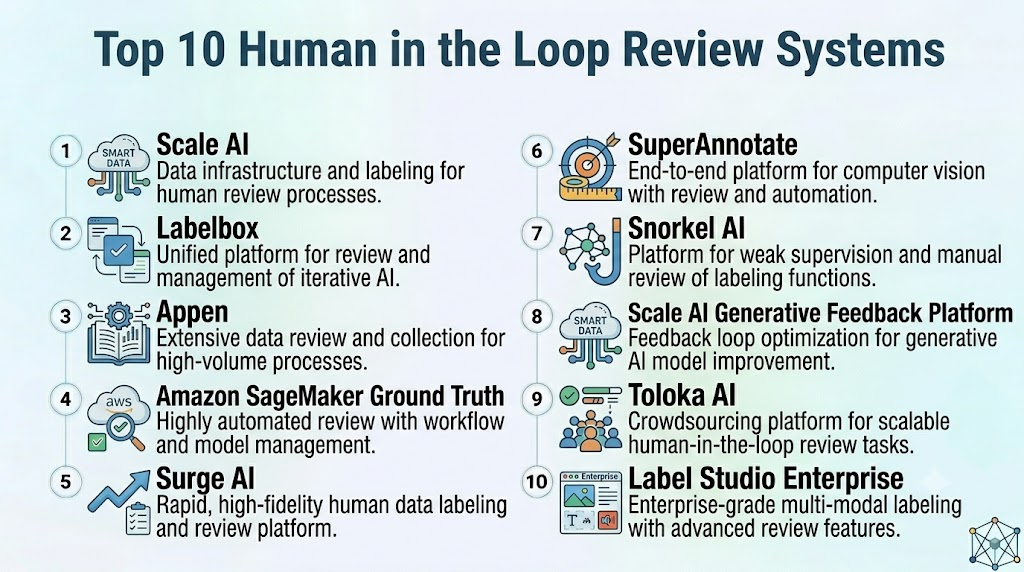
Top 10 Human in the Loop Review Systems
1 — Scale AI
One-line verdict: Best enterprise-grade HITL platform for high-volume AI validation and training data feedback loops.
Short description:
Scale AI provides large-scale human-in-the-loop infrastructure for labeling, validation, and AI output review across industries such as autonomous systems, LLM training, and enterprise AI.
Standout Capabilities
- Large global human workforce for review tasks
- Real-time and batch validation workflows
- LLM feedback collection pipelines
- High-quality dataset correction systems
- Automated task routing based on model confidence
- Multi-stage QA and consensus scoring
- API-driven integration into AI pipelines
AI-Specific Depth
- Model support: Multi-model and LLM pipelines
- Human workflows: Managed global workforce + enterprise teams
- Feedback loops: Direct model training integration
- Quality control: Multi-layer validation + consensus scoring
- Observability: Dataset and workflow performance tracking
Pros
- Extremely scalable human review system
- High-quality validation pipelines
- Strong enterprise adoption
Cons
- Expensive for small teams
- Less customizable compared to open platforms
Security & Compliance
- Enterprise-grade data protection
- Role-based access control available
- Certifications: Not publicly stated
Deployment & Platforms
- Cloud-based managed service
- API-first architecture
Integrations & Ecosystem
- ML training pipelines
- LLM fine-tuning workflows
- Cloud storage systems
- Enterprise data systems
Pricing Model
Usage-based managed service pricing
Best-Fit Scenarios
- Autonomous vehicle validation
- LLM reinforcement learning feedback
- Large-scale enterprise AI review systems
2 — Labelbox
One-line verdict: Best platform for structured human review workflows in enterprise AI pipelines.
Short description:
Labelbox enables human-in-the-loop workflows for labeling, reviewing, and improving AI datasets with strong collaboration and automation tools.
Standout Capabilities
- Workflow automation for review pipelines
- Human feedback integration into training data
- Active learning-based task assignment
- Dataset versioning and management
- Multi-stage review and approval flows
- Collaboration tools for distributed teams
- API-first integration with ML systems
AI-Specific Depth
- Model support: BYO model + multi-model pipelines
- Human workflows: Structured labeling + review pipelines
- Feedback loops: Strong dataset retraining integration
- Quality control: Consensus scoring + reviewer validation
- Observability: Dataset and workflow metrics
Pros
- Strong enterprise workflow control
- Flexible human review pipelines
- Good ML integration
Cons
- Learning curve for complex workflows
- Pricing can scale quickly
Security & Compliance
- RBAC and enterprise access controls
- Audit logs available in enterprise tier
- Certifications: Not publicly stated
Deployment & Platforms
- Cloud-based SaaS platform
Integrations & Ecosystem
- ML pipelines and training systems
- Cloud storage integrations
- API-based workflow automation
- Active learning frameworks
Pricing Model
Tiered enterprise subscription
Best-Fit Scenarios
- Enterprise AI review pipelines
- Computer vision validation workflows
- Structured ML feedback systems
3 — Appen
One-line verdict: Best managed human-in-the-loop workforce platform for global-scale annotation and review.
Short description:
Appen provides large-scale human review services with global contributors for AI training, validation, and moderation workflows.
Standout Capabilities
- Global distributed human workforce
- Multilingual review capabilities
- Content moderation workflows
- Large-scale data validation projects
- Survey and dataset enrichment tools
- Human quality control pipelines
- Scalable managed operations
AI-Specific Depth
- Model support: Service-based LLM and ML pipelines
- Human workflows: Fully managed HITL operations
- Feedback loops: Limited automation but structured feedback
- Quality control: Multi-layer QA validation
- Observability: Project-level reporting
Pros
- Massive global workforce availability
- Strong multilingual capabilities
- Highly scalable managed service
Cons
- Less automation than modern platforms
- Slower iteration cycles
Security & Compliance
- Enterprise security controls
- Data privacy management available
- Certifications: Not publicly stated
Deployment & Platforms
- Managed service platform
Integrations & Ecosystem
- Enterprise ML systems
- Data pipelines and storage
- API-based project management
Pricing Model
Project-based managed service pricing
Best-Fit Scenarios
- Global AI moderation
- Multilingual dataset validation
- Large enterprise labeling projects
4 — Amazon SageMaker Ground Truth
One-line verdict: Best AWS-native HITL system for automated and human-assisted labeling pipelines.
Short description:
SageMaker Ground Truth enables human-in-the-loop labeling and validation within AWS ML pipelines, combining automation with workforce options.
Standout Capabilities
- Human + AI-assisted labeling workflows
- Active learning-based task generation
- Built-in workforce management options
- Tight integration with AWS ML ecosystem
- Scalable data review pipelines
- Automated pre-labeling capabilities
- Dataset pipeline orchestration
AI-Specific Depth
- Model support: AWS-native ML models
- Human workflows: Hybrid human + machine review
- Feedback loops: Strong ML pipeline integration
- Quality control: Multi-stage validation
- Observability: AWS monitoring integration
Pros
- Seamless AWS integration
- Strong automation support
- Highly scalable
Cons
- AWS lock-in
- Complexity for non-AWS users
Security & Compliance
- AWS enterprise security standards
- IAM-based access control
Deployment & Platforms
- AWS cloud-native platform
Integrations & Ecosystem
- SageMaker ML pipelines
- AWS storage (S3)
- CloudWatch monitoring
- AWS AI services
Pricing Model
Pay-as-you-go AWS pricing
Best-Fit Scenarios
- AWS-based AI pipelines
- Enterprise ML workflows
- Automated labeling with human review
5 — Surge AI
One-line verdict: Best for high-quality LLM human feedback and model evaluation workflows.
Short description:
Surge AI specializes in human feedback generation for LLM training, evaluation, and reinforcement learning systems.
Standout Capabilities
- High-quality human LLM feedback collection
- RLHF dataset creation pipelines
- Expert annotator workforce
- Complex reasoning evaluation tasks
- Fine-grained response scoring
- Multilingual evaluation support
- Structured AI feedback loops
AI-Specific Depth
- Model support: LLM-centric multi-model workflows
- Human workflows: Expert human evaluators
- Feedback loops: Strong RLHF integration
- Quality control: Rigorous reviewer calibration
- Observability: Dataset-level scoring analytics
Pros
- Extremely high-quality LLM feedback
- Strong RLHF specialization
- Expert-level human reviewers
Cons
- Narrow focus on LLM use cases
- Premium pricing model
Security & Compliance
- Enterprise-grade data handling
- Access controls available
- Certifications: Not publicly stated
Deployment & Platforms
- Cloud-based managed service
Integrations & Ecosystem
- LLM training pipelines
- Reinforcement learning frameworks
- API-based workflows
Pricing Model
Premium managed service pricing
Best-Fit Scenarios
- LLM fine-tuning (RLHF)
- Model evaluation workflows
- Advanced AI safety validation
6 — SuperAnnotate
One-line verdict: Best collaborative HITL platform for computer vision and multimodal AI workflows.
Short description:
SuperAnnotate provides annotation and human review tools with strong collaboration and automation features for AI teams.
Standout Capabilities
- Human review pipelines for CV data
- AI-assisted labeling workflows
- Multi-stage review processes
- Dataset versioning tools
- Collaboration dashboards
- Active learning integration
- Quality assurance workflows
AI-Specific Depth
- Model support: BYO model integration
- Human workflows: Structured CV + review pipelines
- Feedback loops: Dataset improvement loops
- Quality control: Reviewer-based validation
- Observability: Dataset analytics
Pros
- Strong collaboration tools
- Good automation support
- Clean UI experience
Cons
- Less enterprise governance depth
- Limited LLM-specific tooling
Security & Compliance
Not publicly stated
Deployment & Platforms
- Cloud-based platform
Integrations & Ecosystem
- ML pipelines
- Cloud storage systems
- Annotation APIs
Pricing Model
Tiered SaaS pricing
Best-Fit Scenarios
- Computer vision HITL workflows
- Mid-size AI teams
- Multimodal dataset validation
7 — Snorkel AI
One-line verdict: Best for programmatic data labeling and weak supervision with human validation.
Short description:
Snorkel AI focuses on programmatic labeling combined with human-in-the-loop validation for building high-quality datasets efficiently.
Standout Capabilities
- Weak supervision labeling frameworks
- Programmatic labeling rules
- Human validation workflows
- Dataset generation pipelines
- Active learning integration
- Data-centric AI workflows
- Model training feedback loops
AI-Specific Depth
- Model support: Multi-model pipelines
- Human workflows: Validation-focused HITL
- Feedback loops: Strong data programming loop
- Quality control: Rule-based + human validation
- Observability: Dataset analytics
Pros
- Reduces manual labeling cost
- Strong data-centric AI approach
- Efficient dataset creation
Cons
- Requires ML expertise
- Not fully plug-and-play
Security & Compliance
Not publicly stated
Deployment & Platforms
- Cloud + enterprise deployments
Integrations & Ecosystem
- ML frameworks
- Data pipelines
- Active learning systems
Pricing Model
Enterprise licensing
Best-Fit Scenarios
- Data-centric AI teams
- Weak supervision workflows
- Research-heavy AI environments
8 — Scale AI Generative Feedback Platform
One-line verdict: Best enterprise RLHF and LLM human feedback system for production AI models.
Short description:
This platform extends Scale AI’s HITL capabilities specifically for LLM evaluation, safety, and reinforcement learning feedback.
Standout Capabilities
- RLHF data generation pipelines
- Human preference scoring systems
- Model output ranking workflows
- Safety and bias evaluation
- Large-scale expert workforce
- Real-time feedback integration
- Structured evaluation metrics
AI-Specific Depth
- Model support: LLM-focused multi-model systems
- Human workflows: Expert evaluators for LLM outputs
- Feedback loops: Direct RLHF training integration
- Quality control: Calibration and consensus scoring
- Observability: Model performance tracking
Pros
- Strong RLHF specialization
- High-quality human feedback
- Enterprise scalability
Cons
- High cost structure
- Limited general annotation flexibility
Security & Compliance
Enterprise-grade security controls
Deployment & Platforms
Cloud-managed service
Integrations & Ecosystem
- LLM training pipelines
- Reinforcement learning frameworks
- API-based integration
Pricing Model
Enterprise usage-based pricing
Best-Fit Scenarios
- LLM alignment workflows
- Safety and bias evaluation
- Production-grade RLHF systems
9 — Toloka AI
One-line verdict: Best flexible crowdsourced HITL platform for scalable annotation and validation.
Short description:
Toloka provides human-in-the-loop task execution with a global workforce and flexible AI-assisted workflows.
Standout Capabilities
- Crowdsourced HITL workforce
- Flexible task design system
- AI-assisted labeling
- Scalable validation workflows
- Quality scoring systems
- Multilingual support
- API-driven task management
AI-Specific Depth
- Model support: Multi-model integration
- Human workflows: Crowd-based review systems
- Feedback loops: Moderate ML integration
- Quality control: Worker scoring system
- Observability: Task analytics
Pros
- Highly scalable workforce
- Flexible task design
- Cost-effective for large datasets
Cons
- Variable annotation quality
- Requires strong QA controls
Security & Compliance
Not publicly stated
Deployment & Platforms
- Cloud-based platform
Integrations & Ecosystem
- ML pipelines
- API integrations
- Data platforms
Pricing Model
Pay-per-task pricing model
Best-Fit Scenarios
- Large-scale labeling projects
- Cost-sensitive AI workflows
- Multilingual annotation tasks
10 — Label Studio Enterprise
One-line verdict: Best customizable open HITL system for enterprise-grade annotation workflows.
Short description:
Label Studio Enterprise extends the open-source platform with governance, collaboration, and scalable human review features.
Standout Capabilities
- Custom human review workflows
- Multi-data type support
- Enterprise-grade collaboration tools
- AI-assisted labeling integration
- Workflow orchestration
- Dataset versioning
- API-driven automation
AI-Specific Depth
- Model support: BYO model integration
- Human workflows: Fully customizable HITL pipelines
- Feedback loops: Strong dataset feedback systems
- Quality control: Configurable review layers
- Observability: Dataset tracking tools
Pros
- Highly flexible architecture
- Strong customization capabilities
- Good balance of open-source + enterprise
Cons
- Requires setup and engineering effort
- UI less polished than SaaS-first tools
Security & Compliance
Enterprise RBAC and access controls
Deployment & Platforms
- Self-hosted or cloud enterprise deployment
Integrations & Ecosystem
- ML frameworks
- Data storage systems
- Annotation APIs
- MLOps pipelines
Pricing Model
Enterprise licensing
Best-Fit Scenarios
- Custom AI workflows
- Enterprise ML pipelines
- Teams needing flexible HITL systems
Comparison Table (Top 10)
| Tool Name | Best For | Deployment | Model Flexibility | Strength | Watch-Out | Public Rating |
|---|---|---|---|---|---|---|
| Scale AI | Enterprise RLHF | Cloud/service | Multi-model | High-quality feedback | Cost | N/A |
| Labelbox | Enterprise workflows | Cloud | BYO + multi-model | Structured HITL | Complexity | N/A |
| Appen | Global workforce | Managed service | Service-based | Scale of humans | Slower cycles | N/A |
| SageMaker GT | AWS pipelines | AWS cloud | AWS models | Automation | Lock-in | N/A |
| Surge AI | LLM feedback | Cloud | LLM-focused | RLHF quality | Narrow scope | N/A |
| SuperAnnotate | CV workflows | Cloud | BYO model | Collaboration | Limited LLM focus | N/A |
| Snorkel AI | Data programming | Cloud/enterprise | Multi-model | Weak supervision | Complexity | N/A |
| Scale RLHF | LLM alignment | Cloud | Multi-model | RLHF scale | High cost | N/A |
| Toloka AI | Crowdsourcing | Cloud | Multi-model | Workforce scale | Quality variance | N/A |
| Label Studio | Custom HITL | Self-host/cloud | BYO model | Flexibility | Setup effort | N/A |
Scoring & Evaluation (Weighted Rubric)
| Tool | Core | Reliability | Human Quality | Integrations | Ease | Performance | Security | Support | Weighted Total |
|---|---|---|---|---|---|---|---|---|---|
| Scale AI | 10 | 10 | 10 | 9 | 7 | 9 | 9 | 9 | 9.3 |
| Labelbox | 9 | 9 | 9 | 9 | 8 | 8 | 8 | 8 | 8.6 |
| Appen | 8 | 9 | 9 | 7 | 7 | 8 | 8 | 8 | 8.0 |
| SageMaker GT | 9 | 9 | 8 | 9 | 7 | 9 | 9 | 8 | 8.6 |
| Surge AI | 9 | 10 | 10 | 8 | 7 | 8 | 8 | 8 | 8.7 |
| SuperAnnotate | 8 | 8 | 8 | 8 | 8 | 8 | 7 | 7 | 7.9 |
| Snorkel AI | 9 | 9 | 8 | 8 | 7 | 8 | 8 | 8 | 8.2 |
| Scale RLHF | 10 | 10 | 10 | 9 | 7 | 9 | 9 | 9 | 9.4 |
| Toloka AI | 8 | 8 | 7 | 8 | 8 | 8 | 7 | 7 | 7.6 |
| Label Studio | 8 | 8 | 8 | 8 | 8 | 8 | 7 | 7 | 7.8 |
Which Human in the Loop System Is Right for You?
Solo / Freelancer
Label Studio and SuperAnnotate provide flexible and lightweight HITL capabilities without enterprise overhead.
SMB
SuperAnnotate, Labelbox, and Toloka AI offer scalable workflows without extreme operational complexity.
Mid-Market
Labelbox, Snorkel AI, and SageMaker Ground Truth provide balanced automation and governance.
Enterprise
Scale AI, Surge AI, and Labelbox deliver high-quality, scalable human feedback systems.
Regulated industries
SageMaker Ground Truth and Labelbox provide stronger governance and auditability.
Budget vs premium
- Budget: Label Studio, Toloka AI
- Mid-range: SuperAnnotate, Snorkel AI
- Premium: Scale AI, Surge AI
Build vs buy
- Build: Label Studio
- Buy: Scale AI, Labelbox, SageMaker Ground Truth, Surge AI
Common Mistakes & How to Avoid Them
- No clear review guidelines
- Poor task routing logic
- Ignoring reviewer calibration
- Over-reliance on automation
- No feedback loop into model training
- Lack of audit logging
- Underestimating workforce scaling challenges
- Ignoring quality drift over time
- No integration with ML pipelines
- Using HITL only for labeling, not validation
- Not tracking cost per review
- Weak governance policies
- Overcomplicating workflows early
- No performance benchmarking of reviewers
FAQs
1. What is a Human in the Loop system?
It is a system where humans are involved in validating, correcting, or improving AI outputs within an automated workflow.
2. Why is HITL important in AI?
It improves accuracy, reduces hallucinations, and ensures compliance in critical AI applications.
3. Do HITL systems slow down AI?
They can add latency, but modern systems optimize workflows with automation and confidence scoring.
4. Can HITL systems be fully automated?
No. They are designed to combine automation with human judgment for better reliability.
5. What industries use HITL systems?
Healthcare, finance, autonomous vehicles, legal tech, and enterprise AI systems widely use HITL.
6. What is RLHF in HITL systems?
Reinforcement Learning from Human Feedback, where human evaluations train AI models.
7. Can HITL systems handle real-time workflows?
Yes, many modern systems support real-time validation pipelines.
8. Are HITL systems expensive?
Enterprise platforms can be costly due to human workforce and infrastructure requirements.
9. Can I build my own HITL system?
Yes, using tools like Label Studio or custom workflow orchestration systems.
10. What is the biggest challenge in HITL systems?
Maintaining consistent human quality and scaling workforce operations efficiently.
11. Do HITL systems support LLM training?
Yes, especially for RLHF and model alignment workflows.
12. What is the future of HITL systems?
They are evolving into AI-assisted, semi-autonomous review systems with minimal human intervention.
Conclusion
Human in the Loop systems are critical for ensuring AI reliability, safety, and performance in real-world environments. As AI systems become more autonomous, human oversight remains essential for validation, governance, and continuous improvement.
