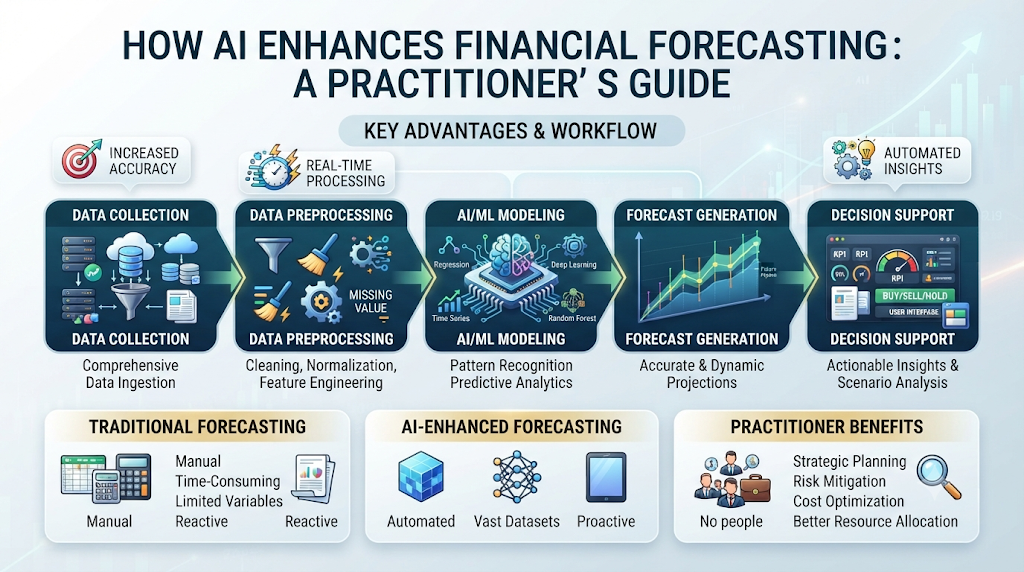
Traditional financial forecasting has long relied on historical spreadsheets, linear regression models, and manual adjustments based on macroeconomic indicators. While these methods provide a baseline, they frequently break down during periods of high volatility, sudden market shifts, or supply chain disruptions. Financial modeling often suffers from lag, siloed data sources, and the human cognitive bias of extrapolating recent trends indefinitely.
Artificial intelligence shifts forecasting from a reactive, backward-looking exercise to a proactive, continuous capability. By processing massive volumes of structured and unstructured data in real time, machine learning models capture non-linear relationships, automate variance analysis, and generate probabilistic scenarios rather than single-point estimates. This article explores how modern financial teams integrate AI into forecasting pipelines, the architectural trade-offs involved, and common failure modes to avoid.
The Limitations of Traditional Financial Forecasting
Most legacy financial models depend heavily on historical financial statements, ERP data, and static budgeting cycles. Finance teams typically build annual budgets and quarterly forecasts using fixed percentage increases over prior years.
This approach creates several operational bottlenecks:
- High Latency: Gathering data across multiple business units often takes weeks, making the forecast outdated before it is published.
- Inability to Handle Non-Linearity: Simple linear regressions fail when market conditions change abruptly, such as sudden shifts in consumer demand or rapid interest rate hikes.
- Manual Error Risk: Heavy reliance on complex spreadsheet macros introduces formula errors and version control issues.
- Limited Variable Integration: Traditional models struggle to ingest and weigh unstructured external variables, such as geopolitical news sentiment, local weather patterns, or real-time competitor pricing data.
How AI Changes the Forecasting Paradigm
Artificial intelligence addresses these limitations by automating data ingestion, uncovering hidden correlations, and shifting organizations from deterministic budgeting to probabilistic forecasting.
1. Multi-Variable and Unstructured Data Ingestion
AI models can process thousands of internal and external variables simultaneously. While a human analyst might track quarterly inflation and historical sales, a machine learning model can ingest daily shipping logs, credit card transaction data, macroeconomic indicators, and qualitative market sentiment from industry reports. This broad visibility allows models to detect leading indicators weeks or months before they appear in financial statements.
2. Algorithmic Flexibility (Beyond Linear Regression)
Financial data is rarely linear. Advanced machine learning architectures—such as gradient boosting machines (e.g., XGBoost) and deep learning models (e.g., LSTMs and Temporal Convolutional Networks)—are designed to recognize complex, time-dependent patterns and seasonality without requiring manual specification of every trend line.
3. Probabilistic Scenario Modeling
Instead of asking “What will revenue be next quarter?”, AI-driven forecasting asks “What is the probability distribution of revenue across various macroeconomic scenarios?” By running thousands of Monte Carlo simulations powered by machine learning algorithms, finance teams can quantify risk exposure and establish dynamic thresholds for capital allocation.
Core Components of an AI-Driven Forecasting Architecture
Implementing AI into financial forecasting requires a systematic data and modeling pipeline. Organizations typically structure their forecasting framework around four main layers.
[ Data Ingestion Layer ]
       │ (ERP, CRM, External Market APIs)
       ▼
[ Feature Engineering ]
       │ (Lag variables, rolling averages, sentiment scores)
       ▼
[ Modeling Engine ]
       │ (Time-series algorithms, Gradient Boosting, LSTMs)
       ▼
[ Validation & Action ]
       │ (Backtesting, human review, dashboard visualization)
1. Data Ingestion
The pipeline must securely connect to primary financial systems, including Enterprise Resource Planning (ERP) databases, Customer Relationship Management (CRM) tools, and external market data feeds. Data hygiene is critical; missing ledger entries or inconsistent chart-of-accounts mappings will degrade model accuracy regardless of algorithm sophistication.
2. Feature Engineering
Raw data must be transformed into meaningful predictors. Financial analysts collaborate with data engineers to build features such as:
- Rolling 30-day and 90-day cash burn rates.
- Customer acquisition cost (CAC) to lifetime value (LTV) ratios over moving windows.
- Macroeconomic variance indices mapped against internal sales cycles.
3. Model Selection and Training
Different financial metrics require different modeling approaches:
- Revenue and Cash Flow Forecasting: Time-series algorithms (like ARIMA or Prophet) combined with gradient boosting often perform best for tracking seasonality and trend shifts.
- Credit Risk and Churn Prediction: Classification algorithms (like Random Forests or Logistic Regression) estimate the probability of client default or subscription cancellation.
- Anomaly Detection: Unsupervised learning models identify unusual expense spikes or fraudulent transactions in general ledger data.
4. Validation and Backtesting
Before deploying a model to influence capital allocation, finance teams must run rigorous backtesting against historical data. This involves training the model on data up to year $T-2$ and testing its predictions against actual results in year $T-1$ to measure error margins (e.g., Mean Absolute Percentage Error).
Practical Implementation: A Cash Flow Forecasting Workflow
Integrating AI into cash flow forecasting does not require abandoning existing systems overnight. Organizations typically follow a staged rollout:
- Audit Existing Data Sources: Verify that historical invoice payment dates, accounts receivable, and accounts payable ledgers are clean and accessible via API or secure data warehouse connectors.
- Establish a Baseline: Run traditional statistical forecasts alongside a pilot machine learning model for one quarter to compare accuracy.
- Automate Variance Reporting: Configure models to automatically flag variances greater than a specified threshold (e.g., 5%) between predicted cash flow and actual bank statements.
- Incorporate Human-in-the-Loop Review: Ensure financial analysts review AI-generated projections before executive presentation, adding qualitative context (e.g., upcoming regulatory changes or pending mergers) that algorithms cannot perceive.
Advantages, Limitations, and When NOT to Use AI
Advantages
- Speed and Frequency: Ability to run rolling forecasts weekly or daily rather than quarterly.
- Scalability: Easily model thousands of stock-keeping units (SKUs), geographic regions, or business segments simultaneously.
- Reduced Bias: Minimizes human optimism bias in revenue projections by relying on empirical data patterns.
Limitations
- Black-Box Problem: Some complex deep learning models lack interpretability, making it difficult to explain why a specific forecast was generated to board members or auditors.
- Data Dependency: Garbage in, garbage out. Poor historical data results in erratic predictions.
- Cost and Complexity: Requires specialized talent (data scientists, modern data engineering stacks) and ongoing maintenance.
When NOT to Use AI
- Data Scarcity: If your business is a new startup with less than 12–24 months of consistent financial history, machine learning models will overfit. Traditional human-driven budgeting or simple historical run-rates are more reliable.
- Unprecedented Macro Shifts: Historical data has zero predictive power during unprecedented black-swan events (e.g., sudden regulatory bans or novel global crises). In these scenarios, expert judgment and qualitative scenario planning must take precedence.
Risks, Failure Modes, and Prevention
- Overfitting: Models that match historical data too closely will fail when faced with new market conditions. Prevention: Use strict cross-validation techniques and penalize overly complex models.
- Concept Drift: Economic regimes change (e.g., shifting from a low-interest-rate environment to high inflation). A model trained exclusively on data from a decade of cheap capital will produce dangerously inaccurate forecasts in a tightening cycle. Prevention: Retrain models frequently and monitor feature stability over time.
- Blind Reliance: Treating AI forecasts as absolute truth rather than probabilistic guidance. Prevention: Maintain human oversight and treat outputs as decision-support tools rather than automated decision-makers.
Frequently Asked Questions
Q1. Does implementing AI forecasting mean replacing our financial planning and analysis (FP&A) team?
No. AI automates data gathering, cleaning, and baseline modeling, freeing FP&A professionals to focus on strategic advisory, risk management, and qualitative interpretation. The human element remains critical for validating assumptions and aligning models with business strategy.
Q2. How much historical data do we need to start using machine learning for forecasting?
For basic time-series forecasting and trend analysis, a minimum of 24 to 36 months of clean, consistent monthly data is recommended. Shorter timeframes limit the model’s ability to recognize seasonality and cyclical market shifts.
Q3. What is the difference between traditional regression and machine learning in finance?
Traditional regression relies on predefined linear relationships between a few variables. Machine learning algorithms can automatically detect non-linear interactions, test thousands of potential predictors, and adjust their internal weights dynamically as new data enters the system.
Q4. How do we handle the “black box” problem when presenting AI forecasts to the board?
Select interpretable machine learning frameworks (such as tree-based models with SHAP values) that clearly display which variables—such as currency fluctuations or pricing changes—drove the forecast outcome. Avoid opaque neural networks for high-stakes board presentations unless explainability tools are attached.
Q5. Can AI forecasting help with working capital management?
Yes. Machine learning models analyze customer payment histories to predict exact invoice payment dates rather than relying on standard net-30 terms. This precision optimizes cash reserves and reduces short-term borrowing costs.
Q6. What are the common software tools used to build financial AI models?
Organizations typically build models using Python libraries (like Pandas, Scikit-Learn, and XGBoost) integrated with modern cloud data warehouses (such as Snowflake or BigQuery) and specialized financial planning platforms that support custom machine learning connectors.
Q7. How often should financial forecasting models be retrained?
Retraining frequency depends on market volatility. In stable industries, quarterly retraining is often sufficient. In fast-moving sectors with high macroeconomic sensitivity, monthly or even weekly automated retraining pipelines are preferred.
Q8. What causes an AI financial forecast to fail suddenly?
The most common cause is “concept drift,” where external market conditions change so drastically that historical patterns no longer apply. Changes in accounting policies, ERP system upgrades that alter data structures, or sudden regulatory shifts can also invalidate existing models.
Q9. Is cloud-based AI forecasting secure for sensitive financial data?
Enterprise-grade cloud data platforms and financial software vendors use strict data encryption at rest and in transit, role-based access controls, and compliance certifications (such as SOC 2 and ISO 27001) to protect sensitive ledger data.
Q10. Where should an organization start its AI forecasting journey?
Start with a high-impact, low-complexity pilot project—such as automating accounts receivable collection timing or optimizing inventory cash flow for a single product line—before attempting to transition enterprise-wide budgeting to an AI-driven model.
Conclusion
Artificial intelligence transforms financial forecasting from a static annual chore into a dynamic, continuous engine of strategic insight. By automating data pipelines and capturing complex market patterns, finance teams can navigate volatility with greater agility and precision. Success requires pairing advanced algorithms with rigorous data hygiene, continuous model validation, and experienced human oversight.