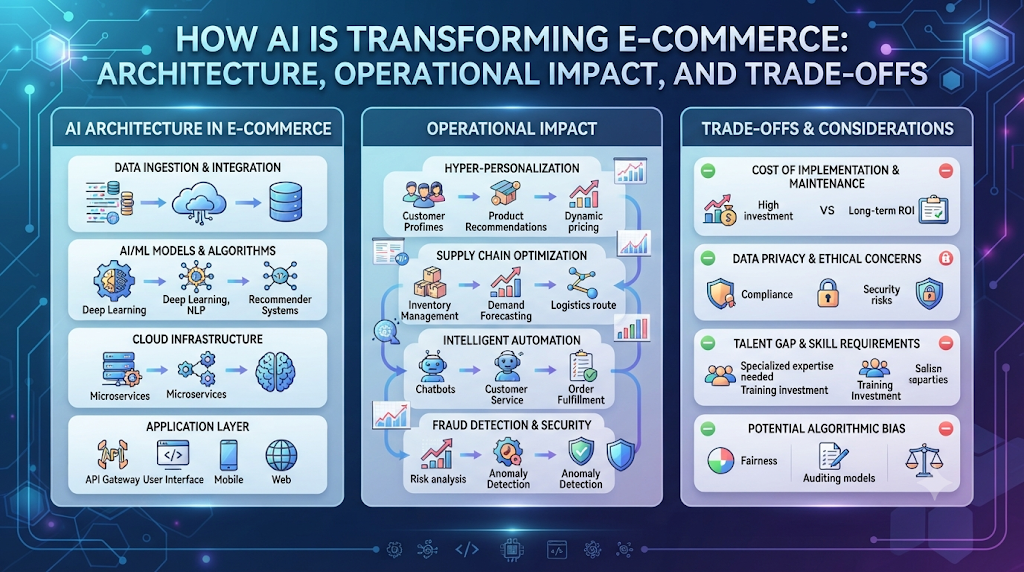
Artificial intelligence has shifted from a speculative retail add-on to the core operational engine of modern digital commerce. Online retail ecosystems no longer run purely on static databases, keyword matching, and manual merchandising rules. Instead, machine learning models, neural search systems, and predictive pipelines dictate everything from real-time pricing adjustments to deep inventory forecasting.
For engineering leaders, product managers, and digital strategists, understanding this transformation requires moving past surface-level marketing terminology. This analysis breaks down how AI is actively reshaping e-commerce architecture, where it delivers genuine economic value, and where technical debt or implementation risks commonly surface.
The Shift from Static Catalogs to Intent-Driven Discovery
Traditional e-commerce relied heavily on rigid taxonomies: hierarchical category trees, exact-match keyword search, and static filter parameters (size, color, price). If a user searched for a term outside the exact database field parameters, the engine returned zero results or irrelevant matches.
Modern e-commerce discovery relies on vector embeddings and semantic search. Large language models and embedding models map product catalogs into high-dimensional vector spaces. When a buyer enters a natural language query—such as “lightweight, breathable jacket for running in damp autumn weather”—the system calculates semantic proximity rather than relying on exact string matches.
Visual and Conversational Search Pipelines
Beyond text, visual search infrastructure has matured into a standard acquisition channel. Buyers upload reference images or screenshots, and computer vision models extract feature vectors—identifying fabric texture, silhouette, and cut—to surface identical or visually similar items instantly.
Simultaneously, conversational commerce has evolved past rigid decision-tree chatbots. Today’s AI shopping assistants combine retrieval-augmented generation (RAG) with transactional tool-calling. These systems query live product inventories, cross-reference sizing databases, and execute secure checkout flows within a single conversational loop.
Hyper-Personalization at Scale
Personalization in e-commerce has moved past rule-based segmentation (e.g., showing winter coats to users with IP addresses in cold climates). Real-time machine learning pipelines now process continuous interaction streams—clickstream velocity, dwell time, scroll depth, and cart abandonment cues—to dynamically alter the storefront experience.
[User Browser / App Stream]
       │
       ▼
[Real-Time Event Bus (Kafka / Kinesis)]
       │
       ▼
[Feature Store / ML Inference Engine] ──> [Dynamic UI & Pricing Engine]
       │
       ├──> Personalized Product Rankings
       ├──> Dynamic Promotional Offers
       └──> Tailored Content Blocks
Recommendation Engine Mechanics
Deep learning recommendation models (such as neural collaborative filtering and transformer-based sequential recommenders) evaluate both user-level historical patterns and session-level intent. If a user typically buys budget items but spends twenty minutes reading technical specifications on a high-end camera, the recommendation engine shifts its real-time weightings. It balances long-term historical profile data against immediate contextual intent, preventing the system from trapping the user in a historical preference silo.
Operational Efficiency: Inventory Forecasting and Dynamic Pricing
While front-end personalization drives conversion rates, back-end algorithmic optimization preserves profit margins. Supply chain complexity and volatile demand curves make manual inventory management obsolete.
Predictive Analytics in the Supply Chain
Machine learning models ingest historical sales figures, macroeconomic indicators, local weather forecasts, and real-time social sentiment data to predict SKU-level demand. By forecasting localized demand spikes weeks in advance, enterprise retailers optimize multi-warehouse distribution, reducing excess safety stock while minimizing costly out-of-stock events.
Real-Time Dynamic Pricing
Dynamic pricing algorithms continuously adjust item pricing based on live elasticity models. These algorithms factor in:
- Competitor price scraping metrics
- Real-time inventory turnover rates
- User-specific conversion probabilities
- Fulfillment and shipping cost variances
While highly effective at maximizing gross margins, dynamic pricing introduces friction regarding brand trust. Sudden, erratic price fluctuations can alienate repeat buyers, requiring businesses to establish strict algorithmic price corridors and guardrails.
Decision Guidance: Advantages, Limitations, and When Not to Use AI
Integrating artificial intelligence across an e-commerce stack demands rigorous cost-benefit analysis. Adopting AI infrastructure simply because it is an industry trend introduces unnecessary architectural complexity.
| Dimension | AI-Driven Approach | Traditional Rule-Based Approach | When to Choose AI |
| Product Discovery | Vector embeddings, semantic search, visual matching | SQL full-text search, manual category filters | Large catalogs (>10,000 SKUs) with diverse, unstructured descriptive attributes. |
| Pricing Models | Real-time algorithmic adjustments based on elasticity | Static pricing tables updated quarterly or seasonally | High-turnover goods, perishable inventory, or highly competitive commodity markets. |
| Customer Support | RAG-enabled LLM assistants with tool-calling capabilities | FAQ pages and rule-based support ticket routing | High-volume transactional queries (order tracking, basic returns, sizing checks). |
| Content Generation | Automated localized descriptions and SEO metadata | Copywriters authoring individual product pages | Rapid catalog expansions with thousands of similar, specification-heavy items. |
When NOT to Use AI
- Niche, Low-Volume Inventories: If a merchant sells a tightly curated collection of twenty handmade artisan goods, complex recommendation networks and dynamic pricing engines add zero value while introducing hosting and maintenance overhead.
- Strictly Regulated Compliance Boundaries: In sectors like specialized pharmaceuticals or heavy industrial machinery, unvalidated generative content or autonomous pricing models can introduce severe legal, safety, and regulatory liabilities.
Risks, Failure Modes, and Mitigation Strategies
Deploying AI systems in production commerce environments exposes organizations to distinct operational vulnerabilities.
- Hallucinations in Conversational Assistants: If an LLM-based support agent hallucinates a return policy or invents a product specification, the merchant faces immediate customer service friction, chargeback risks, or legal exposure.
- Mitigation: Restrict model generation using strict RAG boundaries, constrain responses to indexed enterprise databases, and enforce fallback routing to human agents when confidence scores dip below defined thresholds.
- Data Drift and Economic Shocks: Sudden shifts in consumer behavior (such as macroeconomic downturns or supply chain disruptions) invalidate historical training data, causing predictive models to miscalculate demand.
- Mitigation: Implement continuous model monitoring, automated data-drift alerts, and human-in-the-loop review gates for high-value automated workflows.
- Adversarial Exploitation: Automated pricing scrapers and botnets can manipulate real-time recommendation loops or exploit pricing anomalies.
- Mitigation: Pair pricing and recommendation pipelines with robust bot-mitigation firewalls and rate-limiting infrastructure.
Verification and Success Metrics
To validate that an AI implementation is driving positive business outcomes rather than inflating technical debt, engineering and product teams must track specific operational and financial metrics:
- Incremental Conversion Rate Lift ($ICRL$): Measure conversion rates across a randomized control group (exposed to traditional UI/search) versus the treatment group (exposed to AI personalization or semantic search).
- Mean Time to Resolution ($MTTR$): For conversational support agents, track the percentage of user inquiries resolved completely without human escalation.
- Inventory Forecast Error Variance: Monitor Mean Absolute Percentage Error ($MAPE$) on demand forecasts before and after deploying machine learning replenishment models.
- Latency Impact: Ensure that real-time embedding lookups and vector database queries do not degrade core page-load performance ($\text{P99} < 200\text{ms}$), as increased latency directly suppresses conversion.
Frequently Asked Questions
Q1. How does semantic search differ from traditional keyword search in e-commerce?
Traditional keyword search looks for exact string matches between user queries and product database fields, often failing if a customer uses synonyms or misspellings. Semantic search uses vector embeddings to understand the underlying intent and conceptual meaning of a query, returning relevant products even if the exact keywords do not appear in the product description.
Q2. Does generative AI completely replace human copywriters for product descriptions?
No. While generative AI excels at scaling the production of baseline product descriptions, metadata, and localized translations across thousands of SKUs, human editors remain essential for maintaining consistent brand voice, ensuring factual accuracy, and verifying compliance with regulatory guidelines.
Q3. What are the primary risks of using AI-driven dynamic pricing?
The main risks include alienating repeat customers through erratic price fluctuations, triggering destructive price wars with automated competitor algorithms, and violating regional consumer protection regulations regarding fair pricing transparency.
Q4. How do recommendation engines handle cold-start problems for new users?
When a user has no historical browsing or purchase data, recommendation engines rely on contextual signals such as geographic location, referral source, time of day, and trending global or regional bestsellers to serve relevant initial suggestions.
Q5. Can small-scale e-commerce stores benefit from AI, or is it only for enterprise retailers?
Small-scale stores can leverage AI effectively by integrating third-party SaaS platforms and API services (such as automated search, plug-and-play recommendation plugins, and basic chatbot builders) without needing to build or train custom machine learning models in-house.
Q6. How does retrieval-augmented generation (RAG) improve e-commerce chatbots?
RAG connects large language models directly to live inventory databases, return policies, and shipping APIs. Instead of relying solely on its internal training memory—which can cause hallucinations—the model retrieves factual, real-time store data to generate accurate, context-aware answers for customers.
Q7. What data privacy concerns arise when implementing AI personalization?
Personalization engines collect extensive behavioral data, clickstreams, and purchase history. Retailers must comply with privacy regulations like GDPR and CCPA by ensuring transparent data collection practices, securing user consent, and anonymizing data streams where appropriate.
Q8. How does AI help reduce cart abandonment rates?
AI mitigates cart abandonment by identifying friction points in real time, offering personalized exit-intent incentives, powering seamless conversational checkout flows, and sending automated, behavior-triggered remarketing emails based on abandoned session contents.
Q9. What infrastructure is required to support real-time vector search?
Implementing high-performance vector search requires specialized vector databases (such as Milvus, Pinecone, Qdrant, or pgvector) capable of indexing and querying high-dimensional product embeddings with sub-second latency at scale.
Q10. What is the typical timeline for ROI realization on e-commerce AI investments?
ROI timelines vary by use case. Plug-and-play tools like automated email marketing or basic recommendation widgets often show positive returns within weeks, whereas complex custom supply chain forecasting and dynamic pricing pipelines typically require three to nine months of data ingestion and model tuning to achieve measurable profitability gains.
Conclusion
Artificial intelligence has redefined e-commerce from a static digital catalog into an adaptive, intent-driven ecosystem. By deploying semantic search, real-time personalization, and predictive supply chain management, modern retailers can streamline operations and elevate the buyer journey. Sustainable success in this domain requires treating AI not as a standalone marketing gimmick, but as core infrastructure—balanced with rigorous performance monitoring, cost controls, and strict data governance. To take the next step, audit your current product discovery and inventory workflows to identify single bottlenecks where machine learning can deliver measurable efficiency gains.