Introduction
PII Detection & Redaction tools are specialized systems that identify and remove or mask Personally Identifiable Information (PII) from datasets used in AI training, analytics, and machine learning workflows. PII includes sensitive data such as names, emails, phone numbers, addresses, financial details, health records, and other identifiers that can compromise privacy if exposed.
these tools have become essential for AI compliance, especially with the rapid adoption of LLMs, RAG systems, and synthetic data pipelines. Organizations now process massive volumes of unstructured data, making automated PII detection critical for reducing legal risk and ensuring responsible AI development.
Real-world use cases include:
- Redacting sensitive data from LLM training datasets
- Anonymizing customer support transcripts for AI training
- Cleaning healthcare records before model training
- Preparing enterprise documents for RAG systems
- Ensuring GDPR/CCPA compliance in data pipelines
Key evaluation criteria for buyers:
- Detection accuracy across structured and unstructured data
- Support for multilingual PII detection
- Redaction methods (masking, tokenization, anonymization)
- Integration with data pipelines and ML systems
- Real-time vs batch processing capability
- False positive and false negative handling
- Custom rule configuration
- Scalability for enterprise workloads
- Audit logs and compliance reporting
- API and automation support
Best for: AI teams, data engineers, security and compliance teams, enterprises handling sensitive data, and organizations building LLM/RAG systems.
Not ideal for: Small static datasets or non-sensitive personal projects.
What’s Changed in PII Detection & Redaction Tools
- Shift from regex-based detection to LLM-powered contextual PII identification
- Multilingual and cross-format detection (text, audio, image, video)
- Deep integration with LLM training and RAG pipelines
- Real-time PII redaction in streaming data systems
- Use of transformer models for contextual entity recognition
- Automatic anonymization instead of simple masking
- Integration with data governance and AI compliance platforms
- Strong focus on auditability and explainability
- Support for synthetic replacement instead of deletion
- Embedding-based sensitive data detection
- Edge deployment for privacy-sensitive environments
- Continuous monitoring of data leakage risks
Quick Buyer Checklist
- Does it support structured and unstructured data?
- Can it detect multilingual PII accurately?
- Does it support real-time streaming redaction?
- Can it integrate with ML and LLM pipelines?
- Does it support API-based automation?
- Is it compliant with GDPR, HIPAA, or similar regulations?
- Does it offer customizable detection rules?
- Can it handle large-scale enterprise datasets?
- Does it support audit logging and reporting?
- Does it minimize false positives/negatives?
- Does it support anonymization beyond masking?
- Can it work in hybrid or on-prem environments?
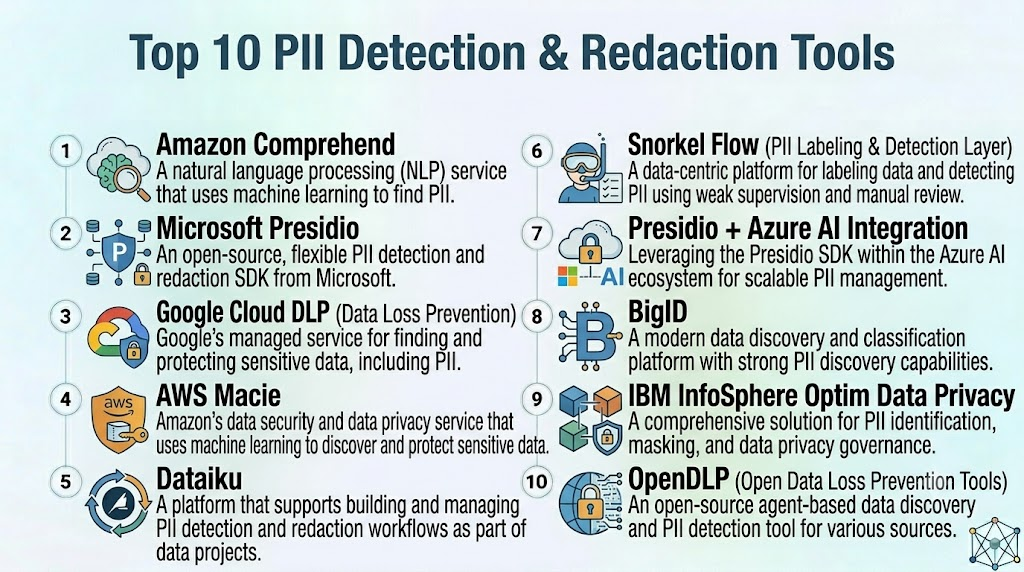
Top 10 PII Detection & Redaction Tools
1 — Amazon Comprehend
One-line verdict: Best AWS-native PII detection service for scalable enterprise data redaction pipelines.
Short description:
Amazon Comprehend is a managed NLP service that includes PII detection capabilities for identifying and redacting sensitive data in text-based datasets at scale.
Standout Capabilities
- Real-time and batch PII detection
- Named entity recognition for sensitive data
- Multilingual text analysis support
- Integration with AWS data pipelines
- Automatic entity classification
- Scalable cloud-based processing
- Custom entity recognition models
AI-Specific Depth
- Model support: AWS NLP models
- Data workflows: Text-focused pipelines
- Detection: Rule + ML-based PII detection
- Redaction: Masking and entity removal
- Observability: AWS monitoring integration
Pros
- Highly scalable
- Deep AWS ecosystem integration
- Easy API-based usage
Cons
- AWS lock-in
- Limited customization compared to open tools
Security & Compliance
- AWS enterprise security standards
- IAM-based access control
- Certifications: Not publicly stated
Deployment & Platforms
- Cloud-based (AWS only)
Integrations & Ecosystem
- AWS S3
- AWS Lambda
- Data pipelines
- ML workflows
Pricing Model
Pay-as-you-go usage-based pricing
Best-Fit Scenarios
- Enterprise cloud data processing
- LLM training data cleaning
- Large-scale text analytics
2 — Microsoft Presidio
One-line verdict: Best open-source framework for customizable PII detection and anonymization.
Short description:
Presidio is an open-source PII detection framework that allows organizations to build custom redaction pipelines with high flexibility.
Standout Capabilities
- Custom PII detection engine
- NLP-based entity recognition
- Regex + ML hybrid detection
- Anonymization and masking tools
- Extensible architecture
- Multilingual support via customization
- API-based integration
AI-Specific Depth
- Model support: Custom NLP + ML models
- Data workflows: Text-heavy pipelines
- Detection: Hybrid ML + rules engine
- Redaction: Masking, hashing, substitution
- Observability: Logging and tracking support
Pros
- Highly customizable
- Open-source and flexible
- Strong developer control
Cons
- Requires engineering setup
- No built-in enterprise dashboard
Security & Compliance
Depends on deployment configuration
Deployment & Platforms
- Self-hosted or cloud deployment
Integrations & Ecosystem
- Azure ecosystem
- ML pipelines
- Custom APIs
- Data processing systems
Pricing Model
Open-source
Best-Fit Scenarios
- Custom compliance pipelines
- Research and enterprise engineering teams
- LLM dataset preprocessing
3 — Google Cloud DLP (Data Loss Prevention)
One-line verdict: Best enterprise-grade PII detection and data masking service in Google Cloud ecosystem.
Short description:
Google Cloud DLP provides powerful PII detection and redaction tools for structured and unstructured data across enterprise environments.
Standout Capabilities
- Advanced sensitive data detection
- Structured and unstructured scanning
- Automated data masking
- Tokenization and de-identification
- Risk analysis tools
- Large-scale batch processing
- Policy-driven detection rules
AI-Specific Depth
- Model support: Google NLP models
- Data workflows: Enterprise data pipelines
- Detection: ML + rule-based hybrid
- Redaction: Tokenization and anonymization
- Observability: Data risk dashboards
Pros
- Strong enterprise security
- High accuracy detection
- Scalable cloud-native system
Cons
- Google Cloud dependency
- Complex pricing structure
Security & Compliance
- Strong compliance framework support
- Access control via IAM
- Certifications: Not publicly stated
Deployment & Platforms
- Google Cloud Platform only
Integrations & Ecosystem
- BigQuery
- Cloud Storage
- Dataflow pipelines
- ML workflows
Pricing Model
Usage-based enterprise pricing
Best-Fit Scenarios
- Enterprise compliance systems
- Large-scale data lakes
- AI training data preprocessing
4 — AWS Macie
One-line verdict: Best for automated PII discovery in AWS data lakes and storage systems.
Short description:
AWS Macie uses machine learning to discover and protect sensitive data stored in AWS environments.
Standout Capabilities
- Automatic sensitive data discovery
- S3 bucket scanning
- PII classification engine
- Risk scoring system
- Continuous monitoring
- Data access insights
- Alerting system for violations
AI-Specific Depth
- Model support: AWS ML detection models
- Data workflows: Storage-focused pipelines
- Detection: ML-based classification
- Redaction: Indirect via workflows
- Observability: Risk dashboards
Pros
- Deep AWS integration
- Automated monitoring
- Strong scalability
Cons
- Limited to AWS ecosystem
- Less customizable than open tools
Security & Compliance
- AWS security framework
- IAM-based access control
Deployment & Platforms
- AWS cloud-native service
Integrations & Ecosystem
- S3 storage
- AWS security tools
- Data pipelines
- CloudWatch monitoring
Pricing Model
Usage-based pricing
Best-Fit Scenarios
- AWS data lakes
- Enterprise storage scanning
- Compliance monitoring
5 — Dataiku
One-line verdict: Best end-to-end data science platform with integrated PII detection workflows.
Short description:
Dataiku is a collaborative data science platform that includes PII detection and data preparation tools for AI workflows.
Standout Capabilities
- Built-in data preparation pipelines
- PII detection plugins
- Visual workflow design
- Collaboration tools
- Data governance features
- Integration with ML pipelines
- Automation of data cleaning
AI-Specific Depth
- Model support: Multi-model pipelines
- Data workflows: End-to-end ML pipelines
- Detection: Plugin-based PII detection
- Redaction: Masking and transformation
- Observability: Workflow tracking
Pros
- End-to-end platform
- Strong collaboration features
- Easy workflow design
Cons
- Not a specialized PII tool
- Enterprise pricing
Security & Compliance
- Role-based access control
- Enterprise governance features
- Certifications: Not publicly stated
Deployment & Platforms
- Cloud and on-prem support
Integrations & Ecosystem
- ML frameworks
- Data warehouses
- APIs and plugins
- BI tools
Pricing Model
Enterprise subscription
Best-Fit Scenarios
- Enterprise data science teams
- ML pipeline management
- Data governance workflows
6 — Snorkel Flow (PII Labeling & Detection Layer)
One-line verdict: Best for programmatic PII detection combined with weak supervision.
Short description:
Snorkel Flow enables programmatic labeling and detection workflows that can be extended to identify and manage PII in large datasets.
Standout Capabilities
- Weak supervision for PII tagging
- Programmatic rule-based detection
- Dataset labeling automation
- Model-assisted detection
- Data governance workflows
- Scalable ML pipelines
- Custom detection logic
AI-Specific Depth
- Model support: Multi-model pipelines
- Data workflows: Programmatic detection systems
- Detection: Rule + ML hybrid system
- Redaction: Configurable transformations
- Observability: Dataset tracking tools
Pros
- Highly flexible detection logic
- Reduces manual labeling effort
- Strong for large datasets
Cons
- Requires ML expertise
- Complex setup
Security & Compliance
Not publicly stated
Deployment & Platforms
- Cloud-based platform
Integrations & Ecosystem
- ML pipelines
- Data labeling systems
- APIs
- Data lakes
Pricing Model
Enterprise licensing
Best-Fit Scenarios
- Large-scale dataset preprocessing
- ML engineering teams
- Compliance-driven pipelines
7 — Presidio + Azure AI Integration
One-line verdict: Best hybrid enterprise solution for Microsoft ecosystem users.
Short description:
This combines Presidio’s open-source flexibility with Azure AI services for enterprise-grade PII detection pipelines.
Standout Capabilities
- Hybrid ML + rules detection
- Azure NLP integration
- Custom anonymization pipelines
- Enterprise API support
- Scalable processing workflows
- Multi-language detection
- Governance-ready pipelines
AI-Specific Depth
- Model support: Azure NLP models + custom models
- Data workflows: Enterprise pipelines
- Detection: Hybrid detection engine
- Redaction: Masking and tokenization
- Observability: Azure monitoring
Pros
- Strong enterprise flexibility
- Azure ecosystem integration
- Highly customizable
Cons
- Complex architecture
- Requires engineering setup
Security & Compliance
- Azure security framework
- RBAC and IAM controls
Deployment & Platforms
- Azure cloud + hybrid setups
Integrations & Ecosystem
- Azure Data Factory
- ML pipelines
- Data storage systems
- APIs
Pricing Model
Hybrid (open-source + Azure usage)
Best-Fit Scenarios
- Microsoft enterprise ecosystems
- Compliance-heavy AI pipelines
- LLM data preprocessing
8 — BigID
One-line verdict: Best enterprise data intelligence platform with advanced PII discovery.
Short description:
BigID focuses on data discovery, classification, and privacy management including advanced PII detection across enterprise systems.
Standout Capabilities
- Deep data discovery engine
- PII classification across systems
- Risk-based data scoring
- Data governance workflows
- Automated compliance reporting
- Sensitive data mapping
- Cross-system scanning
AI-Specific Depth
- Model support: Not model-centric
- Data workflows: Enterprise governance pipelines
- Detection: Advanced classification engine
- Redaction: Policy-driven masking
- Observability: Risk dashboards
Pros
- Strong enterprise governance
- Deep data visibility
- Compliance-ready workflows
Cons
- Not developer-friendly
- Complex deployment
Security & Compliance
- Strong compliance framework support
- Enterprise RBAC
- Certifications: Not publicly stated
Deployment & Platforms
- Cloud and on-prem
Integrations & Ecosystem
- Data warehouses
- Security tools
- ML pipelines
- APIs
Pricing Model
Enterprise subscription
Best-Fit Scenarios
- Data governance programs
- Regulatory compliance systems
- Large enterprise AI pipelines
9 — IBM InfoSphere Optim Data Privacy
One-line verdict: Best legacy enterprise solution for structured data masking and PII protection.
Short description:
IBM provides data privacy tools for structured data anonymization and compliance-focused PII management.
Standout Capabilities
- Structured data masking
- Data anonymization workflows
- Compliance reporting tools
- Enterprise integration support
- Policy-based redaction
- Data transformation pipelines
- Audit logging
AI-Specific Depth
- Model support: Not AI-centric
- Data workflows: Structured enterprise systems
- Detection: Rule-based PII detection
- Redaction: Masking and substitution
- Observability: Compliance reporting
Pros
- Strong enterprise reliability
- Mature compliance tools
- Stable system integration
Cons
- Legacy architecture
- Limited AI-native features
Security & Compliance
- Strong IBM enterprise compliance
- Audit-ready systems
Deployment & Platforms
- On-prem and hybrid cloud
Integrations & Ecosystem
- IBM data platforms
- Enterprise systems
- Databases
- APIs
Pricing Model
Enterprise licensing
Best-Fit Scenarios
- Legacy enterprise systems
- Compliance-heavy data masking
- Structured data governance
10 — OpenDLP (Open Data Loss Prevention Tools)
One-line verdict: Best open-source lightweight PII detection for developers.
Short description:
OpenDLP-style tools provide basic PII scanning and detection capabilities for developers needing lightweight compliance tools.
Standout Capabilities
- Regex-based PII detection
- File and dataset scanning
- Lightweight deployment
- Custom rule configuration
- Basic reporting tools
- Open-source flexibility
- CLI-based workflows
AI-Specific Depth
- Model support: None
- Data workflows: File-based scanning
- Detection: Rule-based system
- Redaction: Manual masking workflows
- Observability: Basic logs
Pros
- Free and open-source
- Easy to deploy
- Lightweight system
Cons
- Low accuracy vs modern tools
- No AI-based detection
Security & Compliance
Not publicly stated
Deployment & Platforms
- Local/self-hosted
Integrations & Ecosystem
- CLI tools
- Basic data pipelines
- Custom scripts
Pricing Model
Open-source
Best-Fit Scenarios
- Small projects
- Developer testing
- Basic compliance checks
Comparison Table (Top 10)
| Tool Name | Best For | Deployment | Detection Type | Strength | Watch-Out | Public Rating |
|---|---|---|---|---|---|---|
| Amazon Comprehend | AWS NLP pipelines | AWS cloud | ML-based | Scalability | AWS lock-in | N/A |
| Microsoft Presidio | Custom pipelines | Self-host/cloud | Hybrid | Flexibility | Setup effort | N/A |
| Google DLP | Enterprise compliance | GCP cloud | ML + rules | Accuracy | Cost complexity | N/A |
| AWS Macie | Data lake scanning | AWS cloud | ML-based | Automation | AWS-only | N/A |
| Dataiku | ML workflows | Hybrid | Plugin-based | End-to-end | Not specialized | N/A |
| Snorkel Flow | Programmatic detection | Cloud | Hybrid | Automation | Complexity | N/A |
| Azure Presidio | Enterprise hybrid | Azure cloud | Hybrid | Flexibility | Setup complexity | N/A |
| BigID | Data governance | Hybrid | ML + rules | Governance | Not dev-friendly | N/A |
| IBM Optim | Legacy enterprises | On-prem | Rule-based | Stability | Outdated UX | N/A |
| OpenDLP | Lightweight scanning | Self-host | Rule-based | Simplicity | Low accuracy | N/A |
Scoring & Evaluation (Weighted Rubric)
| Tool | Core | Accuracy | Automation | Integrations | Ease | Performance | Security | Support | Weighted Total |
|---|---|---|---|---|---|---|---|---|---|
| Amazon Comprehend | 9 | 9 | 9 | 9 | 8 | 9 | 9 | 8 | 8.8 |
| Microsoft Presidio | 9 | 8 | 8 | 9 | 9 | 8 | 8 | 8 | 8.3 |
| Google DLP | 10 | 10 | 9 | 10 | 7 | 9 | 10 | 9 | 9.2 |
| AWS Macie | 9 | 9 | 9 | 9 | 8 | 9 | 9 | 8 | 8.8 |
| Dataiku | 8 | 8 | 8 | 8 | 8 | 8 | 8 | 8 | 8.0 |
| Snorkel Flow | 9 | 9 | 9 | 9 | 7 | 8 | 8 | 8 | 8.4 |
| Azure Presidio | 9 | 8 | 8 | 9 | 8 | 8 | 9 | 8 | 8.4 |
| BigID | 10 | 9 | 9 | 10 | 7 | 9 | 10 | 9 | 9.0 |
| IBM Optim | 8 | 8 | 7 | 8 | 7 | 8 | 9 | 8 | 7.8 |
| OpenDLP | 7 | 6 | 6 | 7 | 9 | 7 | 7 | 6 | 6.8 |
Which PII Detection Tool Is Right for You?
Solo / Freelancer
OpenDLP and Presidio are best for lightweight and flexible setups.
SMB
Dataiku and Microsoft Presidio offer balanced capabilities for growing teams.
Mid-Market
Snorkel Flow, Amazon Comprehend, and Google DLP provide scalable pipelines.
Enterprise
Google DLP, BigID, and AWS Macie dominate enterprise compliance needs.
Regulated industries
Google DLP and BigID are strongest for compliance-heavy environments.
Budget vs premium
- Budget: OpenDLP, Presidio
- Mid-range: Dataiku, Snorkel Flow
- Premium: Google DLP, BigID, AWS Macie
Build vs buy
- Build: Presidio, OpenDLP
- Buy: Google DLP, AWS Macie, BigID
Common Mistakes & How to Avoid Them
- Relying only on regex-based detection
- Ignoring multilingual PII cases
- Not validating false positives
- Poor integration with ML pipelines
- Missing real-time redaction needs
- Lack of audit logging
- Over-masking useful data
- Not updating detection rules
- Ignoring unstructured data formats
- No feedback loop from compliance teams
- Over-reliance on single tool
- Weak access control policies
- No dataset versioning
- Not testing adversarial PII formats
FAQs
1. What is PII detection?
It is the process of identifying personally identifiable information in datasets to protect privacy and comply with regulations.
2. Why is PII redaction important in AI?
It prevents sensitive data from being exposed during model training or inference.
3. What types of data contain PII?
Text, images, audio, video, logs, and structured databases.
4. Can AI detect PII automatically?
Yes, modern tools use ML and NLP models for automated detection.
5. What is redaction vs anonymization?
Redaction hides data, while anonymization replaces it with non-identifiable values.
6. Is PII detection required for LLM training?
Yes, especially for compliance and safety reasons.
7. Do these tools support real-time detection?
Some enterprise tools support streaming PII detection.
8. Can PII tools work with multilingual data?
Yes, advanced tools support multiple languages.
9. Are open-source PII tools reliable?
They are flexible but less accurate than enterprise AI-powered tools.
10. What industries need PII detection most?
Healthcare, finance, legal, and AI companies.
11. Can PII tools integrate with ML pipelines?
Yes, most provide APIs and SDKs for integration.
12. What is the future of PII detection?
It is moving toward LLM-based contextual detection with real-time compliance automation.
Conclusion
PII Detection & Redaction tools are essential for building safe, compliant, and trustworthy AI systems. As organizations increasingly rely on LLMs and large-scale data pipelines, protecting sensitive information has become a foundational requirement rather than an optional step.
No single tool fits all needs. Google DLP and BigID dominate enterprise compliance, AWS Macie excels in cloud-native environments, and Microsoft Presidio offers flexibility for developers.
