Introduction
AI Traffic Flow Optimization Systems use artificial intelligence, machine learning, computer vision, predictive analytics, and real-time data processing to improve transportation efficiency, reduce congestion, and optimize movement across urban and highway networks.
Growing cities face increasing transportation challenges, including traffic congestion, longer commute times, inefficient signal timing, road accidents, and environmental impacts caused by vehicle delays. Traditional traffic management systems often rely on fixed schedules, historical patterns, and manual adjustments, which may not respond effectively to changing traffic conditions.
AI-powered traffic optimization platforms analyze data from traffic cameras, road sensors, connected vehicles, GPS systems, weather information, and transportation databases to understand traffic patterns and make intelligent recommendations.
These systems help transportation authorities:
- Reduce traffic congestion
- Optimize traffic signal timing
- Improve road capacity utilization
- Enhance public transportation efficiency
- Support emergency vehicle movement
- Improve road safety
- Reduce fuel consumption and emissions
AI traffic flow optimization solutions are used by:
- Smart city programs
- Transportation departments
- Highway authorities
- Traffic management centers
- Public transit organizations
- Municipal governments
- Infrastructure operators
Modern platforms combine computer vision, IoT sensors, digital twins, predictive modeling, adaptive signals, and real-time transportation analytics.
The goal of these solutions is to create smarter transportation networks that improve mobility, safety, and urban efficiency.
How AI Traffic Flow Optimization Works
Data Collection
AI systems collect information from:
- Traffic cameras
- Road sensors
- GPS devices
- Connected vehicles
- Public transit systems
- Weather data
Traffic Analysis
AI analyzes:
- Vehicle movement
- Congestion patterns
- Travel times
- Road conditions
- Traffic volume
Prediction
Machine learning models forecast:
- Traffic demand
- Congestion points
- Travel delays
- Incident impacts
Optimization
AI recommends:
- Signal timing changes
- Route adjustments
- Traffic management actions
- Transportation improvements
Continuous Learning
AI improves using:
- Historical traffic data
- Real-time events
- Driver behavior patterns
- Transportation outcomes
Common Use Cases
- Smart city traffic management
- Adaptive traffic signals
- Highway congestion management
- Public transportation optimization
- Emergency route planning
- Road safety improvement
- Parking management
- Fleet routing
- Traffic incident response
- Urban mobility planning
Why AI Traffic Flow Optimization Systems Matter
Reduced Congestion
AI helps transportation agencies manage traffic more efficiently.
Faster Travel Times
Optimized routes and signals improve mobility.
Better Road Safety
AI helps identify incidents and dangerous conditions.
Lower Environmental Impact
Improved traffic flow reduces unnecessary fuel consumption.
Improved Public Transportation
AI helps optimize bus and transit operations.
Evaluation Criteria for Buyers
Real-Time Analytics
Systems should process traffic information quickly.
Computer Vision Capability
Platforms should analyze road images and video effectively.
Predictive Accuracy
Solutions should forecast congestion and demand.
Integration Support
Important integrations include:
- Traffic signals
- Road sensors
- GPS systems
- GIS platforms
- Public transit systems
Scalability
Solutions should support city-wide transportation networks.
Reliability
Traffic systems require continuous availability.
Security
Transportation infrastructure requires strong cybersecurity.
Key Trends
Smart City Transportation
Cities are adopting AI to improve urban mobility.
Connected Vehicle Integration
AI is using vehicle data for better traffic decisions.
Adaptive Traffic Signals
Signals are becoming responsive to real-time conditions.
Digital Twin Transportation Models
Cities are simulating traffic scenarios before making changes.
Autonomous Mobility Support
AI traffic systems are preparing infrastructure for connected and autonomous vehicles.
Sustainable Transportation Planning
AI is helping reduce congestion and emissions.
Methodology
The following platforms were evaluated using:
- AI traffic optimization capabilities
- Real-time analytics
- Transportation intelligence features
- Integration support
- Scalability
- Ease of use
- Security and reliability
- Support and community
- Price and value
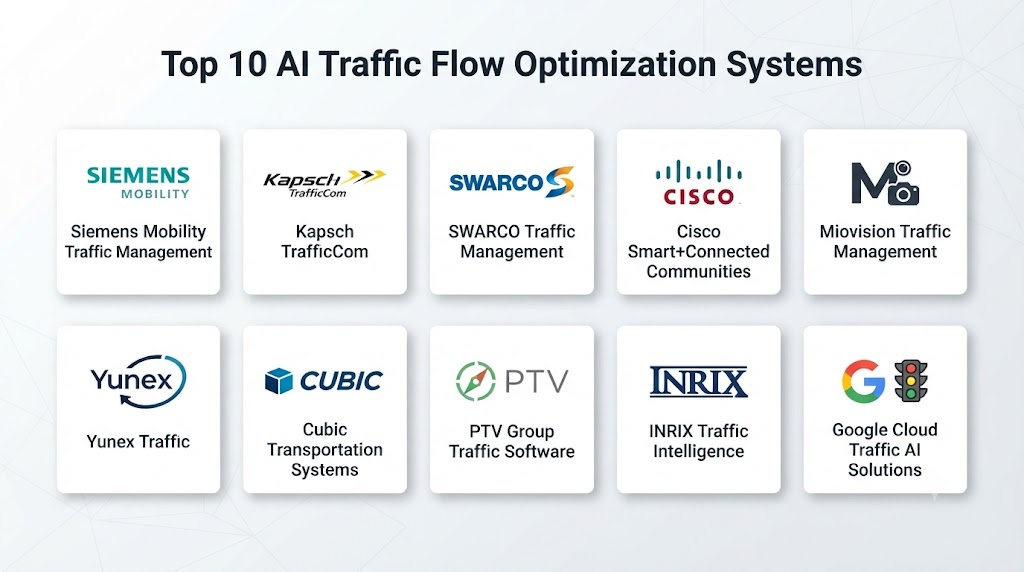
Top 10 AI Traffic Flow Optimization Systems
1. Siemens Mobility Traffic Management
Siemens Mobility provides intelligent transportation solutions for urban and highway traffic management.
Key Features
- Adaptive traffic control
- Traffic monitoring
- Signal optimization
- Transportation analytics
- Incident management
- Traffic prediction
- Smart mobility solutions
- Data integration
- Road network optimization
- Reporting
Pros
- Strong transportation expertise
- Supports large infrastructure projects
- Advanced traffic management
- Global deployment experience
- Good integration capabilities
Cons
- Enterprise-focused
- Complex implementation
- Requires infrastructure investment
Platforms
Enterprise transportation platform.
Deployment or Support
Cloud and infrastructure-based deployment.
Security & Compliance
Enterprise security controls.
Integrations & Ecosystem
Traffic signals, sensors, transportation systems, and smart city platforms.
Support & Community
Enterprise support.
2. Kapsch TrafficCom
Kapsch provides intelligent transportation systems and traffic management solutions.
Key Features
- Traffic monitoring
- Toll management
- Road analytics
- Traffic control
- Incident detection
- Mobility management
- Data analytics
- Connected transportation
- Vehicle information systems
- Reporting
Pros
- Strong transportation focus
- Highway expertise
- Good mobility solutions
- Supports large networks
- Operational analytics
Cons
- Infrastructure-focused
- Requires deployment planning
- Enterprise implementation
Platforms
Transportation technology platform.
Deployment or Support
Enterprise deployment.
Security & Compliance
Security controls vary.
Integrations & Ecosystem
Road systems, transportation networks, and smart mobility platforms.
Support & Community
Professional support.
3. SWARCO Traffic Management
SWARCO provides traffic management and intelligent mobility solutions.
Key Features
- Adaptive traffic signals
- Traffic control
- Mobility analytics
- Road monitoring
- Public transport integration
- Traffic optimization
- Incident management
- Smart city solutions
- Data analysis
- Visualization
Pros
- Strong urban mobility capabilities
- Traffic signal expertise
- Smart city support
- Good integration options
- Transportation-focused
Cons
- Requires infrastructure setup
- Regional availability varies
- Complex deployment
Platforms
Transportation management platform.
Deployment or Support
Enterprise deployment.
Security & Compliance
Security depends on deployment.
Integrations & Ecosystem
Traffic infrastructure, sensors, and city platforms.
Support & Community
Professional support.
4. Cisco Smart+Connected Communities
Cisco provides networking and smart city technology solutions.
Key Features
- Smart city connectivity
- Traffic data management
- IoT infrastructure
- Network intelligence
- Data analytics
- Connected transportation
- Sensor integration
- Digital infrastructure
- Security management
- Cloud connectivity
Pros
- Strong networking capabilities
- Smart city ecosystem
- Reliable infrastructure
- Good IoT support
- Enterprise scalability
Cons
- Requires integration
- Not only traffic-focused
- Technical expertise needed
Platforms
Cloud and enterprise platforms.
Deployment or Support
Hybrid deployment.
Security & Compliance
Enterprise security controls.
Integrations & Ecosystem
IoT devices, city platforms, networks, and transportation systems.
Support & Community
Enterprise support.
5. Miovision Traffic Management
Miovision provides AI-powered traffic management and intersection analytics.
Key Features
- Traffic counting
- Computer vision
- Intersection analytics
- Signal optimization
- Traffic monitoring
- Data collection
- Safety analysis
- Reporting
- Cloud management
- Transportation insights
Pros
- AI-based traffic analytics
- Strong intersection intelligence
- Easy data collection
- Good visualization
- Useful for municipalities
Cons
- Focused on intersections
- Requires camera deployment
- Feature availability varies
Platforms
Cloud platform.
Deployment or Support
Cloud deployment.
Security & Compliance
Security controls vary.
Integrations & Ecosystem
Traffic signals, cameras, and transportation systems.
Support & Community
Customer support.
6. Yunex Traffic
Yunex Traffic provides intelligent traffic management and mobility solutions.
Key Features
- Adaptive traffic control
- Signal optimization
- Traffic analytics
- Urban mobility management
- Incident response
- Connected transportation
- Data processing
- Traffic monitoring
- Smart intersection solutions
- Reporting
Pros
- Transportation specialization
- Strong traffic control capabilities
- Supports smart cities
- Scalable solutions
- Good analytics
Cons
- Infrastructure requirements
- Complex deployment
- Enterprise-focused
Platforms
Transportation platform.
Deployment or Support
Enterprise deployment.
Security & Compliance
Enterprise security controls.
Integrations & Ecosystem
Traffic infrastructure, sensors, and city systems.
Support & Community
Professional support.
7. Cubic Transportation Systems
Cubic provides transportation management and mobility solutions.
Key Features
- Transportation analytics
- Traffic management
- Public transit optimization
- Mobility platforms
- Fare systems
- Data analytics
- Journey planning
- Traffic insights
- Operations management
- Reporting
Pros
- Strong transportation ecosystem
- Supports public mobility
- Good analytics
- Enterprise capabilities
- Integrated solutions
Cons
- Large-scale deployments
- Complex implementation
- Enterprise-focused
Platforms
Enterprise transportation platform.
Deployment or Support
Hybrid deployment.
Security & Compliance
Enterprise security controls.
Integrations & Ecosystem
Transit systems, transportation networks, and mobility platforms.
Support & Community
Enterprise support.
8. PTV Group Traffic Software
PTV provides transportation planning and traffic simulation solutions.
Key Features
- Traffic simulation
- Transportation modeling
- Route analysis
- Mobility planning
- Traffic forecasting
- Scenario analysis
- Visualization
- Urban planning
- Data analytics
- Optimization
Pros
- Strong simulation capabilities
- Useful for planning
- Transportation expertise
- Advanced modeling
- Research adoption
Cons
- Requires expertise
- Planning-focused
- Implementation effort
Platforms
Desktop and cloud platforms.
Deployment or Support
Enterprise deployment.
Security & Compliance
Security depends on deployment.
Integrations & Ecosystem
GIS systems, transportation databases, and planning tools.
Support & Community
Professional support.
9. INRIX Traffic Intelligence
INRIX provides traffic data analytics and mobility intelligence.
Key Features
- Traffic analytics
- Travel time analysis
- Congestion monitoring
- Mobility data
- Road intelligence
- Predictive analytics
- Location insights
- Reporting
- Transportation dashboards
- Data APIs
Pros
- Strong traffic data
- Useful analytics
- Real-time insights
- API capabilities
- Supports planning decisions
Cons
- Data-focused platform
- Requires integration
- Advanced usage needs expertise
Platforms
Cloud platform.
Deployment or Support
Cloud deployment.
Security & Compliance
Security controls vary.
Integrations & Ecosystem
Transportation systems, APIs, GIS platforms, and analytics tools.
Support & Community
Customer support.
10. Google Cloud Traffic AI Solutions
Google Cloud provides AI, mapping, and analytics capabilities for transportation use cases.
Key Features
- Machine learning analytics
- Geospatial analysis
- Traffic data processing
- Predictive modeling
- Data integration
- Cloud analytics
- AI development tools
- Mobility insights
- Visualization
- API support
Pros
- Strong AI infrastructure
- Scalable cloud platform
- Advanced analytics
- Developer ecosystem
- Flexible integrations
Cons
- Requires technical expertise
- Custom development needed
- Cloud dependency
Platforms
Cloud platform.
Deployment or Support
Google Cloud deployment.
Security & Compliance
Google Cloud security controls.
Integrations & Ecosystem
Maps, cloud services, transportation data, and applications.
Support & Community
Google Cloud support.
Comparison Table
| Tool Name | Best For | Platform(s) Supported | Deployment | Standout Feature | Public Rating |
|---|---|---|---|---|---|
| Siemens Mobility | Large transportation networks | Enterprise | Hybrid | Traffic optimization | N/A |
| Kapsch TrafficCom | Highway management | Enterprise | Hybrid | Mobility systems | N/A |
| SWARCO | Smart city traffic | Enterprise | Hybrid | Signal control | N/A |
| Cisco Smart Communities | Connected infrastructure | Cloud/Enterprise | Hybrid | IoT connectivity | N/A |
| Miovision | Intersection analytics | Cloud | Cloud | Computer vision | N/A |
| Yunex Traffic | Traffic control | Enterprise | Hybrid | Adaptive signals | N/A |
| Cubic Transportation | Mobility management | Enterprise | Hybrid | Transit integration | N/A |
| PTV Group | Traffic simulation | Desktop/Cloud | Hybrid | Modeling | N/A |
| INRIX | Traffic intelligence | Cloud | Cloud | Mobility data | N/A |
| Google Cloud Traffic AI | Custom AI solutions | Cloud | Cloud | AI analytics | N/A |
Weighted Evaluation
| Tool Name | Core Features 25% | Ease of Use 15% | Integrations & Ecosystem 15% | Security & Compliance 10% | Performance & Reliability 10% | Support & Community 10% | Price/Value 15% | Total |
|---|---|---|---|---|---|---|---|---|
| Siemens Mobility | 25 | 12 | 15 | 10 | 10 | 10 | 10 | 92 |
| Kapsch TrafficCom | 24 | 12 | 15 | 10 | 10 | 10 | 10 | 91 |
| SWARCO | 24 | 13 | 14 | 10 | 10 | 10 | 11 | 92 |
| Cisco Smart Communities | 23 | 13 | 15 | 10 | 10 | 10 | 12 | 93 |
| Miovision | 23 | 14 | 13 | 10 | 10 | 10 | 12 | 92 |
| Yunex Traffic | 24 | 12 | 14 | 10 | 10 | 10 | 10 | 90 |
| Cubic Transportation | 24 | 12 | 15 | 10 | 10 | 10 | 10 | 91 |
| PTV Group | 23 | 12 | 14 | 10 | 10 | 10 | 11 | 90 |
| INRIX | 22 | 14 | 14 | 10 | 10 | 10 | 12 | 92 |
| Google Cloud Traffic AI | 24 | 12 | 15 | 10 | 10 | 10 | 12 | 93 |
Which AI Traffic Flow Optimization System Is Right for You?
Choose Siemens Mobility when large-scale transportation management is required.
Choose Kapsch TrafficCom when highway and mobility systems are priorities.
Choose SWARCO when adaptive traffic control is needed.
Choose Cisco Smart+Connected Communities when connected city infrastructure matters.
Choose Miovision when intersection analytics are the focus.
Choose Yunex Traffic when intelligent signal management is required.
Choose Cubic Transportation Systems when integrated mobility solutions are needed.
Choose PTV Group when transportation simulation and planning are priorities.
Choose INRIX when traffic intelligence and analytics are needed.
Choose Google Cloud Traffic AI Solutions when custom AI transportation applications are required.
Implementation Playbook
Phase 1: Define Traffic Management Goals
- Identify congestion challenges
- Analyze transportation needs
- Define optimization objectives
- Select data sources
- Establish performance metrics
Phase 2: Prepare Transportation Data
- Connect sensors
- Integrate traffic cameras
- Collect mobility data
- Configure analytics systems
- Establish security controls
Phase 3: Deploy AI Optimization
- Train traffic models
- Configure signals
- Enable monitoring
- Create dashboards
- Test recommendations
Phase 4: Measure Results
- Reduce congestion
- Improve travel times
- Monitor traffic patterns
- Improve safety
- Optimize transportation operations
Phase 5: Maintain Smart Traffic Systems
- Update AI models
- Monitor performance
- Improve data quality
- Review traffic changes
- Maintain cybersecurity
Common Mistakes
- Using outdated traffic data
- Ignoring infrastructure limitations
- Poor sensor placement
- Lack of integration planning
- Overlooking cybersecurity
- Not considering human factors
- Failing to monitor AI recommendations
- Poor maintenance planning
FAQs
1. What are AI Traffic Flow Optimization Systems?
AI Traffic Flow Optimization Systems use artificial intelligence to analyze traffic data and improve transportation efficiency.
2. How does AI reduce traffic congestion?
AI optimizes signals, predicts congestion, and recommends better traffic management strategies.
3. Can AI control traffic signals automatically?
Many systems can adjust traffic signals based on real-time conditions.
4. What data do AI traffic systems use?
They use cameras, sensors, GPS data, vehicle information, and transportation records.
5. Are AI traffic systems used in smart cities?
Yes. Smart cities use AI to improve mobility and transportation planning.
6. Can AI improve emergency response routes?
AI can support faster route planning for emergency services.
7. Are AI traffic systems secure?
Organizations should implement cybersecurity controls to protect transportation infrastructure.
8. Can AI support public transportation?
Yes. AI helps optimize transit operations and passenger movement.
9. How accurate are AI traffic predictions?
Accuracy depends on data quality, system design, and environmental conditions.
10. What should cities consider before implementing AI traffic optimization?
Cities should evaluate data availability, infrastructure readiness, integration needs, security, and cost.
Conclusion
AI Traffic Flow Optimization Systems are transforming transportation management by combining artificial intelligence, real-time analytics, computer vision, and predictive modeling.Siemens Mobility, Kapsch TrafficCom, SWARCO, Miovision, INRIX, and Google Cloud provide powerful capabilities for improving traffic operations, while connected infrastructure platforms support broader smart city initiatives.most effective AI traffic strategy combines intelligent technology with reliable infrastructure, accurate data, transportation expertise, and continuous improvement. AI helps cities create safer, more efficient, and more sustainable transportation networks.
