Introduction
AI governance platforms are systems designed to help organizations control, monitor, and manage artificial intelligence models throughout their lifecycle. In simple terms, they ensure AI behaves safely, ethically, and in line with business and rulatory rules.
As AI becomes deeply integrated into business workflows through LLMs, autonomous agents, and multimodal systems, governance is now a critical requirement rather than an optional layer. Organizations need to prevent risks such as hallucinations, biased outputs, data leakage, prompt injection attacks, and compliance violations while still enabling innovation.
These platforms are widely used for:
- Monitoring LLM outputs for safety and accuracy
- Enforcing data privacy and retention policies
- Tracking model drift and performance degradation
- Managing AI compliance and audit readiness
- Implementing guardrails for AI agents and copilots
- Evaluating model behavior before and after deployment
Key evaluation criteria include data privacy controls, model support, evaluation frameworks, guardrails, observability, integration capabilities, deployment flexibility, cost controls, and auditability.
Best for: Enterprise AI teams, regulated industries like finance and healthcare, AI platform engineers, and organizations scaling LLM or agent-based systems.
Not ideal for: Small experimental projects or simple AI use cases where governance overhead is unnecessary.
What’s Changed in AI Governance Platforms
- Shift from basic model monitoring to full AI lifecycle governance
- Growing need for agent safety and real-time decision control
- Strong focus on prompt injection and jailbreak prevention
- Built-in evaluation pipelines for LLM testing and regression checks
- Increased adoption of policy-as-code frameworks
- Expansion into multimodal governance (text, image, audio, video)
- Deep integration with CI/CD pipelines for AI workflows
- Strong emphasis on cost and token usage optimization
- Unified observability combining logs, traces, and metrics
- Built-in compliance reporting for enterprise regulations
- Increased adoption of human-in-the-loop review systems
- Multi-model routing governance across different AI providers
Quick Buyer Checklist
- Data privacy and retention controls
- Support for BYO models or multi-model routing
- Built-in evaluation and testing frameworks
- Guardrails for safety and policy enforcement
- Observability (logs, traces, metrics, costs)
- Integration with existing AI/ML stack
- Audit logs and compliance reporting
- Role-based access control and SSO
- Latency and performance overhead
- Vendor lock-in risks
- Scalability across multiple AI applications
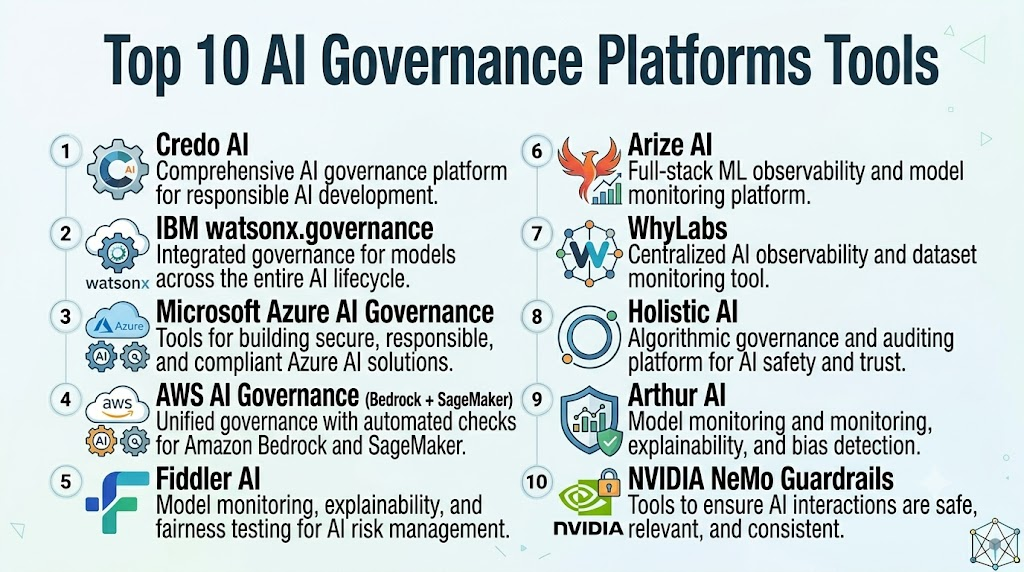
Top 10 AI Governance Platforms Tools
1 — Credo AI
One-line verdict: Best for enterprises building structured AI governance and policy-driven compliance programs.
Short description:
Credo AI helps organizations design, enforce, and manage AI governance policies across models and teams. It is widely used in enterprise environments requiring structured oversight.
Standout Capabilities
- AI policy management framework
- Model risk assessment workflows
- Centralized AI inventory
- Governance dashboards for leadership
- Compliance mapping tools
- Workflow approvals for deployments
- Cross-team collaboration features
AI-Specific Depth
- Model support: Multi-model environments
- RAG integration: Not publicly stated
- Evaluation: Policy-based assessments
- Guardrails: Governance-level enforcement
- Observability: Governance dashboards
Pros
- Strong enterprise governance structure
- Excellent policy control system
- Centralized AI visibility
Cons
- Not developer-focused
- Requires organizational maturity
Security & Compliance
- RBAC and SSO support available
- Audit logs supported
- Certifications: Not publicly stated
Deployment & Platforms
- Cloud-based enterprise SaaS
Integrations & Ecosystem
- APIs for AI workflows
- Enterprise data platforms
- MLOps pipelines integration
Pricing Model
- Enterprise pricing model (Not publicly stated)
Best-Fit Scenarios
- Large enterprises
- Regulated industries
- Multi-model AI environments
2 — IBM watsonx.governance
One-line verdict: Best for enterprise AI governance inside IBM hybrid cloud ecosystems.
Short description:
IBM watsonx.governance provides AI lifecycle monitoring, compliance tracking, and risk management for enterprise AI systems.
Standout Capabilities
- AI lifecycle tracking
- Model risk and bias detection
- Explainability dashboards
- Compliance reporting automation
- Governance workflows
- Enterprise AI cataloging
- Audit-ready documentation
AI-Specific Depth
- Model support: Enterprise ML and LLMs
- RAG integration: IBM ecosystem supported
- Evaluation: Bias and drift evaluation
- Guardrails: Policy-based controls
- Observability: Full lifecycle monitoring
Pros
- Strong compliance tooling
- Deep IBM ecosystem integration
- Enterprise-grade governance
Cons
- Complex setup
- Heavy enterprise dependency
Security & Compliance
- RBAC, SSO, audit logs
- Certifications: Not publicly stated
Deployment & Platforms
- Hybrid cloud
Integrations & Ecosystem
- IBM Cloud services
- Data science platforms
- Enterprise AI tools
Pricing Model
- Enterprise licensing (Not publicly stated)
Best-Fit Scenarios
- IBM ecosystem users
- Regulated industries
- Hybrid cloud AI systems
3 — Microsoft Azure AI Governance
One-line verdict: Best for organizations building AI systems within Azure ecosystem.
Short description:
Azure AI governance tools provide safety, compliance, and monitoring features for AI applications built on Microsoft infrastructure.
Standout Capabilities
- Responsible AI dashboards
- Content safety filters
- Model monitoring tools
- Azure ML integration
- Policy enforcement controls
- AI safety guardrails
- Compliance reporting tools
AI-Specific Depth
- Model support: Azure + BYO models
- RAG integration: Azure AI Search supported
- Evaluation: Safety and fairness evaluation
- Guardrails: Built-in filters
- Observability: Logs and monitoring dashboards
Pros
- Strong ecosystem integration
- Built-in safety features
- Enterprise scalability
Cons
- Strong vendor lock-in
- Azure dependency
Security & Compliance
- RBAC and SSO
- Encryption and audit logs
- Certifications: Not publicly stated
Deployment & Platforms
- Cloud (Azure)
Integrations & Ecosystem
- Azure ML, OpenAI services
- Data pipelines
- Enterprise APIs
Pricing Model
- Usage-based + enterprise tiers
Best-Fit Scenarios
- Azure-native AI teams
- Enterprise SaaS platforms
- Regulated workloads
4 — AWS AI Governance (Bedrock + SageMaker)
One-line verdict: Best for scalable AI governance in AWS-native environments.
Short description:
AWS governance tools combine Bedrock Guardrails and SageMaker monitoring to control AI behavior and ensure safety.
Standout Capabilities
- Prompt filtering rules
- Model monitoring pipelines
- Guardrail policies
- Cost tracking tools
- Multi-model governance
- Data protection controls
- Cloud-scale AI monitoring
AI-Specific Depth
- Model support: Bedrock + BYO models
- RAG integration: AWS-native systems
- Evaluation: Monitoring pipelines
- Guardrails: Strong safety filters
- Observability: CloudWatch + SageMaker
Pros
- Highly scalable
- Strong infrastructure support
- Flexible AI ecosystem
Cons
- Complex architecture
- Multiple services required
Security & Compliance
- IAM controls
- Encryption support
- Audit logging available
Deployment & Platforms
- AWS cloud
Integrations & Ecosystem
- S3, Lambda, Bedrock, SageMaker
- Data engineering tools
Pricing Model
- Usage-based
Best-Fit Scenarios
- AWS-first organizations
- Large-scale AI deployments
- Cloud-native teams
5 — Fiddler AI
One-line verdict: Best for AI observability and model debugging in production systems.
Short description:
Fiddler provides monitoring, explainability, and performance tracking for ML and LLM applications.
Standout Capabilities
- Model drift detection
- Explainability tools
- LLM observability
- Root cause analysis
- Performance tracking
- Alerting system
- Bias detection
AI-Specific Depth
- Model support: ML and LLMs
- RAG integration: Limited
- Evaluation: Strong monitoring
- Guardrails: Indirect
- Observability: Core feature
Pros
- Strong debugging tools
- Good observability
- Easy integration
Cons
- Limited governance layer
- Less compliance focus
Security & Compliance
- RBAC support
- Audit logs
- Certifications: Not publicly stated
Deployment & Platforms
- Cloud SaaS
Integrations & Ecosystem
- ML pipelines
- APIs and data tools
Pricing Model
- Enterprise subscription
Best-Fit Scenarios
- ML production teams
- AI debugging workflows
- Observability-focused orgs
6 — Arize AI
One-line verdict: Best for LLM evaluation and observability workflows.
Short description:
Arize provides AI monitoring, evaluation, and tracing tools for LLM and ML systems.
Standout Capabilities
- LLM tracing
- Evaluation pipelines
- Drift detection
- Prompt monitoring
- Root cause analysis
- Feedback loops
- Performance analytics
AI-Specific Depth
- Model support: LLM + ML
- RAG integration: Supported
- Evaluation: Strong evaluation framework
- Guardrails: Indirect
- Observability: Core strength
Pros
- Strong LLM analytics
- Good evaluation tools
- Developer-friendly
Cons
- Limited governance policies
- Requires setup effort
Security & Compliance
- RBAC support
- Audit logs
Deployment & Platforms
- Cloud-based
Integrations & Ecosystem
- Data warehouses
- LLM APIs
Pricing Model
- Usage-based
Best-Fit Scenarios
- LLM applications
- AI engineering teams
- Evaluation-heavy workflows
7 — WhyLabs
One-line verdict: Best for AI data monitoring and drift detection at scale.
Short description:
WhyLabs focuses on data-centric AI monitoring and anomaly detection systems.
Standout Capabilities
- Data drift detection
- AI monitoring dashboards
- Alerting system
- Data quality checks
- Scalable telemetry
- Model performance tracking
- Anomaly detection
AI-Specific Depth
- Model support: ML and LLMs
- RAG integration: Limited
- Evaluation: Data-focused
- Guardrails: Indirect
- Observability: Strong
Pros
- Lightweight and scalable
- Strong monitoring focus
- Easy integration
Cons
- Limited governance tools
- Less compliance features
Security & Compliance
- RBAC supported
- Audit logs available
Deployment & Platforms
- Cloud SaaS
Integrations & Ecosystem
- Data pipelines
- APIs
Pricing Model
- Usage-based
Best-Fit Scenarios
- Data-heavy AI systems
- Monitoring pipelines
- Production ML workloads
8 — Holistic AI
One-line verdict: Best for regulatory AI governance in EU-focused organizations.
Short description:
Holistic AI provides compliance-focused AI governance and risk management tools.
Standout Capabilities
- AI risk classification
- Compliance reporting
- Governance workflows
- Regulatory mapping
- Bias detection tools
- Audit documentation
- Policy tracking
AI-Specific Depth
- Model support: ML and LLMs
- RAG integration: Not publicly stated
- Evaluation: Compliance-based
- Guardrails: Policy enforcement
- Observability: Governance level
Pros
- Strong compliance alignment
- EU regulatory focus
- Structured workflows
Cons
- Less developer-centric
- Limited observability depth
Security & Compliance
- RBAC and audit logs
- Certifications: Not publicly stated
Deployment & Platforms
- Cloud SaaS
Integrations & Ecosystem
- Enterprise systems
- Compliance tools
Pricing Model
- Enterprise pricing
Best-Fit Scenarios
- EU-regulated organizations
- Compliance-heavy AI use
- Government AI systems
9 — Arthur AI
One-line verdict: Best for enterprise fairness and bias monitoring in AI systems.
Short description:
Arthur AI focuses on monitoring model fairness, performance, and reliability in production.
Standout Capabilities
- Bias detection tools
- Model monitoring dashboards
- Drift detection
- LLM tracking
- Performance analytics
- Explainability tools
- Alerts and reporting
AI-Specific Depth
- Model support: ML and LLM
- RAG integration: Limited
- Evaluation: Strong fairness focus
- Guardrails: Indirect
- Observability: Strong enterprise monitoring
Pros
- Strong fairness tooling
- Enterprise dashboards
- Reliable monitoring
Cons
- Limited open ecosystem
- Setup complexity
Security & Compliance
- RBAC supported
- Audit logs available
- Certifications: Not publicly stated
Deployment & Platforms
- Cloud SaaS
Integrations & Ecosystem
- ML frameworks
- Data platforms
Pricing Model
- Enterprise subscription
Best-Fit Scenarios
- Fairness-sensitive AI systems
- Enterprise ML teams
- Production AI monitoring
10 — NVIDIA NeMo Guardrails
One-line verdict: Best open-source guardrail framework for controlling LLM behavior.
Short description:
NeMo Guardrails is an open-source toolkit for enforcing safety rules and conversational boundaries in LLM applications.
Standout Capabilities
- Conversational guardrails
- Policy-based control
- LLM safety rules
- Agent workflow control
- Open-source flexibility
- Custom rule scripting
- Easy integration
AI-Specific Depth
- Model support: Any LLM
- RAG integration: Supported
- Evaluation: Basic rule validation
- Guardrails: Core functionality
- Observability: Limited
Pros
- Open-source flexibility
- Strong control over LLM behavior
- Developer-friendly
Cons
- Requires engineering effort
- Not full governance suite
Security & Compliance
- Not publicly stated
Deployment & Platforms
- Self-hosted / cloud / hybrid
Integrations & Ecosystem
- LLM APIs
- Python frameworks
- Agent systems
Pricing Model
- Open-source
Best-Fit Scenarios
- Developers building LLM apps
- Startups needing guardrails
- Custom AI agents
Comparison Table
| Tool | Best For | Deployment | Model Flexibility | Strength | Watch-Out | Public Rating |
|---|---|---|---|---|---|---|
| Credo AI | Enterprise governance | Cloud | Multi-model | Policy control | Complexity | N/A |
| IBM watsonx | IBM ecosystems | Hybrid | Enterprise AI | Compliance depth | Setup overhead | N/A |
| Azure AI | Azure users | Cloud | BYO + hosted | Safety tools | Lock-in | N/A |
| AWS AI | AWS workloads | Cloud | Multi-model | Scalability | Fragmentation | N/A |
| Fiddler AI | Observability | Cloud | ML + LLM | Debugging | Limited governance | N/A |
| Arize AI | LLM eval | Cloud | Multi-model | Evaluation | Setup effort | N/A |
| WhyLabs | Monitoring | Cloud | ML + LLM | Drift detection | Limited governance | N/A |
| Holistic AI | EU compliance | Cloud | ML + LLM | Regulation focus | Less dev tools | N/A |
| Arthur AI | Fairness | Cloud | ML + LLM | Bias tracking | Complexity | N/A |
| NeMo Guardrails | Guardrails | Hybrid | Any LLM | Safety rules | Not enterprise suite | N/A |
Scoring & Evaluation (Transparent Rubric)
Scoring reflects comparative strength across governance, observability, and AI safety capabilities.
| Tool | Core | Reliability | Guardrails | Integrations | Ease | Perf/Cost | Security | Support | Total |
|---|---|---|---|---|---|---|---|---|---|
| Credo AI | 9 | 8 | 8 | 9 | 6 | 7 | 9 | 8 | 8.0 |
| IBM watsonx | 9 | 9 | 8 | 9 | 5 | 7 | 9 | 8 | 8.1 |
| Azure AI | 8 | 8 | 9 | 9 | 7 | 8 | 9 | 8 | 8.3 |
| AWS AI | 8 | 8 | 8 | 9 | 6 | 8 | 9 | 8 | 8.1 |
| Fiddler AI | 8 | 9 | 6 | 8 | 7 | 8 | 8 | 7 | 7.7 |
| Arize AI | 8 | 9 | 7 | 8 | 7 | 8 | 8 | 7 | 7.9 |
| WhyLabs | 8 | 8 | 6 | 8 | 8 | 8 | 8 | 7 | 7.6 |
| Holistic AI | 8 | 7 | 8 | 8 | 6 | 7 | 9 | 7 | 7.6 |
| Arthur AI | 8 | 8 | 7 | 8 | 6 | 7 | 9 | 7 | 7.7 |
| NeMo Guardrails | 7 | 7 | 9 | 8 | 8 | 8 | 6 | 6 | 7.4 |
Which AI Governance Platform Tool Is Right for You?
Solo / Freelancer
NeMo Guardrails is ideal for lightweight safety control in LLM apps.
SMB
Arize AI and WhyLabs provide cost-effective monitoring and evaluation capabilities.
Mid-Market
Fiddler AI and Arthur AI balance observability with governance maturity.
Enterprise
IBM watsonx, Azure AI, and Credo AI provide full lifecycle governance and compliance.
Regulated industries
Holistic AI and IBM watsonx are strongest due to compliance mapping and auditability.
Budget vs premium
- Budget: NeMo Guardrails, WhyLabs
- Premium: IBM, Azure, Credo AI
Build vs buy
- Build: Open-source guardrails + observability tools
- Buy: Enterprise governance platforms for compliance-heavy environments
Common Mistakes & How to Avoid Them
- No evaluation framework before deployment
- Ignoring prompt injection risks
- Treating governance as optional
- Poor observability setup
- Missing audit logs
- No cost tracking for tokens
- Over-automation without human review
- Vendor lock-in without abstraction layer
- Weak data retention policies
- No fallback models
- Lack of red teaming
- Fragmented governance across teams
- No ownership of AI risk
- Skipping safety testing
FAQs
1. What is an AI governance platform?
It is a system that manages AI safety, compliance, monitoring, and accountability across models and applications.
2. Why is AI governance important?
Because modern AI systems can generate unpredictable outputs, requiring safety and compliance controls.
3. Do these platforms support LLMs?
Yes, most modern platforms support LLM governance, evaluation, and monitoring.
4. What is the difference between governance and observability?
Governance enforces rules and compliance, while observability tracks performance and behavior.
5. Can I use open-source tools?
Yes, tools like NeMo Guardrails provide open-source governance capabilities.
6. Do these tools increase latency?
Yes, but typically only slightly depending on guardrails and evaluation layers.
7. Can I switch platforms later?
Yes, but migration can be complex due to policies and logs.
8. Do they support BYO models?
Most platforms support bring-your-own-model setups.
9. Are they expensive?
Pricing varies widely and is usually enterprise-based or usage-driven.
10. Do they help with compliance?
Yes, they help map AI systems to regulatory frameworks and audits.
11. Who needs AI governance most?
Enterprises, regulated industries, and companies deploying LLMs at scale.
12. What happens without governance?
Risks include unsafe outputs, compliance violations, and reputational damage.
Conclusion
AI governance platforms are now essential infrastructure for any organization deploying AI at scale. They ensure safety, compliance, and transparency while enabling innovation in LLMs and agent-based systems.
