Introduction
AI Incident Response Playbook Tools help organizations detect, investigate, manage, and respond to AI-related security incidents such as model manipulation, data leakage, prompt injection attacks, harmful outputs, compliance failures, and unauthorized AI usage. These tools combine security operations, AI governance, monitoring, and automation capabilities to help teams create repeatable response workflows. As organizations increasingly deploy AI systems across business processes, having structured incident response processes becomes essential for maintaining trust, security, and regulatory readiness. Real-world use cases include responding to AI model attacks, investigating abnormal model behavior, managing AI compliance incidents, protecting sensitive data, and coordinating security teams during AI failures. Buyers should evaluate incident detection, automation, integrations, AI monitoring capabilities, governance features, reporting, and scalability.
Best for
Enterprises, AI engineering teams, security operations centers, compliance teams, and organizations managing production AI systems.
Not ideal for
Small teams with limited AI deployments or organizations that do not require advanced AI security monitoring and incident management.
Key Trends
- Growing adoption of AI security operations frameworks
- Increased focus on AI-specific incident detection
- Integration between AI governance and security platforms
- Automated incident triage and response workflows
- Real-time AI model monitoring
- Expansion of AI risk management practices
- Integration with SIEM and SOAR platforms
- Increased regulatory focus on AI accountability
- Automated audit trails and compliance reporting
- Security testing integration into AI development pipelines
Methodology
- Selected tools based on AI security, incident response, governance, and automation capabilities
- Evaluated monitoring, workflow automation, integrations, scalability, and compliance support
- Considered enterprise security platforms, AI governance solutions, and open-source frameworks
- Focused on tools supporting production AI environments
- Reviewed suitability for security teams, developers, and enterprises
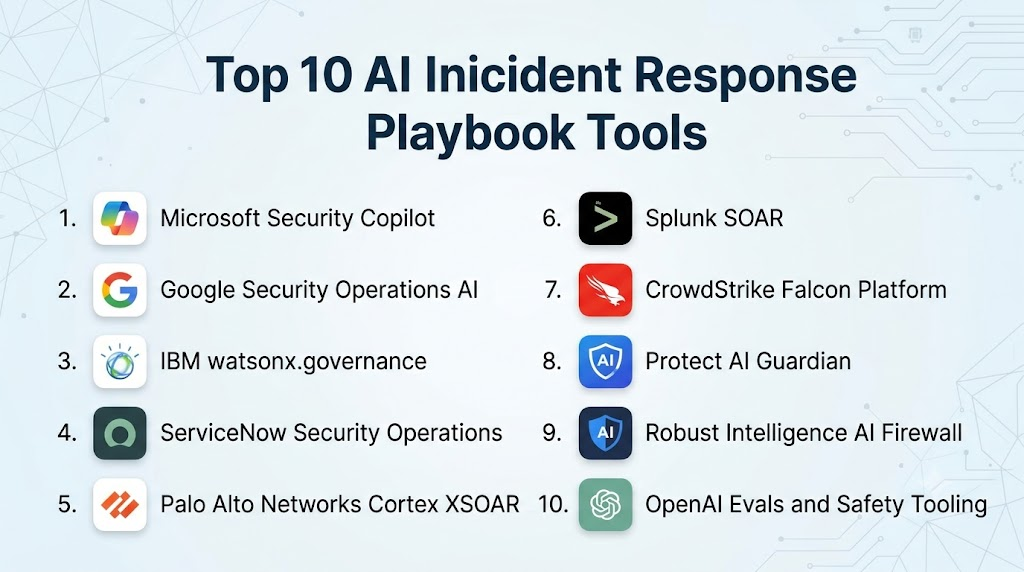
Top 10 AI Incident Response Playbook Tools
1- Microsoft Security Copilot
Verdict: Enterprise AI-powered security investigation and response platform.
Short Description: Microsoft Security Copilot helps security teams investigate threats, summarize incidents, and accelerate response workflows using AI-assisted analysis.
Key Features:
- AI-assisted incident investigation
- Security alert analysis
- Automated response recommendations
- Integration with Microsoft security tools
- Threat intelligence support
Pros:
- Strong enterprise ecosystem
- Advanced security integrations
Cons:
- Best suited for Microsoft environments
- Requires security expertise
Deployment: Cloud-based
Security & Compliance: Enterprise security standards
Integrations & Ecosystem: Microsoft Defender, Sentinel, security platforms
Support & Community: Enterprise support
Pricing Model: Subscription-based
Best-Fit Scenarios: Enterprise security operations
2- Google Security Operations AI
Verdict: AI-assisted security monitoring and investigation platform.
Short Description: Google Security Operations combines threat intelligence, analytics, and automation to help organizations detect and respond to security incidents.
Key Features:
- AI-assisted investigations
- Threat detection workflows
- Security analytics
- Automated response support
- Threat intelligence integration
Pros:
- Strong analytics capabilities
- Cloud-native scalability
Cons:
- Requires Google ecosystem knowledge
- Enterprise-focused solution
Deployment: Cloud-based
Security & Compliance: Enterprise security controls
Integrations & Ecosystem: Google Cloud security tools
Support & Community: Google enterprise support
Pricing Model: Usage-based
Best-Fit Scenarios: Large security teams
3- IBM watsonx.governance
Verdict: AI governance-focused incident management platform.
Short Description: IBM watsonx.governance helps organizations monitor AI risks, manage compliance issues, and establish responsible AI workflows.
Key Features:
- AI risk tracking
- Governance workflows
- Compliance reporting
- Model monitoring
- Audit management
Pros:
- Strong governance capabilities
- Enterprise compliance focus
Cons:
- Complex implementation
- Requires governance maturity
Deployment: Cloud and hybrid
Security & Compliance: Enterprise compliance support
Integrations & Ecosystem: IBM security and AI platforms
Support & Community: Enterprise support
Pricing Model: Enterprise licensing
Best-Fit Scenarios: Regulated organizations
4- ServiceNow Security Operations
Verdict: Workflow-driven incident response automation platform.
Short Description: ServiceNow Security Operations provides security incident workflows, automation, and case management capabilities for enterprise teams.
Key Features:
- Incident workflow automation
- Case management
- Security orchestration
- Reporting dashboards
- Integration ecosystem
Pros:
- Powerful workflow automation
- Enterprise adoption
Cons:
- Configuration complexity
- Higher enterprise cost
Deployment: Cloud-based
Security & Compliance: Enterprise security controls
Integrations & Ecosystem: ITSM, SIEM, security tools
Support & Community: Large enterprise community
Pricing Model: Subscription-based
Best-Fit Scenarios: Large IT and security teams
5- Palo Alto Networks Cortex XSOAR
Verdict: Advanced security orchestration for automated response.
Short Description: Cortex XSOAR helps teams automate incident investigation and response workflows across security environments.
Key Features:
- Automated playbooks
- Threat intelligence integration
- Incident automation
- Security orchestration
- Case management
Pros:
- Strong automation capabilities
- Extensive integrations
Cons:
- Requires security expertise
- Complex setup
Deployment: Cloud and enterprise
Security & Compliance: Enterprise security standards
Integrations & Ecosystem: SIEM, EDR, threat intelligence tools
Support & Community: Enterprise support
Pricing Model: Enterprise subscription
Best-Fit Scenarios: Security operations centers
6- Splunk SOAR
Verdict: Security automation platform with customizable playbooks.
Short Description: Splunk SOAR enables organizations to automate security incident response using configurable workflows and integrations.
Key Features:
- Automated response playbooks
- Security investigation workflows
- Threat intelligence integration
- Case management
- Custom automation
Pros:
- Flexible automation
- Strong security ecosystem
Cons:
- Requires skilled administrators
- Licensing complexity
Deployment: Cloud and on-premises
Security & Compliance: Enterprise security controls
Integrations & Ecosystem: Splunk ecosystem and security tools
Support & Community: Enterprise community
Pricing Model: Subscription-based
Best-Fit Scenarios: Security operations teams
7- CrowdStrike Falcon Platform
Verdict: AI-powered threat detection and response platform.
Short Description: CrowdStrike Falcon uses AI-driven security analytics to detect threats, investigate incidents, and automate response actions.
Key Features:
- AI threat detection
- Incident investigation
- Endpoint protection
- Threat intelligence
- Automated response
Pros:
- Strong detection capabilities
- Large threat intelligence network
Cons:
- Primarily security-focused
- Enterprise pricing
Deployment: Cloud-based
Security & Compliance: Enterprise security standards
Integrations & Ecosystem: Security operations tools
Support & Community: Enterprise support
Pricing Model: Subscription-based
Best-Fit Scenarios: Enterprise security teams
8- Protect AI Guardian
Verdict: AI-specific security monitoring and risk management platform.
Short Description: Protect AI Guardian focuses on protecting machine learning systems by monitoring AI risks, vulnerabilities, and security issues.
Key Features:
- AI vulnerability monitoring
- ML security assessment
- Risk tracking
- Model protection
- AI governance support
Pros:
- AI-focused security approach
- Designed for ML environments
Cons:
- Newer market category
- Limited ecosystem compared to SIEM tools
Deployment: Cloud-based
Security & Compliance: AI security controls
Integrations & Ecosystem: ML security workflows
Support & Community: Vendor support
Pricing Model: Enterprise-based
Best-Fit Scenarios: AI engineering teams
9- Robust Intelligence AI Firewall
Verdict: AI application protection with automated risk prevention.
Short Description: Robust Intelligence provides AI security controls designed to detect and prevent AI failures, attacks, and unsafe model behavior.
Key Features:
- AI attack detection
- Model testing
- Runtime protection
- Risk monitoring
- AI reliability controls
Pros:
- AI-native security capabilities
- Focused on model protection
Cons:
- Specialized use case
- Emerging ecosystem
Deployment: Cloud-based
Security & Compliance: AI security standards
Integrations & Ecosystem: AI development workflows
Support & Community: Vendor support
Pricing Model: Enterprise pricing
Best-Fit Scenarios: Organizations running production AI models
10- OpenAI Evals and Safety Tooling
Verdict: Developer-focused AI evaluation and safety workflow tools.
Short Description: OpenAI evaluation and safety tooling helps teams test AI behavior, identify failures, and improve model reliability.
Key Features:
- Model evaluation workflows
- Safety testing
- Output analysis
- Performance monitoring
- Custom evaluation datasets
Pros:
- Useful for AI developers
- Flexible testing approach
Cons:
- Limited enterprise incident workflow features
- Requires customization
Deployment: Cloud and developer environments
Security & Compliance: Depends on implementation
Integrations & Ecosystem: AI development pipelines
Support & Community: Developer community
Pricing Model: Usage-based or open tooling
Best-Fit Scenarios: AI development teams
Comparison Table
| Platform | AI Monitoring | Incident Automation | Governance | Integrations | Deployment |
|---|---|---|---|---|---|
| Microsoft Security Copilot | High | High | Medium | High | Cloud |
| Google Security Operations | High | High | Medium | High | Cloud |
| IBM watsonx.governance | High | Medium | High | High | Hybrid |
| ServiceNow Security Operations | Medium | High | Medium | High | Cloud |
| Cortex XSOAR | High | Very High | Medium | Very High | Cloud/Hybrid |
| Splunk SOAR | High | Very High | Medium | Very High | Cloud/On-prem |
| CrowdStrike Falcon | High | High | Medium | High | Cloud |
| Protect AI Guardian | Very High | Medium | High | Medium | Cloud |
| Robust Intelligence | Very High | High | High | Medium | Cloud |
| OpenAI Safety Tooling | Medium | Low | Medium | Medium | Cloud |
Evaluation & Scoring Table
| Platform | Security 25% | Automation 20% | Integrations 15% | AI Monitoring 15% | Ease 10% | Scalability 10% | Value 5% | Total |
|---|---|---|---|---|---|---|---|---|
| Microsoft Security Copilot | 24 | 18 | 15 | 14 | 9 | 10 | 5 | 95 |
| Google Security Operations | 23 | 18 | 14 | 15 | 9 | 10 | 5 | 94 |
| IBM watsonx.governance | 24 | 16 | 14 | 15 | 8 | 10 | 5 | 92 |
| ServiceNow Security Operations | 23 | 18 | 15 | 12 | 8 | 10 | 5 | 91 |
| Cortex XSOAR | 25 | 20 | 15 | 14 | 8 | 10 | 5 | 97 |
| Splunk SOAR | 24 | 20 | 15 | 14 | 8 | 10 | 5 | 96 |
| CrowdStrike Falcon | 25 | 18 | 14 | 14 | 9 | 10 | 5 | 95 |
| Protect AI Guardian | 23 | 16 | 12 | 15 | 8 | 9 | 5 | 88 |
| Robust Intelligence | 23 | 17 | 12 | 15 | 8 | 9 | 5 | 89 |
| OpenAI Safety Tooling | 20 | 12 | 10 | 12 | 9 | 8 | 5 | 76 |
Which AI Incident Response Playbook Tool Is Right for You?
- Enterprise Security Operations: Cortex XSOAR, Splunk SOAR, Microsoft Security Copilot
- AI Governance Teams: IBM watsonx.governance, Protect AI Guardian
- Cloud Security Teams: Google Security Operations, Microsoft Security Copilot
- AI Development Teams: OpenAI Safety Tooling, Robust Intelligence
- Highly Automated Response: Cortex XSOAR, Splunk SOAR
- Regulated Industries: IBM, Microsoft, CrowdStrike
Common Mistakes
- Treating AI incidents like traditional security incidents
- Lack of AI-specific monitoring
- Ignoring model behavior tracking
- Missing response ownership definitions
- Not maintaining incident documentation
Frequently Asked Questions
What are AI incident response playbook tools?
They help organizations detect, investigate, and respond to security and operational incidents involving AI systems.
Why are AI-specific incident tools needed?
AI systems introduce unique risks such as prompt attacks, model failures, and data leakage.
Can traditional security tools handle AI incidents?
Traditional tools help, but AI systems often require additional monitoring and governance capabilities.
Do these tools automate incident response?
Many provide automated workflows, investigation assistance, and response recommendations.
Which teams use AI incident response tools?
Security teams, AI engineers, compliance teams, and IT operations groups.
Can these tools monitor AI models in production?
Many platforms provide model monitoring, risk detection, and behavior analysis.
Are AI incident response tools suitable for enterprises?
Yes. Many are designed for large-scale security and compliance environments.
Do these platforms integrate with SIEM tools?
Most enterprise solutions integrate with SIEM, SOAR, and security monitoring platforms.
Can these tools help with AI compliance?
Yes. Many provide reporting, auditing, and governance capabilities.
Are open-source AI incident tools available?
Some AI evaluation and security frameworks are available, but enterprise features vary.
How should organizations start implementation?
Begin with AI asset discovery, risk assessment, and defined response workflows.
Do AI incident tools replace security teams?
No. They support teams by improving detection, investigation, and response efficiency.
Conclusion
AI Incident Response Playbook Tools are becoming essential as organizations expand AI adoption across critical workflows. Platforms like Cortex XSOAR, Splunk SOAR, Microsoft Security Copilot, and IBM watsonx.governance provide different approaches ranging from security automation to AI governance and model protection. The right solution depends on organizational needs, AI maturity, compliance requirements, and existing security infrastructure.
