Introduction
AI Electronic Lab Notebook (ELN) Assistants use artificial intelligence (AI), machine learning (ML), natural language processing (NLP), and scientific data intelligence to help researchers capture, organize, analyze, and manage laboratory information. These platforms enhance traditional electronic lab notebooks by adding intelligent automation, research assistance, data interpretation, experiment documentation support, and workflow optimization.
Traditional laboratory documentation often involves manual note-taking, scattered research files, inconsistent experiment records, and time-consuming data organization. AI-powered ELN assistants help researchers automatically structure experimental information, summarize findings, extract insights from scientific data, and improve collaboration across research teams.
Modern AI ELN solutions combine features such as intelligent search, experiment tracking, scientific knowledge management, automated documentation, data visualization, workflow automation, and integration with laboratory instruments. These platforms support pharmaceutical companies, biotechnology organizations, academic institutions, chemical laboratories, and research teams.
AI Electronic Lab Notebook Assistants integrate with Laboratory Information Management Systems (LIMS), laboratory automation platforms, scientific databases, analytical instruments, and research collaboration tools. They are designed to support scientists by improving productivity and data management while maintaining research accuracy, compliance, and human oversight.
Real-world Use Cases
- Experiment documentation
- Research data organization
- Scientific note automation
- Literature analysis
- Protocol management
- Laboratory collaboration
- Data search and discovery
- Research workflow automation
- Compliance documentation
- Knowledge management
Evaluation Criteria for Buyers
When selecting an AI Electronic Lab Notebook Assistant, consider:
- AI documentation capabilities
- Scientific data management
- Search and knowledge discovery
- LIMS integration
- Laboratory workflow support
- Collaboration features
- Data security
- Compliance capabilities
- Scalability
- Ease of adoption
Best For
- Pharmaceutical companies
- Biotechnology organizations
- Academic research teams
- Chemical laboratories
- Life science organizations
Not Ideal For
Organizations expecting AI to replace scientific judgment, experimental design, or laboratory validation processes.
Key Trends
- AI-powered scientific documentation
- Intelligent research assistants
- Automated experiment summaries
- Digital laboratory transformation
- Scientific knowledge graphs
- Cloud-based research platforms
- AI-driven data analysis
- Connected laboratory ecosystems
- Research collaboration automation
- Autonomous research workflows
Methodology
The platforms below were evaluated based on:
- AI assistance capabilities
- ELN functionality
- Scientific workflow support
- Integration capabilities
- Data management maturity
- Research adoption
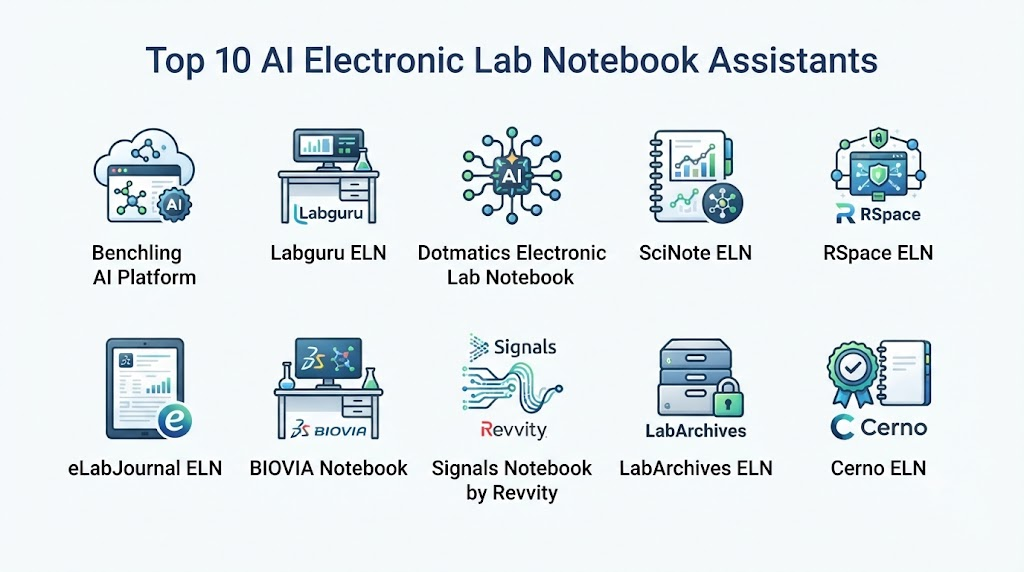
Top 10 AI Electronic Lab Notebook Assistants
1. Benchling
Verdict: Best overall AI-enabled ELN platform for biotechnology research.
Short Description: Benchling provides a cloud-based research platform combining electronic lab notebooks, scientific data management, collaboration tools, and biotechnology workflows.
Key Features
- Electronic lab notebooks
- Research data management
- Experiment tracking
- Collaboration workflows
- Scientific knowledge organization
Pros
- Strong biotechnology adoption
- Centralized research data
- Modern cloud architecture
Cons
- Enterprise-focused implementation
Deployment: Cloud-based
Security & Compliance: Enterprise research data controls
Integrations & Ecosystem: LIMS, laboratory tools, scientific workflows
Support & Community: Enterprise research support
Pricing Model: Custom enterprise pricing
Best-Fit Scenarios: Biotechnology and pharmaceutical research
2. Dotmatics
Verdict: Comprehensive scientific informatics platform with ELN capabilities.
Short Description: Dotmatics provides research software solutions that combine electronic lab notebooks, scientific data management, visualization, and laboratory workflow support.
Key Features
- Electronic lab notebooks
- Scientific data management
- Research collaboration
- Experiment tracking
- Data visualization
Pros
- Broad scientific ecosystem
- Supports multiple research areas
Cons
- Requires implementation planning
3. LabArchives
Verdict: Flexible ELN platform for academic and research organizations.
Short Description: LabArchives provides electronic laboratory notebook capabilities that help researchers document experiments, manage data, and collaborate securely.
Key Features
- Digital experiment records
- Research documentation
- Collaboration tools
- Data organization
- Laboratory workflows
Pros
- Easy adoption
- Supports education and research
Cons
- Advanced AI features may vary
4. SciNote
Verdict: Open and flexible ELN platform supporting research documentation.
Short Description: SciNote provides electronic lab notebook capabilities for managing experiments, protocols, inventory, and research collaboration.
Key Features
- Experiment documentation
- Protocol management
- Inventory tracking
- Team collaboration
- Research organization
Pros
- Flexible platform
- Research-friendly interface
Cons
- Requires configuration for advanced workflows
5. RSpace ELN
Verdict: Secure research-focused electronic lab notebook platform.
Short Description: RSpace provides ELN capabilities for academic, pharmaceutical, and research organizations requiring secure experiment documentation and collaboration.
Key Features
- Experiment records
- Research documentation
- Data management
- Collaboration
- Integration support
Pros
- Strong security focus
- Research-oriented platform
Cons
- Less focused on advanced AI automation
6. Thermo Fisher Scientific SampleManager LIMS + ELN Capabilities
Verdict: Enterprise laboratory data management solution.
Short Description: Thermo Fisher provides laboratory informatics solutions that combine sample management, workflows, and research data organization.
Key Features
- Laboratory data management
- Sample tracking
- Workflow automation
- Research documentation
- Compliance support
Pros
- Enterprise laboratory capabilities
- Strong industry adoption
Cons
- Complex deployment
7. TetraScience Scientific Data Cloud
Verdict: Scientific data platform supporting connected research environments.
Short Description: TetraScience helps organizations collect, organize, and manage scientific data from laboratory systems and instruments.
Key Features
- Scientific data integration
- Laboratory connectivity
- Data pipelines
- Research analytics
- Cloud infrastructure
Pros
- Strong data management
- Enterprise scalability
Cons
- More focused on data infrastructure
8. PerkinElmer Signals Notebook
Verdict: Enterprise ELN platform for scientific research workflows.
Short Description: Signals Notebook provides electronic laboratory notebook capabilities for managing experiments, scientific data, and research collaboration.
Key Features
- Experiment documentation
- Research workflows
- Data capture
- Collaboration tools
- Scientific analysis
Pros
- Strong life sciences focus
- Enterprise capabilities
Cons
- Requires implementation effort
9. IDBS E-WorkBook
Verdict: Enterprise research data management and ELN platform.
Short Description: IDBS E-WorkBook helps organizations manage research data, experiments, workflows, and scientific collaboration.
Key Features
- Electronic laboratory notebooks
- Research workflow management
- Data organization
- Collaboration
- Compliance support
Pros
- Strong enterprise research capabilities
- Supports complex workflows
Cons
- Primarily enterprise-focused
10. OpenAI-Based Custom AI ELN Assistant
Verdict: Flexible AI assistant for customized laboratory documentation workflows.
Short Description: Research organizations can build custom AI ELN assistants using large language models integrated with ELN platforms, LIMS systems, scientific databases, laboratory instruments, and research workflows. These assistants can summarize experiments, generate documentation, analyze research notes, and improve knowledge discovery while requiring scientific review.
Key Features
- Experiment summarization
- Research note analysis
- Protocol assistance
- Scientific knowledge search
- Workflow automation
Pros
- Highly customizable
- Flexible integrations
- Improves researcher productivity
Cons
- Requires AI implementation expertise
- Human validation required
Comparison Table
| Platform | AI Assistance | ELN Capability | Data Management | Integration | Best Use |
|---|---|---|---|---|---|
| Benchling | Excellent | Excellent | Excellent | Excellent | Biotechnology Research |
| Dotmatics | High | Excellent | Excellent | Excellent | Scientific Informatics |
| LabArchives | Medium | Excellent | High | High | Academic Research |
| SciNote | Medium | High | High | High | Research Documentation |
| RSpace | Medium | High | High | High | Secure Research |
| Thermo Fisher SampleManager | High | Excellent | Excellent | Excellent | Enterprise Labs |
| TetraScience | High | Medium | Excellent | Excellent | Scientific Data |
| Signals Notebook | High | Excellent | Excellent | High | Life Sciences |
| IDBS E-WorkBook | High | Excellent | Excellent | High | Enterprise Research |
| OpenAI Custom | Custom | Custom | Custom | Custom | AI ELN Assistant |
Evaluation & Scoring Table
| Platform | AI Features 20% | ELN Capability 20% | Data Management 15% | Integration 15% | Security 10% | Ease 10% | Value 10% | Total |
|---|---|---|---|---|---|---|---|---|
| Benchling | 20 | 20 | 15 | 15 | 10 | 8 | 8 | 96 |
| Dotmatics | 19 | 20 | 15 | 15 | 10 | 8 | 8 | 95 |
| Signals Notebook | 18 | 20 | 15 | 14 | 10 | 8 | 8 | 93 |
| IDBS E-WorkBook | 18 | 20 | 15 | 14 | 10 | 8 | 8 | 93 |
| Thermo Fisher SampleManager | 18 | 19 | 15 | 15 | 10 | 8 | 8 | 93 |
| TetraScience | 18 | 16 | 15 | 15 | 10 | 8 | 8 | 90 |
| LabArchives | 17 | 18 | 13 | 13 | 10 | 9 | 8 | 88 |
| SciNote | 17 | 17 | 13 | 13 | 10 | 9 | 8 | 87 |
| RSpace | 17 | 17 | 13 | 13 | 10 | 8 | 8 | 86 |
| OpenAI Custom | 20 | 16 | 12 | 15 | 8 | 7 | 9 | 87 |
Which AI Electronic Lab Notebook Assistant Is Right for You?
| If your priority is… | Recommended Platform |
|---|---|
| Biotechnology research ELN | Benchling |
| Scientific informatics | Dotmatics |
| Academic research documentation | LabArchives |
| Flexible research ELN | SciNote |
| Secure research records | RSpace |
| Enterprise laboratory workflows | Thermo Fisher SampleManager |
| Scientific data infrastructure | TetraScience |
| Life sciences ELN | Signals Notebook |
| Enterprise research management | IDBS E-WorkBook |
| Custom AI ELN assistant | OpenAI-Based AI Assistant |
Implementation Playbook
First 30 Days
- Identify documentation challenges
- Review laboratory workflows
- Define ELN requirements
- Select integration needs
Days 31–60
- Configure ELN workflows
- Connect research systems
- Train scientists
- Import existing documentation
Days 61–90
- Enable AI assistance
- Automate summaries
- Improve knowledge discovery
- Optimize research collaboration
Common Mistakes
- Poor workflow planning
- Ignoring data standards
- Lack of researcher adoption
- Weak integration strategy
- Poor access controls
- Ignoring compliance needs
- Over-automating scientific decisions
- Not validating AI-generated content
Frequently Asked Questions
1. What are AI Electronic Lab Notebook Assistants?
They are AI-enhanced ELN systems that help researchers document, organize, analyze, and manage laboratory information.
2. How does AI improve ELN systems?
AI helps summarize experiments, organize data, search research information, and automate documentation tasks.
3. Can AI replace scientists using ELNs?
No. AI supports researchers but does not replace scientific decision-making.
4. Who uses AI ELN platforms?
Pharmaceutical companies, biotechnology organizations, academic researchers, and laboratories.
5. What systems do ELN assistants integrate with?
They integrate with LIMS, laboratory instruments, scientific databases, and research platforms.
6. Can AI help with experiment documentation?
Yes. AI can generate summaries, organize notes, and improve documentation workflows.
7. Are AI ELN systems secure?
Organizations should evaluate security controls, access management, and research data protection.
8. What industries use ELN platforms?
Life sciences, biotechnology, pharmaceuticals, chemicals, and academic research.
9. Can ELNs improve research collaboration?
Yes. They provide centralized access to experiment records and scientific information.
10. What should buyers evaluate before adoption?
Consider AI capabilities, ELN features, integrations, scalability, security, and research workflow requirements.
Conclusion
AI Electronic Lab Notebook Assistants are transforming scientific research by improving experiment documentation, data organization, collaboration, and knowledge discovery. By combining artificial intelligence, laboratory informatics, and research workflow automation, these platforms help scientists manage increasingly complex research environments. Organizations adopting AI ELN solutions should focus on usability, integration capabilities, data security, compliance requirements, and scientific workflow support. Platforms such as Benchling, Dotmatics, Signals Notebook, IDBS E-WorkBook, and Thermo Fisher laboratory solutions demonstrate how AI-enabled electronic lab notebooks are creating more connected, efficient, and intelligent research environments.
