Introduction
AI Pharmacovigilance Signal Detection Tools use artificial intelligence (AI), machine learning (ML), natural language processing (NLP), and advanced analytics to identify potential safety signals associated with medicines, vaccines, and healthcare products.
Pharmacovigilance teams analyze large volumes of safety information from sources such as adverse event reports, electronic health records, scientific literature, regulatory databases, and social media channels. Traditional signal detection methods often require extensive manual review, making it difficult to identify emerging safety patterns quickly and efficiently.
AI-powered pharmacovigilance platforms help automate adverse event processing, detect unusual safety trends, prioritize potential risks, and support regulatory reporting workflows. These solutions analyze complex safety data using machine learning models, statistical algorithms, text analytics, and knowledge graphs to improve drug safety monitoring.
Modern AI Pharmacovigilance Signal Detection platforms integrate with safety databases, clinical trial systems, regulatory reporting solutions, medical literature databases, and enterprise healthcare systems. They support pharmaceutical companies, biotechnology organizations, contract research organizations (CROs), and regulatory teams in improving medicine safety surveillance.
These tools assist pharmacovigilance professionals by improving efficiency and identifying potential safety concerns while requiring expert medical review, validation, and regulatory oversight.
Real-world Use Cases
- Adverse event signal detection
- Drug safety monitoring
- Medical literature screening
- Case processing automation
- Risk assessment
- Regulatory reporting support
- Vaccine safety surveillance
- Post-market surveillance
- Benefit-risk analysis
- Safety trend analysis
Evaluation Criteria for Buyers
When selecting an AI Pharmacovigilance Signal Detection Tool, consider:
- AI signal detection capabilities
- Adverse event processing
- NLP and text analytics
- Regulatory compliance support
- Safety database integration
- Automation capabilities
- Data security
- Scalability
- Reporting features
- Human review workflows
Best For
- Pharmaceutical companies
- Biotechnology organizations
- CROs
- Drug safety teams
- Regulatory affairs departments
Not Ideal For
Organizations expecting AI to replace medical experts, safety reviewers, or regulatory decision-making processes.
Key Trends
- AI-driven drug safety monitoring
- Automated adverse event processing
- NLP-based literature surveillance
- Real-world evidence analytics
- Predictive pharmacovigilance
- Regulatory automation
- Knowledge graph-based safety analysis
- Intelligent case management
- Global safety data integration
- Continuous safety monitoring
Methodology
The platforms below were evaluated based on:
- AI pharmacovigilance capabilities
- Signal detection performance
- Safety workflow integration
- Regulatory support
- Automation maturity
- Industry adoption
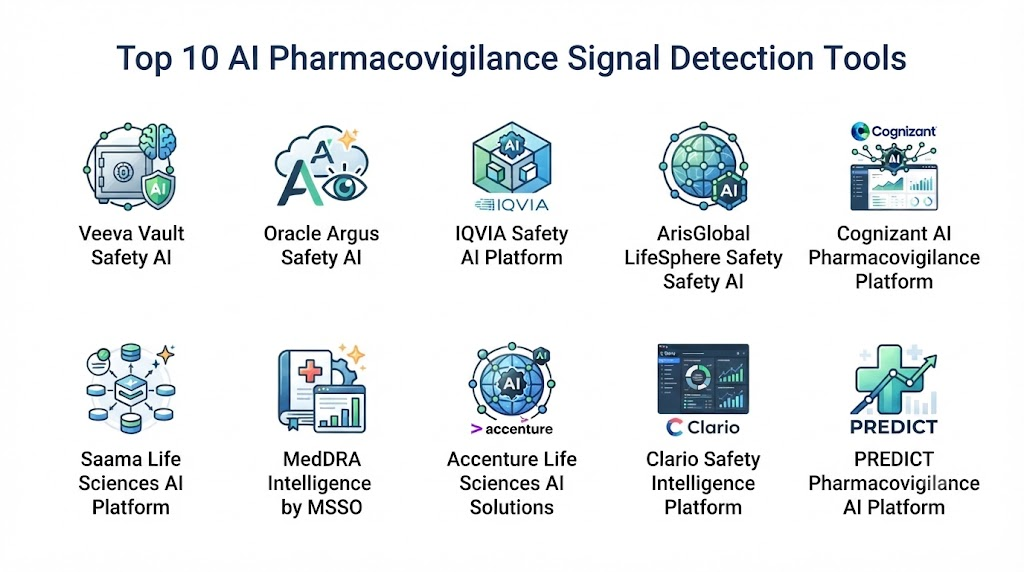
Top 10 AI Pharmacovigilance Signal Detection Tools
1. Oracle Argus Safety AI Capabilities
Verdict: Best overall enterprise pharmacovigilance platform.
Short Description: Oracle Argus Safety provides a comprehensive drug safety management platform supporting adverse event processing, case management, regulatory reporting, and safety surveillance workflows.
Key Features
- Adverse event management
- Safety case processing
- Signal management
- Regulatory reporting
- Workflow automation
Pros
- Strong pharmaceutical adoption
- Enterprise-scale safety management
- Broad regulatory support
Cons
- Requires enterprise implementation
Deployment: Enterprise environments
Security & Compliance: Pharmaceutical data security controls
Integrations & Ecosystem: Safety databases, regulatory systems, clinical platforms
Support & Community: Enterprise support
Pricing Model: Custom enterprise pricing
Best-Fit Scenarios: Global pharmacovigilance operations
2. Veeva Vault Safety
Verdict: Modern cloud-based safety platform with intelligent automation.
Short Description: Veeva Vault Safety helps life sciences organizations manage adverse events, safety workflows, regulatory submissions, and pharmacovigilance operations.
Key Features
- Safety case management
- Workflow automation
- Regulatory reporting
- Safety analytics
- Cloud collaboration
Pros
- Modern cloud architecture
- Strong life sciences ecosystem
Cons
- Requires migration planning
3. IQVIA Vigilance Platform
Verdict: AI-supported safety intelligence platform.
Short Description: IQVIA provides pharmacovigilance solutions that combine healthcare data, analytics, and technology to support drug safety monitoring and signal detection.
Key Features
- Safety analytics
- Signal detection
- Real-world evidence analysis
- Case processing
- Regulatory support
Pros
- Strong healthcare data capabilities
- Global pharmacovigilance expertise
Cons
- Enterprise-focused solution
4. ArisGlobal LifeSphere Safety
Verdict: AI-enabled pharmacovigilance and safety automation platform.
Short Description: ArisGlobal LifeSphere Safety uses automation and intelligent workflows to support adverse event processing, signal management, and regulatory compliance.
Key Features
- Safety case processing
- AI automation
- Signal detection
- Regulatory reporting
- Workflow management
Pros
- Strong automation capabilities
- Designed for life sciences
Cons
- Complex enterprise deployment
5. AETION Evidence Platform
Verdict: Real-world evidence platform supporting safety analysis.
Short Description: Aetion uses analytics and healthcare data to generate real-world evidence insights supporting safety monitoring and regulatory research.
Key Features
- Real-world evidence analysis
- Safety studies
- Healthcare data analytics
- Regulatory research support
- Patient population analysis
Pros
- Strong evidence generation capabilities
- Supports regulatory research
Cons
- More analytics focused than complete safety management
6. Linguamatics NLP Platform
Verdict: NLP-powered platform for medical literature and safety intelligence.
Short Description: Linguamatics uses natural language processing to extract insights from scientific literature and healthcare documents for research and safety analysis.
Key Features
- Medical text mining
- Literature analysis
- NLP extraction
- Knowledge discovery
- Research intelligence
Pros
- Strong NLP capabilities
- Handles large text datasets
Cons
- Requires configuration expertise
7. MedDRA-Based AI Safety Analytics Platforms
Verdict: AI-supported medical terminology and safety analysis approach.
Short Description: AI systems integrated with MedDRA terminology help organizations classify adverse events, analyze safety patterns, and improve pharmacovigilance workflows.
Key Features
- Medical coding support
- Safety data classification
- Signal analysis
- Terminology management
- Reporting support
Pros
- Improves consistency
- Supports regulatory workflows
Cons
- Requires integration with safety systems
8. SAS Drug Development Safety Analytics
Verdict: Advanced analytics platform for pharmaceutical safety research.
Short Description: SAS provides analytics capabilities that help organizations analyze clinical and safety data for pharmacovigilance and regulatory decision support.
Key Features
- Statistical analysis
- Safety analytics
- Data modeling
- Clinical research support
- Reporting
Pros
- Strong analytics reputation
- Enterprise scalability
Cons
- Requires analytics expertise
9. Saama AI Life Sciences Analytics
Verdict: AI analytics platform supporting clinical and safety insights.
Short Description: Saama uses artificial intelligence and analytics to help life sciences organizations improve clinical data analysis and operational decision-making.
Key Features
- AI analytics
- Safety data insights
- Clinical intelligence
- Data automation
- Reporting support
Pros
- Strong AI capabilities
- Life sciences focus
Cons
- Requires implementation support
10. OpenAI-Based Custom AI Pharmacovigilance Assistant
Verdict: Flexible AI assistant for customized drug safety workflows.
Short Description: Organizations can build custom AI pharmacovigilance assistants using large language models integrated with safety databases, adverse event repositories, medical literature sources, regulatory systems, and healthcare datasets. These assistants can summarize safety cases, analyze literature, identify patterns, and support pharmacovigilance teams while requiring expert review.
Key Features
- Safety report summarization
- Literature analysis
- Signal investigation support
- Regulatory document assistance
- Knowledge discovery
Pros
- Highly customizable
- Flexible integrations
- Improves safety team productivity
Cons
- Requires pharmacovigilance expertise
- Human validation required
Comparison Table
| Platform | AI Capability | Signal Detection | Safety Management | Regulatory Support | Best Use |
|---|---|---|---|---|---|
| Oracle Argus Safety | High | Excellent | Excellent | Excellent | Enterprise PV |
| Veeva Vault Safety | High | Excellent | Excellent | Excellent | Cloud Safety Management |
| IQVIA Vigilance | Excellent | Excellent | High | Excellent | Global Safety Analytics |
| ArisGlobal LifeSphere | Excellent | Excellent | Excellent | Excellent | Safety Automation |
| Aetion | High | High | Medium | High | Real-World Evidence |
| Linguamatics | Excellent | High | Medium | Medium | Literature Intelligence |
| MedDRA AI Analytics | High | High | High | High | Safety Classification |
| SAS Safety Analytics | High | High | Medium | High | Statistical Safety Analysis |
| Saama | Excellent | High | Medium | High | AI Life Sciences Analytics |
| OpenAI Custom | Custom | Custom | Custom | Custom | AI Safety Assistant |
Evaluation & Scoring Table
| Platform | AI Features 20% | Signal Accuracy 20% | Safety Data 15% | Integration 15% | Security 10% | Ease 10% | Value 10% | Total |
|---|---|---|---|---|---|---|---|---|
| ArisGlobal LifeSphere | 20 | 20 | 15 | 15 | 10 | 8 | 8 | 96 |
| Oracle Argus Safety | 19 | 20 | 15 | 15 | 10 | 8 | 8 | 95 |
| Veeva Vault Safety | 19 | 19 | 15 | 15 | 10 | 8 | 8 | 94 |
| IQVIA Vigilance | 20 | 19 | 15 | 14 | 10 | 8 | 8 | 94 |
| Saama | 19 | 18 | 14 | 14 | 10 | 8 | 8 | 91 |
| Linguamatics | 18 | 18 | 13 | 13 | 10 | 9 | 8 | 89 |
| SAS Safety Analytics | 18 | 18 | 14 | 13 | 10 | 8 | 8 | 89 |
| Aetion | 17 | 17 | 14 | 14 | 10 | 8 | 8 | 88 |
| MedDRA AI Analytics | 17 | 17 | 13 | 14 | 10 | 8 | 8 | 87 |
| OpenAI Custom | 20 | 16 | 12 | 15 | 8 | 7 | 9 | 87 |
Which AI Pharmacovigilance Signal Detection Tool Is Right for You?
| If your priority is… | Recommended Platform |
|---|---|
| Enterprise safety management | Oracle Argus Safety |
| Cloud pharmacovigilance | Veeva Vault Safety |
| Global safety intelligence | IQVIA Vigilance |
| Safety automation | ArisGlobal LifeSphere |
| Real-world evidence safety analysis | Aetion |
| Literature signal detection | Linguamatics |
| Statistical safety analytics | SAS |
| AI life sciences analytics | Saama |
| Medical coding intelligence | MedDRA AI Analytics |
| Custom AI safety assistant | OpenAI-Based AI Assistant |
Implementation Playbook
First 30 Days
- Define pharmacovigilance goals
- Review safety data sources
- Identify signal detection requirements
- Select AI workflow priorities
Days 31–60
- Integrate safety databases
- Configure AI analytics workflows
- Train safety teams
- Validate signal detection processes
Days 61–90
- Automate monitoring workflows
- Improve signal prioritization
- Optimize reporting processes
- Establish continuous safety review
Common Mistakes
- Treating AI signals as final decisions
- Ignoring medical review
- Poor safety data quality
- Weak regulatory alignment
- Lack of workflow integration
- Ignoring patient privacy
- Overlooking false positives
- Poor validation processes
Frequently Asked Questions
1. What are AI Pharmacovigilance Signal Detection Tools?
They are AI-powered systems that analyze safety data to identify potential medicine-related risks.
2. How does AI improve pharmacovigilance?
AI helps process large safety datasets, detect patterns, and prioritize potential signals.
3. Can AI replace drug safety experts?
No. AI supports pharmacovigilance teams but requires expert medical review.
4. Who uses AI pharmacovigilance platforms?
Pharmaceutical companies, CROs, biotechnology organizations, and regulatory teams.
5. What data sources do these tools analyze?
They analyze adverse event reports, medical literature, clinical data, and real-world evidence.
6. Can AI detect new drug safety risks?
Yes. AI can identify unusual patterns requiring further investigation.
7. Are AI safety signals automatically approved?
No. Signals require expert assessment and regulatory review.
8. Do these platforms support regulatory reporting?
Many platforms integrate with regulatory reporting workflows.
9. How is safety data protected?
Organizations use secure systems, access controls, and compliance practices.
10. What should buyers evaluate before adoption?
Consider AI capabilities, regulatory support, integrations, security, scalability, and workflow requirements.
Conclusion
AI Pharmacovigilance Signal Detection Tools are transforming drug safety monitoring by helping organizations analyze large volumes of safety information, identify potential risks earlier, and improve regulatory workflows. By combining artificial intelligence, natural language processing, predictive analytics, and healthcare data intelligence, these platforms support faster and more effective pharmacovigilance operations.Organizations adopting AI pharmacovigilance solutions should focus on data quality, regulatory alignment, expert validation, and workflow integration. Platforms such as ArisGlobal LifeSphere, Oracle Argus Safety, Veeva Vault Safety, IQVIA Vigilance, and Saama demonstrate how artificial intelligence is improving medicine safety monitoring and supporting better healthcare outcomes.
