Last updated: 29 November 2026
The main difference between SOA and microservices is scope. Service-oriented architecture (SOA) is usually an enterprise-wide approach that exposes business functions as services so that many applications can share them. Microservices is a way to build a particular application or product as a set of small services that teams can deploy independently.
That difference drives most of the others: how services talk to each other, who owns the data, how much gets reused and how releases happen. The two styles share ideas, so the boundary is not always sharp.
SOA and Microservices in Plain Terms
What is SOA?
The Open Group, a standards body, defines SOA as an architectural style that supports service-orientation. In simple terms, you organize systems around services that represent useful functions, rather than around individual applications.
Picture a company with separate billing, customer relationship and warehouse systems. In an SOA program, capabilities such as “check credit” or “get customer record” are published as services with agreed contracts. Any approved application can call them.
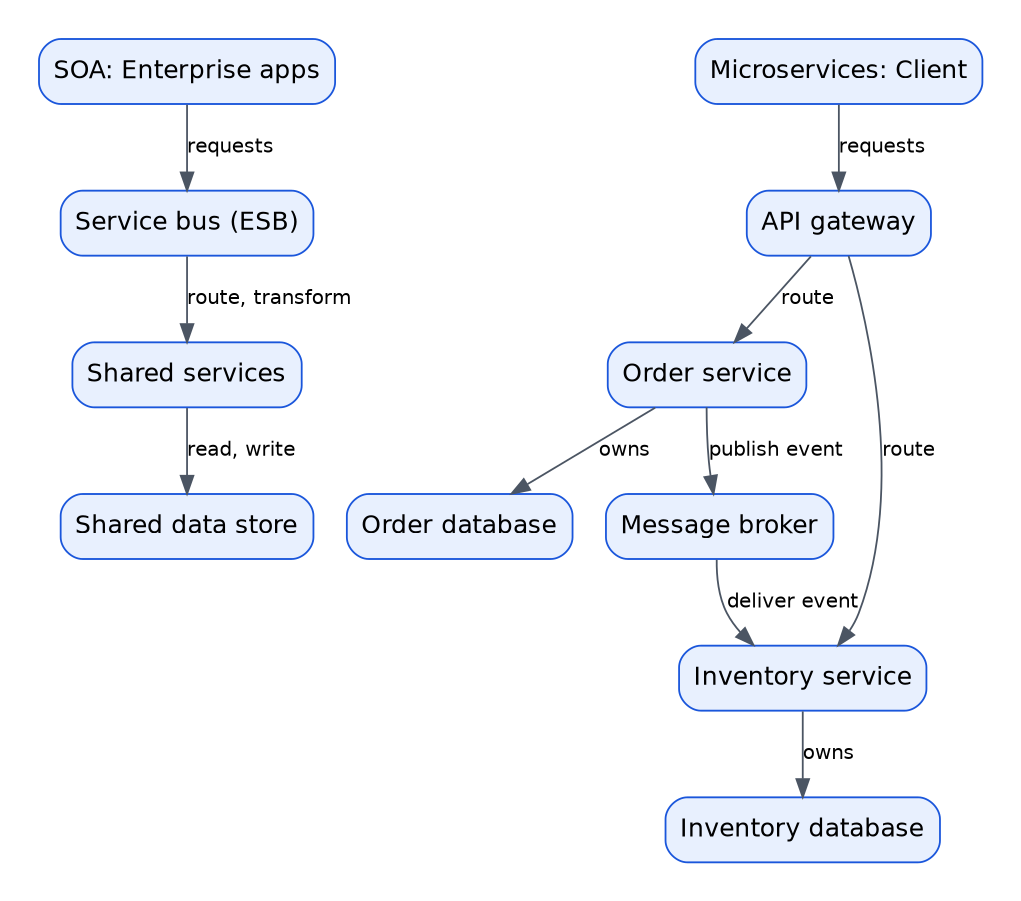
Many SOA implementations connect these services through an enterprise service bus (ESB). This is a central integration layer that can route messages, translate formats and protocols, and apply rules. AWS lists SOAP, AMQP and MSMQ among the protocols used in this setting. An ESB is a common implementation choice, though, and the Open Group’s short definition does not depend on one.
What are microservices?
Microsoft’s Azure Architecture Center describes microservices as small, autonomous services. Each should implement a single business capability within a bounded context, which is a clear boundary inside which one model of the business applies.
Each service has its own codebase, can be deployed without redeploying the whole application, and is responsible for its own data. Services communicate through well-defined APIs or asynchronous messages, and they do not have to share a technology stack.
James Lewis and Martin Fowler popularized a description of the style in an article dated March 2014. They offered common characteristics rather than a formal definition, including organization around business capabilities, automated deployment, “smart endpoints and dumb pipes”, and decentralized control of data and technology.
The Difference Between SOA and Microservices at a Glance
The table shows typical tendencies. Real systems often mix traits from both columns.
| Dimension | SOA (typical) | Microservices (typical) |
|---|---|---|
| Scope | Enterprise, across many applications | One application or product domain |
| Main goal | Integration and reuse | Independent change, deployment and scaling |
| Service size | Often a broad business function | A narrower capability owned by a small team |
| Communication | Often through a central ESB | APIs and lightweight messaging |
| Where logic lives | Services, and sometimes the bus | Services; the transport stays simple |
| Data | Often shared data stores | Private to the owning service |
| Reuse | Strongly encouraged | Through APIs; some duplication accepted |
| Governance | More centralized standards | More team autonomy within platform guardrails |
| Main risk | The bus or a shared service becomes a bottleneck | Distributed system and operational complexity |
How the Differences Work in Practice
Integration: smart bus or smart services
In an ESB-centered design, the bus may decide where a message goes, convert it and apply business rules. This helps when you must connect older systems that you cannot easily change. The cost is that important behavior collects in one shared place. AWS and IBM both point out that the ESB can become a single point of failure.
Microservices favor putting domain logic in the services. HTTP APIs and message brokers carry requests and events without knowing the business rules. An API gateway often sits in front for routing and shared concerns such as authentication. Microsoft advises keeping domain knowledge out of that gateway, or it turns into a new coupling point.
Data: share it or own it
SOA environments often let several services use the same data stores. This supports consistent data governance, but a schema change can affect many consumers.
A microservice keeps its storage private. Other services ask through its API or keep a local copy built from its events. This allows each team to pick a suitable database and change its schema more safely.
The price is consistency. A business operation spanning several services usually cannot rely on one ordinary database transaction. Teams commonly design for eventual consistency and use compensating actions, such as releasing reserved stock when a payment fails.
Reuse versus independence
Reuse is a central promise of SOA: build a capability once and let many applications call it. Every new consumer, however, adds another party that a change might break.
Microservices are more willing to accept duplication to keep services decoupled. This does not mean copying everything. It means weighing the convenience of shared code or data against the release coordination it creates.
Deployment, size and teams
Independent deployment is the practical test for microservices. If five services must always be released together, you have added network calls without gaining autonomy.
There is no correct number of lines of code. Lewis and Fowler reported a range of sizes, from teams of about a dozen people per service to a team of about six supporting six services. Business boundaries and ownership are better guides than smallness.
A Worked Example: Placing an Order
This is a hypothetical online store. The snippets are simplified illustrations and have not been tested here.
In an ESB-style SOA design, the ordering application sends one request to the bus. The routing rules below are pseudocode, not the syntax of any product.
on message "SubmitOrder":
    convert web format to enterprise order format
    call CustomerService.checkCredit
    if approved:
        call InventorySystem.reserve   (translate to legacy protocol)
        call BillingSystem.createInvoice
    else:
        return rejection
In a microservices design, the Order service saves the order in its own database and publishes an event.
POST /orders HTTP/1.1
Host: localhost:8080
Content-Type: application/json

{"customerId": "C-100", "items": [{"sku": "BOOK-1", "qty": 2}]}

Event published by the Order service:
{
  "type": "OrderPlaced",
  "eventId": "evt-001",
  "orderId": "O-500",
  "items": [{"sku": "BOOK-1", "qty": 2}]
}
The Inventory service reacts to the event, reserves stock and publishes its own result. Payment and Order services respond in turn. No central component holds the whole workflow in this version.
Event choreography is only one option. Microservices can also use direct synchronous calls or an explicit orchestrator for a workflow. Orchestration alone does not make a system SOA.
Which Should You Choose?
SOA-style integration fits when
- You need to connect many existing or standalone enterprise applications.
- Those systems use different protocols and data formats.
- Several departments need the same governed business capabilities.
Microservices fit when
- Several teams need to release parts of one product on separate schedules.
- Different parts have clearly different scaling or technology needs.
- You have solid automated testing, CI/CD, monitoring and on-call ownership.
Consider neither yet when
A small team with an unsettled domain may be better served by a well-structured modular monolith. Microsoft notes that microservices have more moving parts than an equivalent monolith and demand mature development and operations practices.
You can also combine the styles. A company might use SOA principles to integrate its major systems while one digital product inside it is built as microservices.
Best Practices
- Start with business boundaries. Map capabilities and data ownership before choosing tools.
- Treat contracts as products. Version them, test compatibility and know your consumers.
- Keep the middle thin. Put business rules with an owning service, not in a gateway or broker.
- Design for failure. Set timeouts, limit retries and make repeated messages safe to process.
- Trace requests end to end. Use centralized logs, metrics and distributed tracing, for example with OpenTelemetry.
- Standardize the platform. Team autonomy still benefits from common security, logging and deployment rules.
Common Mistakes and Troubleshooting
| Symptom | Likely cause | What to try |
|---|---|---|
| Services must be released together | Tight contracts or poor boundaries | Use backward-compatible changes, or merge the services |
| One schema change breaks several services | Shared database | Assign an owner and move access behind APIs or events |
| A user request is slow | Long chain of synchronous calls | Trace it, reduce chattiness, make suitable steps asynchronous |
| Every change waits on the integration team | Business logic concentrated in the bus | Move rules gradually into the services that own them |
| An order is charged twice | Retried request or redelivered message | Use idempotency keys and record processed event IDs |
Another frequent mistake is calling any system with REST APIs “microservices”. The protocol says little about ownership or deployability. Likewise, SOA does not have to mean SOAP.
Hands-On Exercise: Classify Your Architecture
Take a system you know, or the store above, and answer these questions for each service.
- Who consumes it: one product, or many applications across the organization?
- Can it be deployed without coordinating with another team?
- Does any other service read or write its database directly?
- Where do its routing, transformation and business rules live?
- What happens to users if it is unavailable for ten minutes?
Record the answers like this. The entry is invented for illustration.
service: inventory
consumers: [orders, warehouse-app]
deploys_independently: false
database_shared_with: [billing]
rules_outside_service: ["stock rounding in ESB"]
if_down: "orders cannot be confirmed"
next_action: "remove billing's direct database access"
Broad cross-application consumption points toward SOA concerns. Independent deployment and private data point toward microservices. Mixed answers are normal; use them to choose one improvement instead of chasing a label.
FAQ
Are microservices a type of SOA?
It depends on how broadly you define SOA. Lewis and Fowler acknowledged that microservices resemble what some SOA advocates had favored, and that some people see them as service orientation done right. They also argued that SOA means many different things, often ESB-based integration that differs sharply from microservices.
Is SOA obsolete?
The label alone does not tell you that. The need to integrate many enterprise systems through clear, governed services still exists. Judge a design by whether it solves your problem and remains affordable to change.
Do microservices require containers or Kubernetes?
No tool is part of the basic idea. Containers and orchestrators such as Kubernetes are common ways to deploy, scale and recover services, but using them does not make an application a set of microservices.
Can microservices use a message broker?
Yes. Platforms such as Apache Kafka or Azure Service Bus can support asynchronous communication. The key is to keep business logic in the services.
How do I move from SOA or a monolith to microservices?
Migrate incrementally. Pick one capability with a clear boundary and a real need to change independently. Give it its own data, route traffic to it and measure the result before extracting more.
Bottom Line
SOA mainly asks how an organization can share and integrate business capabilities. Microservices mainly ask how teams can build, release and run parts of an application independently. Decide which question you are facing, then adopt only as much distribution as it justifies.