Introduction
The global video game industry has evolved from simple pixelated arcades into hyper-realistic, reactive virtual worlds. At the absolute core of this massive structural transformation is Artificial Intelligence (AI). Modern gaming is no longer restricted to hardcoded scripts or predictable movement patterns. Today, game developers utilize Machine Learning (ML), Deep Learning, Reinforcement Learning (RL), Computer Vision, and Generative AI to craft living environments that continuously react to individual human behaviors. For comprehensive tutorials on artificial intelligence, machine learning architectures, and modern technology frameworks, educational resources on AIUniverse.xyz provide in-depth technical breakdowns for students, software engineers, and technology professionals worldwide.
What is Artificial Intelligence in Gaming?
Artificial Intelligence in Gaming refers to the implementation of computational algorithms, decision-making trees, machine learning models, and generative systems that simulate human-like intelligence, environmental responsiveness, and dynamic content generation inside interactive virtual spaces.
Unlike traditional computer software that focuses primarily on strict deterministic outputs, game AI handles non-deterministic logic, probabilistic choices, spatial navigation, pathfinding, and real-time environment adaptation.
In modern game architecture, Game AI spans across two main domains:
- Academic/General AI: Systems built on neural networks, reinforcement learning models, and deep learning algorithms designed to learn, adapt, and make autonomous decisions from dynamic data inputs.
- Gameplay AI: Tailored decision engines, finite state machines (FSM), behavior trees, and utility systems crafted specifically to enhance engagement, challenge, immersion, and overall entertainment value without breaking game balance.
Evolution of AI in Video Games
To appreciate how advanced modern game AI has become, we must examine its historical progression across key technological shifts:
[Early Arcade Era] --------> [Finite State Era] --------> [Behavior Tree Era] --------> [Modern Machine Learning Era]
Simple Ghost Patterns        State Transitions           Hierarchical Decisions          Generative & Adaptive Agents
(Pac-Man / Space Invaders)   (Half-Life / Halo)          (Halo 3 / F.E.A.R.)             (Reinforcement Learning & LLMs)
- The Early Arcade Era: Early arcade systems relied on static hardcoded rules. Characters followed fixed movement paths and basic conditional triggers.
- Finite State Machines (FSM): Systems transitioned characters between predefined states (e.g., Idle, Search, Attack, Retreat) based on direct player triggers.
- Behavior Trees & Utility Systems: Developers introduced complex decision networks that allowed non-player characters (NPCs) to evaluate multiple environmental parameters, prioritize actions, and coordinate group tactics dynamically.
- Machine Learning & Generative AI: Present-day game engines integrate deep neural networks, natural language processors, real-time computer vision, and generative asset engines to create responsive worlds that learn directly from player performance.
Why AI Matters for Modern Gaming
Modern game development demands incredible scale, graphical fidelity, and deep interactive design. Building expansive virtual worlds manually requires massive human effort, high financial capital, and extensive QA testing timelines. AI addresses these bottlenecks while elevating the end-user experience:
- Scalability: Procedural content engines generate vast terrains, dungeon structures, and asset variations automatically.
- Realism & Immersion: Intelligent characters remember past choices, adapt to tactical styles, and speak naturally.
- Player Retention: Adaptive difficulty systems keep players inside their optimal psychological flow state—preventing both extreme frustration and boredom.
- Development Efficiency: Automated testing models and asset generation tools drastically lower production timelines for studios of all sizes.
How AI Enhances Player Experience
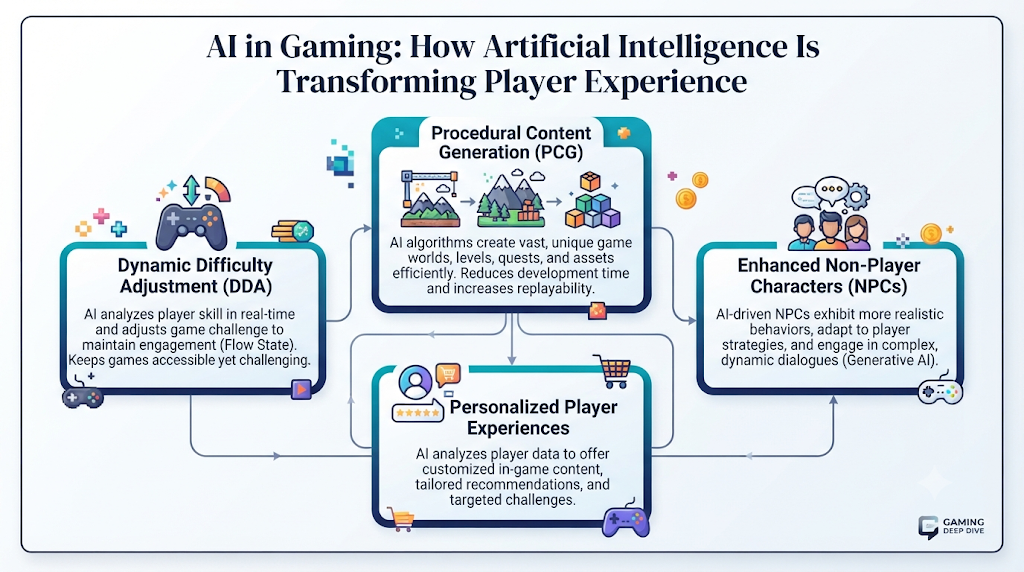
The ultimate objective of integrating artificial intelligence into games is to optimize Player Experience (PX). Rather than treating players as passive consumers of hardcoded scripts, AI transforms players into active participants inside reactive narrative and mechanical environments.
                     +---------------------------------------+
                     |        Player Input & Behavior        |
                     +---------------------------------------+
                                         |
                                         v
                     +---------------------------------------+
                     |      AI Experience Optimization       |
                     +---------------------------------------+
                                         |
        +--------------------------------+--------------------------------+
        |                                |                                |
        v                                v                                v
+---------------+               +-----------------+               +---------------+
| Dynamic NPCs  |               |  Personalized   |               |   Procedural  |
| & Tacticians  |               |   Gameplay &    |               |  Environments |
|               |               |   Difficulty    |               |  & Content    |
+---------------+               +-----------------+               +---------------+
Intelligent NPC (Non-Player Character) Behavior
Historically, Non-Player Characters (NPCs) were predictable entities with repetitive dialogue trees and obvious movement loops. Modern AI elevates NPCs into believable virtual inhabitants:
- Contextual Awareness: Intelligent NPCs evaluate surround sound, sight lines, cover availability, and team resources before making tactical moves.
- Dynamic Goal Management: Using Goal-Oriented Action Planning (GOAP), NPCs autonomously evaluate their internal status (health, ammo, morale) against external threats to select logical action plans.
- Long-Term Memory Systems: Advanced character frameworks maintain episodic memory stores. If a player steals from or assists an NPC, the character retains that context throughout the campaign, altering future dialogue, prices, and alliances.
Adaptive Difficulty and Personalized Gameplay
Every player possesses different mechanical skill levels, reflex speeds, and strategic comprehension. Static difficulty levels (Easy, Normal, Hard) often fail to capture this spectrum.
Dynamic Difficulty Adjustment (DDA) monitors real-time telemetry metrics—such as player accuracy, death frequency, resource accumulation, and completion times.
- Preventing Frustration: If a player experiences repeated failures at a single location, the DDA system subtly scales enemy accuracy, health pools, or item drop rates to maintain momentum.
- Preventing Boredom: If an expert player effortlessly clears encounters, the AI introduces aggressive squad maneuvers, reduced item availability, and complex wave behaviors to keep the challenge engaging.
Procedural Content Generation
Procedural Content Generation (PCG) uses algorithmic logic and machine learning to build virtual assets, levels, landscapes, quests, and visual patterns automatically.
+------------------+     +-------------------+     +------------------+
| Seed Value &     | --> | AI PCG Rules engine| --> | Unique Output:   |
| Rule Parameters  |     | & Deep Networks   |     | Level/Terrain    |
+------------------+     +-------------------+     +------------------+
- Infinite Exploration: Games generate distinct planet surfaces, dungeon layouts, and biome features for every playthrough.
- Constraint-Based Generation: AI models apply strict structural rules so generated levels remain physically navigatable, logically balanced, and aesthetically consistent.
- Noise Functions & Wave Function Collapse: Advanced mathematics combine with neural networks to render realistic terrain textures, river paths, and architectural structures.
AI-Powered Opponent Strategies
In tactical shooters, real-time strategy games, and fighting titles, playing against computer opponents used to mean dealing with artificially boosted stats or “cheating” AI that read raw button inputs. Modern strategic AI models focus on true spatial and tactical intelligence:
- Flanking & Cover Usage: Opponents coordinate squad maneuvers, suppressing player cover while squad members advance from flank angles.
- Resource Optimization: Strategy AI models calculate micro and macro economics in real time, managing army compositions, scouting routes, and tech upgrades smoothly.
- Adaptation to Meta: AI agents analyze popular human playstyles and alter their counter-strategies accordingly.
Reinforcement Learning in Game Development
Reinforcement Learning (RL) is an advanced branch of machine learning where an autonomous agent learns optimal behavior by interacting directly with a game environment, receiving positive rewards for effective decisions and negative penalties for mistakes.
                     +-----------------------+
                     |      Environment      |
                     +-----------------------+
                       /                   \
        State / Reward                      Action
                     v                       \
                     +-----------------------+
                     |       RL Agent        |
                     +-----------------------+
Key RL Frameworks in Gaming
- Deep Q-Networks (DQN): Combines Q-learning with deep neural networks to evaluate visual game frames and select optimal discrete actions.
- Proximal Policy Optimization (PPO): Widely used in modern game engines to train realistic character locomotion, flight physics, and complex movement behaviors.
- Actor-Critic Models: Splitting the learning task between an “Actor” (taking actions) and a “Critic” (evaluating action quality) enables continuous action-space mastery, such as racing line precision.
Machine Learning for Game Analytics
Modern live-service titles operate as digital ecosystems. Machine Learning pipelines continuously process telemetry data sent from millions of active player clients:
- Churn Prediction: Machine learning models identify behavioral signals (e.g., declining session times, abandoned quests) that indicate a player is likely to quit, triggering personalized rewards or re-engagement incentives.
- Economic Balancing: ML systems monitor in-game currency flow, item auction houses, and drop probabilities to protect virtual economies from inflation or exploit bugs.
- Player Segmentation: Clustering algorithms group players based on preferences (e.g., competitive achievers, narrative explorers, social builders) to customize store recommendations and seasonal event content.
Computer Vision in Gaming
Computer Vision (CV) enables computing hardware to interpret, process, and react to visual input from camera hardware and digital screen buffers.
- Motion Tracking & Gesture Control: Cameras analyze body movement in real time, translating human gestures into precise character actions without physical game controllers.
- Facial Expression Mapping: High-fidelity capture systems map human actor expressions directly onto 3D character meshes, capturing subtle emotional details.
- Real-Time Image Reconstruction: Deep learning super-sampling techniques analyze low-resolution visual renders and reconstruct ultra-high-definition outputs in real time, dramatically improving framerates and graphical performance.
Natural Language Processing (NLP) in Interactive Games
Natural Language Processing (NLP) enables video games to interpret, process, and generate human speech and text in real time.
[Player Voice Input] ---> [Speech-To-Text] ---> [NLP Intent Parser] ---> [Game Action Trigger]
- Voice-Driven Commands: Players issue unscripted voice instructions to squad members, control ship systems, or cast spell combinations organically.
- Unscripted Dialogue Systems: Integrating specialized Large Language Models (LLMs) allows players to converse freely with virtual characters using original spoken sentences rather than selecting pre-written menu options.
- Real-Time Text Translation: Global multiplayer chat streams utilize live translation models to remove language barriers between international teammates.
Generative AI for Game Content Creation
Generative AI is revolutionizing internal pre-production workflows and dynamic runtime assets:
- 3D Mesh & Texture Generation: Diffusion models and neural radiance fields convert 2D concept sketches or text prompts into fully textured 3D environment meshes instantly.
- Dynamic Audio & Voiceover Synthesis: Generative speech engines synthesize distinct voice profiles for thousands of background characters without recording studio audio for every dialogue line.
- Adaptive Music Pipelines: Generative audio systems compose and alter musical keys, tempos, and instrumentation dynamically based on emotional intensity on screen.
AI in Multiplayer Matchmaking
Balanced multiplayer lobbies are fundamental to long-term community retention. Traditional Skill-Based Matchmaking (SBMM) evaluated basic win-loss ratios. Modern AI matchmaking engines leverage deeper multidimensional parameters:
- Skill Assessment: Neural networks measure reaction speed, accuracy under pressure, movement efficiency, and map awareness alongside win-loss metrics.
- Behavioral Matchmaking: Machine learning models group highly cooperative players together while placing toxic or disruptive accounts in isolated queues.
- Latency & Connection Optimization: Routing algorithms evaluate network jitter, packet routes, and regional server loads to minimize network lag for every player in a lobby.
AI for Anti-Cheat and Fair Play Systems
Cheating ruins fair competition in online titles. Traditional client-side anti-cheat tools look for known software signatures on a user’s local hard drive. Modern cheaters use hardware bypasses and external memory devices.
AI-Based Anti-Cheat (Server-Side Behavioral Analysis):
+-----------------------+     +------------------------+     +------------------------+
| Server Input Telemetry| --> | Neural Pattern Analyzer| --> | Flagged Anomaly:       |
| (Mouse/Aim Vector)    |     | (Detects Inhuman Aim)  |     | Automated Quarantine   |
+-----------------------+     +------------------------+     +------------------------+
- Inhuman Movement Detection: Server-side AI models analyze raw mouse vectors, frame-by-frame aim acceleration, and recoil compensation patterns. If movement physics deviate from human muscle capabilities, the account is flagged instantly.
- Voice Toxicity Monitoring: Natural language processing models evaluate live voice chat streams to detect verbal abuse, harassment, or hate speech in real time, automatically maintaining safe community spaces.
AI in Game Testing and Quality Assurance
Quality Assurance (QA) testing for massive open-world titles requires thousands of hours of playtesting to identify collision bugs, level exploits, and performance dips.
- Automated Exploration Bots: Reinforcement learning agents explore digital environments at hyper-speed—running into every wall, casting every ability, and jumping on every geometry seam simultaneously.
- Performance Anomaly Detection: Automated scripts monitor memory leaks, frame drops, and rendering crashes across hundreds of hardware configurations simultaneously.
- Game Balance Simulation: AI bots run millions of simulated matches overnight, providing developers with statistically rich heatmaps showing over-powered weapons, broken character abilities, or poorly designed map bottlenecks.
AI in VR and AR Gaming
Virtual Reality (VR) and Augmented Reality (AR) demand unprecedented levels of environmental interaction and physiological comfort.
- Foveated Rendering via Eye Tracking: Computer vision models track exact eye gaze points, rendering high detail only where the human fovea is focused while lowering resolution in peripheral zones to maximize GPU performance.
- Spatial Anchoring & Scene Understanding: AR engines scan physical living rooms, identifying tables, couches, and walls so virtual characters can hide behind actual home furniture realistically.
- Natural Spatial Locomotion: Machine learning models convert real-world room-scale movements into fluid virtual avatar physics, reducing motion sickness.
Popular AI Technologies and Game Engines
Below is a comparison of leading AI frameworks, specialized development platforms, and native game engine systems widely used across the interactive entertainment industry:
| Engine / Platform | Key AI Features & Tools | Primary Use Cases | Major Industry Benefits |
| Unreal Engine | Mass Entity System, StateTree, Environment Query System (EQS), Behavior Trees | Open-world titles, high-density crowds, tactical enemy squads | High performance with vast character counts, native visual scripting |
| Unity | Unity ML-Agents Toolkit, Unity Sentis, NavMesh pathfinding | Reinforcement learning research, cross-platform games, runtime neural inferences | Accessible C# integration, extensive machine learning library support |
| NVIDIA ACE (Avatar Cloud Engine) | Audio2Face, Riva ASR, NeMo Guardrails, generative speech synthesis | Intelligent real-time NPC dialogue, lifelike facial animations | Real-time conversational avatars, multi-language speech support |
| Inworld AI | Contextual character memory, personality orchestration, LLM engine | Dynamic narrative games, unscripted role-playing titles | Deeper narrative immersion, emergent story possibilities |
| Incredibuild / Modulate | ToxMod voice audio analysis, server-side toxicity classification | Multiplayer competitive moderation, real-time safety | Automated community safety, lower moderation costs |
Real-World Examples of AI in Popular Games
To see AI concepts in practice, consider these standout implementations:
- Alien: Isolation: The game utilizes a dual-layer AI system. A macro “Director” AI constantly knows the player’s exact location and directs a micro “Micro” alien AI toward that vicinity. However, the alien itself must use pathfinding, sight, and hearing to find the player, creating tension without feeling unfair.
- Middle-earth: Shadow of Mordor (Nemesis System): Enemy Orcs remember interactions, survive battles, earn promotions, and develop specific grudges against the player, creating procedural personal rivalries.
- Left 4 Dead (The Director): An adaptive AI monitor tracks player health, ammo, and distance. It dynamically spawns zombie hordes, boss encounters, and health packs to maintain maximum excitement.
- Forza Series (Drivatar): Cloud-based machine learning models study real player driving styles, braking points, and cornering aggressive habits to train personalized digital avatars that race against other players globally.
- The Last of Us Part II: Enemies communicate using designated vocal tags, sharing tactical updates over radio frequencies while actively searching cover positions in coordinated squad pairs.
Benefits of AI for Players and Game Developers
+-------------------------------------------------------------------+
|                     AI IN GAME DEVELOPMENT                        |
+-------------------------------------------------------------------+
                  /                                 \
                 v                                   v
   +---------------------------+       +---------------------------+
   |   BENEFITS FOR PLAYERS    |       |  BENEFITS FOR DEVELOPERS  |
   +---------------------------+       +---------------------------+
   | * Personalized Gameplay   |       | * Accelerated Asset Tools |
   | * Immersive, Smart Worlds |       | * Automated Quality Assurance|
   | * Unscripted Narrative    |       | * Balanced In-Game Economy|
   | * Fairer Online Lobbies   |       | * Reduced Repetitive Work |
   +---------------------------+       +---------------------------+
For Players
- Infinite Replayability: Procedural engines and adaptive narrative agents ensure no two playthroughs feel identical.
- Tailored Challenge Levels: Gameplay smoothly adjusts to human skill progression.
- Immersive Interactive Worlds: Characters respond logically to subtle player actions.
For Game Developers
- Accelerated Production Cycles: Automated asset pipelines reduce tedious manual production work.
- Lower QA Costs: AI testing bots detect critical performance bugs automatically.
- Data-Driven Live Operations: Game balance updates are guided by machine learning telemetry analysis.
Challenges and Ethical Considerations
While artificial intelligence offers massive advantages, the gaming industry must navigate several technical and ethical hurdles:
- Intellectual Property & Training Data: Generative models trained on public artist portfolios raise questions regarding copyright ownership and creative consent.
- Job Displacement Concerns: Developers must balance automated efficiency with protecting human craftsmanship in art, writing, and design.
- The “Uncanny Valley” Effect: Photorealistic characters with slightly unnatural voice synthesis or eye movements can cause awkward player reactions.
- Server Latency & Hardware Costs: Running complex LLMs or deep neural inferences locally requires heavy hardware resources, while cloud processing introduces network latency.
Future Trends in AI-Powered Gaming
Looking forward, several emerging technological shifts will define the next phase of gaming:
- Fully Generative Game Worlds: Entire game environments, quest structures, and audio landscapes will generate dynamically on the fly based on voice or text prompts.
- Edge-AI & Local Inferences: On-device neural processing units (NPUs) will execute real-time AI characters locally without relying on internet connections or cloud servers.
- Emotion-Driven Gameplay: Bio-feedback sensors (heart rate monitors, eye trackers) will feed data directly into AI game loops, altering music, horror elements, and lighting based on real-world player emotion.
- Autonomous AI Teammates: AI squad members will adapt to individual communication habits, acting as true cooperative partners.
Career Opportunities in AI and Game Development
The rapid convergence of computer science, machine learning, and interactive graphics has created high-demand career paths across top global game studios:
- Game AI Engineer: Specializes in developing behavior trees, GOAP systems, pathfinding algorithms, and state machines inside game engines.
- Machine Learning Researcher (Gaming): Trains deep reinforcement learning agents for gameplay simulation, physics control, and automated testing.
- Procedural Technical Artist: Combines mathematical logic, shader coding, and 3D modeling skills to build automated environment generation pipelines.
- Game Data Scientist / ML Analyst: Builds predictive algorithms to analyze player telemetry, optimize matchmaking queues, and balance virtual live-service economies.
- Prompt & Generative Systems Engineer: Integrates real-time Large Language Models, voice processing, and neural radiance assets into active gameplay pipelines.
Frequently Asked Questions
What is the primary difference between traditional game programming and AI in gaming?
Traditional game programming relies on deterministic, hardcoded rules (“if player enters room, play sound”). AI in gaming uses adaptive algorithms, finite state machines, machine learning, and decision trees that enable virtual elements to evaluate environmental conditions and react dynamically.
Does AI in gaming replace human game designers and artists?
No, AI acts as a creative co-pilot and productivity amplifier. While AI automates repetitive tasks like background mesh generation or automated bug hunting, core narrative vision, artistic direction, emotional depth, and creative mechanics still require human game designers.
How does Procedural Content Generation (PCG) benefit small development studios?
Procedural Content Generation enables small or independent development teams to build expansive game worlds, diverse dungeon layouts, and thousands of asset variations without hiring hundreds of manual 3D artists.
What is Dynamic Difficulty Adjustment (DDA)?
Dynamic Difficulty Adjustment is an AI mechanism that tracks real-time player telemetry—such as success rates, reaction speeds, and health states—to subtly adjust enemy strength, resource drops, or challenge levels, keeping the player inside an optimal engagement flow state.
How is Reinforcement Learning used in video games?
Reinforcement learning trains autonomous agents by rewarding successful actions and penalizing errors inside a simulated environment. Game developers use RL to build adaptive competitive bots, train realistic movement physics, and perform hyper-fast quality assurance testing.
Can AI detect cheaters in online multiplayer games?
Yes, server-side AI anti-cheat systems analyze raw input telemetry, mouse movement vectors, and recoil patterns in real time. If an account exhibits movement physics beyond human physical limits, the system flags and quarantines the account automatically.
What role does Natural Language Processing play in games?
Natural Language Processing allows players to speak or type unscripted sentences to NPCs, issue complex voice commands to squad members, and experience dynamic real-time text translations in global multiplayer chat channels.
What are the main limitations of running real-time generative AI inside games?
The primary hurdles are computational overhead and network latency. Generating high-fidelity LLM dialogue or dynamic 3D meshes in real time requires heavy GPU power or cloud server processing, which can introduce frame drops or input delay if not optimized properly.
Which game engines are best suited for building AI-powered games?
Unreal Engine and Unity are leading industry game engines. Unreal Engine excels in native crowd systems and state trees, while Unity offers powerful ML-Agents toolkits and runtime neural inference frameworks. Specialized platforms like NVIDIA ACE and Inworld AI complement these engines.
How can a beginner start a career in AI game development?
Beginners should build strong fundamentals in computer science languages like C++ and Python, study data structures and linear algebra, learn pathfinding algorithms (A* pathfinding), explore game engines like Unity or Unreal Engine, and experiment with open-source machine learning libraries like PyTorch or ML-Agents.
Conclusion
Artificial Intelligence has transformed video games from static, linear entertainment into dynamic, highly personalized virtual experiences. By combining smart NPC behaviors, adaptive difficulty tuning, procedural content generation, computer vision, and generative content models, modern developers can build living worlds that constantly adapt to individual human playstyles. As technology continues to advance, the boundary between player input and environmental response will continue to dissolve. The future of gaming is intelligent, emergent, and infinitely reactive.
