Introduction
Modern software delivery no longer stops at compiling code and provisioning compute instances. As enterprise systems expand, technical organizations manage an increasingly fractured web of disciplines—ranging from continuous deployment pipelines and telemetry systems to streaming data warehouses, machine learning lifecycle management, dynamic cloud expenditure, and continuous vulnerability scanning. XOps addresses this fragmentation by establishing an umbrella operational paradigm that unifies specialized “Ops” disciplines under shared automation architectures, cross-domain governance models, and end-to-end feedback loops. Rather than managing development, data engineering, model lifecycle management, and infrastructure as isolated practices, organizations apply core operational automation principles universally. For engineering leads and platform architects seeking to scale complex software ecosystems, exploring comprehensive educational resources at XOpsSchool helps bridge the practical knowledge gap across these intersecting operational disciplines.
What Is XOps?
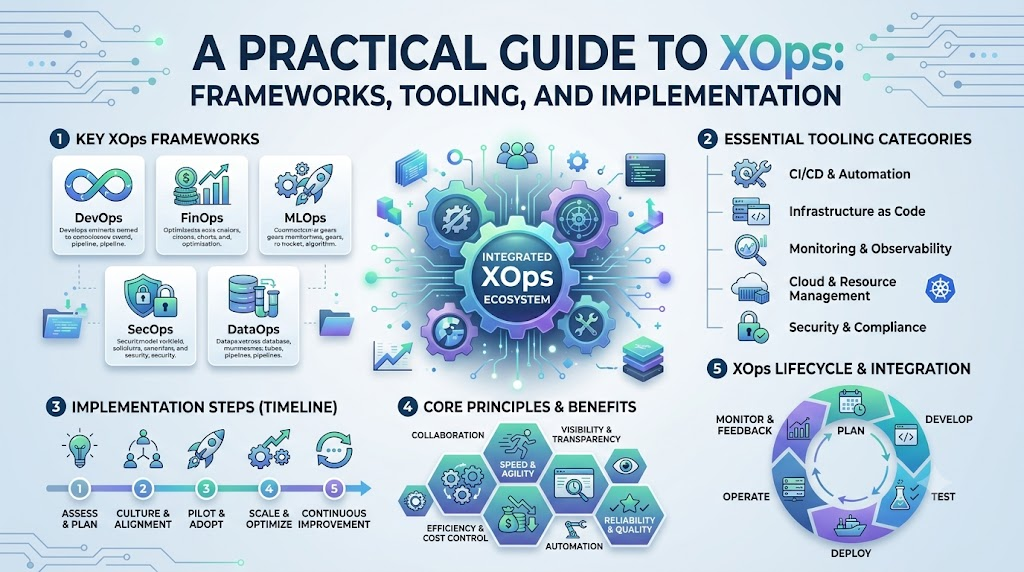
XOps (short for “Anything Operations” or “Cross-Operations”) represents the strategic unification of operational practices across software engineering, data management, artificial intelligence, security, and cloud economics. The variable “X” acts as a placeholder for any domain that requires structured lifecycle management, continuous automation, repeatable governance, and collaborative workflows.
Where DevOps established continuous integration and continuous delivery (CI/CD) for application code, modern enterprises must also deliver analytical data feeds, machine learning inference engines, and compliant cloud architectures. XOps provides the framework to integrate these disciplines so that changes in an upstream dataset, machine learning weights, or cloud security policies flow through automated validation pipelines just like application source code.
The Core Pillars of the XOps Ecosystem
To understand how XOps works in practice, it is necessary to examine the primary operational tracks it brings into alignment:
- DevOps (Development Operations): Focuses on source control, automated builds, automated integration testing, container orchestration, and continuous release pipelines for application software.
- DataOps (Data Operations): Applies CI/CD principles to data pipelines, schema migrations, and ETL processes, ensuring that analytics and business intelligence feeds maintain data quality and low latency.
- MLOps (Machine Learning Operations): Bridges data science and infrastructure by automating model training, feature validation, model tracking, containerized deployment, and production drift monitoring.
- AIOps (Artificial Intelligence for IT Operations): Leverages automated pattern analysis and predictive intelligence across logs, metrics, and distributed traces to automate anomaly detection and incident triage.
- SecOps / DevSecOps (Security Operations): Integrates static and dynamic code analysis, vulnerability scanning, secret detection, and compliance as code into every stage of execution.
- FinOps (Financial Operations): Establishes financial accountability and real-time cloud cost tracking, tying operational choices directly to infrastructure billing and resource sizing.
Comparative Overview: Core XOps Operational Tracks
The following table highlights how continuous delivery and automation principles adapt across different operational tracks within a unified enterprise environment:
| Operational Track | Primary Focus | Core Lifecycle Inputs | Primary Failure Modes | Standard Technologies |
| DevOps | Application delivery & uptime | Source code, dependencies, build manifests | Build errors, deployment rollbacks, latency | Docker, Kubernetes, Jenkins, GitHub Actions |
| DataOps | Data flow reliability & quality | Schemas, raw telemetry, relational data | Broken schemas, missing records, pipeline stalls | Apache Airflow, dbt, Spark, Kafka |
| MLOps | Model training & inference delivery | Training weights, feature stores, hyperparameters | Concept drift, data drift, stale inferences | MLflow, Kubeflow, Feast, Triton |
| AIOps | Incident intelligence & telemetry | Distributed traces, aggregate metrics, error logs | Alert storms, alert fatigue, false positives | Datadog, Prometheus, Dynatrace, OpenTelemetry |
| FinOps | Cloud spend optimization & governance | Billing exports, compute reservation data, tags | Resource sprawl, idle instances, budget overruns | Kubecost, AWS Cost Explorer, CloudHealth |
| SecOps | Threat modeling & policy enforcement | IAM policies, dependency trees, runtime alerts | Zero-day exposures, unauthorized access, misconfigurations | Trivy, SonarQube, Open Policy Agent, Falco |
How XOps Functions: Architectural Workflow
An enterprise implementing XOps treats every operational artifact—application code, infrastructure definitions, data pipelines, model weights, and access policies—as declarative version-controlled assets.
+-------------------------------------------------------------------------+
|                  Version Control & Declarative State                    |
|       (Git: App Code, Terraform IaC, dbt Models, MLOps Pipelines)       |
+-------------------------------------------------------------------------+
                                     │
                                     ▼
+-------------------------------------------------------------------------+
|                      Automated Validation Gates                         |
|   (Static Analysis, Data Schema Tests, Model Benchmarks, Cost Checks)   |
+-------------------------------------------------------------------------+
                                     │
                                     ▼
+-------------------------------------------------------------------------+
|                   Unified Orchestration & Platform                      |
|                  (Kubernetes, Cloud Infrastructure)                     |
+-------------------------------------------------------------------------+
                                     │
                                     ▼
+-------------------------------------------------------------------------+
|                 Holistic Telemetry & Observability Layer                |
|           (Traces, Metrics, Data Quality Logs, Drift Trackers)          |
+-------------------------------------------------------------------------+
                                     │
                                     ▼
+-------------------------------------------------------------------------+
|                  Automated Feedback & Remediation Loops                 |
|             (AIOps Alert Reduction, FinOps Rightsizing, CI/CD)          |
+-------------------------------------------------------------------------+
1. Unified Declarative State
Every asset lives in Git. Infrastructure as Code (Terraform, OpenTofu) provisions base compute and networking; Kubernetes manifests declare runtime topology; dbt transformations manage data warehouse state; and pipeline configuration files define machine learning training steps.
2. Automated Validation Gates
When a pull request triggers a commit, automated pipelines run specialized checks in parallel. While unit and integration tests run for application code, data contracts validate database migrations, static analysis scans for exposed secrets, and cost calculation engines project changes in monthly cloud expenditure.
3. Unified Delivery and Deployment
Artifacts that pass gate checks deploy to shared cloud-native platforms. Container registries store application images and model inference runtimes, while workflow orchestrators deploy batch data pipelines onto scalable compute clusters.
4. Continuous Cross-Telemetry and Feedback
Telemetry does not live in isolated dashboards. OpenTelemetry standards pipe metrics, distributed traces, system events, and application logs into centralized analysis platforms. Automated systems correlate application errors with underlying cloud saturation, data pipeline delays, or machine learning model degradation.
Practical Example: The XOps Workflow in Action
Consider an enterprise e-commerce platform deploying a real-time recommendation engine:
- The DataOps Team schedules continuous extraction of user interaction events from Kafka into analytical storage using Apache Airflow, applying automated data validation checks to drop corrupted clickstream records.
- The MLOps Team trains a new recommendation model using these clean event tables. Automated pipelines benchmark the model against baseline inference metrics and package the weights into a containerized Triton inference service.
- The SecOps System runs a static container security scan on the container image, verifying zero critical vulnerabilities and validating that IAM roles adhere to the principle of least privilege.
- The FinOps Layer analyzes the requested GPU instances in the Kubernetes deployment manifest, validating resource utilization against allocated departmental budgets.
- The DevOps Pipeline executes a canary deployment onto a Kubernetes cluster, gradually routing live user traffic to the new recommendation service.
- The AIOps Layer monitors real-time latency and anomaly trends. If inference latency spikes or model drift exceeds safety margins, the deployment pipeline triggers an automated rollback to the prior release.
Practical Benefits of Implementing XOps
Adopting a unified operations methodology resolves friction points common to scaling technology organizations:
- Elimination of Operational Silos: Engineering, operations, data, and security teams share a common baseline for change approval, deployment automation, and service level objectives.
- Accelerated Time-to-Production: Applying automated delivery practices to data engineering and machine learning workflows reduces the time required to bring data products to market.
- Actionable Operational Visibility: Correlating telemetry across data pipelines, infrastructure health, application response times, and billing outputs enables rapid root-cause analysis.
- Controlled Cloud Expenditure: Direct integration of FinOps safeguards prevents runaway compute usage during high-throughput model training and data aggregation jobs.
- Proactive Security posture: Shifting security and compliance checks left into the automated build pipeline eliminates manual pre-deployment audits.
Implementation Challenges and Practical Solutions
Transitioning to an XOps framework presents distinct organizational and architectural hurdles:
Tooling Fragmentation and Complexity
Organizations frequently adopt separate commercial platforms for monitoring, pipeline management, model tracking, and cloud billing. This causes high licensing overhead and context switching.
- Remediation: Standardize on open interfaces such as OpenTelemetry for tracing and metrics, unified container runtimes, and platform engineering abstractions like internal developer portals (IDPs).
Cultural and Skillset Misalignment
Data scientists, software engineers, and cloud architects maintain differing definitions of release cadences, testing, and production readiness.
- Remediation: Establish cross-functional platform engineering groups that provide automated templates and Golden Paths, allowing domain specialists to deploy safely without mastering low-level cloud infrastructure.
Data Governance and Compliance Overhead
Managing access to sensitive customer data across automated training pipelines and development environments creates regulatory exposure.
- Remediation: Automate data masking, role-based access control (RBAC), and policy-as-code validations directly inside the data ingestion pipeline.
Frequently Asked Questions
What does the acronym XOps stand for?
XOps stands for “Anything Operations” or “Cross-Operations.” It serves as an umbrella term encompassing specialized operational practices including DevOps, DataOps, MLOps, AIOps, SecOps, and FinOps into an integrated framework.
How does XOps differ from traditional DevOps?
Traditional DevOps primarily centers on software development, infrastructure configuration, and application release workflows. XOps expands these principles to include data processing workflows, machine learning models, cost management, and artificial intelligence-driven telemetry.
Why is XOps gaining importance in modern enterprise IT?
As enterprises adopt machine learning, complex streaming data architectures, and multi-cloud systems, treating operations as isolated functional silos leads to tool sprawl, blind spots, and delivery delays. XOps creates unified standards across all technological lifecycles.
What core tools are commonly found in an XOps ecosystem?
Common tools include container orchestration platforms like Kubernetes, infrastructure automation systems like Terraform, CI/CD runners like GitHub Actions, workflow orchestrators like Apache Airflow, model trackers like MLflow, and observability solutions like Prometheus and Grafana.
What role does Platform Engineering play in an XOps adoption?
Platform engineering teams build and maintain the internal developer platforms, standardized templates, and deployment workflows that allow product, data, and machine learning teams to execute XOps practices autonomously.
Can small engineering teams benefit from XOps?
Yes. Even smaller teams running lightweight analytics or machine learning components alongside their web applications benefit from early consistency in version control, automated testing, containerized deployments, and cost visibility.
How does FinOps integrate into an XOps pipeline?
FinOps introduces automated budget guardrails, cost estimations within pull requests, and real-time cloud usage telemetry into the core deployment and infrastructure provisioning pipeline.
What is the distinction between MLOps and AIOps within XOps?
MLOps manages the operational lifecycle of training, deploying, and monitoring machine learning models. AIOps applies machine learning and automated analytics to IT operations telemetry (logs, metrics, traces) to automate incident management.
What are the primary technical prerequisites for adopting XOps?
Core prerequisites include a baseline maturity in containerization, version control, Infrastructure as Code, continuous integration practices, and standardized telemetry collection.
Where can engineers start learning XOps disciplines?
Beginners and professionals should build a foundation in standard DevOps practices (Git, Linux, CI/CD, containers), and then expand into specialized adjacent tracks like DataOps, MLOps, or SRE through hands-on labs, structured coursework, and technical training portals.
Conclusion
Modern technology delivery involves far more than pushing compiled application code into production. It demands continuous synchronization between data platforms, machine learning models, cloud expenditure, security controls, and core infrastructure. XOps provides the unifying architectural framework that brings these critical operational functions into a cohesive, automated delivery model. Organizations that transition from isolated operational silos to an integrated XOps model achieve faster deployment velocity, lower incident remediation times, predictable infrastructure costs, and resilient software ecosystems. The journey begins by establishing declarative version control across all assets, building standardized validation gates, and fostering shared operational accountability across every technical discipline.
