Introduction
Artificial intelligence is no longer limited to research teams or large technology companies. Businesses of different sizes are using AI to automate repetitive work, analyze information, improve customer interactions, support employees, detect operational problems, and make faster decisions. The difficult part is not deciding whether AI is useful. The difficult part is deciding where AI should be applied, what data and infrastructure it requires, how much autonomy it should have, and how its results should be measured and governed. A successful AI initiative therefore starts with a business problem—not with a model, chatbot, or AI subscription. This guide explains how organizations can approach AI implementation systematically, from identifying suitable use cases to deployment, governance, monitoring, and continuous improvement.
What Does AI Implementation Mean for a Business?
Implementing AI means integrating artificial intelligence capabilities into an organization’s processes, products, decisions, or services.
This can involve very different technologies.
| AI approach | Typical business application |
|---|---|
| Machine learning | Forecasting, classification, prediction |
| Generative AI | Content, summarization, document processing |
| Large language models | Search, assistants, knowledge systems |
| Computer vision | Inspection, image analysis, quality control |
| Speech AI | Transcription, voice assistants, call analysis |
| Predictive analytics | Demand, risk, maintenance forecasting |
| Recommendation systems | Product and content recommendations |
| AI agents | Multi-step workflow automation |
| AIOps | IT monitoring, anomaly detection, incident analysis |
The right technology depends on the problem.
For example, a company that wants to predict customer churn may need a supervised machine-learning model. A company that wants employees to search internal policies using natural language may benefit more from a retrieval-augmented generation system.
Choosing the technology first often creates unnecessary complexity.
Start With the Business Problem
The first question should not be:
“Which AI tool should we buy?”
Instead ask:
“Which business process is expensive, slow, error-prone, difficult to scale, or dependent on repetitive human effort?”
Good candidates often have one or more of these characteristics:
- High transaction volume
- Repetitive manual work
- Large amounts of structured or unstructured data
- Long processing times
- Frequent human errors
- Difficult information retrieval
- Predictable decision patterns
- High customer-service workload
- Expensive operational processes
- Valuable opportunities for personalization
Example
Suppose a company receives 20,000 customer-support requests every month.
Instead of immediately deploying an autonomous AI agent, the company could start with:
Phase 1: classify incoming requests
Phase 2: recommend relevant knowledge-base articles
Phase 3: generate draft responses
Phase 4: allow agents to approve responses
Phase 5: automate selected low-risk requests
This progressive approach reduces operational risk while producing evidence about whether the technology actually works.
Identify High-Value AI Use Cases
Not every process deserves AI.
A useful prioritization framework evaluates four dimensions:
| Factor | Key question |
|---|---|
| Business value | How much measurable value could this create? |
| Feasibility | Do we have the data, systems, and skills required? |
| Risk | What happens if the AI produces an incorrect result? |
| Adoption | Will employees or customers actually use it? |
A simple scoring model can help:
AI Opportunity Score = Business Value × Feasibility × Adoption ÷ Risk
This is not a scientific formula. It is a decision aid for comparing opportunities consistently.
Example use-case matrix
| Use case | Value | Complexity | Risk | Priority |
|---|---|---|---|---|
| Internal document search | High | Medium | Low | High |
| Meeting summarization | Medium | Low | Low | High |
| Customer-response drafting | High | Medium | Medium | High |
| Fraud detection | Very High | High | High | Strategic |
| Fully autonomous financial decisions | High | Very High | Very High | Carefully evaluate |
| AI-generated marketing drafts | Medium | Low | Low | High |
The important distinction is between interesting AI applications and economically valuable AI applications.
Assess Your Data Before Building AI
AI quality is heavily influenced by the quality and accessibility of the underlying data.
Before implementation, evaluate:
- Where does the data live?
- Who owns it?
- Is it accurate?
- Is it current?
- Is it duplicated?
- Is it structured or unstructured?
- Are there missing values?
- Are historical records available?
- Are there access restrictions?
- Does the organization have permission to use the data?
- Does the data contain personal or confidential information?
For generative AI projects, also examine:
- PDFs
- policies
- manuals
- support documentation
- contracts
- product information
- knowledge bases
- emails
- internal wikis
- databases
The overlooked issue: data freshness
An AI assistant can technically answer a question correctly based on an outdated document while still giving the business a wrong answer.
Therefore, production AI systems need controls for:
data freshness + source authority + access permissions + document versioning.
Choose the Right AI Architecture
There is no universal AI architecture.
A business might choose among:
Option 1: Use an existing AI service
Useful when:
- the problem is relatively standard
- speed matters
- customization requirements are limited
- the organization does not want to maintain models
Option 2: Use an API-based foundation model
Useful for:
- text generation
- summarization
- classification
- conversational applications
- document processing
- coding assistance
Option 3: Retrieval-Augmented Generation (RAG)
Useful when AI needs to answer questions using company-specific information.
A simplified architecture is:
User
  |
  v
Application
  |
  v
AI / LLM
  |
  +----> Retrieval Layer
  |          |
  |          v
  |     Company Knowledge
  |
  v
Response
  |
  v
Human / Business Workflow
RAG can be preferable to retraining a model when the underlying business information changes frequently.
Option 4: Custom machine-learning model
Consider this when:
- proprietary data provides a meaningful advantage
- the prediction problem is well-defined
- sufficient historical data exists
- accuracy requirements justify the engineering investment
Option 5: AI agents
Agents can execute multiple steps and interact with tools or business systems.
They can be useful for workflows such as:
Receive request
      ↓
Understand intent
      ↓
Retrieve information
      ↓
Call approved system
      ↓
Validate result
      ↓
Take permitted action
      ↓
Record audit information
      ↓
Request human approval if necessary
The more autonomy an AI system receives, the more important authorization, validation, observability, and rollback become.
Build an AI Business Case
Before moving from experimentation to production, quantify the expected value.
Consider:
Direct savings
- Reduced manual processing
- Lower support workload
- Reduced error-handling costs
- Faster document processing
- Lower operational overhead
Revenue impact
- Improved conversion
- Better personalization
- Faster sales response
- New AI-enabled products
- Improved customer retention
Productivity impact
- Faster research
- Faster software development
- Better employee knowledge access
- Reduced administrative work
Risk reduction
- Better fraud detection
- Improved anomaly detection
- Faster incident identification
- Improved compliance monitoring
A basic ROI calculation can be expressed as:
ROI = (Annual AI Benefit − Annual AI Cost) ÷ Annual AI Cost × 100
But avoid measuring AI purely through cost savings.
If an AI assistant saves 10 hours per employee each month but employees do not use the saved time productively, the theoretical productivity gain may never become business value.
Run a Proof of Concept Before Full Deployment
A proof of concept should answer a specific question.
For example:
Can an AI system classify customer-support tickets with sufficient accuracy to reduce manual triage?
That is much better than:
Let’s build an AI chatbot.
Define measurable acceptance criteria before testing.
Example
| Metric | Target |
|---|---|
| Classification accuracy | ≥ 90% |
| Critical error rate | < 1% |
| Average response latency | < 3 seconds |
| Human correction rate | < 10% |
| Cost per transaction | Within budget |
| User adoption | ≥ 70% |
The exact targets depend on the use case.
The important point is to define what success means before the technology becomes emotionally or financially difficult to abandon.
Establish Human Oversight
AI should not automatically receive authority simply because it produces convincing answers.
Human involvement should depend on the consequence of an error.
Low-risk tasks
AI can often operate with limited intervention for:
- formatting
- summarization
- brainstorming
- draft generation
- internal search
Medium-risk tasks
Human review may be appropriate for:
- customer communications
- financial analysis
- operational recommendations
- code changes
- business reports
High-risk tasks
Stronger human control may be required for:
- medical decisions
- employment decisions
- credit decisions
- legal decisions
- financial transactions
- safety-critical operations
- irreversible actions
The design principle is:
The greater the potential impact of an AI error, the stronger the control around that AI decision should be.
Implement AI Governance
AI governance should not be treated as paperwork added after deployment.
It should be part of the system design.
NIST’s AI Risk Management Framework organizes AI risk management around four functions:
Govern → Map → Measure → Manage.
These functions can provide a useful operating model for organizations:
Govern
Define:
- ownership
- policies
- accountability
- acceptable use
- risk tolerance
- documentation requirements
Map
Understand:
- intended use
- users
- affected stakeholders
- data
- dependencies
- potential harms
- operational environment
Measure
Evaluate:
- accuracy
- reliability
- bias
- security
- robustness
- latency
- cost
- user outcomes
Manage
Take action when:
- performance deteriorates
- risk increases
- data changes
- incidents occur
- business requirements change
NIST describes the framework as voluntary and designed to be adaptable rather than a one-size-fits-all checklist.
Protect Business and Customer Data
One of the most common mistakes in enterprise AI adoption is treating data protection as an afterthought.
Before sending information to an AI system, classify it.
For example:
| Data type | Example | Typical control |
|---|---|---|
| Public | Published documentation | Standard access |
| Internal | Internal procedures | Authenticated access |
| Confidential | Business plans | Restricted access |
| Sensitive | Customer information | Strong access and handling controls |
| Highly restricted | Critical secrets | Avoid unnecessary AI exposure |
Controls may include:
- encryption
- identity-based access
- role-based permissions
- data masking
- tokenization
- private networking
- secrets management
- audit logs
- retention policies
- data-loss prevention
- vendor security assessments
An AI assistant should also respect the user’s underlying permissions.
If an employee cannot access a confidential document through the normal enterprise system, the AI assistant should not provide that document simply because it has access to the underlying knowledge store.
Evaluate AI Output, Not Just the Model
A model can perform well in a benchmark and poorly in a specific business workflow.
Production evaluation should consider the complete system:
Model + prompts + retrieval + tools + business rules + user interface + human review
For generative AI, evaluate:
- factual accuracy
- hallucination rate
- relevance
- completeness
- citation/source quality
- consistency
- refusal behavior
- prompt-injection resistance
- sensitive-data leakage
- latency
- cost
For predictive models, consider:
- precision
- recall
- F1 score
- false-positive rate
- false-negative rate
- calibration
- drift
- business impact
The appropriate metric depends on the consequences of errors.
Integrate AI Into Existing Workflows
AI should not become another isolated application employees must remember to open.
Where possible, integrate it into existing systems.
For example:
CRM
 |
 +--> Customer interaction
        |
        v
      AI service
        |
        +--> Customer history
        +--> Knowledge base
        +--> Approved tools
        |
        v
     Suggested action
        |
        v
       CRM
The goal is to reduce workflow friction.
A technically impressive AI system that employees rarely use has little practical value.
Monitor AI After Deployment
Deployment is not the end of an AI project.
AI systems can degrade because:
- customer behavior changes
- source documents become outdated
- data distributions change
- prompts change
- models change
- APIs change
- integrations fail
- costs increase
- users discover unexpected failure modes
Monitor at least four categories.
Technical metrics
- latency
- availability
- error rate
- token consumption
- infrastructure utilization
AI quality metrics
- accuracy
- hallucination rate
- retrieval quality
- model drift
- human correction rate
Business metrics
- revenue
- cost reduction
- conversion
- resolution time
- productivity
- customer satisfaction
Risk metrics
- security incidents
- unauthorized access
- data leakage
- policy violations
- harmful outputs
14. Control AI Costs
AI costs can grow unexpectedly when usage scales.
Track:
Cost per request
Cost per user
Cost per successful business outcome
The third metric is often the most useful.
Suppose System A costs $0.01 per request and System B costs $0.05.
If System A requires significant human correction while System B completes the task reliably, the cheaper model may actually be more expensive at the business level.
Evaluate the entire workflow rather than model pricing alone.
Cost optimization techniques can include:
- smaller models for simple tasks
- caching
- batching
- prompt optimization
- retrieval optimization
- routing requests by complexity
- limiting unnecessary context
- asynchronous processing
- usage quotas
Train Employees
Successful AI adoption is partly a technology project and partly a workforce project.
Employees should understand:
- what the AI system does
- what it cannot reliably do
- when human review is required
- what information must not be entered
- how to report errors
- how to verify AI-generated information
- how AI decisions affect their responsibilities
This is increasingly relevant from a regulatory perspective. In the EU, Article 4 of the AI Act requires providers and deployers to take measures supporting AI literacy among relevant staff, taking their knowledge, experience, education, training, and use context into account.
Even where a specific regulation does not apply, AI literacy is operationally valuable.
Create an AI Operating Model
As AI adoption grows, organizations eventually need clear ownership.
A practical model might include:
| Role | Responsibility |
|---|---|
| Executive sponsor | Business direction and funding |
| Product owner | Use-case value and requirements |
| Data owner | Data quality and access |
| AI/ML team | Models and AI engineering |
| Security | Threats, access, controls |
| Legal/compliance | Regulatory and contractual issues |
| IT/platform team | Infrastructure and integration |
| Business users | Validation and adoption |
| Risk/governance | Oversight and controls |
Small organizations do not necessarily need separate departments for every role.
One person may hold multiple responsibilities.
The important part is that accountability exists.
Common AI Implementation Mistakes
1. Starting with the technology
Buying an AI platform without defining the business problem often creates an expensive experiment rather than a useful capability.
2. Automating a broken process
AI does not automatically fix bad workflows.
If the underlying process is unnecessarily complicated, automate only after understanding why.
3. Ignoring data quality
Poor data can produce consistently poor results at impressive speed.
4. Measuring model performance only
A model can be technically accurate while delivering little business value.
5. Giving AI too much autonomy too early
Start with controlled assistance before moving toward autonomous execution when the consequences justify caution.
6. Ignoring security
AI introduces new attack and data-exposure surfaces, including prompt injection, insecure tool use, excessive permissions, and sensitive-data leakage.
7. Treating governance as paperwork
Governance should influence architecture, access, testing, monitoring, and operational decisions.
8. Forgetting change management
Employees may resist AI if they do not understand how it affects their work.
9. Scaling before proving value
A successful pilot does not automatically justify enterprise-wide deployment.
10. Failing to define a rollback strategy
Every important AI workflow should have a controlled way to disable, bypass, or revert the AI component.
A Practical AI Implementation Roadmap
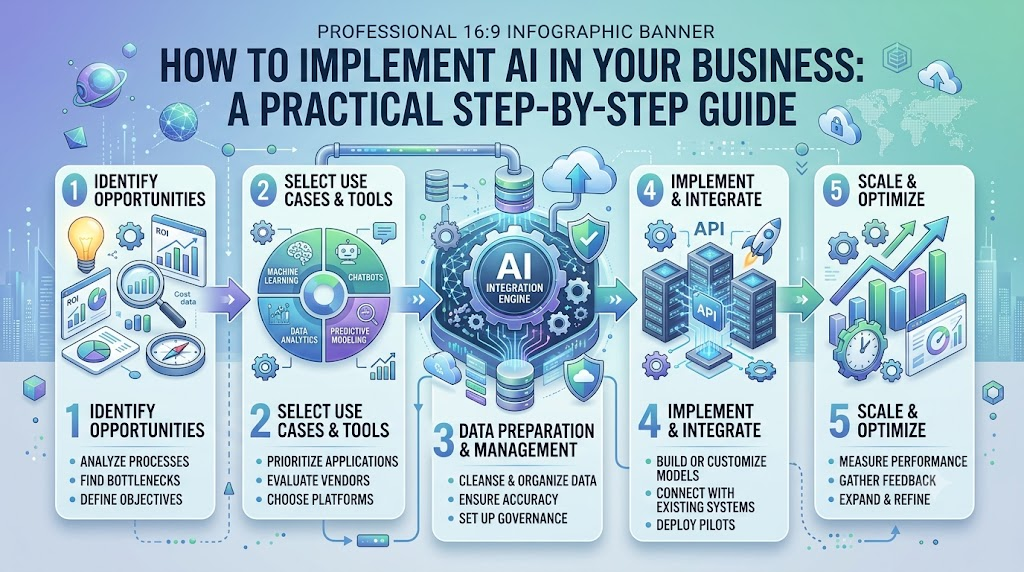
A phased roadmap is usually safer than attempting an organization-wide transformation immediately.
Phase 1 — Discovery
- Identify business problems
- Interview stakeholders
- Map existing workflows
- Identify candidate use cases
- Estimate potential value
Phase 2 — Assessment
- Evaluate data
- Assess security requirements
- Review regulatory constraints
- Determine technical feasibility
- Select evaluation metrics
Phase 3 — Prototype
- Build a limited proof of concept
- Test representative data
- Measure quality
- Identify failure modes
- Gather user feedback
Phase 4 — Pilot
- Integrate with a real workflow
- Establish human oversight
- Monitor costs
- Monitor quality
- Document incidents
Phase 5 — Production
- Harden infrastructure
- Establish access controls
- Add observability
- Create operational procedures
- Define ownership
- Establish rollback mechanisms
Phase 6 — Scale
- Replicate successful patterns
- Standardize components
- Improve governance
- Expand employee training
- Optimize cost and performance
AI Implementation Checklist
Before deploying an AI capability, ask:
Business
- Is there a clearly defined business problem?
- Is the expected value measurable?
- Is there an accountable owner?
- Are success criteria documented?
Data
- Is the required data available?
- Is it accurate and sufficiently current?
- Are permissions defined?
- Is sensitive data appropriately protected?
Technology
- Is the selected AI approach appropriate?
- Are integrations reliable?
- Can the system scale?
- Is latency acceptable?
- Is the cost sustainable?
Security
- Are access controls implemented?
- Are secrets protected?
- Is sensitive data appropriately handled?
- Have major AI-specific attack scenarios been evaluated?
- Are logs and audit trails available?
Governance
- Is AI usage documented?
- Are responsibilities assigned?
- Are human-review requirements defined?
- Are regulatory obligations assessed?
- Is there an incident-response process?
Operations
- Are quality metrics monitored?
- Are model or data changes tracked?
- Is there a rollback mechanism?
- Are costs monitored?
- Is there a process for continuous improvement?
How AIUniverse.xyz Can Fit Into the AI Adoption Journey
AIUniverse.xyz can be positioned as an AI/ML knowledge resource for organizations and professionals exploring artificial intelligence, machine learning, and related operational practices. Available descriptions of the platform characterize it as a knowledge hub covering AI, ML, deep learning, and related areas, alongside learning resources and AI/ML-oriented services.
For a business, a resource such as AIUniverse.xyz can be useful during the education, research, and technology-evaluation stages of an AI adoption program.
However, learning about AI is only one component of implementation.
A mature adoption process still requires:
Business problem → Data → Architecture → Security → Evaluation → Integration → Governance → Monitoring → Business measurement
That distinction matters. Reading about AI technologies can help a team understand its options, but production adoption requires operational ownership and measurable outcomes.
A Simple Example: Implementing AI in a Customer Support Team
Consider a hypothetical company with 50 customer-support representatives.
The company receives thousands of tickets every month.
Current workflow
Customer
   ↓
Support ticket
   ↓
Agent reads ticket
   ↓
Searches documentation
   ↓
Writes response
   ↓
Closes ticket
AI-assisted workflow
Customer
   ↓
Support ticket
   ↓
AI classifies request
   ↓
AI retrieves relevant documentation
   ↓
AI drafts response
   ↓
Agent reviews
   ↓
Response sent
   ↓
Outcome recorded
The company could initially measure:
- average handling time
- first-response time
- resolution time
- agent correction rate
- customer satisfaction
- AI operating cost
If the results are consistently positive, the company could gradually automate selected low-risk ticket categories.
This is much more defensible than deploying a fully autonomous support agent on day one.
The Mature AI Architecture
As an organization grows its AI capabilities, the architecture may evolve toward several shared layers:
                    Business Applications
                           |
              +------------+------------+
              |            |            |
            CRM          ERP        Support
              |            |            |
              +------------+------------+
                           |
                    AI Application Layer
                           |
             +-------------+-------------+
             |             |             |
           RAG          AI Agents      ML Models
             |             |             |
             +-------------+-------------+
                           |
                  AI Gateway / Controls
                           |
        +------------------+------------------+
        |                  |                  |
     Security          Evaluation         Observability
        |                  |                  |
        +------------------+------------------+
                           |
                     Data Platform
                           |
        +------------------+------------------+
        |                  |                  |
    Documents         Databases           Events
The architecture should evolve according to actual business requirements.
Do not build every layer simply because a mature AI architecture diagram contains it.
How to Know Whether AI Implementation Is Working
A successful AI project should demonstrate improvement in a business outcome.
Possible indicators include:
- 30% reduction in manual processing time
- faster customer-response times
- improved forecast accuracy
- reduced operational errors
- increased employee productivity
- improved customer satisfaction
- lower cost per transaction
- increased conversion
- reduced incident resolution time
The exact target should be defined before implementation.
The strongest AI programs connect:
AI metric → workflow metric → business metric
For example:
AI response accuracy → support-agent correction rate → customer-resolution time
This chain makes it easier for leadership to understand whether the technology is actually producing value.
FAQs
1. What is the first step in implementing AI in a business?
Start by identifying a specific business problem where AI could produce measurable improvement. Define the current process, its cost or limitations, and what success would look like.
2. Does every business need to build its own AI model?
No. Many organizations can achieve useful results through existing AI services, APIs, retrieval-based systems, or specialized platforms. Custom model development should be justified by requirements and economics.
3. How long does AI implementation take?
It depends on the use case. A simple internal AI assistant may be prototyped quickly, while regulated, data-intensive, or deeply integrated systems can require substantially more engineering, testing, governance, and operational preparation.
4. What data is required for AI implementation?
The requirement depends on the use case. Generative AI applications may rely on business documents and knowledge bases, while predictive machine-learning systems may require historical, labeled datasets.
5. How can businesses reduce AI implementation risks?
Use controlled pilots, access restrictions, human oversight, evaluation datasets, monitoring, audit logs, security controls, governance policies, and clear rollback procedures.
6. Should AI decisions always be reviewed by humans?
No. The appropriate level of human oversight depends on the risk and consequences of errors. Low-risk tasks can often be automated more extensively, while high-impact decisions generally require stronger controls.
7. How should AI ROI be measured?
Connect AI performance to operational and business outcomes. Examples include processing time, cost per transaction, error rates, customer satisfaction, revenue, conversion, and productivity.
8. Can small businesses implement AI without a large AI team?
Yes. Smaller organizations can begin with narrowly scoped applications using managed AI services and existing software. The important requirement is to match the solution’s complexity to the organization’s actual needs and capabilities.
Conclusion
Implementing AI in a business is not primarily a model-selection exercise. It is a combination of business process design, data management, software engineering, security, governance, change management, and continuous measurement. The most reliable path is to begin with a specific business problem, select a use case with measurable value, validate the required data, build a controlled pilot, evaluate the complete workflow, and scale only after the evidence supports expansion. Organizations should also treat AI as a lifecycle rather than a one-time deployment. Models, data, users, regulations, costs, and business requirements change over time. NIST’s AI RMF provides one useful risk-management structure through its Govern, Map, Measure, and Manage functions, while its Generative AI Profile addresses risks specific to generative-AI systems.
