Introduction
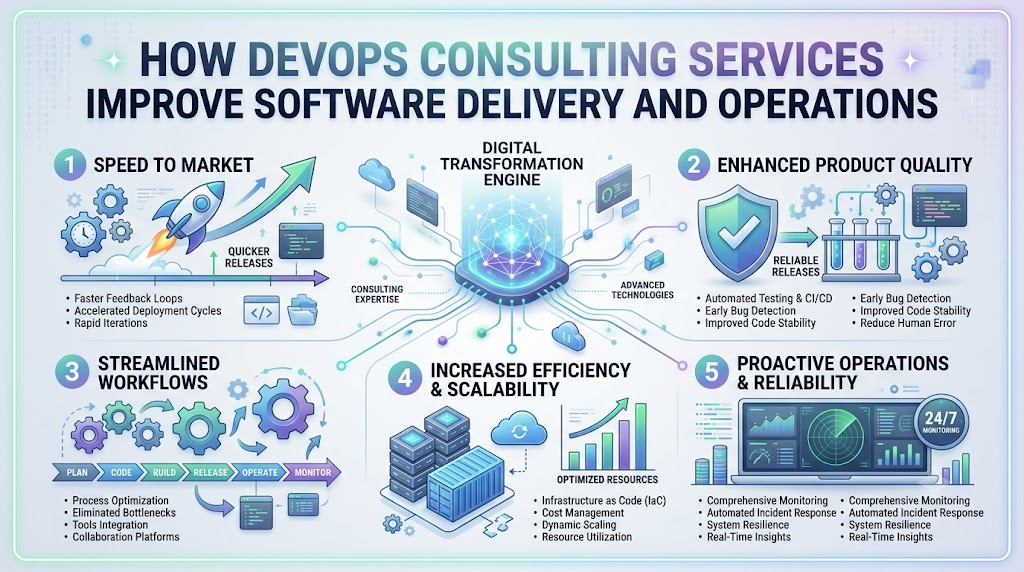
Engineering organizations frequently find that shipping code into production feels harder as their teams grow. Deployment cycles stretch across weeks, fragile handoffs between developers and infrastructure teams create friction, and unexpected production incidents stall product roadmaps. Adopting modern engineering practices is rarely solved by installing a single tool. It requires redesigning the workflows, automation guardrails, and architectural patterns that power the entire software lifecycle. Engaging professional DevOps Consulting Services helps engineering leaders evaluate their existing software delivery chain, eliminate manual bottlenecks, and establish resilient infrastructure practices. Rather than providing off-the-shelf scripts, strategic technical advisory aligns continuous integration, cloud-native orchestration, security controls, and operational observability with clear business priorities. This comprehensive guide examines how organizations evaluate, design, and implement DevOps advisory engagements to build stable, automated, and scalable delivery pipelines.
What Modern DevOps Consulting Services Actually Deliver
Many engineering managers assume that seeking external consulting means hiring a temporary administrator to write infrastructure scripts or patch a build server. True advisory operates at a much higher architectural and organizational level.
Effective consulting addresses the intersection of people, automated processes, and modern platform design. Installing Kubernetes or creating a GitHub Actions workflow does not solve release friction if testing protocols are undefined or development and operations teams operate with contradictory incentives.
A structured engagement systematically assesses where code gets trapped on its way to production. The primary focus is establishing sustainable engineering practices that internal teams can maintain, extend, and own long after the engagement concludes.
+-----------------------------------------------------------------------------------+
|                           Continuous Value Stream                                 |
|                                                                                   |
|  [ Code & Commit ] ──> [ Automated CI/Test ] ──> [ DevSecOps Policy Gates ]       |
|                                                               │                   |
|  [ Observability / SRE ] <── [ Kubernetes / Cloud ] <── [ CD / GitOps Engine ]    |
+-----------------------------------------------------------------------------------+
The Core Pillars of a DevOps Consulting Engagement
To create a delivery engine capable of handling high release frequency without compromising system stability, consulting partners generally focus on six foundational technical pillars.
1. Delivery Maturity Assessment and Value Stream Mapping
Before changing configurations, an experienced architect analyzes the end-to-end path from a developer opening a pull request to that feature serving production traffic.
This phase documents deployment frequency, lead time for changes, change failure rates, and mean time to recovery (MTTR). It identifies whether regressions originate from unmaintained test suites, manual environment provisioning, or fragile deployment approvals.
2. Infrastructure as Code (IaC) and Environment Parity
Manual infrastructure modifications lead to configuration drift, untracked security holes, and environments that behave differently across staging and production.
Consultants introduce declarative infrastructure frameworks such as OpenTofu, Terraform, or cloud-native SDKs. Every virtual network, database cluster, storage bucket, and access role is checked into version control, making environments reproducible, testable, and auditable.
3. Continuous Integration and Continuous Delivery (CI/CD)
CI/CD workflows should operate as deterministic verification engines rather than basic shell scripts.
A production-ready pipeline automatically validates linting, runs unit and integration tests, evaluates security compliance, packages immutably versioned container images, and executes zero-downtime deployment patterns like canary or blue-green rollouts.
4. Cloud Architecture and Kubernetes Orchestration
Applications operating across AWS, Microsoft Azure, or Google Cloud require architectures optimized for resilience and cost efficiency.
Where container orchestration is justified, consultants design managed Kubernetes environments using Amazon EKS, Azure AKS, or Google GKE. This design incorporates structured ingress routing, robust namespace governance, service meshes where necessary, and automated horizontal pod autoscaling.
5. DevSecOps and Software Supply Chain Security
Security cannot function as an isolated compliance check conducted a week before a production release.
Advisors integrate automated static analysis (SAST), container scanning, software bill of materials (SBOM) generation, and secrets management into existing developer tools, ensuring policy enforcement occurs automatically at build time.
6. Observability, Telemetry, and SRE Practices
A system cannot be reliably operated if its internal states are invisible.
Consultants implement unified telemetry frameworks—standardizing structured logs, system metrics, and distributed request tracing with tools like OpenTelemetry, Prometheus, and Grafana. This provides the foundation for setting realistic Service Level Objectives (SLOs) and actionable alerts.
Evaluating Operational Models: In-House, Managed, or Advisory
Engineering leaders must determine whether to hire dedicated internal staff, partner with an advisory firm, or contract ongoing managed operational services. Each delivery structure has distinct trade-offs:
| Operating Model | Ideal Use Case | Primary Advantage | Key Trade-Off / Risk |
| In-House DevOps Team | Established engineering organizations with high domain stability | Full cultural integration and deep institutional memory | Slower hiring cycles, retention risk, and high overhead |
| DevOps Consulting Services | Modernization, architectural overhauls, and pipeline redesign | Immediate access to senior architecture patterns and best practices | Requires internal engineering bandwidth to receive knowledge transfer |
| Managed DevOps Services | Teams lacking 24/7 internal ops staff who need ongoing support | Continuous monitoring, patching, and incident response support | External dependencies and potential abstraction from operational details |
| DevOps Outsourcing | Companies managing sudden capacity spikes or specific migrations | Flexible scaling of engineering capacity without long-term commitments | Requires strict interface definitions and comprehensive documentation |
When Platform Engineering Meets DevOps
As engineering organizations expand beyond a handful of teams, a common failure mode appears: every development squad builds its own conflicting scripts, cloud accounts, and Kubernetes manifests. This fragmentation buries product developers under infrastructure complexity.
Strategic consulting engagements often shift toward Platform Engineering to solve this problem.
Platform engineering teams do not replace DevOps; they productize it. Instead of requiring every software engineer to master complex Kubernetes YAML files and cloud networking rules, platform specialists build an Internal Developer Platform (IDP).
+-----------------------------------------------------------------------------------+
|                        Product Engineering Teams                                  |
|         (Feature Development, Business Logic, Rapid Iteration)                   |
+-----------------------------------------┬-----------------------------------------+
                                          │ Self-Service API / CLI / Portal
+-----------------------------------------▼-----------------------------------------+
|                        Internal Developer Platform (IDP)                          |
|    - Golden Path Templates    - Automated Environments   - Secret Provisioning    |
|    - Standardized Pipelines   - Compliance Guardrails    - Integrated Telemetry   |
+-----------------------------------------┬-----------------------------------------+
                                          │ Declarative Infrastructure (IaC)
+-----------------------------------------▼-----------------------------------------+
|                    Cloud Infrastructure & Container Clusters                      |
|                  (AWS / Azure / GCP / Hybrid / Kubernetes)                        |
+-----------------------------------------------------------------------------------+
By providing curated “golden paths,” developers can spin up environments, configure databases, and deploy workloads autonomously within pre-configured organizational security boundaries. This eliminates ticket-based wait times without sacrificing architectural consistency.
Technical Considerations Across the Lifecycle
Implementing automated delivery pipelines and cloud architectures involves balancing conflicting technical requirements.
Infrastructure Complexity vs. Team Capabilities
Deploying a multi-region, service-mesh-enabled Kubernetes cluster provides impressive scalability, but it also introduces operational overhead. If an application consists of two monolithic services with predictable traffic patterns, managed container runtimes or simpler virtual machine configurations may offer better operational simplicity. A consultant should help evaluate whether the architectural complexity matches the application’s actual operational needs.
Security Automation (DevSecOps)
Shifting security left must not turn the CI pipeline into a bottleneck. When every pull request triggers comprehensive vulnerability scans that run for thirty minutes, developers quickly look for ways to bypass the checks.
Mature implementations run fast linting, secret detection, and dependency checks during pull request evaluation, reserving resource-intensive dynamic analysis (DAST) for asynchronous testing stages.
Multi-Cloud vs. Cloud-Native Specialization
While avoiding vendor lock-in sounds prudent in theory, building an infrastructure layer that behaves identically across AWS, Azure, and Google Cloud often prevents teams from leveraging cloud-native managed capabilities. Most organizations achieve better agility by designing portable application runtimes using containers and standard protocols, while using their primary cloud provider’s native services for managed databases and networking.
Common Implementation Mistakes in Enterprise DevOps
Even well-funded transformation projects run into predictable hurdles when engineering leadership focuses on tool selection over operational habits.
- Treating DevOps as a Single TeamIsolating a group of engineers in a corner and labeling them the “DevOps Team” frequently recreates the exact silo the organization intended to break. Operations becomes a bottleneck again under a different title. Sustainable consulting embeds shared delivery responsibilities across product teams.
- Automating Flawed WorkflowsWriting continuous delivery pipelines for manual, poorly documented, and unverified release processes merely speeds up mistakes. Process standardization must precede automation.
- Tool Sprawl and Incompatible StacksAllowing individual squads to independently pick CI servers, secret managers, and deployment tools creates high maintenance overhead. Standardization on core tools reduces cognitive load and simplifies company-wide security audits.
- Ignoring Observability and Incident ProtocolsAccelerating deployment velocity without adequate real-time telemetry increases the blast radius of unexpected bugs. Automated pipelines must be paired with canary deployment strategies, health checks, and automated rollbacks.
Practical Tips
- Audit Before You Automate: Map your deployment path end-to-end to identify where code spends the most time waiting for human input before introducing new tools.
- Standardize on Golden Paths: Build pre-approved, automated deployment templates for your developers so the safest, most reliable way to deploy is also the fastest.
- Shift Security Left Thoughtfully: Automate static code analysis and dependency checking directly inside pull requests, maintaining clear policies that prevent vulnerable artifacts from reaching artifact registries.
- Prioritize Measurable Reliability: Use SLIs and SLOs to base delivery decisions on actual production stability rather than subjective debates between feature teams and operators.
- Focus on Knowledge Transfer: Ensure every consulting engagement includes pair-programming, runbook creation, and internal training sessions so your internal team can operate and evolve the platform independently.
Frequently Asked Questions
What do DevOps consulting services typically include?
DevOps consulting services typically cover infrastructure audits, CI/CD pipeline automation, Infrastructure as Code adoption, cloud migration, container orchestration with Kubernetes, DevSecOps integration, and observability setup. The primary objective is establishing an automated, reliable software delivery lifecycle tailored to the organization’s business needs.
How does DevOps consulting differ from managed DevOps services?
DevOps consulting focuses on strategy, architecture, pipeline design, and guiding an organization through technical modernization. In contrast, managed DevOps services provide ongoing operational support, including day-to-day cluster maintenance, monitoring, 24/7 on-call incident response, and regular platform patching.
When should an organization invest in DevOps consulting?
Organizations typically seek consulting when deployment cycles become slow or risky, infrastructure costs spiral, or teams plan a major migration to cloud or Kubernetes. It is especially beneficial when internal teams lack the specialized experience to design scalable, modern platform architectures.
Will adopting DevOps eliminate our dedicated operations roles?
No. Adopting DevOps changes how operations works rather than eliminating the discipline. Operations engineers often transition into Site Reliability Engineering (SRE) or platform engineering roles, focusing on building reusable automation, governance, and self-service developer platforms instead of processing manual tickets.
How does DevSecOps fit into a modern consulting engagement?
DevSecOps integrates security directly into early software development stages. Modern consulting embeds static analysis, container image scanning, secrets detection, and compliance-as-code into the automated build pipeline, ensuring vulnerabilities are flagged and resolved before code reaches staging or production environments.
Why is Kubernetes consulting often requested alongside DevOps?
Kubernetes provides powerful container orchestration, automated scaling, and unified workload management across hybrid environments. However, its networking, storage, and access controls introduce operational complexity. Consulting helps teams architect secure, cost-effective clusters while avoiding unnecessary architectural sprawl.
What is the role of an Internal Developer Platform in DevOps?
An Internal Developer Platform (IDP) provides product developers with self-service access to infrastructure, deployment pipelines, and operational monitoring. By standardizing these tools into reusable “golden paths,” engineering organizations reduce cognitive load on developers and maintain consistent governance across squads.
Can small engineering teams benefit from DevOps advisory?
Yes. Small teams often gain significant leverage by avoiding architectural mistakes early. A focused consulting engagement helps early-stage companies establish lightweight CI/CD, secure cloud configurations, and infrastructure templates without over-engineering complex multi-cluster environments before they are needed.
How do we measure the return on investment of a DevOps engagement?
ROI is evaluated through operational delivery metrics such as increased deployment frequency, shorter lead times from commit to production, lower change failure rates, reduced downtime during releases, and optimized cloud infrastructure spending.
How should an enterprise choose the right DevOps consulting partner?
Look for partners who emphasize practical business outcomes over trendy toolchains. An effective partner assesses your existing team culture, demonstrates deep architecture expertise across cloud and container ecosystems, and prioritizes hands-on knowledge transfer so your internal engineers retain ownership.
Conclusion
Scaling software systems requires a balanced foundation of automated pipelines, solid cloud architecture, and clear engineering culture. Adopting modern engineering practices is an iterative journey of eliminating friction, clarifying system behavior, and giving product teams the autonomy to ship features safely. Investing in structured DevOps Consulting Services provides the strategic perspective and deep technical architecture required to modernize legacy workflows, adopt containerized orchestration, and implement robust operational telemetry. By partnering with Cotocus, technology leaders can evaluate their delivery bottlenecks, implement resilient cloud-native foundations, and empower their teams to deliver reliable software with confidence.
