Introduction
Securing an international employment offer is an incredible professional milestone, but it is only the first half of the journey. For thousands of Indian professionals every year, navigating the formal immigration rules, employer sponsorship requirements, and legal documentation is where real complications arise. Securing an overseas job offer does not automatically grant you legal permission to work in that country. Understanding your legal rights, sponsorship status, and filing procedures is critical before resigning from your current Indian role or booking flights. This comprehensive guide covers the essential components of obtaining a work visa for Indians, including core eligibility criteria, official documentation requirements, the multi-stage application journey, real financial commitments, and practical tips to avoid common pitfalls. Explore the verified steps and resources available on DesiNRI to build your global career with confidence.
Understanding the Overseas Work Visa
An overseas work visa is a legal authorization issued by a sovereign government granting a foreign national permission to enter, reside, and engage in gainful employment within its borders for a specified employer, duration, or occupation. For Indian citizens holding Indian passports, moving abroad for employment almost universally requires securing formal work authorization prior to departure.
It is vital to distinguish between general visitor visas, business travel visas, and actual work visas:
- Business Visit Visas: Generally allow attendance at conferences, business meetings, contract negotiations, or short-term training. They strictly forbid engaging in local productive work, receiving local compensation, or replacing a local resident worker.
- Employer-Sponsored Work Visas: Tied directly to an authorized overseas hiring entity that petitions the local immigration or labor department on your behalf.
- Open/Unrestricted Work Visas: Available in select migration systems (such as post-study graduate visas or specific dependent permits) that permit working for nearly any licensed local employer without prior sponsorship.
Most first-time Indian migrants transition via employer-sponsored frameworks. Because these systems are designed to balance economic demand against domestic workforce protections, understanding your specific visa conditions before signing employment contracts prevents severe legal and career setbacks.
Core Eligibility Requirements for Indian Applicants
Every sovereign state establishes its own migration criteria, but major employment destinations share common qualification benchmarks for skilled workers.
1. Genuine Job Offer and Authorized Sponsorship
Before applying for an employer-sponsored work visa, an applicant must possess an unconditional, written employment offer from an eligible international employer. In many developed markets (such as the UK, US, Australia, Ireland, and Canada), the hiring company must hold an active government sponsorship license or labor certification.
2. Labor Market Testing and Quota Compliance
In many jurisdictions, employers must first demonstrate to their national labor authority that no qualified citizen or permanent resident is available to fill the position. This process—known as a Labor Market Impact Assessment (LMIA) in Canada, prevailing wage determination and labor certification in the US, or resident market testing elsewhere—must be completed by the employer before filing your visa petition.
3. Educational Qualifications and Credential Evaluation
Indian academic degrees (such as B.Tech, B.Sc, B.Com, MBA, or MBBS) typically require verification against the destination country’s educational framework:
- Degree certificates must match the skill classification of the targeted job.
- Certain destinations mandate formal credential evaluation assessments (e.g., WES in North America or ECCTIS in the United Kingdom).
4. Relevant Skilled Work Experience
You must demonstrate a proven, verifiable professional background directly aligning with the position’s job code. Immigration officers cross-reference:
- Official service certificates on company letterheads.
- Verifiable corporate contact emails and phone numbers.
- Salary payment records corresponding to relevant tax filings.
5. English Language Proficiency
Depending on the destination, demonstrating standardized language ability is mandatory:
- Recognized tests include IELTS General Training, PTE Academic, or TOEFL iBT.
- Minimum score thresholds vary by skill tier, technical level, and whether regulatory licensing is involved.
6. Health and Character Standards
- Medical Screening: Chest X-rays (for tuberculosis screening) and blood tests conducted at government-empanelled clinics.
- Police Clearance Certificates (PCC): Issued by the Regional Passport Office (RPO) or local police authorities in India verifying an absence of disqualifying criminal history.
Essential Visa Document Checklist
Incomplete, inconsistent, or improperly attested documentation causes the vast majority of visa refusals and administrative processing delays for Indian candidates. Organizing your dossier systematically prevents critical oversights.
| Document Category | Key Items Required | Important Attestation / Format Notes |
| Identity & Travel | Valid Indian Passport, Photographs | Minimum 6–12 months validity remaining; blank visa pages; biometric photos meeting specific dimensional rules. |
| Employment Proof | Offer Letter, Sponsorship Certificate | Must state job title, SOC/ANZSCO code, exact base salary, weekly working hours, and employer tax ID. |
| Indian Experience | Experience Letters, Relieving Letters | Written on official company letterheads outlining roles, dates, and responsibilities signed by authorized HR. |
| Financial Records | Bank Statements, Form 16, ITRs | Last 6 months of bank statements with official bank stamp; minimum 3 years of Indian Income Tax Returns. |
| Academic Records | Degree Certificates, Mark Sheets | Consolidated transcripts; official English translations if original degree issued in regional Indian language. |
| Character & Health | Indian Police Clearance Certificate (PCC), Medicals | PCC issued through the Passport Seva Kendra (PSK); medical exam reports from designated panel physicians. |
Step-by-Step Application Process
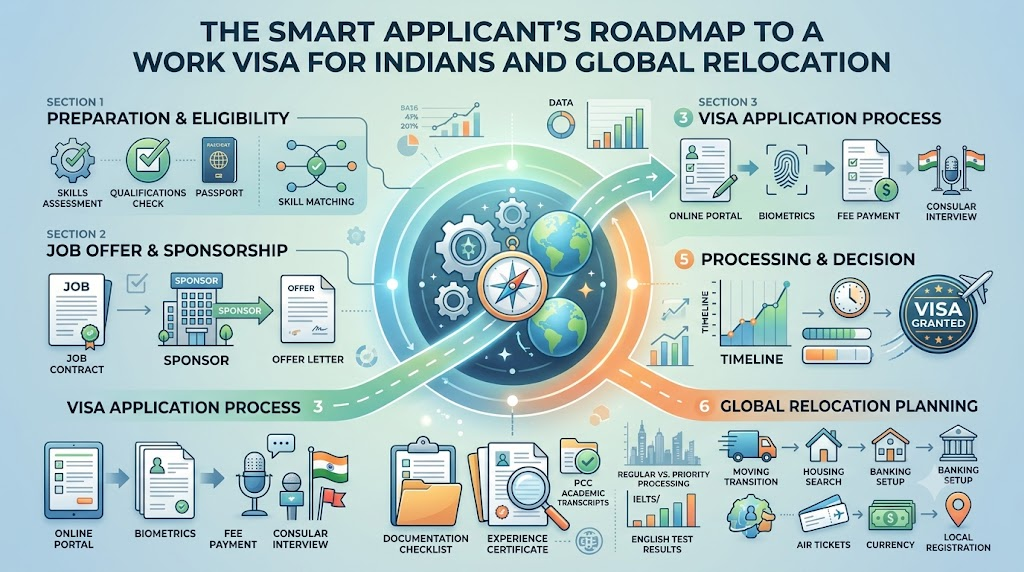
While specific systems vary, the standard journey from job offer to relocation follows a structured sequence.
Step 1: Offer & Sponsorship
   │
   ▼
Step 2: Credential & Language Testing
   │
   ▼
Step 3: Document Compilation & Verification
   │
   ▼
Step 4: Visa Petition / Online Application
   │
   ▼
Step 5: Fee Payment & Surcharges
   │
   ▼
Step 6: Biometrics & Consular Appointment
   │
   ▼
Step 7: Processing, Decision & Travel
Step 1: Secure the Offer and Verify Sponsorship
Confirm your prospective employer possesses the legal license to sponsor foreign talent and has initiated the required resident labor market checks.
Step 2: Clear Credential and Language Assessments
Book your IELTS or PTE exam immediately, and submit degree credentials to foreign credential evaluators if required by that country’s immigration department.
Step 3: Gather Indian Documents
Collect stamped banking records, payslips from all previous Indian employers, Form 16s, and apply for your PCC via the official Passport Seva portal.
Step 4: Complete the Official Visa Application
Your employer submits the preliminary sponsorship petition. Once approved, you file the personal visa application form on the host nation’s official immigration portal.
Step 5: Settle Statutory Fees
Pay the visa application fee, biometrics charge, and mandatory regional healthcare surcharges using an international credit card enabled for cross-border payments.
Step 6: Complete Biometrics and Interview
Attend your appointment at an authorized visa processing facility (e.g., VFS Global, TLScontact, or the relevant Consulate). Provide finger scans, official photographs, and submit your physical passport. Attend a consular interview if mandated by that country’s rules.
Step 7: Application Tracking and Final Decision
Track application updates solely through the government’s official application reference portal. Avoid making irreversible travel bookings until your physical visa vignette or official digital visa grant notice is issued.
Financial Planning: Official Fees vs. Relocation Costs
Relocating internationally requires substantial capital reserves. Applicants often budget solely for the visa processing fee, overlooking substantial preliminary certification expenses and initial settlement costs.
1. Official and Statutory Expenses
- Visa Application Charge: Paid directly to the host country’s immigration department.
- Healthcare Surcharges: Mandatory annual payments (such as the UK Immigration Health Surcharge) payable upfront for the entire duration of the visa.
- Biometrics Fees: Administrative processing fees charged by authorized collection centers.
2. Preliminary Documentation Costs in India
- Standardized Language Testing: Fixed fees per attempt for IELTS or PTE examinations.
- Educational Credential Assessments: Fees per application paid to foreign credential evaluators.
- Medical Screening: Testing costs paid directly to empanelled diagnostic centers.
- PCC and Document Attestation: Ministry of External Affairs (MEA) apostille and verification costs.
3. Initial Settlement Capital
- Airfare and Initial Lodging: Flights and temporary serviced accommodation for the first 2 to 4 weeks.
- Rental Deposits: Most international rental markets require between 1 and 3 months of rent as an upfront security deposit plus initial rent.
- Settlement Buffer: Liquid savings required to cover daily expenses, groceries, local transport cards, and mobile connections before your first local salary disbursement.
Processing Times and Understanding Variations
Visa processing schedules are dynamic and depend entirely on the host country’s caseload, occupation category, and geopolitical developments.
- Standard Timelines: Typical skilled worker petitions average anywhere between 3 weeks to 4 months following biometrics submission.
- Priority Processing: Many jurisdictions offer accelerated review options for an additional government fee, cutting waiting times to 5 to 15 business days.
- Administrative Review: If an employment history check or background review is required, applications can be placed on hold for several months.
Never rely on anecdotal forum timelines. Published processing averages should be treated as indicative estimates rather than firm guarantees.
Work Rights, Dependents, and Visa Conditions
A work visa does not confer absolute freedom of movement or employment. You must adhere strictly to the conditions attached to your visa grant.
1. Primary Work Rights and Restrictions
Most sponsored work visas bind you strictly to the sponsoring employer named on your visa document. You cannot legally moonlight, freelance, consult for third parties, or transition to a new employer without submitting a fresh visa variation or sponsorship transfer with the immigration department.
2. Dependent Spouses and Children
- Inclusion: Most skilled work visas permit the primary applicant to bring immediate family members (spouse and dependent children under 18).
- Dependent Work Rights: While some countries permit dependent spouses unrestricted open work rights, others limit them to visitor status or require them to secure their own independent employment sponsorship.
- Schooling Costs: Depending on the destination and visa subclass, schooling for dependent children in public systems may be free, subsidized, or charged at full international student rates.
Career Planning vs. Legal Immigration Planning
A common point of confusion among Indian professionals seeking overseas roles is conflating the job search process with legal work authorization.
Job Search Process                    Immigration Process
-----------------                     -------------------
1. Resume Optimization                1. Government Quota Checks
2. Technical Interviews               2. Labor Market Testing
3. Salary & Role Negotiation   =/=    3. Sovereign Visa Adjudication
4. Formal Employment Offer            4. Legal Right to Work Issued
Passing technical interviews and receiving a written contract does not equate to holding a work permit. An employer may offer a role in good faith, only to have the labor certification rejected by immigration officials due to domestic workforce quotas or salary threshold adjustments.
Always negotiate contingencies in your offer letter ensuring that your employment start date is explicitly dependent on formal, unconditional visa issuance.
Scam Awareness and Candidate Safety
The high demand for international employment has created an environment where fraudulent recruiters, unauthorized agents, and phishing rings target Indian job seekers.
- The “Guaranteed Visa” Red Flag: No private consultant, recruitment company, or HR professional can guarantee visa approval. Sovereign immigration officers retain sole discretionary authority.
- Upfront Job Offer Fees: Legitimate employers cover their own recruitment agency fees and corporate sponsorship costs. Demands for “processing charges,” “interview fees,” or “security deposits” to unlock an offer letter indicate a scam.
- Fake Verification Sites: Scammers frequently create clone websites resembling government immigration departments or major multinationals. Always verify web addresses against official
.govor verified top-level corporate domains. - Unsolicited Offers: Receiving an unprompted employment contract without multiple rounds of video or in-person technical interviews is a standard indicator of employment fraud.
Practical Application Scenario: Indian Software Engineer
To understand how these components assemble in practice, consider this realistic relocation workflow:
- Offer Stage: An Indian senior software engineer based in Bengaluru receives a formal offer from a technology firm in Dublin, Ireland.
- Employer Filings: The employer applies for and secures an Employment Permit through Ireland’s Department of Enterprise, Trade and Employment (DETE).
- Document Gathering: With the permit in hand, the engineer gathers their 3-year Indian degree mark sheets, 5 years of verified experience certificates, last 6 months of stamped bank statements, and Indian Form 16s.
- PCC & Medicals: The engineer schedules an appointment at the Bengaluru Passport Seva Kendra to obtain an official Police Clearance Certificate.
- Visa Lodgment: The applicant completes the official online visa form, pays the consular fees, and schedules a biometrics submission at the local VFS Global center.
- Relocation Transition: Upon receiving the passport with the entry visa vignette, the engineer confirms resignation notices, arranges temporary overseas accommodation, and reviews local banking requirements via diaspora guides on DesiNRI.
Frequently Asked Questions (FAQs)
What are the basic visa requirements for Indians applying for an overseas work visa?
The core requirements include a valid Indian passport, a formal job offer from an approved sponsor, verifiable educational qualifications, relevant professional experience, proof of English language proficiency, an official Police Clearance Certificate, and passing a medical screening with an empanelled physician.
Can an Indian citizen apply for a foreign work visa without a job offer?
Most international work visas require a formal job offer and employer sponsorship. However, certain countries offer specialized points-based skilled migrant visas or working holiday pathways where applicants with high educational, language, and age scores can migrate without a prior job offer.
How does an employer prove they can sponsor an Indian worker?
Employers must demonstrate valid corporate registration and hold a government-issued sponsorship license. In many countries, they must also complete a labor market test showing no qualified domestic worker was available, and guarantee that the offered salary meets or exceeds national minimum thresholds.
How long does it take for an Indian applicant to receive a work visa decision?
Processing timelines range between 3 weeks to 4 months following biometrics submission, depending on the country, visa category, and seasonal backlog. Many immigration authorities offer expedited priority services for an additional fee, reducing decision times to 1 to 3 weeks.
Can I bring my family with me on a skilled work visa?
Yes, most skilled work visas allow you to sponsor immediate dependents, specifically your legal spouse and unmarried children under age 18. Dependents must submit separate applications, clear character and medical checks, and prove access to sufficient living funds.
Are dependent spouses allowed to work under my work visa?
Work authorization for dependent spouses varies by country and visa subclass. Some jurisdictions permit spouses unrestricted open work rights, whereas others classify them as visitors or mandate that they independently obtain employer-sponsored work authorization before taking up employment.
What happens to my visa status if I lose my job abroad?
If your employment terminates, host governments typically grant a grace period of 30 to 90 days. During this window, you must find a new licensed sponsor, switch to an alternate legal visa category, or prepare to depart the country voluntarily before overstaying.
What is the difference between a work visa and permanent residency?
A work visa is a temporary, conditional permit tied to employment and valid for a fixed duration. Permanent residency grants the indefinite right to live, work, and study anywhere in the country without employer sponsorship, often serving as a pathway to citizenship.
Can I switch employers while working on a sponsored work visa?
Yes, but you cannot begin working for a new employer immediately. The new employer must typically issue a fresh sponsorship petition, and you must receive an updated visa grant or official authorization from the immigration department prior to switching duties.
How can Indian job seekers identify and avoid overseas recruitment scams?
Avoid any agency that charges upfront fees for guaranteed job offers, issues contracts without formal technical interviews, uses generic free email addresses, or claims guaranteed visa approvals. Always verify company details and use official government portals to validate immigration information.
Conclusion
Navigating the transition from an Indian professional career to international employment requires careful attention to immigration rules, honest self-assessment, and organized documentation. While the prospect of building a global career is exciting, treating the administrative visa process with the same rigor as your professional interviews is essential. Ensure your credentials are authenticated, maintain clear records of your employment history, and budget realistically for upfront relocation and government fees. For ongoing updates on visa regulations, overseas job pathways, and community insights from Indian expats worldwide, explore the guides and resources available on DesiNRI.
