Introduction
Artificial intelligence has seamlessly woven itself into the fabric of daily human life. From the moment you unlock your smartphone using facial recognition to the curated streaming recommendations waiting on your television dashboard, intelligent systems are quietly operating in the background. AI is no longer a distant futuristic luxury relegated to science fiction novels. It is a present infrastructure powering the global economy.
Across every major global sector, the influence of modern intelligent software is expanding exponentially. In enterprise spaces, corporations rely heavily on deep neural pipelines to forecast changing consumer market patterns. Healthcare environments deploy complex machine learning algorithms to spot diagnostic anomalies in radiographic imagery days before a human eye can perceive them. Education fields utilize personalized, adaptive platforms that match a student’s unique learning speed. Across engineering sectors, advanced algorithms optimize global distribution logistics instantly.
+--------------------------------------------------------------------------+
|                        GLOBAL ENTERPRISE AI ADOPTION                     |
+--------------------------------------+-----------------------------------+
| SECTOR                               | PRIMARY USE CASE                  |
+--------------------------------------+-----------------------------------+
| Healthcare                           | Diagnostic Image Recognition      |
| Finance                              | Automated Fraud Detection Systems |
| Retail & E-Commerce                  | Real-Time Customer Personalization|
| Logistics                            | Supply Chain Route Optimization   |
+--------------------------------------+-----------------------------------+
| Discover comprehensive technical career pipelines directly through       |
| the official educational portals found at https://www.aiuniverse.xyz     |
+--------------------------------------------------------------------------+
Developing a comprehensive understanding of artificial intelligence is one of the most career-resilient choices an individual can make. As traditional computational workflows automate rapidly, individuals possessing the technical proficiency to build, configure, and maintain machine learning architectures find themselves in unprecedented demand. This reality spans across technical and non-technical fields alike.
The absolute best window of opportunity for beginners to enter this discipline is right now. You do not need an elite computer science background or an advanced mathematical doctorate to establish a solid footprint in the field. By using structured educational paths, learning the core technology, and committing to building real projects, anyone can learn artificial intelligence from scratch.
Featured Snippet
How Can Beginners Learn Artificial Intelligence from Scratch?
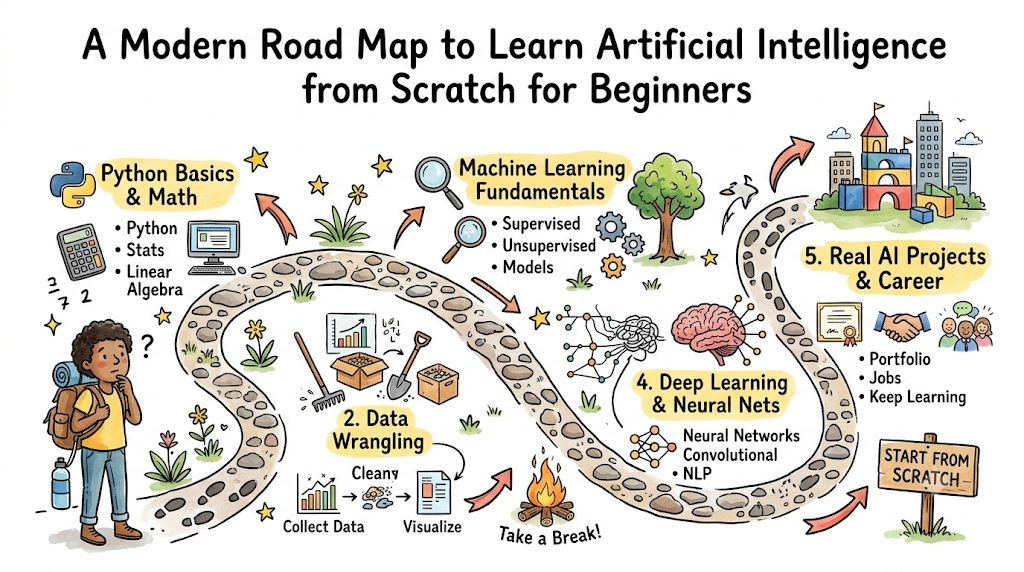
Beginners can learn artificial intelligence from scratch by following a structured five-stage learning roadmap:
- Master fundamental mathematics focusing on linear algebra, statistics, and calculus.
- Achieve fluency in Python programming and data manipulation libraries.
- Understand core machine learning classification and regression algorithms.
- Dive into deep learning architectures and neural frameworks like PyTorch.
- Build and deploy practical, real-world portfolio applications.
Understanding Artificial Intelligence
What Is Artificial Intelligence?
At its foundational root, Artificial Intelligence is a broad branch of computer science dedicated to creating software systems capable of executing tasks that traditionally require human cognitive processing. This encompasses vital analytical operations such as reasoning, contextual understanding, complex problem-solving, sensory perception, and autonomous linguistic generation.
Unlike conventional software engineering programs—which rely strictly on explicit, hard-coded rules written by a human developer—AI systems parse massive datasets to discover underlying trends. They adjust their internal logical steps dynamically based on the informational feedback loops they encounter.
History and Evolution of AI
The theoretical origin of artificial intelligence began formally in 1956 during the historic Dartmouth Summer Research Project. Early pioneers predicted that machines mimicking human thought processes were only a few decades away. However, early research hit massive roadblocks due to severe limitations in compute power and a lack of digital data storage. This dry spell led to several decades of reduced funding known as “AI Winters.”
The modern revolution emerged in the late 2000s and early 2010s, powered by the rise of high-performance Graphics Processing Units (GPUs) and the explosion of big data from the internet. This combination made deep learning highly practical, sparking an exponential wave of innovation that led directly to today’s conversational systems, autonomous vehicles, and generative transformers.
[1956: Dartmouth Workshop] ---> [1970s-1980s: AI Winters] ---> [2010s: Deep Learning Boom] ---> [Present: Generative Era]
Why AI Matters Today
Artificial intelligence matters today because society has fundamentally outgrown manual data processing. The sheer volume of digital information generated daily by global networks makes manual human analysis completely impossible.
AI bridges this gap by turning chaotic, unstructured enterprise data into clear, actionable strategies. It serves as an economic engine that streamlines operations, lowers production overhead, and unlocks entirely new categories of consumer products across the globe.
Types of Artificial Intelligence
Narrow AI (Weak AI)
Narrow AI refers to software applications meticulously optimized to execute a singular, highly specific task with exceptional efficiency. These systems possess zero functional awareness outside their designated operational scope. Every single AI system currently running in production today falls squarely into this category.
General AI (Artificial General Intelligence – AGI)
General AI represents a completely theoretical class of intelligence where a machine possesses the capacity to learn, comprehend, and flexibly apply abstract cognitive skills across any intellectual domain—completely matching human capabilities. AGI does not exist yet; it remains an active, heavily debated focus of long-term computer science research.
Super AI (Artificial Superintelligence – ASI)
Super AI describes a hypothetical future state where an autonomous system’s collective intellectual capacity surpasses the finest minds of human civilization across every conceivable metric, including creative design, social intelligence, and logical problem-solving. This remains a topic of long-term philosophical discussion and theoretical research.
In Simple Terms: > Think of Narrow AI as a world-class chess computer. It can defeat any human grandmaster on earth, but it has no idea what a sandwich is, how to drive a car, or how to write a simple sentence. It is exceptionally brilliant at exactly one thing.
Real-World Example: > When you open your email application and see an automated folder filter separating valid incoming correspondence from unsolicited junk messages, you are watching a Narrow AI binary classification system work in real-time.
Common Mistake: > Many beginners stall their education by worrying that super-intelligent machines will render programming obsolete before they finish learning. Do not get distracted by science-fiction scenarios; focus on learning the practical, rule-based algorithmic systems used by businesses today.
Key Takeaways
- Artificial intelligence relies entirely on data-driven patterns rather than rigid, manually hard-coded instructions.
- Every modern production system encountered in industry today is classified strictly as Narrow AI.
- The current technology boom is powered by affordable GPU processing clusters and massive digital datasets.
AI vs. Machine Learning vs. Deep Learning
Understanding the technical boundaries between Artificial Intelligence, Machine Learning, and Deep Learning is essential for a beginner. These terms are not interchangeable synonyms; instead, they represent concentric layers of technology nested inside one another.
+-------------------------------------------------------+
| ARTIFICIAL INTELLIGENCE (Broadest Field)              |
|   +-------------------------------------------------+ |
|   | MACHINE LEARNING (Data-Driven Learning)         | |
|   |   +-------------------------------------------+ | |
|   |   | DEEP LEARNING (Multi-layer Neural Nets)   | | |
|   |   +-------------------------------------------+ | |
|   +-------------------------------------------------+ |
+-------------------------------------------------------+
Detailed Comparison Table
| Aspect | Artificial Intelligence | Machine Learning | Deep Learning |
| Definition | The broad science of mimicking human intelligence using software. | A subset of AI focused on systems that learn patterns directly from data. | A specialized subset of ML using multi-layered neural networks. |
| Scope | Complete umbrella covering all intelligent systems. | Broad subset focused on statistical mathematical learning. | Specialized sub-layer focused on deep network architectures. |
| Complexity | Varies widely from simple rule engines to complex systems. | Moderate; requires manual engineering of data features. | High; demands specialized GPU hardware setups. |
| Data Needs | Can operate on explicit expert rules without data. | Requires thousands of clean, tabular data rows. | Requires millions of unstructured data points. |
| Examples | Chess algorithms, automated pathfinding software. | Linear regression models, random forest classifiers. | Convolutional networks, large transformer language models. |
| Applications | Robotic automation, basic video game logic engines. | Credit score evaluation, real-time email spam filters. | Autonomous vehicle tracking, live language translation. |
In Simple Terms: > Imagine learning to cook. Artificial Intelligence is the entire concept of culinary arts. Machine Learning is a specific cooking technique where you follow a basic recipe framework but tweak the seasoning based on taste test data. Deep Learning is an industrial kitchen that uses automated appliances to prepare gourmet meals for thousands of guests simultaneously using raw, unchopped ingredients.
Real-World Example: > Consider a customer support platform. A basic AI approach uses hard-coded rules to route users based on specific keywords. A Machine Learning approach looks at historical customer logs to predict which department should handle an incoming message. A Deep Learning approach uses a generative model to understand emotional nuances and draft complete, contextual text responses instantly.
Common Mistake: > Beginners frequently attempt to build advanced deep learning architectures before mastering classical machine learning models. Skipping these foundational steps leaves you without the core skills needed to debug complex neural networks when they fail.
Key Takeaways
- Machine learning is a distinct sub-field located inside the broader universe of artificial intelligence.
- Deep learning removes the need for manual feature engineering by discovering patterns directly in raw data.
- Classical machine learning remains the most cost-effective and practical choice for standard tabular business data.
Skills Needed to Learn AI
Mathematics Fundamentals
You do not need an advanced math degree to start a career in AI, but you do need a solid grasp of core mathematical pillars. Skipping these fundamentals makes it incredibly difficult to understand why models behave the way they do or how to fix them when things go wrong.
       [AI Mathematics Core]
                 |
  +--------------+--------------+
  |              |              |
[Linear Algebra] [Probability] [Statistics]
- Linear Algebra: You need to understand vectors, matrices, matrix multiplication, and transpositions. In AI, all input data—whether text, audio, or images—is converted into multi-dimensional matrices.
- Probability: Core concepts like Bayes’ Theorem, conditional probabilities, and random variables are essential. AI models calculate probabilities to make predictions under uncertain conditions.
- Statistics: Focus on mean, variance, standard deviation, hypothesis testing, and standard distributions. These metrics help you evaluate data trends and understand model performance.
Programming Skills
Code is the vehicle used to bring mathematical concepts to life. You need a strong foundation in core programming concepts before diving into complex AI frameworks.
- Python: The undisputed standard language for modern artificial intelligence. Focus on mastering loops, object-oriented principles, custom functions, data structures (lists, dictionaries), and error handling.
- Data Structures & Algorithms: A solid understanding of time complexity (Big O notation), sorting routines, trees, and graphs will help you write efficient, scalable code.
Data Skills
AI models are completely dependent on the data used to train them. Knowing how to handle, clean, and explore data is a critical skill for any practitioner.
- Data Collection & Cleaning: Real-world data is often chaotic, incomplete, and filled with errors. You must learn how to handle missing records, remove duplicate entries, and fix formatting inconsistencies.
- Exploratory Data Analysis (EDA): The practice of summarizing data characteristics using statistical charts and graphs. This process helps you spot hidden trends before feeding data into a model.
In Simple Terms: > Think of building an AI model like constructing a house. Mathematics is the blueprint, programming is the toolset, and data is the raw building material. If any of these components are weak, the entire structure will collapse.
Real-World Example: > When an e-commerce platform builds a system to predict customer churn, data engineers use Python to clean millions of purchase records, statistics to analyze buying trends, and linear algebra to process those habits into an actionable predictive model.
Common Mistake: > Many beginners fall into the trap of studying pure mathematics for months without writing a single line of code. The most effective approach is to learn mathematical concepts alongside practical programming exercises.
Key Takeaways
- Linear algebra transforms real-world information into a matrix format that computer hardware can process.
- Python serves as the primary language for AI development due to its rich ecosystem of libraries.
- Data preparation and cleaning often consume the vast majority of an AI engineer’s daily workflow.
Step-by-Step AI Learning Roadmap
+--------------------------------------------------------------------------------------------------+
|                                     THE 10-STEP AI LEARNING ROADMAP                              |
+--------------------------------------------------------------------------------------------------+
| [01. Fundamentals] -> [02. Python Code] -> [03. Applied Math] -> [04. Classical ML]              |
|                                                                                                  |
| [08. Portfolio]    <- [07. GenAI Tech]  <- [06. Projects]     <- [05. Deep Learning]             |
|                                                                                                  |
| [09. Communities]  -> [10. Career Roles]                                                         |
+--------------------------------------------------------------------------------------------------+
Step 1: Understand AI Fundamentals
- Goal: Learn core industry terminology and understand the boundaries of modern AI capabilities.
- Approach: Read foundational articles, watch introductory overviews, and explore everyday AI use cases.
- Expected Outcome: The ability to explain the practical distinctions between Narrow AI, Machine Learning, and Deep Learning without relying on industry hype.
Step 2: Learn Python
- Goal: Build the core programming skills needed to write clean, maintainable automation and data scripts.
- Approach: Complete interactive coding tutorials and build simple automation scripts like web scrapers or file organizers.
- Expected Outcome: Fluency in core Python concepts like object-oriented programming, file management, and custom error handling.
Step 3: Learn Mathematics for AI
- Goal: Understand the underlying mathematical formulas that power machine learning optimizations.
- Approach: Study applied linear algebra matrices, core calculus derivatives, and descriptive statistical metrics alongside your programming practice.
- Expected Outcome: The ability to confidently read and interpret standard algorithmic optimization equations.
Step 4: Study Machine Learning Basics
- Goal: Learn how to train, evaluate, and tune classical regression, classification, and clustering models.
- Approach: Use structured libraries like Scikit-Learn to train algorithms on clean tabular datasets.
- Expected Outcome: A deep understanding of core concepts like overfitting, feature engineering, and model validation metrics.
Step 5: Learn Deep Learning
- Goal: Master multi-layer artificial neural networks for processing complex, unstructured datasets.
- Approach: Build and train neural architectures using deep learning frameworks like PyTorch or TensorFlow.
- Expected Outcome: The ability to construct, train, and troubleshoot neural network layers for image or text classification.
Step 6: Work on AI Projects
- Goal: Move past structured tutorials by applying your skills to messy, real-world datasets.
- Approach: Source unique datasets from public repositories and build end-to-end analytical pipelines.
- Expected Outcome: A proven ability to solve open-ended data problems without relying on step-by-step guides.
Step 7: Explore Generative AI
- Goal: Learn how to build applications using modern foundational models and large language architectures.
- Approach: Work with API endpoints, master prompt engineering, and build context-aware systems using Vector Databases and Retrieval-Augmented Generation (RAG).
- Expected Outcome: The ability to deploy custom, data-backed intelligent assistants and text generation tools.
Step 8: Build a Portfolio
- Goal: Present your technical skills clearly to prospective employers and collaborators.
- Approach: Publish clean, well-documented code repositories on GitHub, accompanied by detailed technical explanations.
- Expected Outcome: A professional digital portfolio that clearly demonstrates your ability to solve real-world problems.
Step 9: Join AI Communities
- Goal: Connect with peers, share knowledge, and stay updated on the latest industry developments.
- Approach: Engage in technical forums, participate in hackathons, and contribute to open-source software projects.
- Expected Outcome: A growing professional network that provides access to unlisted career opportunities and collaborative projects.
Step 10: Apply for AI Roles
- Goal: Transition your skills into a full-time professional career or consulting business.
- Approach: Optimize your resume for technical roles, practice coding challenges, and apply for positions like AI Engineer or Data Scientist.
- Expected Outcome: Securing a professional technical role within the global artificial intelligence economy.
In Simple Terms: > Learning AI is like learning to play an instrument. You start with basic musical notation (math), practice simple scales (Python), perform classic compositions (Machine Learning), write your own songs (Projects), and eventually join a professional band (Career).
Real-World Example: > Aspiring engineers often follow this exact path: starting with foundational Python scripts, mastering Scikit-Learn to predict real estate pricing, and eventually building advanced deep learning models that detect anomalies in medical images.
Common Mistake: > A common pitfall is trying to jump straight to Step 7 (Generative AI) without mastering Step 2 (Python) or Step 4 (Machine Learning). Without those core engineering foundations, you will struggle to build reliable, production-ready applications.
Key Takeaways
- Following a structured learning path helps prevent burnout and keeps you from feeling overwhelmed by the sheer volume of topics.
- Building real portfolio projects is much more valuable to employers than collecting course certificates.
- Connecting with active developer communities keeps you grounded and aligned with current industry hiring standards.
Best Programming Languages for AI
While Python remains the dominant language for modern AI development, several other programming languages are highly effective depending on your specific infrastructure constraints and production needs.
+------------------------------------------------------------------------+
|                      PROGRAMMING LANGUAGE LANDSCAPE                    |
+------------------------------------------------------------------------+
| Python       =============================================> (Dominant) |
| Julia        =========================> (Scientific Compute)           |
| R            =====================> (Pure Statistical Analysis)        |
| C++          =================> (High-Performance Hardware Deployment) |
+------------------------------------------------------------------------+
Language Comparison Table
| Language | Difficulty | AI Ecosystem | Best Use Cases |
| Python | Low | Exceptionally vast; contains standard production frameworks. | Universal AI development, data science, deep learning research. |
| R | Moderate | Strong for statistical analysis; limited for deep production. | Academic research, pure statistical analysis, data visualization. |
| Java | High | Stable enterprise tools; more verbose than Python. | Large-scale enterprise systems, legacy systems integration. |
| Julia | High | Modern frameworks built for high-performance math. | Advanced scientific computing, massive algorithmic modeling. |
| JavaScript | Moderate | Growing browser-based frameworks; limited for heavy training. | In-browser model deployment, web-based interactive AI tools. |
In Simple Terms: > Python is the English of the AI world—universal, easy to learn, and spoken everywhere. C++ is like technical shorthand—hard to master, but incredibly fast when every millisecond counts. R is like specialized academic jargon—perfect for pure statistical research but rarely used to build consumer web apps.
Real-World Example: > A research team might use Python to quickly design and train a new computer vision model, but pass the final weights to an infrastructure team that rewrites the core execution layer in C++ so it can run smoothly on low-power automotive hardware.
Common Mistake: > Beginners often waste valuable weeks trying to learn three or four programming languages simultaneously. Pick Python first, master it completely, and only explore other languages if your specific production environment demands it.
Key Takeaways
- Python is the industry standard for AI development due to its clean syntax and massive library support.
- Languages like C++ and Julia are typically reserved for specialized, high-performance computing constraints.
- Focus on mastering one primary language to build strong programming fundamentals before diversifying.
Essential AI Tools and Frameworks
Core Tools Matrix
| Framework | Core Purpose | Learning Curve | Primary Industry Use Case |
| NumPy | High-performance multi-dimensional matrix operations. | Linear | Foundational array mathematics. |
| Pandas | Tabular data manipulation and analysis. | Linear | Structured data cleaning and exploration. |
| Scikit-Learn | Classical machine learning algorithms. | Moderate | Predictive business modeling. |
| TensorFlow | Production-scale deep learning deployment. | Steep | Enterprise-grade neural networks. |
| PyTorch | Dynamic, research-focused deep learning. | Steep | Modern AI research and vision pipelines. |
| Keras | High-level abstraction layer for neural networks. | Linear | Rapid deep learning prototyping. |
| Hugging Face | Pre-trained transformer models and pipelines. | Moderate | Natural Language Processing tools. |
| OpenCV | Real-time image and video processing. | Moderate | Industrial computer vision systems. |
    [Data Prep Layer]     --->     [Classical ML Layer]    --->    [Deep Learning Layer]
    (NumPy, Pandas)                (Scikit-Learn)                 (PyTorch, TensorFlow)
NumPy
NumPy provides the mathematical foundation for scientific computing in Python. It introduces highly optimized, multi-dimensional array structures that allow you to perform complex mathematical calculations on massive datasets instantly.
Pandas
Pandas is the go-to tool for structured data analysis. It provides the DataFrame structure, which lets you easily load, clean, transform, and analyze tabular data from formats like CSV files or SQL databases.
Scikit-Learn
Scikit-Learn is an exceptionally clean, well-documented library for classical machine learning. It features robust implementations of standard classification, regression, clustering, and dimensionality reduction algorithms.
TensorFlow
Developed by Google, TensorFlow is an end-to-end open-source platform built for large-scale deep learning. It excels at distributed training across massive server clusters and handles high-volume production deployments with ease.
PyTorch
Created by Meta’s AI Research lab, PyTorch has become the favorite framework among AI researchers and modern developers. Its dynamic computation graphs allow you to modify network behavior on the fly, making it highly intuitive to write and debug.
Keras
Keras is a high-level API designed to run on top of TensorFlow. It simplifies the process of building deep learning models by stripping away low-level boilerplate code, allowing you to build and test neural networks in just a few lines of code.
Hugging Face
Hugging Face has become the hub for natural language processing and transformer models. It provides incredibly easy access to state-of-the-art, pre-trained language and vision models, allowing you to fine-tune massive architectures with minimal compute overhead.
OpenCV
OpenCV is an open-source library dedicated to real-time computer vision tasks. It provides thousands of optimized algorithms for image processing, facial identification, object tracking, and robotic vision pipelines.
In Simple Terms: > Imagine building a professional workshop. NumPy and Pandas are your raw materials and sorting bins. Scikit-Learn is your dependable set of hand tools for everyday building. PyTorch and TensorFlow are heavy industrial factory machines meant for mass production, and Hugging Face is a warehouse of pre-assembled components ready to use immediately.
Real-World Example: > When developing a predictive maintenance application, an engineer uses Pandas to clean incoming sensor logs, Scikit-Learn to quickly evaluate classic predictive models, and PyTorch to build an advanced neural network if the data patterns turn out to be highly complex.
Common Mistake: > A common mistake is importing advanced deep learning libraries like PyTorch for simple problems that could be solved faster and more efficiently with a straightforward linear regression model in Scikit-Learn.
Key Takeaways
- NumPy and Pandas form the essential foundation for almost all data engineering work in Python.
- PyTorch is widely preferred for flexible research, while TensorFlow excels in rigid, large-scale enterprise production.
- Leveraging pre-trained models from Hugging Face saves massive amounts of time and computing power.
Understanding Machine Learning Fundamentals
Machine learning is where software transitions from human-written rules to data-driven learning. To build effective models, you need a clear understanding of the three primary learning paradigms.
                  [Machine Learning Paradigms]
                               |
       +-----------------------+-----------------------+
       |                       |                       |
[Supervised]            [Unsupervised]           [Reinforcement]
(Labeled Data)         (Unlabeled Data)         (Reward Systems)
Supervised Learning
In supervised learning, models learn from labeled training data. This means every input record in your dataset is paired with the correct corresponding answer. The algorithm analyzes these pairings to discover the underlying mathematical relationship, allowing it to predict targets for entirely new, unseen data points.
- Continuous Example (Regression): Predicting a house’s market price based on features like square footage, neighborhood data, and the number of bedrooms.
- Discrete Example (Classification): Scanning an incoming email to classify it as either valid inbox correspondence or unsolicited spam.
Unsupervised Learning
Unsupervised learning deals with unlabeled datasets. The algorithm is given raw data without any explicit target answers. Its goal is to independently explore the dataset, identify hidden structures, and group similar data points together based on shared characteristics.
- Clustering Example: Analyzing customer purchase histories to segment buyers into distinct behavioral groups for targeted marketing campaigns.
Reinforcement Learning
Reinforcement learning relies on a system of structural rewards and behavioral penalties. An autonomous software agent interacts with a dynamic environment, taking actions and analyzing feedback to maximize its cumulative reward score over time.
- Operational Example: Training an autonomous drone to navigate a complex obstacle course by rewarding successful flight paths and penalizing collisions.
Model Training and Evaluation
The core workflow of machine learning involves splitting your data into distinct sets for training and testing. You train your model on the first portion of the data, and then evaluate its real-world performance by testing it on the unseen portion. This step is essential to ensure your model can generalize well to new data rather than just memorizing the training set.
Raw Dataset ===> [ Training Set (80%) ] ---> Train Model
            ===> [ Testing Set  (20%) ] ---> Evaluate Performance
In Simple Terms: > Supervised learning is like studying for an exam with a complete answer key. Unsupervised learning is like looking at a pile of mixed coins and sorting them into groups by size and color without knowing their names. Reinforcement learning is like training a puppy—rewarding good behavior and ignoring or correcting mistakes until it learns the routine.
Real-World Example: > Credit card companies use supervised learning models trained on millions of historical transactions to instantly flag fraud, while using unsupervised clustering models to group users into different lifestyle spending profiles.
Common Mistake: > Beginners often evaluate their models using the exact same data they used for training. This creates a false sense of success called overfitting, where the model looks perfect on paper but fails completely when deployed in the real world.
Key Takeaways
- Supervised learning requires clearly labeled data targets for both classification and regression tasks.
- Unsupervised learning discovers natural patterns and groupings within unstructured data without human assistance.
- Evaluating your models on separate, unseen test data is essential to prove they work in real-world scenarios.
Introduction to Deep Learning
Deep Learning is the technology responsible for the most dramatic breakthroughs in modern artificial intelligence, from human-like conversation to autonomous driving systems.
Input Data ===> [Hidden Layer 1] ===> [Hidden Layer 2] ===> [Hidden Layer 3] ===> Output Prediction
Neural Networks
Artificial Neural Networks are computational architectures inspired by the biological networks of the human brain. They pass data through layers of interconnected processing nodes (neurons). Each connection has an adjustable weight that tunes the signal’s strength, allowing the network to gradually learn highly complex, non-linear relationships in data.
Deep Neural Networks
A neural network is considered “deep” when it contains multiple hidden layers stacked between its input and output channels. These deep architectures can break down incredibly complex problems into smaller, manageable pieces, passing insights from layer to layer to extract high-level abstract features directly from raw data inputs.
Computer Vision (CV)
Computer vision is the branch of AI that enables software to interpret visual data from the physical world. Built on Convolutional Neural Networks (CNNs), these systems excel at processing images and video feeds for applications like facial recognition, object detection, medical imaging diagnostics, and autonomous driving navigation.
Natural Language Processing (NLP)
Natural Language Processing enables computers to parse, interpret, and generate human language. Modern NLP relies on advanced Transformer architectures that process sentences as complete units rather than word-by-word, allowing models to understand contextual meaning, sentiment, and intent with incredible accuracy.
Generative AI
Generative AI represents the frontier of modern deep learning. Instead of simply analyzing or classifying existing data, these systems generate entirely new text, imagery, or media. Built on massive foundation models trained on global datasets, they can generate high-quality code, draft long-form content, or design complex graphics from simple text prompts.
In Simple Terms: > A basic neural network is like a small committee of inspectors looking at a product. A deep neural network is an entire factory assembly line with dozens of specialized stations, where each station refines the product before passing it to the next developer for final assembly.
Real-World Example: > When you upload a photo to a social media platform, a computer vision system instantly scans the pixels, identifies facial features, and suggests tags. At the same time, an NLP translation system can instantly rewrite image captions into different languages for users worldwide.
Common Mistake: > Many beginners assume that deep learning is the best solution for every single problem. In reality, deep neural networks require massive computing power and huge datasets, making them inefficient choices for simple, structured data problems.
Key Takeaways
- Deep learning utilizes multi-layered artificial neural networks to extract abstract patterns from raw data.
- Convolutional neural networks power modern computer vision, while transformer architectures drive natural language processing.
- Deep learning models require significant amounts of data and computing power to train effectively compared to classical machine learning.
Real-World AI Applications
Industry Solutions Matrix
+-----------------------------------------------------------------------+
|                       REAL-WORLD AI IMPACT MATRIX                     |
+-------------------+-----------------------------------+---------------+
| BUSINESS INDUSTRY | CORE AI SOLUTION                  | FOCUS BENEFIT |
+-------------------+-----------------------------------+---------------+
| Healthcare        | Convolutional Tumor Detection Nets| Early Recovery|
| Finance           | Real-Time Neural Fraud Screeners  | Lower Risk    |
| Retail            | Context-Aware Rec Systems         | Higher Sales  |
| Education         | Adaptive Curriculum Customizers   | Smart Learning|
| Cybersecurity     | Dynamic Network Anomaly Detectors | Instant Action|
+-------------------+-----------------------------------+---------------+
Healthcare
- Problem: Medical professionals face extreme cognitive fatigue and massive diagnostic backlogs when manually reviewing thousands of complex radiological scans daily.
- AI Solution: Deep convolutional neural networks analyze medical imagery down to the individual pixel layer to flag potential anomalies.
- Benefits: Speeds up diagnostic turnarounds and catches critical conditions early when they are most treatable.
Finance
- Problem: Financial institutions lose billions of dollars annually to sophisticated, rapidly changing identity theft and credit fraud networks.
- AI Solution: Machine learning anomaly detection pipelines evaluate millions of credit card transactions in real-time, instantly checking location data and spending habits.
- Benefits: Block fraudulent transactions instantly at checkout before financial damage can occur.
Retail
- Problem: Traditional retail environments struggle with static, unengaging product displays that fail to match changing consumer tastes.
- AI Solution: Context-aware collaborative recommendation filters match individual browsing behavior with historical inventory data to offer personalized recommendations.
- Benefits: Drive higher average order values and significantly boost long-term customer loyalty.
Education
- Problem: Rigid, one-size-fits-all classroom curriculums often leave struggling students behind while disengaging advanced learners.
- AI Solution: Intelligent, adaptive tutoring platforms analyze user quiz responses in real-time to dynamically adjust the difficulty of the material.
- Benefits: Improve student retention rates and make high-quality, personalized education accessible to anyone with an internet connection.
Cybersecurity
- Problem: Security operations centers are overwhelmed by massive volumes of digital network traffic, making it easy for subtle, malicious exploits to slip through unnoticed.
- AI Solution: Machine learning classification systems continuously monitor network telemetry to flag unusual behavior.
- Benefits: Detect and isolate active digital threats instantly before they can escalate into a major data breach.
In Simple Terms: > AI acts like a brilliant, tireless assistant for every industry—sorting through mountains of information in fractions of a second to help human experts focus their time and energy on the most critical tasks.
Real-World Example: > Modern shipping companies use predictive AI models to analyze weather patterns, traffic data, and vehicle maintenance logs, allowing them to optimize delivery routes globally and save millions of gallons of fuel.
Common Mistake: > It is easy to assume that deploying AI will instantly fix a broken business model. AI is an optimization tool, not a cure-all; if your underlying business processes or data collection methods are flawed, your models will simply automate those mistakes at scale.
Key Takeaways
- AI creates measurable value by automating repetitive tasks and processing complex data at scale.
- Successful deployments require deep collaboration between software developers and industry domain experts.
- Modern organizations use predictive models to lower risks, cut operational overhead, and improve customer satisfaction.
Beginner AI Projects
Project Matrix
| Project Name | Primary Core Skill Learned | Essential Tools Required | Complexity Level |
| Contextual Chatbot | Conversational flow, basic NLP logic processing. | Python, Hugging Face, Flask API. | Beginner |
| Image Classifier | Processing image arrays, working with neural layers. | PyTorch, torchvision, Jupyter Notebooks. | Intermediate |
| Recommendation Engine | Matrix factorization, collaborative filtering logic. | Pandas, Scikit-Learn, NumPy arrays. | Intermediate |
| Sentiment Analyzer | Processing text data, feature extraction methods. | NLTK, Scikit-Learn, Python scripts. | Beginner |
| Predictive Analytics | Feature engineering, handling missing values. | Pandas, Scikit-Learn, Matplotlib charts. | Beginner |
    [Level 1: Beginner]        --->       [Level 2: Intermediate]
    (Sentiment, Predictive)               (Image Classifier, Rec Engine)
Chatbot Project
- Skills Learned: You will learn how to clean text data, manage conversation states, and interface with deep learning language models.
- Tools Required: Python, Hugging Face Transformers, Flask or FastAPI for building the web interface.
- Difficulty Level: Beginner.
Image Classification
- Skills Learned: You will master image preprocessing, data augmentation, convolutional layer tuning, and evaluation metrics like accuracy matrices.
- Tools Required: Python, PyTorch, torchvision dataset utilities, Jupyter Notebooks.
- Difficulty Level: Intermediate.
Recommendation System
- Skills Learned: You will understand collaborative filtering, content-based recommendation logic, and how to compute matrix similarity scores.
- Tools Required: Python, Pandas dataframes, NumPy, Scikit-Learn metrics.
- Difficulty Level: Intermediate.
Sentiment Analysis
- Skills Learned: You will learn how to clean unstructured text, remove stop words, convert words into vectors, and evaluate classification metrics.
- Tools Required: Python, NLTK or SpaCy text parsing tools, Scikit-Learn algorithms.
- Difficulty Level: Beginner.
Predictive Analytics Project
- Skills Learned: You will gain experience handling real-world missing values, performing exploratory data analysis, and building regression models.
- Tools Required: Python, Pandas data cleaning tools, Scikit-Learn regression, Matplotlib visualizations.
- Difficulty Level: Beginner.
In Simple Terms: > Think of these beginner projects as your toolkits. Building a text sentiment analyzer or a simple property price predictor proves you understand the core mechanics of AI, moving you beyond just reading theory to actually writing functional code.
Real-World Example: > Most professional AI engineers started with these exact same foundational steps: building simple text classifiers in Jupyter Notebooks before scaling up to design complex enterprise systems.
Common Mistake: > Beginners often pick overly ambitious first projects, like trying to build a fully autonomous self-driving car system from scratch. This quickly leads to frustration; start with small, well-documented projects and gradually increase the complexity as your skills grow.
Key Takeaways
- Practical portfolios are built by successfully delivering small, focused, end-to-end projects.
- Sourcing messy, open-ended datasets teaches you far more about real-world AI engineering than using perfectly pre-cleaned tutorial data.
- Clearly documenting your project code on GitHub is essential to stand out to hiring managers and technical recruiters.
Common Mistakes Beginners Make
Learning Too Many Topics at Once
The sheer amount of new information in the AI space can easily lead to tutorial burnout. Beginners often try to study deep neural layers, vector database designs, and quantum computing concepts all in the same week, which prevents them from building a strong foundation in any of them.
- The Solution: Stick to a structured, linear learning path. Do not move on to advanced deep learning until you can comfortably write clean Python scripts and build classical machine learning pipelines.
Ignoring Mathematics Completely
Relying entirely on high-level APIs like Keras or Hugging Face without understanding the underlying math creates major roadblocks. When your model performance plateaus or behaves unexpectedly, you will struggle to debug it without a basic grasp of linear algebra and statistics.
- The Solution: Allocate a portion of your weekly study time to learning the mathematical mechanics behind the algorithms you are writing in code.
Watching Tutorials Without Practice
It is easy to fall into a false sense of progress while passively watching instructors write complex code on a screen. True engineering skills are only built when you open a blank code editor and write solutions yourself.
- The Solution: For every hour you spend watching a lecture or reading a guide, spend at least two hours actively writing, breaking, and debugging code on your local machine.
+-------------------------------------------------------------+
|                THE BALANCED STUDY TIME SPLIT                |
+------------------------------------+------------------------+
| ACTIVITY                           | PERCENTAGE OF TIME     |
+------------------------------------+------------------------+
| Active Hands-on Coding             | [================ 65%] |
| Reading Mathematical Theory        | [===== 20%]            |
| Watching Lecture Videos            | [==== 15%]             |
+------------------------------------+------------------------+
Copying Projects Without Understanding
Cloning an existing GitHub repository and running it without changing anything does not help you learn. If you cannot explain why a specific hyperparameter was chosen or how the data was transformed, you cannot claim the project as part of your skills portfolio.
- The Solution: When using tutorial code, rewrite it line-by-line, document each function in your own words, and test how the model responds when you modify the input variables.
Avoiding Real Projects
Waiting until you feel “completely ready” before starting your first real project will only delay your progress. Real-world data is messy, and you will learn the most when dealing with the unexpected errors that come with open-ended datasets.
- The Solution: Start building practical projects as soon as you master basic Python and data cleaning. Treat every error message as an opportunity to deepen your understanding.
In Simple Terms: > You cannot learn to swim by sitting on the beach reading manual textbooks or watching Olympic swimmers. You have to get in the water, deal with the waves, and practice the strokes yourself.
Real-World Example: > Many self-taught developers struggle in technical interviews because they can copy tutorial workflows perfectly but cannot explain what metrics like precision and recall mean when evaluating a basic model.
Common Mistake: > Do not let the fear of making mistakes in your code slow you down. Every experienced AI engineer spends a significant part of their day fixing broken code and debugging unexpected model errors.
Key Takeaways
- True technical proficiency comes from writing code and debugging errors firsthand, not passive watching.
- A basic understanding of core mathematics is essential for diagnosing why models fail.
- Focus on mastering foundational concepts before trying to learn every new framework that enters the market.
Best Practices for Learning AI
Focus on Fundamentals
The most important step is mastering core data structures, basic statistics, and classical machine learning models. Technologies shift quickly, but these foundational principles remain the same, giving you the tools to learn new frameworks easily throughout your career.
Practice Consistently
Commit to writing code every single day, even if it is just for thirty minutes. Regular, focused practice is far more effective for building long-term muscle memory than occasional, frantic weekend cramming sessions.
Build Projects
Focus your energy on building practical tools that solve real-world problems. Building a functional application from scratch teaches you how to handle the end-to-end challenges of data preparation, model training, and deployment.
Learn by Solving Problems
When your code breaks or your model fails to converge, don’t rush to delete it and start over. Use those debugging moments to dive deep into the documentation, step through your code, and understand exactly what went wrong.
Identify System Error ===> Read Error Trace Logs ===> Inspect Variable States ===> Implement Fix
Read Research Summaries
Stay connected with the broader AI community by reading research summaries, technical engineering blogs, and breakdown articles. This habits helps you understand how major tech companies design and scale their production systems.
Stay Updated
Set aside time every week to follow reputable tech newsletters, read engineering updates, and track open-source repository releases. Keeping up with industry trends ensures your skills remain relevant as the technology evolves.
In Simple Terms: > Think of mastering AI like building long-term physical fitness. There are no shortcuts or magic tricks. It comes down to showing up every day, sticking to a proven routine, and challenging yourself with increasingly difficult goals over time.
Real-World Example: > The most successful AI engineers aren’t necessarily the ones who memorized every single library function; they are the ones who mastered problem-solving fundamentals, allowing them to adapt to new tools and frameworks with ease.
Common Mistake: > Avoid trying to read advanced academic AI research papers before you understand classical machine learning. Focus on clear, beginner-friendly textbooks and practical coding guides first.
Key Takeaways
- Developing deep problem-solving skills is far more valuable than simply memorizing specific code syntax.
- Consistency is key—short daily coding sessions build much stronger skills than occasional weekend cramming.
- Tracking real engineering blogs helps you understand how top-tier companies solve large-scale data challenges.
AI Career Opportunities
The artificial intelligence economy offers diverse career paths, each requiring a unique mix of programming skills, mathematical depth, and domain expertise.
                                [AI Career Vectors]
                                         |
     +-------------------+---------------+-------------------+
     |                   |               |                   |
[ML Engineer]     [Data Scientist]  [NLP Engineer]    [AI Product Manager]
AI Engineer
- Responsibilities: Build, deploy, and maintain machine learning models in production environments. AI engineers bridge the gap between data science and traditional software engineering.
- Required Skills: Strong Python programming, cloud infrastructure (AWS/GCP), containerization (Docker), and API development.
- Career Progression: Junior AI Engineer $\rightarrow$ Senior Infrastructure Architect $\rightarrow$ Chief Technology Officer.
Machine Learning Engineer
- Responsibilities: Design, train, and optimize custom algorithmic models to solve complex predictive challenges.
- Required Skills: Deep understanding of mathematical modeling, proficiency in PyTorch or TensorFlow, and experience with distributed data processing.
- Career Progression: ML Associate $\rightarrow$ Principal ML Research Lead $\rightarrow$ Director of Artificial Intelligence.
Data Scientist
- Responsibilities: Analyze massive, messy datasets to uncover hidden patterns and translate them into actionable business strategies.
- Required Skills: Advanced statistical analysis, SQL database queries, data visualization, and clear executive communication skills.
- Career Progression: Data Analyst $\rightarrow$ Senior Data Scientist $\rightarrow$ Chief Data Officer.
NLP Engineer
- Responsibilities: Build and optimize systems that understand human language, such as conversational assistants, translation tools, and text analytics platforms.
- Required Skills: Deep learning frameworks, transformer architectures, and experience with tokenization and large language models.
- Career Progression: NLP Specialist $\rightarrow$ Core Language Solutions Architect $\rightarrow$ Director of Conversational AI.
Computer Vision Engineer
- Responsibilities: Develop algorithms that allow software to process visual data, including object tracking, facial recognition, and automated spatial mapping.
- Required Skills: Advanced OpenCV proficiency, convolutional neural network design, and experience optimizing models for edge hardware.
- Career Progression: Vision Developer $\rightarrow$ Autonomous Systems Lead $\rightarrow$ VP of Robotics Engineering.
AI Product Manager
- Responsibilities: Bridge the gap between engineering teams and business goals by defining product features, managing roadmaps, and ensuring technical solutions deliver real business value.
- Required Skills: Strong understanding of AI capabilities, agile project management, and clear cross-functional communication.
- Career Progression: Assistant PM $\rightarrow$ Senior AI Product Manager $\rightarrow$ VP of Product Strategy.
Research Scientist
- Responsibilities: Push the boundaries of AI by researching and developing entirely new algorithmic concepts, architectures, and theoretical frameworks.
- Required Skills: Strong academic background, extensive mathematical expertise, and a proven track record of publishing peer-reviewed research papers.
- Career Progression: Post-Doctoral Fellow $\rightarrow$ Principal Research Scientist $\rightarrow$ Director of Global AI Labs.
In Simple Terms: > Think of an AI team like a professional racing team. The Research Scientist designs new engine concepts, the ML Engineer tunes the car’s performance, the Data Scientist analyzes the track and telemetry data, and the AI Product Manager coordinates the entire strategy to win the race.
Real-World Example: > When building an autonomous vehicle, Research Scientists design new spatial tracking theories, Computer Vision Engineers train models to spot pedestrians, AI Engineers deploy those models to the car’s onboard computers, and Product Managers ensure the system meets safety regulations.
Common Mistake: > Many beginners assume they need to master every single one of these roles to get hired. Focus on choosing one specific path that matches your strengths—whether that’s core software engineering, deep data analysis, or product strategy.
Key Takeaways
- AI Engineers focus on deploying and scaling models, while Data Scientists specialize in discovering business insights.
- Advanced roles like Research Scientist typically require deep mathematical foundations and academic research experience.
- Choosing a clear career path early helps you focus your learning and build a highly relevant portfolio.
Certifications and Learning Resources
Industry Certification Roadmap
  [Beginner Tier]        --->      [Intermediate Tier]      --->      [Advanced Tier]
(AWS Cloud Practitioner)          (Azure AI Engineer)               (Google Cloud ML Professional)
Beginner Certifications
- AWS Certified Cloud Practitioner: Provides a solid foundation in core cloud computing infrastructure, security, and data architecture basics.
- Microsoft Certified: Azure AI Fundamentals: A great introductory certification covering basic machine learning concepts and core cloud AI services.
Intermediate Certifications
- Microsoft Certified: Azure AI Engineer Associate: Validates your ability to build, deploy, and manage production-ready AI models using modern enterprise cloud pipelines.
- TensorFlow Developer Certificate: Demonstrates a practical understanding of building and tuning foundational deep learning models.
Advanced Certifications
- Google Cloud Certified – Professional Machine Learning Engineer: A high-level certification verifying your ability to design, build, and optimize scalable, production-grade ML architectures.
- AWS Certified Machine Learning – Specialty: Validates expertise in choosing, tuning, and deploying the right machine learning models for complex enterprise challenges.
Recommended Learning Platforms
Building elite technical skills requires a mix of structured courses, practical practice, and community support. Platforms like Coursera and edX offer excellent, comprehensive lectures from top-tier universities. For hands-on coding, Kaggle provides real-world datasets and competitive challenges that test your skills against global engineering talent.
+--------------------------------------------------------------------------+
|                        RECOMMENDED LEARNING PLATFORMS                    |
+-------------------+------------------------------------------------------+
| PLATFORM          | BEST USE CASE                                        |
+-------------------+------------------------------------------------------+
| Coursera / edX    | Structured theoretical lectures & university courses |
| Kaggle            | Hands-on coding challenges & open source datasets    |
| GitHub            | Portfolio hosting & open source code collaboration   |
+-------------------+------------------------------------------------------+
| Accelerate your path from beginner to industry-ready developer with      |
| the targeted tutorials available at https://www.aiuniverse.xyz          |
+--------------------------------------------------------------------------+
In Simple Terms: > Certifications are like badges on a uniform—they show you have completed structured training, but you still need a portfolio of real, working projects to prove you can use those skills on the job.
Real-World Example: > A self-taught developer can stand out in a competitive job market by combining an Azure AI engineering certification with a GitHub portfolio of well-documented, real-world machine learning applications.
Common Mistake: > Don’t fall into the trap of collecting dozens of entry-level certificates without taking the time to build original, independent coding projects. Employers prioritize practical problem-solving skills over course completion badges.
Key Takeaways
- Baseline certifications help structure your learning and prove you understand core cloud technologies.
- Platforms like Kaggle are excellent for finding messy, real-world datasets to practice your data-cleaning skills.
- Always back up your certifications with a public portfolio of original, working code repositories.
Future of Artificial Intelligence
The field of artificial intelligence is moving beyond simple predictive models toward autonomous systems that can reason, adapt, and solve complex problems in real-time.
[Static Predictions] ===> [Autonomous Multi-Agent Systems] ===> [Cross-Domain Multimodal Systems]
Generative AI
Generative AI is shifting from a novelty tool to a core component of modern enterprise software. Future models will focus on generating highly structured, zero-defect code pipelines, complex industrial designs, and personalized media streaming tailored to individual users in real-time.
AI Agents
The next major shift in technology centers on autonomous AI Agents. Instead of simply answering text prompts, these intelligent agents can plan multi-step workflows, interface with external software tools, self-correct their code when errors occur, and collaborate to achieve complex business goals with minimal human oversight.
Multimodal AI
Modern AI architectures are becoming inherently multimodal. They process text, code, audio, video, and spatial sensor arrays simultaneously within a single unified model, giving them a much deeper, context-aware understanding of the physical world.
Autonomous Systems
We are moving closer to truly autonomous systems, from self-managing industrial supply chains to next-generation delivery networks. These systems rely on continuous reinforcement learning loops to safely navigate and adapt to changing, unpredictable real-world environments.
AI in Scientific Discovery
Artificial intelligence is accelerating breakthroughs across scientific fields. By analyzing massive molecular configurations, deep learning networks compress decades of traditional laboratory experimentation into just a few days of automated analysis, speeding up drug discovery, genomics research, and materials science.
Enterprise AI Adoption
For modern businesses, AI integration is becoming an operational necessity. Companies are moving away from generic, one-size-fits-all models toward highly customized networks fine-tuned on secure, internal company data to automate complex back-office workflows and optimize product development.
In Simple Terms: > AI is evolving from a simple digital assistant that waits for your questions into a proactive, reliable partner that can plan tasks, use software tools, and work alongside you to solve complex real-world challenges.
Real-World Example: > Modern energy grids deploy multi-agent AI systems that track changing weather conditions and consumer usage patterns in real-time, automatically adjusting power distribution to prevent outages and cut energy waste.
Common Mistake: > Don’t get overwhelmed trying to learn every new AI hype cycle or framework that drops. Focus on mastering core engineering and data fundamentals, which will give you the flexibility to adapt to whatever tools emerge in the future.
Key Takeaways
- The industry is shifting from simple, prompt-driven models toward autonomous, multi-step AI agents.
- Multimodal models combine text, audio, and visual data to develop a much deeper understanding of real-world contexts.
- Mastering core computer science and data fundamentals ensures your skills remain valuable as new AI technologies emerge.
Case Study Section
1. College Student Learning AI
- Starting Point: A sophomore majoring in environmental science with zero prior programming experience.
- Learning Roadmap: Completed a basic introductory Python course online, studied core statistics, and spent three months mastering classical machine learning models via Scikit-Learn.
- Challenges: Faced a steep learning curve with programming logic and struggled with debugging terminal code errors early on.
- Outcomes: Successfully built an open-source predictive model that forecasts regional air quality patterns using public climate sensor data.
- Lessons Learned: Focus on applying your coding skills to domains you are already passionate about to keep your motivation high.
2. Software Developer Transitioning to AI
- Starting Point: A veteran full-stack web developer with ten years of experience writing JavaScript systems.
- Learning Roadmap: Skips baseline programming fundamentals to focus directly on linear algebra, calculus, and advanced deep learning frameworks like PyTorch.
- Challenges: Overcoming the mindset shift from writing explicit, hard-coded software rules to training data-driven algorithmic models.
- Outcomes: Transitioned into a senior role within their company’s core machine learning infrastructure deployment division.
- Lessons Learned: Strong traditional software engineering skills—like writing clean code and managing deployment pipelines—are highly valuable assets in the AI space.
3. Non-Technical Professional Entering AI
- Starting Point: A senior marketing operations manager with a background in traditional humanities.
- Learning Roadmap: Focused on data analytics fundamentals, mastered SQL data queries, and learned how to build workflows using pre-trained generative AI API endpoints.
- Challenges: Struggled with math anxiety when first encountering advanced statistical data optimization formulas.
- Outcomes: Successfully shifted into a role as an AI Product Manager, leading a team of developers building automated marketing tools.
- Lessons Learned: You don’t need to write deep learning code from scratch to add significant value to an AI engineering team.
4. Data Analyst Becoming ML Engineer
- Starting Point: A business intelligence analyst with deep expertise in Excel sheets and Tableau dashboards.
- Learning Roadmap: Upgraded their skills from basic SQL queries to advanced Python scripting, feature engineering, and model deployment pipelines.
- Challenges: Learning how to containerize models and deploy them as resilient, live production APIs.
- Outcomes: Secured a full-time position as a Machine Learning Engineer within a major regional financial tech company.
- Lessons Learned: Having a strong background in data cleaning and business analysis gives you a massive advantage when building predictive models.
5. Entrepreneur Learning AI for Business
- Starting Point: A founder running an e-commerce logistics platform with no prior technical background.
- Learning Roadmap: Studied the practical capabilities of modern AI systems, mastered prompt engineering, and learned how to connect tools using automated workflow platforms.
- Challenges: Filtering through extreme industry hype to find practical, cost-effective tools that actually deliver business value.
- Outcomes: Successfully integrated intelligent automation into their customer support and shipping workflows, cutting operational overhead by 30%.
- Lessons Learned: Focus on using proven, cost-effective AI tools to solve specific business problems rather than trying to build complex models from scratch.
+--------------------------------------------------------------------------+
|                        LEARNING JOURNEYS COMPARISON                      |
+------------------------+------------------------+------------------------+
| CASE STUDY PROFILE     | PRIMARY CHALLENGE      | FINAL OUTCOME          |
+------------------------+------------------------+------------------------+
| Environmental Student  | Code Syntax Mastery    | Climate Tracker Project|
| Full-Stack Developer   | Mathematical Logic Shift| Enterprise ML Engineer |
| Marketing Professional | Core Math Anxiety      | AI Product Manager Role|
| Business Intelligence  | Production Deployment  | FinTech Core Architect |
| Logistics Founder      | Evaluating Tool Hype   | 30% Overhead Reduction |
+------------------------+------------------------+------------------------+
90-Day AI Learning Plan
[Days 1-30: Foundation Phase] ---> [Days 31-60: Classical ML] ---> [Days 61-90: Deep Learning & Deployment]
Days 1–30: The Foundation Phase
- Weekly Goals: Build clean programming habits in Python and master core statistical data concepts.
- Practical Milestones: Write custom Python scripts to clean messy text files, compute summary statistics without external libraries, and build simple interactive calculators.
- Study Schedule: Spend 60% of your time writing code, 30% practicing core math, and 10% watching introductory lectures.
Days 31–60: Classical Machine Learning Phase
- Weekly Goals: Master classical data cleaning, exploratory analysis, and supervised learning models using Scikit-Learn.
- Practical Milestones: Build a complete predictive model for a tabular dataset, handle missing values, optimize hyperparameters, and evaluate your performance using confusion matrices.
- Study Schedule: Focus 70% of your time on training and tuning models on real-world datasets, and 30% on studying algorithmic theory.
Days 61–90: Deep Learning & Portfolio Phase
- Weekly Goals: Build basic deep learning networks using PyTorch, understand natural language processing, and publish your final portfolio.
- Practical Milestones: Train a basic neural network to classify images, build a text sentiment analyzer, and publish your code repositories with clean documentation on GitHub.
- Study Schedule: Spend 50% of your time writing and debugging neural network code, 40% building your portfolio, and 10% connecting with technical communities.
FAQ Section
- What is AI in simple terms?Artificial Intelligence is a branch of computer science dedicated to creating software programs capable of learning, reasoning, and solving complex problems by discovering patterns in data rather than relying on human-written, hard-coded rules.
- Can I learn AI without coding?While you can use visual, no-code automation tools for basic workflows, building a professional career as an AI engineer or researcher requires a solid understanding of programming languages like Python to customize and deploy models.
- Is mathematics mandatory for AI?Yes, a foundational understanding of linear algebra, statistics, and calculus is essential for diagnosing model performance, tuning hyperparameters, and understanding how machine learning algorithms optimize their predictions.
- How long does it take to learn AI?With a focused, structured learning plan of 10 to 15 hours per week, a dedicated beginner can build strong foundational skills and create a portfolio of working machine learning models within 6 to 9 months.
- Which programming language is best for AI?Python is the undisputed standard language for artificial intelligence due to its clean syntax, ease of learning, and massive ecosystem of specialized libraries like Scikit-Learn, PyTorch, and Hugging Face.
- Can beginners learn AI from scratch?Absolutely. Anyone can learn artificial intelligence by following a clear, step-by-step roadmap that builds skills systematically—starting with Python programming, moving to core mathematics, and progressing to hands-on machine learning projects.
- Do I need a computer science degree?No, many successful AI engineers and data scientists are self-taught or come from non-technical backgrounds. Employers prioritize a strong public portfolio of original code and proven problem-solving skills over formal degrees.
- What projects should I build first?Beginners should start with practical, well-documented projects like a tabular property price predictor, an email spam classifier, a text sentiment analyzer, or a basic image classification network.
- How do I become an AI engineer?Focus on mastering Python, data structures, and classical machine learning models. From there, learn how to build deep learning architectures, connect cloud infrastructure pipelines, and showcase your skills with clean portfolio projects on GitHub.
- Is AI a good career choice?Yes, artificial intelligence is a rapidly growing field with strong global demand across every industry, offering competitive salaries, career resilience, and opportunities to solve complex, real-world challenges.
- What is the difference between Machine Learning and Deep Learning?Machine learning focuses on statistical models that often require manual data preparation, while deep learning uses multi-layered artificial neural networks to automatically discover patterns directly from raw, unstructured data.
- What hardware do I need to learn AI?A standard consumer laptop is perfectly fine for learning Python and classical machine learning. For heavy deep learning workloads, you can leverage free, cloud-based GPU platforms like Google Colab without buying expensive hardware.
- What is overfitting in machine learning?Overfitting happens when a model memorizes the training data too perfectly, capturing random noise instead of the underlying trend. This causes it to perform exceptionally well on training data but fail when face with new data.
- How do I find high-quality datasets for my projects?You can source free, open-ended datasets across almost any industry using public repositories like Kaggle Datasets, the UCI Machine Learning Repository, and Google Dataset Search.
- What are foundational models in AI?Foundation models are massive deep learning architectures trained on enormous global datasets. They can be easily adapted and fine-tuned to handle a wide range of downstream tasks, like text generation or image recognition.
- How much math do I need for a career in AI?You don’t need a pure mathematics degree, but you should be comfortable with matrix multiplication from linear algebra, probability theorems, and basic calculus derivatives to understand how models learn.
- Can AI replace human software developers?No, modern AI tools excel at automating repetitive coding tasks and drafting boilerplate code, but they lack the high-level system architecture design, strategic thinking, and creative problem-solving skills of human developers.
- What is Natural Language Processing (NLP)?Natural Language Processing is the specialized field of AI focused on enabling software systems to read, analyze, understand, and generate human languages in a way that captures contextual meaning.
- How do I stay updated on rapid AI changes?Follow reputable engineering updates from major tech labs, subscribe to curated developer newsletters, read research summaries, and track active open-source repositories on platforms like GitHub.
- What is the best way to showcase my technical portfolio?Host your code repositories publicly on GitHub, write clear, comprehensive documentation explaining your design choices, and deploy your models as interactive web apps so recruiters can test them easily.
Final Summary
Learning artificial intelligence from scratch is a highly achievable goal if you approach it with a clear, structured plan. True expertise isn’t built by trying to memorize every new framework that hits the market. It comes from mastering core programming fundamentals, understanding the underlying mathematical concepts, and committing to regular, hands-on coding practice.
As you step onto this career path, remember that every expert developer started exactly where you are today—staring at a blank text editor and figuring out how to fix their first broken script. Treat every error message as an opportunity to learn, keep building, and stay curious. Your journey into the future of technology starts with the very next line of code you write.
