Introduction
Modern transportation is undergoing its most significant revolution since the invention of the steam engine. The traditional way we move from one place to another is shifting away from human-dependent control toward intelligent, automated systems. At the heart of this transformation are self-driving cars, which promise to make our roads safer, reduce traffic congestion, and provide freedom of movement to those unable to drive. Artificial intelligence acts as the brain of these modern systems, transforming standard machinery into smart, adaptive vehicles. By mimicking human perception and cognitive abilities, software can process complex driving conditions in fractions of a second. This rapid adaptation allows technology to handle unpredictable real-world scenarios far more efficiently than traditional software code ever could. To help students, developers, and tech enthusiasts grasp these shifts, AIUniverse.xyz serves as an accessible educational platform. The resource breaks down complex machine learning models, autonomous driving technology, and robotics into clear, practical concepts for learners at all levels.
What Are Autonomous Vehicles?
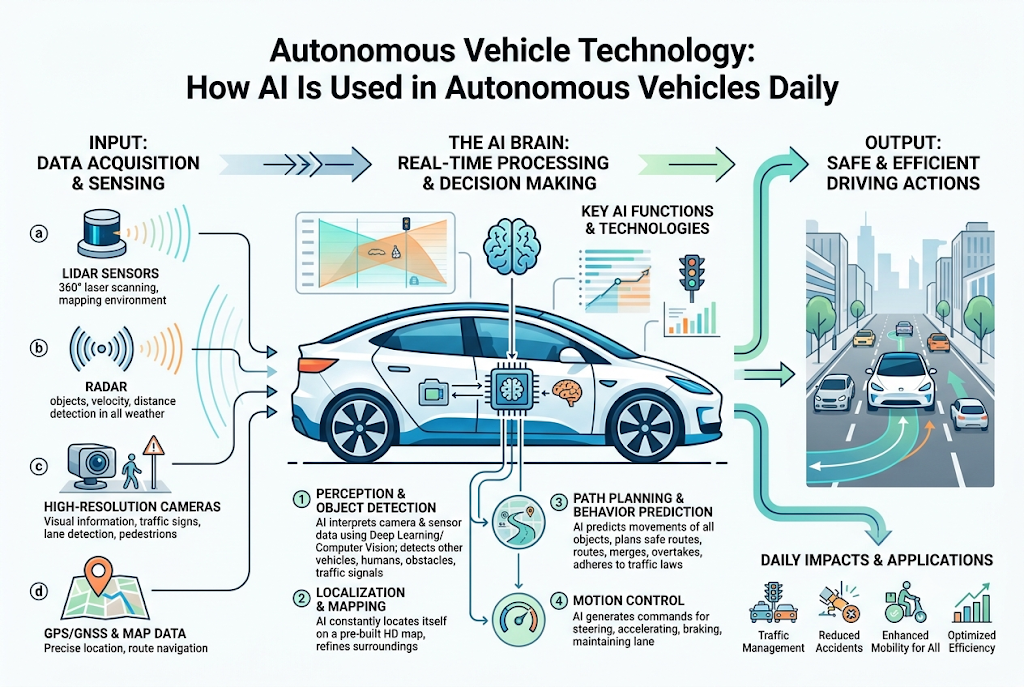
An autonomous vehicle is a car, truck, or transport system capable of sensing its environment and navigating without human intervention. By combining advanced software with physical hardware, these systems analyze their surroundings to travel safely from an initial starting point to a pre-determined destination.
+-------------------------------------------------------+
|                 AUTONOMOUS VEHICLE                    |
|                                                       |
|  [ SENSORS ]  ======>  [ AI BRAIN ]  ======> [ACTUATORS]
|  (Eyes/Ears)           (Decision)            (Steering)
+-------------------------------------------------------+
The primary purpose of autonomous driving technology is to create a safer, more efficient, and accessible transportation network. Human error causes the vast majority of traffic accidents worldwide. By replacing distracted or fatigued driving with calculated, mathematical precision, automation aims to save thousands of lives daily.
To understand how this technology is implemented, the automotive industry uses six distinct levels of driving automation:
- Level 0 (No Automation): The human driver performs all operating tasks, though the car may provide basic warnings.
- Level 1 (Driver Assistance): The vehicle handles a single task, such as adaptive cruise control, while the human manages everything else.
- Level 2 (Partial Automation): The system can control steering and acceleration simultaneously, but the driver must remain fully engaged.
- Level 3 (Conditional Automation): The car manages most driving situations, but the human must be ready to take over instantly when requested.
- Level 4 (High Automation): The vehicle handles all driving tasks under specific geographic or weather conditions without requiring human intervention.
- Level 5 (Full Automation): The system operates autonomously under all conditions, completely eliminating the need for a human driver or steering wheel.
Core AI Technologies Behind Autonomous Vehicles
Machine Learning
Machine learning enables a vehicle to recognize patterns by analyzing massive volumes of historical driving data. Instead of programming explicit rules for every possible scenario, engineers train algorithms on millions of real-world driving miles. This training allows the software to recognize a stop sign whether it is perfectly clean, covered in snow, or slightly faded by the sun.
Computer Vision
Computer vision serves as the eyes of the vehicle. This technology processes visual inputs from onboard cameras to understand and interpret physical surroundings. By breaking down digital video frames, computer vision algorithms trace lane boundaries, calculate the distance to the vehicle ahead, and identify unexpected obstacles in the middle of the road.
Deep Learning
Deep learning utilizes complex multi-layered neural networks to process intricate data structures. In self-driving cars, deep learning networks analyze raw pixel data to categorize objects into specific classes, such as pedestrians, cyclists, or construction barriers. This deep analysis allows the vehicle to differentiate a plastic bag blowing in the wind from a small animal darting across the lane.
Sensor Fusion
No single sensor is perfect; cameras struggle in heavy fog, while radar lacks visual detail. Sensor fusion is the algorithmic process of combining inputs from cameras, Radar, and LiDAR (Light Detection and Ranging) to create a single, unified view of the environment. This ensures that if one sensor is compromised, other data feeds maintain an accurate map of the surrounding space.
Natural Language Processing
Natural language processing manages communication between human passengers and the vehicle’s internal computer system. By converting spoken language into actionable code, passengers can easily change destinations, request stops, or ask for updates about the remaining trip duration. This interactive element makes autonomous vehicles accessible and user-friendly for everyone.
Decision-Making Algorithms
Once the vehicle understands its surroundings, decision-making algorithms determine the next safe action. These mathematical models constantly calculate multiple trajectories, weigh safety risks, and choose the most efficient path forward. This system determines precisely when the vehicle should accelerate, brake, merge into an adjacent lane, or yield to an oncoming car.
How AI Is Used in Autonomous Vehicles
Detecting Roads and Lanes
When a human drives, they look ahead to keep the car centered between painted lines. AI systems use computer vision to achieve the exact same result. The vehicle’s cameras capture real-time video of the pavement, and machine learning models isolate the high-contrast lines marking lane boundaries.
For example, when a self-driving car navigates a curved highway, the system continuously calculates the curvature of the lane markers. If the vehicle begins to drift toward the edge, the system applies subtle steering corrections to keep the car perfectly centered, even if the lane paint is partially worn away.
Recognizing Traffic Signs and Signals
Understanding traffic laws requires real-time identification of road signs and traffic lights. Deep learning models are trained on diverse datasets containing thousands of examples of stop signs, yield signs, speed limits, and traffic lights taken from various angles and under different lighting conditions.
Consider approaching a busy intersection. The vehicle’s visual system detects a traffic light ahead, isolates its position against the background sky, and monitors the active color phase. If the light transitions from green to yellow, the decision-making brain computes the stopping distance and brings the vehicle to a smooth stop before entering the crosswalk.
Identifying Pedestrians and Other Vehicles
Safety in dense urban environments requires tracking moving objects. Autonomous vehicle technology classifies objects based on how they move and look. The system places digital bounding boxes around pedestrians, cyclists, and nearby vehicles to track their speeds and directions.
       [ Detected Truck ] -> Moving 45 mph
               |
[ Your AI Car ] ------- [ Pedestrian ] -> Stepping off curb!
               |
       [ Cyclist ] ---------> Moving 12 mph
If a pedestrian stands on a sidewalk, the AI monitors their orientation. If the person takes a step toward the crosswalk, the machine learning system flags this behavior, anticipates a potential collision path, and proactively reduces vehicle speed before the person even steps onto the road.
Route Planning and Navigation
Intelligent transportation systems rely heavily on algorithmic route planning to navigate complex city grids. Instead of simply following a static map, the vehicle’s navigation system tracks live traffic reports, construction updates, and weather conditions.
If a sudden accident blocks a highway three miles ahead, the routing system calculates alternative paths within seconds. It evaluates factors like toll fees, traffic signal density, and road conditions to select the fastest and safest alternative path to the destination without interrupting the passenger.
Obstacle Detection and Avoidance
Unexpected obstacles require instantaneous responses to prevent serious accidents. When a vehicle drives down a suburban street, sensor fusion constantly scans for anomalies in the immediate path of travel.
If a couch falls off the back of a truck directly ahead, the vehicle’s Radar and LiDAR systems immediately flag the sudden obstruction. Within milliseconds, the AI assesses adjacent lanes for oncoming traffic. If the neighboring lane is clear, the vehicle gently steers around the object; if a car is present, it applies maximum braking force.
Driver Assistance Features
Many vehicles on the road today utilize artificial intelligence through advanced driver assistance systems (ADAS). These features act as a safety net, working quietly in the background during manual human operation.
Automatic emergency braking, blind-spot monitoring, and highway lane-keeping assist are practical implementations of this technology. If a driver fails to notice a sudden stop in traffic, the ADAS system calculates the imminent danger and engages the brakes automatically to prevent a rear-end collision.
Continuous Learning and Improvement
Every mile an autonomous vehicle drives generates valuable operational data. When a vehicle encounters a rare or unique situation—such as an unusual construction vehicle or a complex detour—the data snippet is recorded and uploaded to cloud servers.
Engineers use these unique edge cases to retrain machine learning models. Once updated, the improved software is pushed back out to the entire fleet of vehicles via over-the-air updates. This collective learning process ensures that an improvement discovered by a single vehicle immediately benefits every other car on the network.
AIUniverse.xyz Guide to AI in Autonomous Vehicles
Understanding AI Fundamentals
To explore the mechanics of autonomous vehicle technology, you must first master the core concepts of artificial intelligence. Understanding how algorithms learn from data inputs, recognize repeating patterns, and process information provides the foundational knowledge required to study more complex mobility architectures.
Learning Computer Vision Concepts
Computer vision allows self-driving cars to interpret visual data from cameras. By studying pixel processing, edge detection, and object classification, you learn exactly how a machine converts a flat digital image into a detailed 3-D map of road signs, lane markings, and nearby traffic.
Exploring Intelligent Navigation
Navigation in autonomous systems goes far beyond standard GPS mapping. It involves studying graph theory, pathfinding algorithms, and dynamic rerouting strategies that allow an artificial brain to choose the safest, most efficient journey through unpredictable urban grids.
Building Knowledge of Autonomous Systems
A functional autonomous system requires a balance between hardware components and software instructions. By studying how sensors, control units, and physical mechanical parts interact, you gain a deep, technical understanding of how a line of software code translates into a physical turn of a vehicle’s steering wheel.
Preparing for AI Mobility Technologies
The transportation industry is shifting rapidly toward complete automation. By building your conceptual knowledge, learning fundamental algorithms, and understanding software architectures, you position yourself to contribute to the next generation of smart transit solutions.
Real-World Applications
Self-Driving Cars
Personal passenger vehicles and robotaxis are the most recognizable applications of autonomous vehicle technology. Fleets of driverless ridesharing cars currently operate in several major cities, picking up passengers, navigating complex intersections, and dropping users off without any human in the driver’s seat.
Autonomous Trucks
Long-haul freight transport is perfectly suited for automation. Autonomous semi-trucks handle demanding highway driving between distribution centers, navigating predictable routes with high fuel efficiency. This deployment reduces driver fatigue and optimizes supply chain operations over long distances.
Public Transportation
Autonomous shuttles and self-driving buses are transforming public transit. Operating along fixed urban loops or dedicated campus paths, these vehicles provide reliable, cost-effective first-and-last-mile transportation services for communities and university settings.
Delivery Vehicles
The final mile of logistics is often the most expensive. Small, autonomous delivery robots and driverless vans navigate neighborhood streets to bring groceries, hot meals, and retail packages directly to consumers’ doorsteps, reducing delivery costs and local emissions.
Agricultural Vehicles
Modern farms rely heavily on autonomous tractors, seeders, and harvesters. Equipped with high-precision GPS and machine learning systems, these large machines navigate expansive crop fields along precise paths to optimize planting, monitor crop health, and harvest yields with minimal waste.
Mining and Industrial Vehicles
In hazardous industrial environments, such as open-pit mines or massive shipping ports, massive autonomous haul trucks move tons of material without human operators. These machines run continuously in dangerous conditions, significantly increasing overall operational efficiency and worker safety.
Benefits of AI in Autonomous Vehicles
Improved Road Safety
Unlike human drivers, artificial intelligence never experiences fatigue, emotional distraction, or chemical impairment. By maintaining a constant, 360-degree awareness of their surroundings, these systems can significantly reduce the frequency and severity of traffic accidents.
Reduced Human Error
Human error, such as tailgating, speeding, and erratic lane changes, is a primary cause of road accidents. Automated systems strictly obey traffic laws, maintain safe following distances, and respond to hazards with optimal mathematical precision.
Better Traffic Management
Autonomous vehicles can communicate with traffic infrastructure and surrounding cars to optimize traffic flow. By maintaining steady speeds and avoiding unnecessary braking, these vehicles minimize the stop-and-go waves that cause highway congestion.
Increased Mobility
Self-driving technology provides independent mobility for individuals who cannot operate traditional vehicles. This includes elderly citizens, individuals with visual impairments, and those with physical disabilities, offering them greater freedom and independence.
Fuel and Energy Efficiency
AI algorithms optimize acceleration and braking patterns to minimize energy consumption. For electric and internal combustion vehicles alike, smoother driving profiles mean reduced emissions and lower operational costs per mile traveled.
Enhanced Driving Experience
By shifting the responsibility of driving to an automated system, passengers can reclaim commuting time. People can work, read, rest, or enjoy entertainment during their journey, transforming a stressful commute into a productive or relaxing experience.
Traditional Vehicles vs AI-Powered Autonomous Vehicles
| Feature | Traditional Vehicles | AI-Powered Autonomous Vehicles |
| Driving Control | Human Driver | AI-Assisted or Automated |
| Decision-Making | Human | AI-Based |
| Obstacle Detection | Driver Observation | Sensors and AI |
| Navigation | Manual | Intelligent Navigation |
| Learning Capability | None | Continuous Improvement |
Common Challenges
Complex Road Conditions
Heavy rain, dense snow, and thick fog present significant challenges for self-driving cars. Snow can completely cover painted lane markers, while heavy downpours can scatter LiDAR laser beams and block camera lenses, making accurate perception difficult.
Sensor Limitations
Every physical sensor has operational blind spots or environmental limitations. Cameras struggle with sudden blinding glare from the sun, while Radar can struggle to differentiate between a stalled car and a metal sign on a curve, requiring sophisticated sensor fusion strategies.
Data Quality
Machine learning models are only as good as the information used to train them. If training datasets lack examples of rare occurrences, such as a unicyclist or a horse-drawn carriage, the vehicle may fail to categorize the obstacle correctly in the real world.
Safety Validation
Proving that an autonomous vehicle is significantly safer than a human driver requires billions of test miles. Validating software performance across millions of rare, unpredictable edge cases remains a monumental engineering and testing challenge for the industry.
Ethical Considerations
When an unavoidable accident occurs, the vehicle’s software must make difficult split-second decisions. Programming an algorithm to choose between minimizing damage to the vehicle or avoiding a sudden obstacle requires addressing complex ethical and societal questions.
Best Practices for Learning
- Understand AI fundamentals: Focus on how data inputs, mathematical patterns, and basic algorithms guide software learning models.
- Learn computer vision basics: Study how computers process digital images, detect contrasting edges, and categorize distinct objects.
- Study sensor technologies: Understand the operational strengths and weaknesses of hardware like cameras, Radar, and LiDAR systems.
- Explore autonomous driving workflows: Learn how information flows sequentially from raw sensing to perception, path planning, and physical actuation.
- Build simple AI projects related to mobility: Write basic lane-detection scripts or create object-tracking models using free open-source code libraries.
Career Opportunities
- AI Engineer: Designing and tuning the intelligent algorithms that form the core cognitive brain of the vehicle.
- Autonomous Vehicle Engineer: Integrating physical mechanical components with complex software control systems.
- Computer Vision Engineer: Developing advanced software models that help vehicles see and interpret road environments accurately.
- Robotics Engineer: Creating the physical mechanisms and feedback loops that allow software to safely control steering, braking, and acceleration.
- Machine Learning Engineer: Training, testing, and optimizing large neural networks on massive driving datasets to improve real-world perception.
- Automotive Software Developer: Writing the safe, reliable, and secure source code that runs directly on the vehicle’s embedded computers.
Future of AI in Autonomous Vehicles
Smarter Urban Transportation
Future cities will feature highly coordinated transit ecosystems where autonomous shuttles, delivery pods, and personal cars operate in complete harmony. This integration will maximize road capacity and minimize travel times for everyone.
AI-Powered Traffic Systems
Intelligent traffic management systems will communicate directly with self-driving fleets. Smart traffic lights will adjust their cycles in real time based on incoming vehicle volume, reducing idle times at intersections and eliminating unnecessary gridlock.
Vehicle-to-Vehicle Communication
Vehicles will use wireless networks to communicate directly with one another. If a car experiences a slip on an icy patch of road, it will instantly alert trailing vehicles miles behind, allowing them to adjust speeds safely before reaching the hazard.
[ Lead Car ] -> "Ice detected ahead!" (Wireless Signal)
       |
       v
[ Following Car ] -> Safely slows down automatically
Autonomous Logistics
The moving of goods will become fully automated from the factory floor to the consumer’s doorstep. Self-driving freight trains, highway semi-trucks, and final-mile delivery robots will connect seamlessly to optimize global supply chains.
Intelligent Smart Cities
Autonomous transportation will serve as the backbone of future smart cities. By optimizing energy consumption, reducing parking space requirements, and lowering carbon emissions, self-driving vehicles will help create cleaner, more sustainable urban environments.
Common Misconceptions
Autonomous Vehicles Need No Human Oversight
Many people believe that self-driving cars can operate perfectly anywhere without supervision. In reality, modern automated systems still require human oversight or specific operating conditions, and fully driverless operation remains restricted to approved geographic areas.
AI Makes Driving Error-Free
While artificial intelligence dramatically reduces accidents caused by human distraction, it cannot violate the laws of physics. If an obstacle appears suddenly from behind a blind corner, a vehicle may still be unable to stop in time, regardless of how advanced its software is.
Autonomous Vehicles Only Use Cameras
Some assume that self-driving systems rely exclusively on cameras to view the road. In truth, safe automation requires redundant sensor arrays, combining cameras with Radar and LiDAR to verify data and ensure reliable operation across all weather conditions.
AI Learns Without Quality Data
A common belief is that an artificial brain can figure out how to drive simply by operating on the road. In truth, AI requires highly curated, high-quality, and carefully labeled data sets to learn safely, alongside rigorous validation from human engineers.
FAQ Section
- What is the primary keyword when researching AI in self-driving cars?The primary keyword used by researchers, students, and engineers looking to understand this field is “How AI Is Used in Autonomous Vehicles.”
- How does computer vision differ from standard camera recording?Standard camera recording simply saves raw video pixels to a storage device for humans to view later. Computer vision analyzes those pixels mathematically in real time to locate objects, trace lane lines, and understand the surrounding environment.
- What is sensor fusion in autonomous vehicle technology?Sensor fusion is the process of combining data from cameras, Radar, and LiDAR into a single comprehensive map. This ensures that the vehicle retains an accurate understanding of its environment even if individual sensors are limited by rain or sun glare.
- Can an autonomous vehicle drive safely in heavy snow?Heavy snow remains a significant challenge for autonomous driving technology because it covers lane markings and reduces sensor accuracy. Current engineering efforts focus on improving sensor fusion and localization algorithms to overcome these weather obstacles.
- What are edge cases in machine learning training?Edge cases are rare, unusual, or unexpected situations that a vehicle encounters on the road, such as a person riding a unicycle or an unusual construction vehicle. Engineers use these scenarios to retrain models and improve software safety.
- Are Level 2 automated cars considered completely self-driving?No, Level 2 vehicles are not fully self-driving. While they can control steering and speed simultaneously, the human driver must remain completely engaged, monitor the environment, and be ready to take manual control at any second.
- How does vehicle-to-vehicle communication improve road safety?This communication allows cars to share real-time data regarding speed, braking, and road hazards wirelessly. If a leading vehicle brakes hard, trailing cars receive an immediate digital notification, allowing them to slow down safely before a human could react.
- What role does deep learning play in object classification?Deep learning uses multi-layered neural networks to analyze intricate visual patterns. This allows a vehicle’s computer to quickly differentiate between a pedestrian standing near a crosswalk, a cyclist, or a static metal sign.
- Why is data quality more important than data quantity for driving systems?Millions of miles of repetitive highway data do not teach a vehicle how to handle complex city intersections. High-quality, diverse data that includes unique scenarios is essential for training safe, reliable machine learning models.
- Where can beginners find educational resources to learn about autonomous technology?Beginners can use educational platforms like AIUniverse.xyz to find clear, practical guides that explain machine learning, computer vision, and the foundational concepts behind modern autonomous systems.
Final Summary
Artificial intelligence is the core engine driving the autonomous vehicle movement, transforming standard mechanical vehicles into smart, reactive systems. By coordinating machine learning, computer vision, and sensor fusion, these vehicles can effectively perceive their environments, plan optimal routes, and respond to sudden hazards with incredible precision.
Building a safer, more efficient transportation network requires a deep understanding of these interrelated software systems. For students, developers, and technology enthusiasts eager to explore this field, AIUniverse.xyz provides accessible learning guides, breaking down complex autonomous systems into digestible, actionable knowledge. As these mobility technologies continue to mature, mastering these foundational AI concepts will allow you to understand, adapt to, and shape the future of intelligent transportation.
