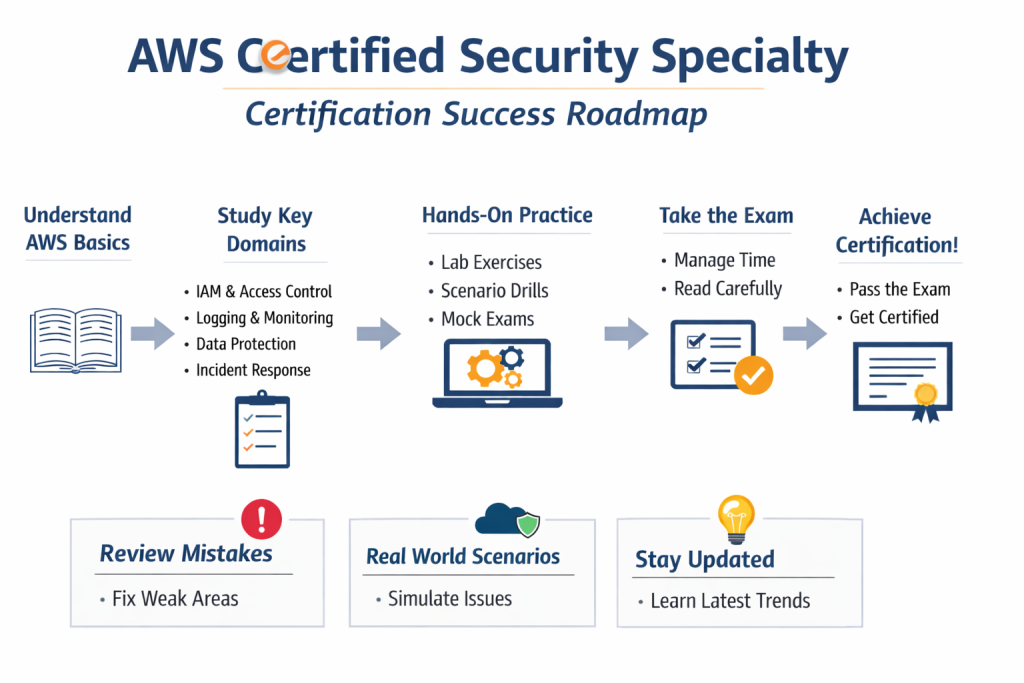
Introduction
Cloud security is no longer a “security team only” job. Today, engineers and managers are expected to understand how identity, network controls, encryption, logging, and governance work together in AWS. When something goes wrong, teams must detect it early, respond fast, and prove what happened using logs and evidence. That is why AWS Certified Security – Specialty is valuable—it checks whether you can secure AWS environments in real, production-style scenarios. This guide is written for working engineers and managers in India and globally. It gives you a practical view of what the certification covers, what you should build during preparation, and how to plan your study across 7–14 days, 30 days, or 60 days. You will also get role-based mapping, learning paths, FAQs, testimonials, and next steps.
What this certification is really about
AWS Certified Security – Specialty validates your ability to design, implement, and operate security controls in AWS. It goes beyond “what service does what” and focuses on decision-making: which control fits a threat, which logs prove an event, and how to reduce blast radius. You are expected to think like someone securing real environments across teams, accounts, and workloads.
This certification checks whether you can protect data, manage access safely, secure infrastructure, monitor security signals, and respond to incidents with clarity. It also tests governance thinking—how you keep security consistent as systems scale. If you work on cloud platforms, DevSecOps, reliability, or security operations, the skills match daily work closely.
Certification and exam details you should know
This exam is designed for professionals who already know AWS fundamentals and want to prove advanced security capability. It includes both single-answer and multi-answer questions, which means you must be careful with “almost correct” options. Time management matters because scenarios can be long and options can be close.
You should prepare with practical labs because the exam rewards real-world reasoning. The fastest way to improve your score is to practice case-like questions where IAM, logging, network controls, and encryption appear together. If you treat topics separately, you will feel confident in reading but weak in solving.
Exam blueprint: domains and weightage
The exam is divided into six domains that reflect how cloud security is actually handled in organizations. Instead of testing one service deeply, it tests how you combine services to create secure outcomes. You will see questions that mix identity, monitoring, encryption, and governance in one scenario.
The best way to use the blueprint is to study by domain, not by service. For each domain, build at least one mini-project and write a small checklist of what “good” looks like. This blueprint-led approach keeps your learning focused and reduces confusion from too many AWS services.
Certification table
| Certification | Track | Level | Who it’s for | Prerequisites | Skills covered | Recommended order |
|---|---|---|---|---|---|---|
| AWS Certified Security – Specialty | Cloud Security | Specialty | Security Engineers, Cloud Engineers, DevSecOps, Platform/SRE, Engineering Managers (security-aware) | Strong AWS fundamentals + practical exposure to IAM, logging, encryption, network security, governance | Threat detection, logging, IAM, infrastructure security, data protection, governance | After AWS foundation + hands-on AWS security practice |
AWS Certified Security – Specialty (Mini-sections)
What it is
AWS Certified Security – Specialty validates your advanced ability to secure AWS workloads across identity, network, data, monitoring, incident response, and governance. It focuses on real security decisions and operational security, not just definitions. It is a strong signal that you can design and run security controls in cloud environments.
Who should take it
This is ideal for Security Engineers and Cloud Engineers who already work in AWS and want to prove security depth. It also suits DevSecOps engineers who build secure pipelines and platform guardrails, and SRE/Platform engineers who own incident response and reliability. Managers who review cloud designs can also benefit because it improves risk and control understanding.
Skills you’ll gain
- Design least-privilege access using roles, policies, boundaries, and safe permission patterns
- Build security logging and monitoring flows that support investigations and compliance evidence
- Protect data using encryption strategies, access controls, and key management decisions
- Secure AWS infrastructure using network isolation, secure connectivity, and hardened design choices
- Handle incident response with clear triage, containment, and recovery workflows
- Apply governance controls so security stays consistent across multiple teams and accounts
Real-world projects you should be able to do after it
- Build an AWS security logging plan with centralized visibility, retention, and audit readiness
- Create threat detection workflows and a practical incident response runbook for common threats
- Design a secure multi-account architecture with guardrails and least-privilege access separation
- Implement data protection patterns for storage and databases, including encryption and access control
- Harden public-facing workloads with secure network boundaries and safe exposure patterns
- Build compliance-friendly evidence collection workflows that reduce audit stress for teams
Preparation plan (7–14 days / 30 days / 60 days)
7–14 days (fast track)
This plan is for people who already work on AWS security controls regularly. You should spend less time reading and more time doing hands-on labs and scenario drills. Each day, force yourself to solve at least one scenario that touches multiple domains. Your goal is speed + accuracy, because the exam is time-bound and options can be tricky.
Suggested flow: Day 1–2 blueprint mapping, Day 3–8 labs by domain, Day 9–12 scenario practice, Day 13–14 full mock + deep review. Focus heavily on your weakest domain and revisit it with practical problems. Make a “mistakes list” and review it daily.
30 days (balanced plan)
This plan fits most working engineers with limited daily time. You can combine learning with hands-on labs without burnout, and still cover the full blueprint. The key is consistency: short daily sessions plus weekly scenario sets. You should finish each week with a simple checkpoint: can you explain your design choice in plain English?
Suggested flow: Week 1 fundamentals + IAM refresh, Week 2 data protection and encryption patterns, Week 3 logging/monitoring + incident response, Week 4 governance + full scenario revision. Do at least two timed practice sets in the final week. Keep notes in a “decision guide” format: when to use what and why.
60 days (deep foundation plan)
This plan is best if you are switching into security or returning to hands-on after a gap. It gives you time to build strong fundamentals and still master the exam style. You should take a project-first approach: build small security solutions and learn from mistakes. That way your knowledge becomes durable, not just exam-focused.
Suggested flow: Month 1 foundations + weekly labs, Month 2 scenario mastery + mock exams. In the final two weeks, avoid random new topics and focus only on revision and weak areas. Track your progress by domains and keep improving accuracy under time pressure.
Common mistakes
- Memorizing services instead of practicing real scenarios that mix IAM, logs, encryption, and network
- Ignoring multi-answer question style and selecting “partially correct” options too quickly
- Treating IAM as only policies, not identity patterns like roles, trust boundaries, and session controls
- Skipping log-triage practice, so incident response questions feel confusing
- Underestimating governance topics like guardrails, audit evidence, and consistent separation of duties
- Not doing timed practice, then running out of time during the actual exam
Best next certification after this
If you want deeper security growth, stay in the same direction and take certifications that strengthen security architecture and security operations thinking. If you want broader capability, pair security with cloud architecture or reliability so you can design and run secure systems end-to-end. If you are moving toward leadership, focus on governance, security program execution, and risk management because those skills scale across teams.
Choose your path (6 learning paths)
DevOps path
DevOps engineers benefit most when security becomes part of daily delivery, not a late-stage review. Focus on safe CI/CD access patterns, secrets handling, and least privilege for automation. Build guardrails that prevent risky changes, and learn how security logging helps debug incidents. The outcome is faster delivery with fewer production security surprises.
DevSecOps path
DevSecOps is about building security into pipelines and platforms with repeatable controls. Focus on policy-driven security, secure defaults, and automated checks that reduce manual approvals. Practice connecting detection signals with response workflows so you can react quickly. The outcome is a security-by-design system that developers can still move fast with.
SRE path
SREs should focus on security as a reliability problem: detection, alert tuning, triage, and containment. Build habits around incident response, blast-radius reduction, and secure operational practices. Practice scenarios where secure network isolation and IAM boundaries reduce the impact of failures. The outcome is stronger uptime and faster incident handling when threats occur.
AIOps/MLOps path
For AIOps and MLOps, the main risk is unsecured data and pipelines. Focus on protecting data flows, securing pipelines and artifacts, and controlling access to sensitive environments. Add monitoring patterns that detect anomalies and unusual usage. The outcome is trustworthy automation and machine learning systems that are safe to operate at scale.
DataOps path
DataOps teams should focus on access control, auditability, encryption, and governance across data pipelines. Build patterns for secure data sharing without data leakage. Practice logging and monitoring that supports compliance and investigations. The outcome is a secure and scalable data platform that keeps analytics productive and controlled.
FinOps path
FinOps teams benefit when cloud cost control includes governance and access safety. Learn how least privilege applies to billing, budgets, and account-level controls. Practice spotting spend anomalies that may also indicate security misuse. The outcome is responsible cloud spending with strong guardrails and reduced financial risk.
Role → recommended certifications mapping
| Role | Recommended certifications (suggested sequence) |
|---|---|
| DevOps Engineer | AWS fundamentals → AWS security specialty → DevSecOps-focused security practice |
| SRE | Observability + incident response basics → AWS security specialty → secure reliability mastery |
| Platform Engineer | Cloud platform fundamentals → AWS security specialty → governance and multi-account guardrails |
| Cloud Engineer | AWS architecture baseline → AWS security specialty → operations + security integration |
| Security Engineer | Security fundamentals → AWS security specialty → advanced cloud security operations |
| Data Engineer | Data platform basics → data security patterns → AWS security specialty for cloud controls |
| FinOps Practitioner | Cloud cost basics → governance controls → AWS security specialty for risk-aware cost management |
| Engineering Manager | Cloud security risk literacy → AWS security specialty overview prep → security program execution |
Next certifications to take (3 options)
Same track (security depth)
This is best when your job is security-focused and you want deeper ownership of controls and governance. You build stronger design review ability, improve investigation skills, and become more confident with security operations. This path also helps when you are responsible for audit readiness and cross-team security baselines.
Cross-track (broader cloud impact)
This is best for engineers who want to be “end-to-end” owners: secure design plus stable operations. Pairing security with cloud architecture or reliability makes you valuable in platform roles. It also improves how you communicate decisions to product and leadership because you can explain trade-offs clearly.
Leadership (security at scale)
This is best if you are moving toward leading teams or security programs. Focus on governance, standards, policies, and operating models that scale. Your goal becomes consistency across teams and reducing organizational risk without slowing delivery. This path suits managers, leads, and principal-level engineers.
Top institutions that help with training + certification support
DevOpsSchool
DevOpsSchool offers structured training that aligns with the certification blueprint and emphasizes hands-on practice. It is useful if you want guided learning, real scenario discussions, and structured revision plans. It suits working professionals who need a clear weekly plan.
Cotocus
Cotocus supports learners with practical guidance and mentoring-style learning. It is helpful when you want implementation thinking, not only exam notes. Many learners prefer it for scenario-based problem solving. It fits engineers who learn best through real use cases.
ScmGalaxy
ScmGalaxy supports structured learning paths that help you build foundations before advanced practice. It works well for learners who want step-by-step progression and consistent practice. It can support both fundamentals and exam readiness. It is often chosen for steady learning discipline.
BestDevOps
BestDevOps is useful for learners who want direct hands-on focus and fast exam-oriented preparation. It suits professionals who like doing labs and correcting mistakes quickly. It can also help in targeted revision for weak areas. The approach is usually practical and focused.
devsecopsschool
devsecopsschool suits engineers moving into DevSecOps work, especially pipeline security and platform guardrails. It helps connect security tools and controls to delivery workflows. It is useful if you want security automation thinking. It fits DevOps-to-DevSecOps transitions well.
sreschool
sreschool is helpful for professionals who want secure reliability and disciplined incident response practices. It supports operational thinking like triage, runbooks, and risk reduction. It fits SRE and platform teams well. The focus is on stable systems with strong controls.
aiopsschool
aiopsschool is relevant for teams working with monitoring, anomaly detection, and automation at scale. It helps connect operational analytics to faster detection and response. It fits engineers working in large telemetry environments. It also supports thinking around signal-to-noise reduction.
dataopsschool
dataopsschool helps learners build secure and reliable data pipelines with governance and auditability. It supports practical access controls and safe data operations. It fits data engineers who want strong control without blocking analytics. It is useful for secure data delivery thinking.
finopsschool
finopsschool helps professionals connect cost management with governance and control. It supports patterns for accountability, budgeting discipline, and monitoring anomalies. It fits teams managing cloud spend at scale. It also helps reduce financial and operational risk together.
Testimonials
Aarav
“I finally understood how IAM, logs, encryption, and network controls connect in real environments. The scenario practice changed how I think and reduced my guessing. I now feel confident explaining decisions during reviews.”
Neha
“The preparation plan was realistic with my work schedule and made hard topics easier. The focus on real projects helped me remember concepts long-term. I could see how it maps directly to production work.”
Michael
“As a manager, this guide improved how I review cloud security designs and ask better questions. It helped me understand risk and governance without needing deep daily hands-on work. My team discussions became more structured.”
FAQs — focused on difficulty, time, prerequisites, sequence, value, outcomes
- Is AWS Certified Security – Specialty difficult?
Yes, it can feel difficult because questions are scenario-based and options are close. If you practice real-world cases across domains, it becomes manageable. The exam rewards reasoning more than memorization. - How long does it take to prepare?
Most working professionals take 30 to 60 days depending on experience. If you already secure AWS workloads daily, you may prepare faster. If you are new to security, take the full 60 days. - Do I need prior AWS certifications before taking it?
Not mandatory, but strong AWS fundamentals are important. If you lack basics, you will spend extra time learning core services. A solid foundation reduces stress during scenario questions. - What prerequisites help the most?
IAM basics, cloud networking basics, encryption basics, and logging basics. These appear across many questions and decide your score. Practical exposure is more helpful than reading only. - What is the best study sequence?
Start with IAM and infrastructure security, then move to logging/monitoring and incident response. After that, focus on data protection and governance. Finish with mixed scenario practice. - How much hands-on practice is required?
Hands-on is strongly recommended because the exam expects real operational judgment. If you only read, you may struggle in scenario questions. Even small labs can make a big difference. - Is it valuable for DevOps engineers?
Yes, especially if you work with CI/CD and production infrastructure. You will learn safer automation patterns and secure deployment thinking. It also helps you collaborate better with security teams. - Is it useful for SRE and platform engineers?
Yes, because monitoring, logging, and incident response are core SRE topics. This certification adds strong security depth to reliability work. It improves how you handle security incidents in production. - Does it help career outcomes?
It can strengthen credibility for cloud security roles and security-aware platform roles. It also improves your interview storytelling because you can explain real designs and trade-offs. Many teams value it for cloud security ownership. - What are common reasons people fail?
They study services separately and do not practice scenarios. They also underestimate multi-answer questions and time pressure. Weak IAM reasoning is another frequent cause. - How should managers use this certification?
Managers can use it to improve design review quality and security risk decision-making. It helps in asking the right questions and understanding governance. Hands-on labs are optional but helpful for confidence. - What is the best final-week strategy?
Do timed scenario sets and review wrong answers deeply. Focus revision on your weakest domain and the most weighted domains. Keep a short “decision guide” for quick recall.
FAQs on AWS Certified Security – Specialty
- What should I focus on first: IAM or monitoring?
Start with IAM because access control impacts everything. Then move to monitoring so you can detect and investigate issues fast. Together, they create strong security foundations. - How do I avoid getting lost in too many AWS services?
Study by exam domains and keep a simple map of which services solve which problem. For every service, ask “when should I use it and why.” This keeps learning practical and focused. - Do I need deep cryptography knowledge?
You need practical encryption understanding, not deep math. Focus on encryption choices, key control, rotation, access permissions, and auditability. Learn how to explain why your choice fits the scenario. - How do I practice incident response properly?
Use small drills: detect, triage, contain, recover, and document. Practice reading logs and deciding first actions quickly. Repeat until it becomes a habit, not a theory. - Why are multi-answer questions difficult?
Because several options look correct but only some fully meet the scenario. Practice elimination thinking and learn why options are wrong. This reduces guessing and improves accuracy. - Can I pass without working in a security role today?
Yes, if you build hands-on labs and practice scenarios consistently. You must learn how controls behave in real systems. Project practice is your shortcut to experience. - Is this certification valuable outside AWS-only companies?
Yes, because the thinking transfers to other clouds. Identity patterns, monitoring, governance, encryption, and incident response are universal. AWS is the platform here, but the security reasoning is broader. - What should I do if I fail once?
Review weak domains, redo hands-on labs, and retake only after scenario practice improves. Focus on the top domains by weightage and the mistakes you repeat. A second attempt becomes easier with targeted correction.