Introduction
Digital Asset Compliance Tools help organizations manage regulatory requirements, transaction monitoring, sanctions screening, anti-money laundering controls, risk assessments, and reporting related to cryptocurrencies, tokenized assets, stablecoins, NFTs, and other digital assets. As regulators worldwide continue to increase oversight of digital asset markets, compliance has become a critical business function rather than an optional add-on.
Organizations handling digital assets must demonstrate transparency, monitor transactions, identify suspicious activities, and comply with evolving regulations. Modern compliance platforms automate many of these tasks while helping teams reduce operational risk.
Real-World Use Cases
- Cryptocurrency exchange compliance programs
- Virtual Asset Service Provider compliance management
- AML transaction monitoring and investigations
- Wallet screening and sanctions checks
- Digital asset risk assessment and due diligence
- Regulatory reporting and audit preparation
Evaluation Criteria for Buyers
- Blockchain coverage
- AML monitoring capabilities
- Sanctions screening accuracy
- Risk scoring effectiveness
- Regulatory reporting support
- Investigation workflow tools
- API availability
- Scalability
- Security controls
- Integration ecosystem
Best for: Cryptocurrency exchanges, fintech companies, banks, compliance teams, digital asset custodians, payment providers, regulators, and enterprise risk management teams.
Not ideal for: Organizations with no digital asset exposure, very small businesses that process limited crypto transactions, or teams needing only basic blockchain visibility.
Key Trends in Digital Asset Compliance Tools
- AI-powered transaction monitoring is reducing false positives.
- Real-time sanctions screening is becoming a regulatory expectation.
- Multi-chain compliance monitoring is replacing single-chain approaches.
- Stablecoin-specific compliance controls are emerging.
- Blockchain intelligence platforms are expanding into fraud prevention.
- Automated regulatory reporting is gaining adoption.
- Identity verification and blockchain analytics are becoming tightly integrated.
- Risk-based compliance frameworks are replacing rule-only approaches.
- Enterprise APIs are becoming essential for large-scale deployments.
- Institutions are demanding unified compliance platforms covering multiple digital asset workflows.
How We Selected These Tools
The following tools were selected using a consistent evaluation framework:
- Strong market adoption and industry recognition
- Broad blockchain coverage
- Comprehensive compliance capabilities
- Reliability and performance reputation
- Security-focused architecture
- API and integration availability
- Enterprise scalability
- Support for regulatory and investigative workflows
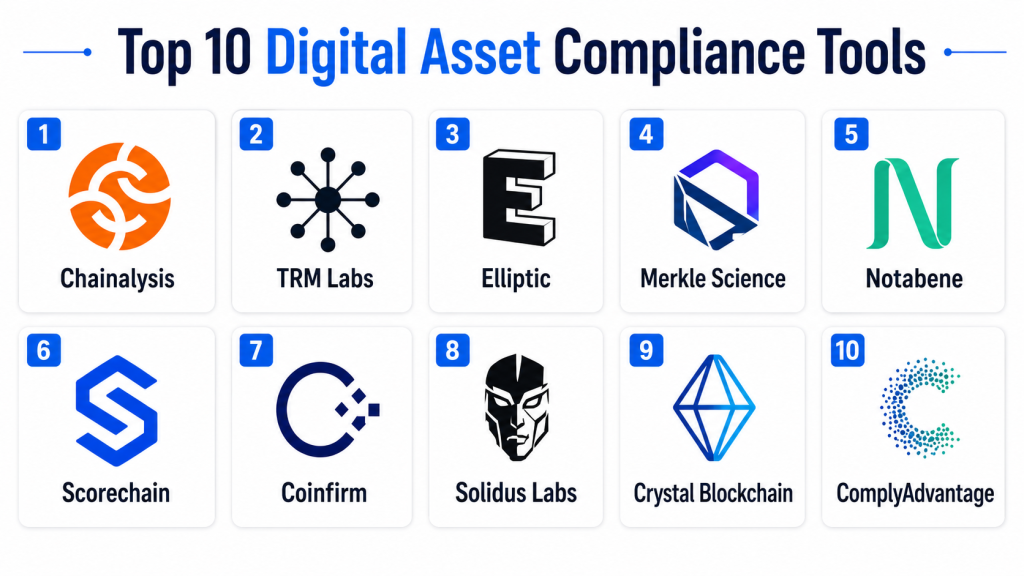
Top 10 Digital Asset Compliance Tools
1- Chainalysis
Short description:
Chainalysis is one of the most recognized blockchain intelligence and compliance platforms in the market. It helps exchanges, financial institutions, regulators, and law enforcement organizations monitor blockchain activity, investigate transactions, assess risk, and comply with AML requirements. The platform supports numerous blockchains and offers extensive compliance automation capabilities. It is widely used by large enterprises and government agencies. Its investigation capabilities are particularly strong. Organizations seeking advanced blockchain intelligence often shortlist Chainalysis.
Key Features
- Transaction monitoring
- Wallet screening
- Sanctions compliance
- Risk scoring
- Investigation tools
- Regulatory reporting support
- Multi-chain analytics
Pros
- Extensive blockchain coverage
- Strong investigative capabilities
- Enterprise-focused platform
Cons
- Premium pricing
- Complex implementation
- May exceed SMB requirements
Platforms / Deployment
- Web
- Cloud
Security & Compliance
- MFA
- RBAC
- Audit logs
- Encryption
- Additional certifications not publicly stated
Integrations & Ecosystem
Chainalysis integrates with exchange platforms, financial crime systems, compliance workflows, and enterprise risk tools.
- APIs
- Case management systems
- AML platforms
- Exchange infrastructure
- Banking systems
Support & Community
Strong enterprise support, extensive documentation, professional services, onboarding assistance, and a large industry user base.
2- TRM Labs
Short description:
TRM Labs provides blockchain intelligence, transaction monitoring, sanctions screening, and investigative capabilities. The platform is increasingly used by exchanges, financial institutions, government agencies, and compliance teams. TRM emphasizes real-time monitoring and broad blockchain coverage. Its user interface is often praised for ease of navigation. The platform supports risk analysis across multiple digital asset ecosystems. It has become a major competitor in the compliance intelligence space.
Key Features
- Risk monitoring
- Wallet screening
- Sanctions checks
- Cross-chain analysis
- Investigation workflows
- Fraud detection
- Reporting tools
Pros
- Strong analytics
- Modern interface
- Rapid innovation
Cons
- Enterprise-focused pricing
- Advanced features require training
- Some customization may require support
Platforms / Deployment
- Web
- Cloud
Security & Compliance
- MFA
- RBAC
- Audit capabilities
- Additional certifications not publicly stated
Integrations & Ecosystem
Provides APIs and integrations for exchanges, compliance operations, and risk management teams.
- APIs
- Exchange systems
- Compliance platforms
- Investigation tools
- Financial crime workflows
Support & Community
Strong customer success programs, documentation, and enterprise support.
3- Elliptic
Short description:
Elliptic is a blockchain analytics and risk management platform designed for digital asset compliance. The platform helps organizations identify suspicious transactions, assess wallet risks, and meet regulatory requirements. Elliptic supports multiple blockchain networks and offers extensive risk intelligence. Financial institutions frequently use it to strengthen compliance programs. The platform balances usability with enterprise-grade capabilities. It remains a leading choice in digital asset compliance.
Key Features
- Transaction monitoring
- Wallet risk scoring
- AML compliance
- Investigation tools
- Screening services
- Multi-chain support
- Regulatory reporting
Pros
- Strong compliance features
- Broad ecosystem coverage
- Enterprise-ready platform
Cons
- Learning curve
- Premium pricing
- Best suited for regulated organizations
Platforms / Deployment
- Web
- Cloud
Security & Compliance
- MFA
- Audit logs
- RBAC
- Encryption
Integrations & Ecosystem
Integrates with banking systems, exchanges, compliance programs, and risk workflows.
- APIs
- Compliance tools
- Risk systems
- Exchanges
- Financial platforms
Support & Community
Enterprise support, onboarding assistance, training resources, and customer success services.
4- Merkle Science
Short description:
Merkle Science focuses on transaction monitoring, risk management, and compliance investigations. The platform is designed for financial institutions, cryptocurrency businesses, and regulators. It helps organizations identify suspicious activity and meet AML obligations. Multi-chain monitoring and risk intelligence are key strengths. The platform also supports investigation workflows and regulatory reporting. It continues to gain adoption among compliance-focused organizations.
Key Features
- AML monitoring
- Risk intelligence
- Investigation workflows
- Wallet screening
- Multi-chain analytics
- Reporting tools
- Alert management
Pros
- Compliance-focused design
- Good investigative capabilities
- Strong monitoring tools
Cons
- Enterprise-oriented pricing
- Smaller ecosystem than some competitors
- Advanced features may require training
Platforms / Deployment
- Web
- Cloud
Security & Compliance
- MFA
- Encryption
- RBAC
- Audit logging
Integrations & Ecosystem
- APIs
- Compliance systems
- Exchange platforms
- Risk workflows
- Monitoring tools
Support & Community
Professional onboarding and enterprise support programs.
5- Notabene
Short description:
Notabene specializes in Travel Rule compliance and digital asset regulatory workflows. The platform helps organizations exchange required customer information securely during crypto transactions. It supports compliance with evolving Travel Rule regulations globally. Many Virtual Asset Service Providers use Notabene to streamline regulatory obligations. The platform focuses on interoperability and automation. It is particularly valuable for organizations managing international digital asset transfers.
Key Features
- Travel Rule compliance
- Secure information exchange
- Regulatory workflow automation
- Risk monitoring
- Audit trails
- Compliance reporting
- Partner network connectivity
Pros
- Travel Rule specialization
- Strong interoperability
- Growing industry adoption
Cons
- Narrower focus than full analytics platforms
- Additional tools may be needed
- Best suited for regulated entities
Platforms / Deployment
- Web
- Cloud
Security & Compliance
- Encryption
- Audit logs
- MFA
- RBAC
Integrations & Ecosystem
- APIs
- Exchange platforms
- Compliance solutions
- Identity systems
- Regulatory workflows
Support & Community
Strong onboarding and regulatory expertise.
6- Scorechain
Short description:
Scorechain offers AML compliance, transaction monitoring, and blockchain analytics capabilities. The platform serves exchanges, fintech companies, financial institutions, and compliance professionals. It provides risk scoring and transaction monitoring across multiple blockchain networks. The solution emphasizes usability and automation. Organizations use it to strengthen AML programs while reducing manual review workloads. It offers a balanced feature set for many regulated businesses.
Key Features
- AML monitoring
- Risk scoring
- Transaction analysis
- Wallet screening
- Compliance reporting
- Case management
- Multi-chain coverage
Pros
- User-friendly interface
- Strong AML functionality
- Flexible deployment options
Cons
- Smaller ecosystem
- Less brand recognition
- Advanced investigations less extensive
Platforms / Deployment
- Web
- Cloud
Security & Compliance
- MFA
- RBAC
- Audit logs
Integrations & Ecosystem
- APIs
- Compliance systems
- Exchange platforms
- Risk management tools
Support & Community
Documentation and enterprise support available.
7- Coinfirm
Short description:
Coinfirm provides blockchain analytics and AML compliance solutions for digital asset businesses. The platform helps organizations identify risks, monitor transactions, and satisfy regulatory requirements. It supports multiple blockchain ecosystems and provides compliance automation. Financial institutions and exchanges frequently utilize its risk intelligence capabilities. Coinfirm focuses heavily on regulatory transparency. It remains a recognized player within the compliance ecosystem.
Key Features
- AML monitoring
- Risk analytics
- Wallet screening
- Compliance reporting
- Investigation tools
- Multi-chain intelligence
- Transaction monitoring
Pros
- Strong compliance focus
- Broad blockchain coverage
- Good risk intelligence
Cons
- Enterprise-oriented pricing
- Advanced setup may require support
- Competitive market pressure
Platforms / Deployment
- Web
- Cloud
Security & Compliance
- MFA
- Audit logs
- Encryption
Integrations & Ecosystem
- APIs
- Exchanges
- Banking systems
- Compliance workflows
- Monitoring platforms
Support & Community
Professional services and onboarding support available.
8- Solidus Labs
Short description:
Solidus Labs focuses on market integrity, surveillance, risk monitoring, and compliance management. The platform helps organizations detect market manipulation, suspicious activities, and regulatory risks. It serves exchanges, brokers, and financial institutions. Its surveillance capabilities are particularly valuable for organizations operating trading environments. Automation helps reduce compliance workloads. The platform supports increasingly complex regulatory expectations.
Key Features
- Market surveillance
- Risk monitoring
- Compliance workflows
- Trade monitoring
- Alert management
- Investigation support
- Reporting tools
Pros
- Strong surveillance capabilities
- Suitable for trading environments
- Advanced monitoring
Cons
- Specialized focus
- Higher complexity
- Enterprise-centric
Platforms / Deployment
- Web
- Cloud
Security & Compliance
- MFA
- RBAC
- Audit logging
Integrations & Ecosystem
- Trading platforms
- APIs
- Compliance systems
- Monitoring tools
- Enterprise workflows
Support & Community
Enterprise support and onboarding resources.
9- Crystal Blockchain
Short description:
Crystal Blockchain provides blockchain analytics and compliance solutions designed to help organizations investigate transactions and identify risks. It supports transaction tracing, risk assessment, and compliance workflows. The platform is used by compliance teams, investigators, and financial institutions. Multi-chain support enables broader visibility across digital assets. The solution is designed to simplify blockchain investigations. It offers a balance of usability and analytical depth.
Key Features
- Transaction tracing
- Risk analysis
- Investigation workflows
- Wallet screening
- Compliance reporting
- Analytics dashboards
- Multi-chain monitoring
Pros
- Investigation-focused
- User-friendly interface
- Strong analytics
Cons
- Smaller ecosystem
- Fewer enterprise integrations
- Limited brand recognition
Platforms / Deployment
- Web
- Cloud
Security & Compliance
- MFA
- Audit logging
- Encryption
Integrations & Ecosystem
- APIs
- Compliance systems
- Investigation workflows
- Exchange environments
Support & Community
Documentation and commercial support available.
10- ComplyAdvantage
Short description:
ComplyAdvantage is a financial crime compliance platform that supports sanctions screening, AML monitoring, customer risk assessment, and transaction monitoring. While not exclusively focused on digital assets, it is widely used by fintechs and crypto businesses. Its risk intelligence and screening capabilities help organizations meet regulatory obligations. The platform provides automation and scalable compliance infrastructure. Many growing fintech organizations leverage it to modernize compliance programs.
Key Features
- AML monitoring
- Sanctions screening
- Risk intelligence
- Customer risk assessment
- Transaction monitoring
- Reporting tools
- Compliance automation
Pros
- Broad compliance capabilities
- Strong screening tools
- Scalable architecture
Cons
- Not crypto-exclusive
- Advanced customization may require support
- Enterprise pricing structure
Platforms / Deployment
- Web
- Cloud
Security & Compliance
- MFA
- RBAC
- Audit logs
- Encryption
Integrations & Ecosystem
- APIs
- Banking systems
- Fintech platforms
- Compliance tools
- Risk management workflows
Support & Community
Strong documentation, onboarding, and customer success resources.
Comparison Table
| Tool Name | Best For | Platform(s) Supported | Deployment | Standout Feature | Public Rating |
|---|---|---|---|---|---|
| Chainalysis | Enterprise compliance | Web | Cloud | Blockchain intelligence | N/A |
| TRM Labs | Multi-chain monitoring | Web | Cloud | Real-time risk analysis | N/A |
| Elliptic | AML programs | Web | Cloud | Wallet risk intelligence | N/A |
| Merkle Science | Transaction monitoring | Web | Cloud | Compliance investigations | N/A |
| Notabene | Travel Rule compliance | Web | Cloud | Regulatory interoperability | N/A |
| Scorechain | AML automation | Web | Cloud | Compliance workflows | N/A |
| Coinfirm | Risk intelligence | Web | Cloud | AML analytics | N/A |
| Solidus Labs | Market surveillance | Web | Cloud | Market abuse detection | N/A |
| Crystal Blockchain | Investigations | Web | Cloud | Transaction tracing | N/A |
| ComplyAdvantage | Financial crime compliance | Web | Cloud | Risk intelligence | N/A |
Evaluation & Scoring of Digital Asset Compliance Tools
| Tool | Core | Ease | Integrations | Security | Performance | Support | Value | Weighted Total |
|---|---|---|---|---|---|---|---|---|
| Chainalysis | 10 | 8 | 10 | 9 | 9 | 9 | 7 | 8.95 |
| TRM Labs | 9 | 9 | 9 | 9 | 9 | 8 | 8 | 8.75 |
| Elliptic | 9 | 8 | 9 | 9 | 9 | 8 | 8 | 8.60 |
| Merkle Science | 8 | 8 | 8 | 8 | 8 | 8 | 8 | 8.00 |
| Notabene | 8 | 8 | 8 | 8 | 8 | 8 | 8 | 8.00 |
| Scorechain | 8 | 8 | 7 | 8 | 8 | 8 | 8 | 7.85 |
| Coinfirm | 8 | 7 | 8 | 8 | 8 | 8 | 8 | 7.90 |
| Solidus Labs | 9 | 7 | 8 | 8 | 9 | 8 | 7 | 8.00 |
| Crystal Blockchain | 7 | 8 | 7 | 8 | 8 | 7 | 8 | 7.55 |
| ComplyAdvantage | 8 | 8 | 9 | 9 | 9 | 8 | 8 | 8.35 |
These scores are comparative rather than absolute. A higher score indicates stronger overall capability across the weighted criteria. Organizations should prioritize categories most relevant to their compliance requirements. Enterprise users may prioritize security and integrations, while growing firms may emphasize usability and value. A lower-ranked solution may still be the best fit for a specific use case.
Which Digital Asset Compliance Tool Is Right for You?
Solo / Freelancer
Most freelancers do not require enterprise compliance platforms. Simpler screening or risk assessment services are often sufficient.
SMB
Scorechain, Coinfirm, and ComplyAdvantage offer balanced functionality for growing organizations seeking compliance without excessive complexity.
Mid-Market
Merkle Science, Elliptic, and TRM Labs provide strong compliance controls with scalability for expanding operations.
Enterprise
Chainalysis, TRM Labs, Elliptic, and Solidus Labs are frequently shortlisted by large financial institutions and regulated exchanges.
Budget vs Premium
Budget-conscious organizations may prefer Scorechain or Coinfirm. Premium enterprise buyers typically evaluate Chainalysis, TRM Labs, and Elliptic.
Feature Depth vs Ease of Use
TRM Labs offers a strong balance between advanced capabilities and usability. Chainalysis provides exceptional depth but may require more training.
Integrations & Scalability
Chainalysis, ComplyAdvantage, TRM Labs, and Elliptic offer strong integration ecosystems and enterprise scalability.
Security & Compliance Needs
Highly regulated organizations should prioritize platforms with extensive audit capabilities, risk monitoring, sanctions screening, and investigation support.
Frequently Asked Questions
1- What is a digital asset compliance tool?
A digital asset compliance tool helps organizations monitor blockchain transactions, identify risks, screen wallets, comply with AML regulations, and generate regulatory reports. These platforms automate compliance activities and reduce operational risk.
2- Why are compliance tools important for cryptocurrency businesses?
Cryptocurrency businesses operate in highly regulated environments. Compliance tools help satisfy AML obligations, detect suspicious activities, reduce financial crime exposure, and support regulatory audits.
3- How do these platforms identify risky transactions?
Most platforms use blockchain analytics, risk intelligence databases, sanctions lists, behavioral analysis, and transaction tracing techniques to identify suspicious activity and assign risk scores.
4- Are digital asset compliance tools only for exchanges?
No. Banks, fintech companies, custodians, payment providers, regulators, and institutional investors also use these platforms to manage compliance risks and monitor digital asset activities.
5- What is Travel Rule compliance?
Travel Rule compliance involves sharing specific sender and recipient information between regulated entities during digital asset transfers. Specialized tools help automate and secure this process.
6- Can these tools monitor multiple blockchains?
Yes. Most leading platforms support monitoring across multiple blockchain networks, allowing organizations to maintain visibility across diverse digital asset ecosystems.
7- How difficult is implementation?
Implementation complexity varies. Some organizations can integrate APIs quickly, while larger enterprises may require extensive configuration, workflow design, and staff training.
8- Do these platforms replace compliance teams?
No. They automate monitoring and investigations but still require compliance professionals to review alerts, make decisions, and manage regulatory obligations.
9- What are common mistakes when selecting a platform?
Common mistakes include focusing only on cost, ignoring integration requirements, overlooking scalability, underestimating training needs, and failing to evaluate blockchain coverage.
10- How should organizations evaluate vendors?
Organizations should assess blockchain coverage, monitoring capabilities, reporting functions, investigation workflows, integration options, security controls, scalability, and overall operational fit.
Conclusion
Digital asset compliance has evolved into a strategic requirement for organizations operating in cryptocurrency and blockchain ecosystems. As regulatory scrutiny increases, businesses need solutions that provide transaction monitoring, sanctions screening, risk intelligence, investigation workflows, and reporting capabilities. Chainalysis, TRM Labs, and Elliptic continue to lead the enterprise market, while Merkle Science, Scorechain, Coinfirm, and others offer compelling alternatives for specific use cases. The best choice depends on your regulatory obligations, transaction volume, budget, and integration requirements. Rather than searching for a universal winner, create a shortlist of two or three platforms, conduct a pilot deployment, validate integrations, evaluate compliance workflows, and confirm security requirements before making a final investment decision.
