Introduction
Predictive Maintenance Platforms are software solutions designed to anticipate equipment failures before they occur by leveraging IoT sensors, machine learning, and real-time analytics. In plain English, these tools monitor machinery, collect operational data, and predict potential issues, allowing organizations to schedule maintenance proactively rather than reactively. This approach reduces downtime, improves efficiency, and cuts maintenance costs.
In , predictive maintenance is more critical than ever as manufacturing, transportation, and industrial operations become increasingly automated. The combination of edge computing, AI, and cloud-based analytics enables companies to monitor assets across multiple locations and make informed decisions in real time.
Real-world use cases include:
- Predicting equipment failure in manufacturing assembly lines to prevent unplanned downtime.
- Monitoring turbine performance in energy production to avoid catastrophic failures.
- Fleet vehicle maintenance prediction to reduce breakdowns and service costs.
- HVAC and building equipment monitoring for large facilities to optimize energy use.
- Continuous monitoring of semiconductor fabrication equipment to maintain yield and throughput.
What buyers should evaluate:
- Accuracy and reliability of failure predictions
- Integration with IoT sensors and existing industrial equipment
- AI and machine learning analytics capabilities
- Real-time monitoring and alerting
- Ease of deployment across multiple sites
- Reporting, visualization, and dashboard capabilities
- Scalability for enterprise operations
- Security and compliance features
- Total cost of ownership and ROI potential
Best for: industrial operations managers, maintenance engineers, reliability teams, and CIOs in manufacturing, energy, transportation, and facility management.
Not ideal for: small operations with minimal equipment or companies that outsource maintenance and lack extensive sensor data.
Key Trends in Predictive Maintenance Platforms
- AI and machine learning for predictive failure detection and anomaly identification.
- Edge computing for real-time local analysis, reducing latency.
- Integration with IoT sensors and industrial automation systems.
- Cloud-enabled analytics dashboards for multi-site monitoring.
- Predictive maintenance integrated with workflow automation.
- Enhanced cybersecurity and compliance for operational data.
- Use of digital twins to simulate equipment behavior before maintenance.
- Support for heterogeneous environments with diverse machine types.
- Modular and scalable systems suitable for SMB to enterprise.
- Flexible subscription and pricing models to support both large and small operators.
How We Selected These Tools (Methodology)
- Market adoption and recognition across industrial sectors.
- Completeness of predictive maintenance features, including AI, sensors, and analytics.
- Reliability and performance signals in real-world operations.
- Security posture and compliance readiness.
- Breadth of integrations with MES, ERP, and IoT platforms.
- Suitability for small, mid-market, and large enterprises.
- Ease of configuration and operator usability.
- Vendor support quality and documentation.
- Innovation and readiness for 2026+ operational requirements.
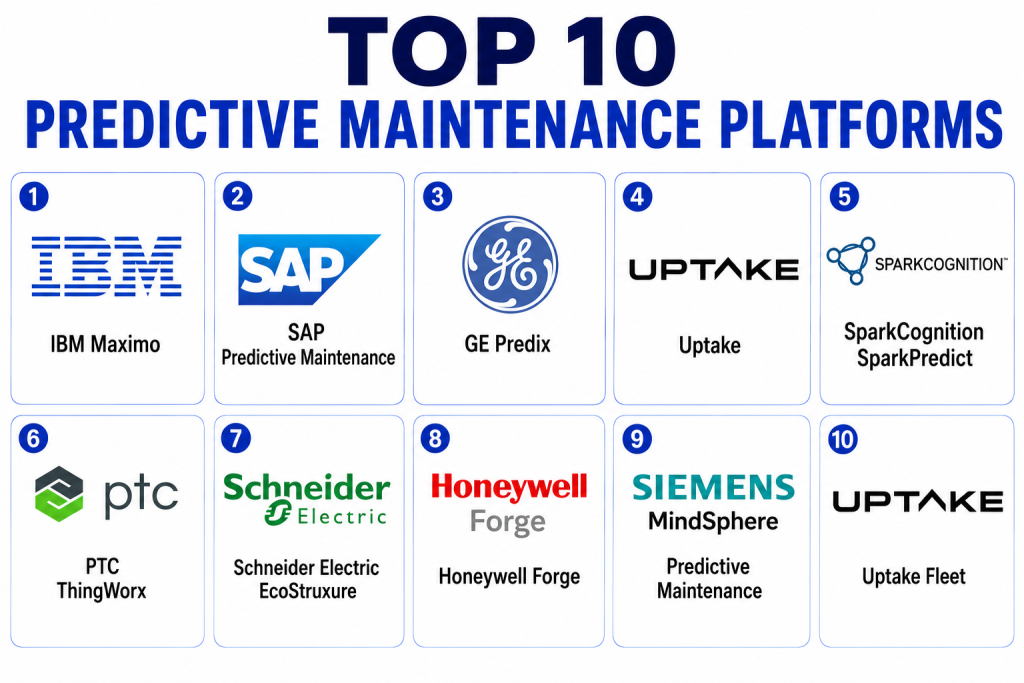
Top 10 Predictive Maintenance Platforms
1- IBM Maximo
Short description: Enterprise-grade predictive maintenance platform offering AI-powered asset management, condition monitoring, and failure prediction for complex industrial operations.
Key Features
- AI-driven anomaly detection
- Real-time asset monitoring
- IoT sensor integration
- Predictive maintenance scheduling
- Customizable dashboards and reporting
- Multi-site deployment support
Pros
- Highly scalable for large enterprises
- Mature analytics and AI capabilities
Cons
- Complex implementation process
- Higher total cost of ownership
Platforms / Deployment
- Web / Windows / Linux
- Cloud / On-premises / Hybrid
Security & Compliance
- Not publicly stated
Integrations & Ecosystem
Integrates with ERP, IoT, and MES platforms
- Industrial sensor APIs
- MES and ERP connectors
- BI dashboards
Support & Community
- Vendor-led onboarding
- Technical support
- Active enterprise community
2- SAP Predictive Maintenance
Short description: Cloud-based predictive maintenance software that leverages machine learning to forecast equipment failures and optimize maintenance schedules.
Key Features
- Machine learning-based prediction
- Real-time asset monitoring
- IoT connectivity
- Automated work order generation
- KPI dashboards and analytics
Pros
- Strong cloud analytics
- Seamless integration with SAP ERP
Cons
- Less flexible for non-SAP environments
- Learning curve for configuration
Platforms / Deployment
- Web / Windows
- Cloud / Hybrid
Security & Compliance
- Not publicly stated
Integrations & Ecosystem
- SAP ERP and MES integration
- IoT sensor interfaces
- API for custom analytics
- BI tools
Support & Community
- Vendor documentation
- Training programs
- SAP user community
3- GE Predix
Short description: Industrial IoT platform with predictive maintenance capabilities, enabling real-time monitoring, anomaly detection, and condition-based maintenance for large-scale operations.
Key Features
- IoT sensor data collection
- Machine learning analytics
- Real-time anomaly alerts
- Asset health dashboards
- Multi-site monitoring
Pros
- Optimized for industrial and energy sectors
- Strong IoT integration
Cons
- Complex initial setup
- Requires ongoing data management
Platforms / Deployment
- Web / Linux
- Cloud / Hybrid
Security & Compliance
- Not publicly stated
Integrations & Ecosystem
- IoT devices and sensors
- MES and ERP connectors
- BI reporting and dashboards
- API access for automation
Support & Community
- Technical support
- Vendor-led training
- Enterprise community
4- Uptake
Short description: AI-driven predictive maintenance platform designed for industrial and transportation sectors to reduce downtime and optimize equipment lifecycle.
Key Features
- AI and ML failure prediction
- Asset condition monitoring
- Automated maintenance scheduling
- Data analytics dashboards
- Multi-site deployment
Pros
- Real-time monitoring and alerts
- Scalable across industries
Cons
- Requires significant sensor integration
- Premium pricing for full capabilities
Platforms / Deployment
- Web / Windows / Linux
- Cloud / Hybrid
Security & Compliance
- Not publicly stated
Integrations & Ecosystem
- IoT and industrial sensors
- ERP and MES connectors
- API support for dashboards
Support & Community
- Vendor support and training
- Online knowledge base
- Moderate user community
5- SparkCognition SparkPredict
Short description: Predictive maintenance platform combining AI, IoT, and analytics to monitor equipment health and predict failures before downtime occurs.
Key Features
- AI anomaly detection
- IoT connectivity
- Asset performance monitoring
- Predictive work orders
- Reporting and visualization
Pros
- Effective for complex industrial assets
- AI-driven analytics
Cons
- Smaller enterprise adoption
- Requires AI expertise for configuration
Platforms / Deployment
- Web / Linux
- Cloud / Hybrid
Security & Compliance
- Not publicly stated
Integrations & Ecosystem
- MES and ERP connectors
- IoT sensor APIs
- Custom analytics dashboards
Support & Community
- Vendor support
- Training resources
- Enterprise user community
6- PTC ThingWorx
Short description: Industrial IoT platform with predictive maintenance features, real-time monitoring, and AI analytics for asset health and process optimization.
Key Features
- IoT sensor integration
- Predictive maintenance analytics
- Real-time dashboards
- Condition-based alerts
- Workflow automation
Pros
- Strong IoT and connectivity
- Easy to scale across sites
Cons
- Complex setup for SMBs
- Premium pricing for full features
Platforms / Deployment
- Web / Windows / Linux
- Cloud / On-premises / Hybrid
Security & Compliance
- Not publicly stated
Integrations & Ecosystem
- IoT sensors
- MES/ERP connectors
- API access for analytics
- BI integration
Support & Community
- Technical support
- Vendor-led training
- Active enterprise community
7- Schneider Electric EcoStruxure
Short description: Predictive maintenance and asset performance management platform designed for energy, building, and industrial operations.
Key Features
- Real-time equipment monitoring
- Predictive failure analytics
- IoT sensor integration
- Maintenance scheduling
- KPI dashboards
Pros
- Optimized for energy and facilities
- Cloud-based and scalable
Cons
- Limited for non-industrial assets
- May require professional services for full deployment
Platforms / Deployment
- Web / Windows / Linux
- Cloud / Hybrid
Security & Compliance
- Not publicly stated
Integrations & Ecosystem
- IoT devices
- MES and ERP integration
- API support
- Analytics dashboards
Support & Community
- Vendor support
- Documentation and training
- Enterprise user forums
8- Honeywell Forge
Short description: Enterprise predictive maintenance platform leveraging AI, IoT, and analytics to reduce unplanned downtime in industrial environments.
Key Features
- AI-powered failure prediction
- Asset health monitoring
- Real-time alerts and dashboards
- Multi-site support
- IoT integration
Pros
- Suitable for large industrial operations
- Advanced analytics and visualization
Cons
- Implementation complexity
- Requires IoT sensor deployment
Platforms / Deployment
- Web / Linux / Windows
- Cloud / Hybrid
Security & Compliance
- Not publicly stated
Integrations & Ecosystem
- Industrial sensors
- ERP and MES systems
- API and BI reporting
Support & Community
- Vendor support and training
- Documentation
- Enterprise community
9- Siemens MindSphere Predictive Maintenance
Short description: Industrial IoT platform for predictive maintenance, equipment monitoring, and AI-driven analytics in manufacturing and energy sectors.
Key Features
- IoT sensor integration
- AI-based anomaly detection
- Real-time dashboards
- Predictive work order generation
- Multi-site scalability
Pros
- Strong industrial focus
- Integrates with Siemens automation systems
Cons
- Complex configuration
- Higher cost for small operations
Platforms / Deployment
- Web / Windows / Linux
- Cloud / Hybrid
Security & Compliance
- Not publicly stated
Integrations & Ecosystem
- Siemens PLC and automation systems
- MES/ERP integration
- API access for dashboards
Support & Community
- Vendor-led training
- Technical support
- Enterprise community
10- Uptake Fleet
Short description: Predictive maintenance platform tailored for fleet and transportation operations, providing real-time monitoring and AI-based failure prediction.
Key Features
- Vehicle sensor integration
- Predictive failure alerts
- Fleet health dashboards
- Maintenance scheduling
- Multi-site support
Pros
- Optimized for fleets and transportation
- AI-driven analytics reduces downtime
Cons
- Limited to fleet assets
- Hardware sensor setup required
Platforms / Deployment
- Web / Linux / Windows
- Cloud / Hybrid
Security & Compliance
- Not publicly stated
Integrations & Ecosystem
- Vehicle telematics sensors
- ERP and fleet management software
- API for dashboards
Support & Community
- Vendor support
- Training and onboarding
- Moderate user community
Comparison Table (Top 10)
| Tool Name | Best For | Platform(s) Supported | Deployment | Standout Feature | Public Rating |
|---|---|---|---|---|---|
| IBM Maximo | Industrial enterprises | Web/Windows/Linux | Cloud/On-prem/Hybrid | AI-driven asset monitoring | N/A |
| SAP Predictive Maintenance | SAP users | Web/Windows | Cloud/Hybrid | ERP integration | N/A |
| GE Predix | Industrial & energy | Web/Linux | Cloud/Hybrid | IoT sensor analytics | N/A |
| Uptake | Multi-industry | Web/Windows/Linux | Cloud/Hybrid | AI anomaly detection | N/A |
| SparkCognition SparkPredict | Complex assets | Web/Linux | Cloud/Hybrid | Deep learning failure prediction | N/A |
| PTC ThingWorx | Industrial IoT | Web/Windows/Linux | Cloud/Hybrid | Asset monitoring & workflow | N/A |
| Schneider EcoStruxure | Energy & industrial | Web/Windows/Linux | Cloud/Hybrid | Multi-site monitoring | N/A |
| Honeywell Forge | Enterprise industrial | Web/Linux/Windows | Cloud/Hybrid | AI-powered dashboards | N/A |
| Siemens MindSphere | Manufacturing & energy | Web/Windows/Linux | Cloud/Hybrid | Siemens automation integration | N/A |
| Uptake Fleet | Transportation & fleets | Web/Linux/Windows | Cloud/Hybrid | Fleet sensor monitoring | N/A |
Evaluation & Scoring of Predictive Maintenance Platforms
| Tool Name | Core (25%) | Ease (15%) | Integrations (15%) | Security (10%) | Performance (10%) | Support (10%) | Value (15%) | Weighted Total (0–10) |
|---|---|---|---|---|---|---|---|---|
| IBM Maximo | 9 | 7 | 8 | 6 | 9 | 8 | 7 | 8.0 |
| SAP Predictive Maintenance | 8 | 7 | 7 | 6 | 8 | 7 | 7 | 7.5 |
| GE Predix | 8 | 6 | 8 | 6 | 8 | 7 | 7 | 7.5 |
| Uptake | 8 | 7 | 7 | 6 | 8 | 7 | 7 | 7.5 |
| SparkCognition SparkPredict | 9 | 6 | 7 | 6 | 8 | 7 | 7 | 7.6 |
| PTC ThingWorx | 8 | 7 | 7 | 6 | 8 | 7 | 7 | 7.5 |
| Schneider EcoStruxure | 8 | 7 | 7 | 6 | 8 | 7 | 7 | 7.5 |
| Honeywell Forge | 9 | 6 | 7 | 6 | 8 | 7 | 7 | 7.6 |
| Siemens MindSphere | 8 | 6 | 7 | 6 | 8 | 7 | 7 | 7.5 |
| Uptake Fleet | 8 | 7 | 7 | 6 | 8 | 7 | 7 | 7.5 |
Scores are comparative, showing relative strengths in core features, usability, integrations, security, performance, support, and value.
Which Predictive Maintenance Platform Is Right for You?
Solo / Freelancer
Generally not applicable; designed for industrial operations.
SMB
Uptake or PTC ThingWorx provide cost-effective, cloud-enabled deployment for small factories or fleets.
Mid-Market
SparkCognition SparkPredict or Honeywell Forge offer advanced AI monitoring without requiring full enterprise scale.
Enterprise
IBM Maximo, GE Predix, or SAP Predictive Maintenance provide multi-site scalability, AI-driven analytics, and IoT sensor integration.
Budget vs Premium
SMB-friendly platforms: Uptake, ThingWorx.
Enterprise: IBM Maximo, GE Predix, Honeywell Forge.
Feature Depth vs Ease of Use
High depth: IBM Maximo, GE Predix, Honeywell Forge.
Ease of use: Uptake, PTC ThingWorx.
Integrations & Scalability
Enterprise platforms offer broad integration with ERP, MES, and IoT sensors. SMB solutions may need additional configuration.
Security & Compliance Needs
Check SOC 2 or ISO certifications when dealing with sensitive operational data; otherwise “Not publicly stated” is the default.
Frequently Asked Questions (FAQs)
1- What pricing models are common?
Hardware plus software license or subscription-based cloud pricing; costs depend on number of assets, sensors, and deployment scale.
2- How long does onboarding take?
Small operations: a few days; enterprise multi-site deployments: several weeks.
3- Are AI features standard?
Not all platforms include AI. IBM Maximo, GE Predix, and SparkCognition leverage AI for predictive analytics, others may rely on rule-based monitoring.
4- How scalable are these tools?
Enterprise platforms support multi-site, multi-asset deployments. SMB platforms handle single-site implementations efficiently.
5- What integrations are essential?
MES, ERP, IoT sensor platforms, and workflow automation systems are critical for predictive maintenance effectiveness.
6- Are these platforms secure?
Varies; some provide encryption and access control. Compliance certifications often “Not publicly stated.”
7- Can you switch vendors?
Yes, but may require data migration, sensor recalibration, and retraining.
8- What are common implementation mistakes?
Skipping integration checks, neglecting operator training, ignoring maintenance scheduling.
9- How is ROI measured?
Reduced downtime, lower repair costs, fewer defects, and increased operational efficiency.
10- Are there open-source alternatives?
Few open-source platforms exist; most predictive maintenance solutions are proprietary enterprise software.
Conclusion
Predictive Maintenance Platforms are vital for modern industrial operations, enabling proactive maintenance, reduced downtime, and improved operational efficiency. Enterprise users benefit from IBM Maximo, GE Predix, and SAP Predictive Maintenance, while SMBs and mid-market operations may adopt Uptake or PTC ThingWorx for accessible AI and analytics. Buyers should shortlist 2–3 platforms, run pilot programs, validate integrations and security, and scale gradually to maximize ROI and operational efficiency.
