Introduction
Seismic Interpretation Software is designed to help geoscientists, geophysicists, and reservoir engineers visualize, analyze, and interpret seismic survey data to understand subsurface structures. These platforms process 2D and 3D seismic datasets, map horizons and faults, detect anomalies, and support exploration and production decisions in the oil and gas industry. In , advanced interpretation software is essential for reducing exploration risk, optimizing reservoir development, and integrating with digital workflows like AI-driven analytics and cloud-based collaboration.
Real-world use cases include:
- Mapping reservoirs, faults, and stratigraphic features for exploration.
- Analyzing seismic amplitudes and attributes to predict hydrocarbon presence.
- Integrating well log data and seismic for structural modeling.
- Supporting drilling and well placement decisions.
- Collaborative interpretation across global teams using cloud platforms.
What buyers should evaluate:
- 2D/3D seismic visualization and interpretation tools
- Attribute analysis and seismic inversion capabilities
- Horizon and fault mapping functionality
- Integration with well logs, reservoir modeling, and GIS
- Cloud and collaborative capabilities
- AI-assisted interpretation and automation
- Security, access control, and audit logging
- Deployment flexibility (desktop, cloud, hybrid)
- Vendor support, documentation, and training
- Scalability for large datasets and multi-site projects
Best for: Geoscientists, reservoir engineers, oil and gas exploration teams, and upstream operators managing exploration and production projects.
Not ideal for: Small-scale operators with minimal exploration needs or those using manual workflows and simple mapping tools.
Key Trends in Seismic Interpretation Software
- AI and Machine Learning for automated fault detection and horizon picking.
- Cloud-based collaboration enabling global geoscience teams to interpret in real-time.
- Integration with well data and geological models for enhanced reservoir characterization.
- Advanced 3D visualization and VR/AR for immersive subsurface analysis.
- Attribute analysis and seismic inversion tools for detailed lithology and hydrocarbon prediction.
- Predictive analytics to forecast drilling risks and optimize exploration outcomes.
- Standardized data formats and open APIs for interoperability.
- Edge computing for large datasets to reduce processing time.
- Environmental and ESG analytics integration for regulatory compliance and sustainability.
- Mobile-enabled field review for wellsite data capture and validation.
How We Selected These Tools (Methodology)
- Evaluated market adoption and reputation in upstream oil and gas.
- Reviewed feature completeness for seismic visualization, attribute analysis, and interpretation workflows.
- Assessed reliability and performance for large-scale 3D seismic datasets.
- Considered security posture, including access control and data protection.
- Evaluated integration capabilities with well logs, reservoir models, and GIS platforms.
- Scored scalability across datasets and multi-site operations.
- Reviewed vendor support quality and training programs.
- Considered innovation in AI-assisted interpretation and cloud collaboration.
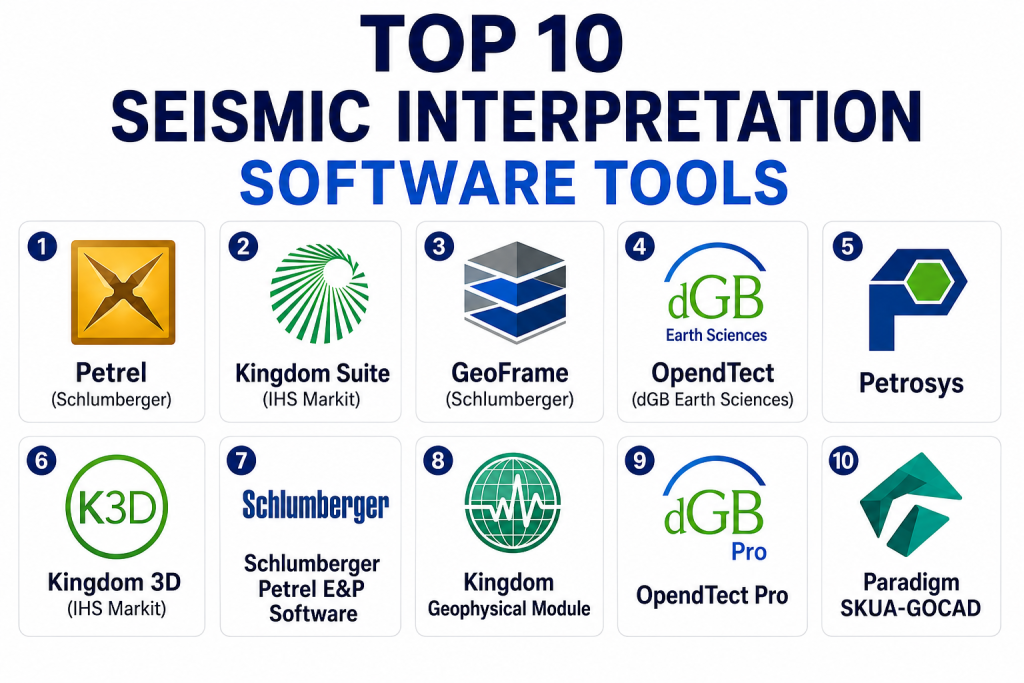
Top 10 Seismic Interpretation Software Tools
1- Petrel (Schlumberger)
Short description: Petrel is a leading platform for seismic interpretation, reservoir modeling, and subsurface visualization in oil and gas exploration, combining multiple data sources to create integrated geological models.
Key Features
- 2D and 3D seismic interpretation
- Horizon and fault mapping
- Attribute analysis and seismic inversion
- Integration with well data and reservoir models
- Collaborative workflows across teams
Pros
- Industry-standard with extensive functionality
- Strong integration with Schlumberger ecosystem
Cons
- High cost for small operators
- Steep learning curve for new users
Platforms / Deployment
- Windows / Web
- Cloud / Hybrid
Security & Compliance
- Encryption and RBAC
- Not publicly stated
Integrations & Ecosystem
- Well logs and reservoir modeling tools
- GIS and mapping platforms
- Schlumberger seismic processing modules
Support & Community
- Global vendor support and training
- Documentation and user forums
2- Kingdom Suite (IHS Markit)
Short description: Kingdom Suite provides geoscientists with 2D/3D seismic interpretation tools, integrated well log analysis, and structural modeling capabilities for exploration and development.
Key Features
- Fault and horizon interpretation
- 2D/3D seismic visualization
- Attribute and amplitude analysis
- Well log integration
- Mapping and volumetric analysis
Pros
- User-friendly interface for geoscientists
- Strong data visualization capabilities
Cons
- Limited collaboration tools compared to cloud-native solutions
- Requires separate modules for advanced modeling
Platforms / Deployment
- Windows
- Cloud / Hybrid
Security & Compliance
- Not publicly stated
Integrations & Ecosystem
- Seismic and well log data
- Reservoir and GIS integration
- Analytical and mapping tools
Support & Community
- Vendor support
- Online documentation and training courses
3- GeoFrame (Schlumberger)
Short description: GeoFrame is a classic platform for seismic data management, interpretation, and well integration, widely used for upstream oil and gas projects.
Key Features
- 2D and 3D seismic interpretation
- Well-log correlation and integration
- Structural mapping and horizon picking
- Attribute extraction and analysis
- Data management and version control
Pros
- Robust well integration features
- Established industry presence
Cons
- Older interface compared to newer tools
- Limited collaborative cloud features
Platforms / Deployment
- Windows
- Hybrid
Security & Compliance
- Not publicly stated
Integrations & Ecosystem
- Schlumberger processing software
- Well data management
- GIS mapping tools
Support & Community
- Vendor support and documentation
- Training programs
4- OpendTect (dGB Earth Sciences)
Short description: OpendTect is an open-source and commercial seismic interpretation platform, providing 3D visualization, attribute analysis, and AI-assisted interpretation workflows.
Key Features
- 2D/3D seismic visualization
- Attribute and inversion analysis
- Fault and horizon picking
- AI-assisted feature detection
- Open-source extensibility
Pros
- Flexible open-source platform
- Supports customization and plugin development
Cons
- Steeper learning curve for advanced features
- Some enterprise features require paid licenses
Platforms / Deployment
- Windows / macOS / Linux
- Cloud / On-prem
Security & Compliance
- Not publicly stated
Integrations & Ecosystem
- GIS and reservoir models
- Well log data
- Custom plugins for analysis
Support & Community
- Active open-source community
- Vendor support for commercial modules
5- Petrosys
Short description: Petrosys specializes in mapping and subsurface data integration, enabling geoscientists to build geological and seismic maps for exploration planning.
Key Features
- 2D/3D mapping and visualization
- Data integration from multiple sources
- Reservoir and structural overlays
- Attribute and contour analysis
- Export to GIS and reservoir modeling systems
Pros
- Strong mapping and data integration tools
- Intuitive visual workflows
Cons
- Limited predictive analytics
- Requires other tools for full interpretation pipeline
Platforms / Deployment
- Windows
- Cloud / Hybrid
Security & Compliance
- Not publicly stated
Integrations & Ecosystem
- GIS and CAD systems
- Seismic and well log imports
- Reservoir modeling exports
Support & Community
- Vendor support
- Documentation
6- Kingdom 3D (IHS Markit)
Short description: Kingdom 3D offers enhanced 3D seismic interpretation, reservoir characterization, and integration with geological models for oil and gas exploration.
Key Features
- 3D seismic interpretation and visualization
- Horizon and fault modeling
- Attribute and amplitude analysis
- Reservoir integration
- Multi-user collaboration
Pros
- Strong 3D visualization
- Integrated reservoir data workflows
Cons
- Premium pricing
- Requires technical expertise for full utility
Platforms / Deployment
- Windows
- Cloud / Hybrid
Security & Compliance
- Not publicly stated
Integrations & Ecosystem
- Reservoir and well data
- GIS systems
- Petrel interoperability
Support & Community
- Vendor support
- Training and documentation
7- Schlumberger Petrel E&P Software
Short description: Petrel E&P extends standard Petrel functionality for exploration and development projects, focusing on integrated workflows from seismic to reservoir modeling.
Key Features
- Seismic to reservoir model integration
- 3D visualization and analysis
- Attribute and inversion tools
- Horizon and fault interpretation
- Collaborative project management
Pros
- Complete upstream workflow integration
- Widely used and supported
Cons
- High cost
- Complex training required
Platforms / Deployment
- Windows / Web
- Cloud / Hybrid
Security & Compliance
- Not publicly stated
Integrations & Ecosystem
- Schlumberger processing software
- Reservoir simulators
- GIS and mapping tools
Support & Community
- Vendor support
- Professional training programs
8- Kingdom Geophysical Module
Short description: This module enhances seismic interpretation within the Kingdom suite, adding geophysical data handling, attribute analysis, and volumetric visualization.
Key Features
- 3D seismic volume visualization
- Attribute extraction
- Fault and horizon mapping
- Integration with well and reservoir data
- Collaborative interpretation
Pros
- Advanced geophysical capabilities
- Integrated with existing Kingdom workflows
Cons
- Requires additional licensing
- Steeper learning curve
Platforms / Deployment
- Windows
- Cloud / Hybrid
Security & Compliance
- Not publicly stated
Integrations & Ecosystem
- Well logs and reservoir models
- GIS integration
- Petrel compatibility
Support & Community
- Vendor support
- Documentation
9- OpendTect Pro
Short description: The professional extension of OpendTect, offering advanced seismic attribute analysis, inversion, and AI-assisted workflows for exploration geoscientists.
Key Features
- 3D seismic attribute analysis
- AI-assisted horizon and fault picking
- Advanced inversion tools
- Multi-volume handling
- Workflow customization
Pros
- AI-assisted interpretation
- Supports large datasets
Cons
- Complexity for new users
- Premium licensing for advanced features
Platforms / Deployment
- Windows / macOS / Linux
- Cloud / On-prem
Security & Compliance
- Not publicly stated
Integrations & Ecosystem
- Well logs and reservoir models
- GIS integration
- Custom scripting via plugins
Support & Community
- Vendor support
- Open-source community forums
10- Paradigm SKUA-GOCAD
Short description: SKUA-GOCAD is a professional geology and seismic interpretation suite for structural modeling, geostatistics, and reservoir characterization in oil & gas.
Key Features
- Structural 3D modeling
- Seismic horizon and fault interpretation
- Geostatistics and uncertainty analysis
- Reservoir property integration
- Collaborative project management
Pros
- Deep geostatistical capabilities
- Industry-standard for reservoir modeling
Cons
- High cost and steep learning curve
- Requires specialized training
Platforms / Deployment
- Windows / Web
- Cloud / Hybrid
Security & Compliance
- Not publicly stated
Integrations & Ecosystem
- Reservoir simulators
- GIS and seismic data
- Petrel interoperability
Support & Community
- Vendor support
- Documentation and professional training
Comparison Table (Top 10)
| Tool Name | Best For | Platform(s) Supported | Deployment | Standout Feature | Public Rating |
|---|---|---|---|---|---|
| Petrel | Integrated E&P | Windows/Web | Cloud/Hybrid | 3D seismic + reservoir | N/A |
| Kingdom Suite | Exploration & mapping | Windows | Cloud/Hybrid | Well & seismic integration | N/A |
| GeoFrame | Data management | Windows | Hybrid | Well-log correlation | N/A |
| OpendTect | AI & open-source | Win/mac/Linux | Cloud/On-prem | AI-assisted picking | N/A |
| Petrosys | Mapping & integration | Windows | Cloud/Hybrid | 2D/3D mapping | N/A |
| Kingdom 3D | 3D interpretation | Windows | Cloud/Hybrid | 3D visualization | N/A |
| Petrel E&P | Full upstream workflow | Windows/Web | Cloud/Hybrid | Reservoir + seismic | N/A |
| Kingdom Geo Module | Geophysical analysis | Windows | Cloud/Hybrid | Volumetric attributes | N/A |
| OpendTect Pro | Professional 3D AI | Win/mac/Linux | Cloud/On-prem | Advanced inversion | N/A |
| SKUA-GOCAD | Reservoir & geostatistics | Windows/Web | Cloud/Hybrid | Structural modeling | N/A |
Evaluation & Scoring of Seismic Interpretation Tools
| Tool Name | Core (25%) | Ease (15%) | Integrations (15%) | Security (10%) | Performance (10%) | Support (10%) | Value (15%) | Weighted Total |
|---|---|---|---|---|---|---|---|---|
| Petrel | 9 | 7 | 9 | 7 | 9 | 8 | 6 | 8.0 |
| Kingdom Suite | 8 | 8 | 8 | 7 | 8 | 7 | 7 | 7.7 |
| GeoFrame | 8 | 7 | 8 | 7 | 8 | 7 | 7 | 7.5 |
| OpendTect | 8 | 7 | 7 | 7 | 8 | 7 | 7 | 7.4 |
| Petrosys | 8 | 8 | 7 | 7 | 8 | 7 | 7 | 7.6 |
| Kingdom 3D | 8 | 7 | 7 | 7 | 8 | 7 | 7 | 7.5 |
| Petrel E&P | 9 | 7 | 9 | 7 | 9 | 8 | 6 | 8.0 |
| Kingdom Geo Module | 8 | 7 | 7 | 7 | 8 | 7 | 7 | 7.5 |
| OpendTect Pro | 8 | 6 | 7 | 7 | 8 | 7 | 7 | 7.3 |
| SKUA-GOCAD | 9 | 6 | 8 | 7 | 9 | 8 | 6 | 7.9 |
Interpretation:
Scores compare core seismic interpretation capabilities, usability, integration flexibility, security, performance, support, and overall value. Organizations should select tools based on project size, data complexity, and team expertise.
Which Seismic Interpretation Tool Is Right for You?
Solo / Freelancer
OpendTect or Petrosys are suitable for small-scale or academic projects with flexible budgets and limited data volume.
SMB
Kingdom Suite, Kingdom 3D, or Leapfrog 3D provide strong visualization and data integration for medium-sized exploration teams.
Mid-Market
Petrel, GeoFrame, and Petrel E&P balance interpretive power with integration into existing well and reservoir workflows.
Enterprise
SKUA-GOCAD, OpendTect Pro, and Petrel E&P offer deep geostatistical, 3D modeling, and reservoir simulation integration for large-scale oil & gas operations.
Budget vs Premium
Open-source and mid-market solutions are cost-effective but require technical expertise; premium platforms offer comprehensive workflows and support.
Feature Depth vs Ease of Use
Enterprise platforms provide extensive features but require training; mid-market platforms balance usability and functionality.
Integrations & Scalability
Cloud and hybrid platforms integrating seismic, well logs, GIS, and reservoir models provide best scalability and collaboration across global teams.
Security & Compliance Needs
Evaluate encryption, RBAC, and audit logging for secure project collaboration and compliance with industry standards.
Frequently Asked Questions (FAQs)
1— What is seismic interpretation software?
Software used to visualize, interpret, and model seismic survey data for subsurface exploration and reservoir analysis.
2— How much does it cost?
Costs vary by license type, scale, and whether AI-assisted features or 3D modeling modules are included.
3— Can these tools handle 3D seismic data?
Yes, enterprise and mid-market solutions are designed for large 3D volumes.
4— Are there open-source options?
OpendTect provides open-source and commercial editions for flexibility.
5— Do these tools integrate with well data?
Yes, integration with well logs and reservoir models is standard for informed interpretation.
6— Can multiple users collaborate in real-time?
Cloud-enabled and hybrid platforms allow team collaboration with version control.
7— Are AI features useful?
Yes, AI accelerates horizon picking, fault detection, and attribute analysis.
8— Is training required?
Yes, enterprise solutions require specialized training for full utility.
9— Can these tools support reservoir simulation?
Platforms like Petrel and SKUA-GOCAD integrate with reservoir simulation workflows.
10— How to choose the right tool?
Consider dataset size, team expertise, integration needs, and project type to select an appropriate seismic interpretation platform.
Conclusion
Seismic Interpretation Software is critical for understanding subsurface geology, guiding drilling decisions, and optimizing exploration and production. Open-source or mid-market tools like OpendTect and Petrosys are suitable for smaller projects, while Petrel, SKUA-GOCAD, and Kingdom Suite provide advanced capabilities for enterprise oil and gas operations. Start with a shortlist, test with project data, and evaluate integration and collaboration workflows before full deployment to maximize insight, accuracy, and operational efficiency.
