Introduction
Smart contract development tools help developers create, test, deploy, audit, and manage blockchain-based smart contracts. These tools simplify the development lifecycle by providing integrated environments, testing frameworks, security analysis capabilities, deployment automation, and blockchain connectivity.
As blockchain adoption continues to expand across finance, supply chains, gaming, digital identity, and decentralized applications, smart contract security and reliability have become critical business concerns. Organizations increasingly require tools that support secure coding practices, automated testing, auditing workflows, and multi-chain deployment strategies.
Real-world use cases include:
- Decentralized Finance (DeFi) applications
- NFT marketplaces and digital asset platforms
- Blockchain gaming ecosystems
- Enterprise blockchain automation
- Supply chain and asset tracking solutions
What buyers should evaluate:
- Smart contract language support
- Security testing capabilities
- Deployment automation
- Multi-chain compatibility
- Developer experience
- Community adoption
- Integration ecosystem
- Documentation quality
- Scalability support
- Cost and licensing model
Best for: Blockchain developers, Web3 startups, DeFi projects, enterprise blockchain teams, security auditors, and organizations building decentralized applications.
Not ideal for: Traditional software projects without blockchain requirements, simple web applications, or organizations lacking blockchain development expertise.
Key Trends in Smart Contract Development Tools
- AI-assisted smart contract generation and code review are becoming standard capabilities.
- Automated vulnerability detection is increasingly integrated into development workflows.
- Multi-chain deployment support is replacing single-blockchain development approaches.
- Formal verification tools are gaining adoption for high-value financial contracts.
- Zero-knowledge proof integration is becoming more common.
- Smart contract monitoring and observability platforms are expanding rapidly.
- Security-first development pipelines are replacing traditional blockchain coding practices.
- Enterprise compliance and governance features are becoming key differentiators.
- Cloud-based blockchain development environments continue gaining popularity.
- Automated audit and remediation workflows are reducing deployment risks.
How We Selected These Tools (Methodology)
The tools included in this analysis were evaluated using the following criteria:
- Market adoption among blockchain developers
- Industry recognition and ecosystem influence
- Feature completeness across the development lifecycle
- Security testing and auditing capabilities
- Community support and documentation quality
- Integration flexibility and extensibility
- Multi-chain and protocol compatibility
- Suitability for startups, enterprises, and individual developers
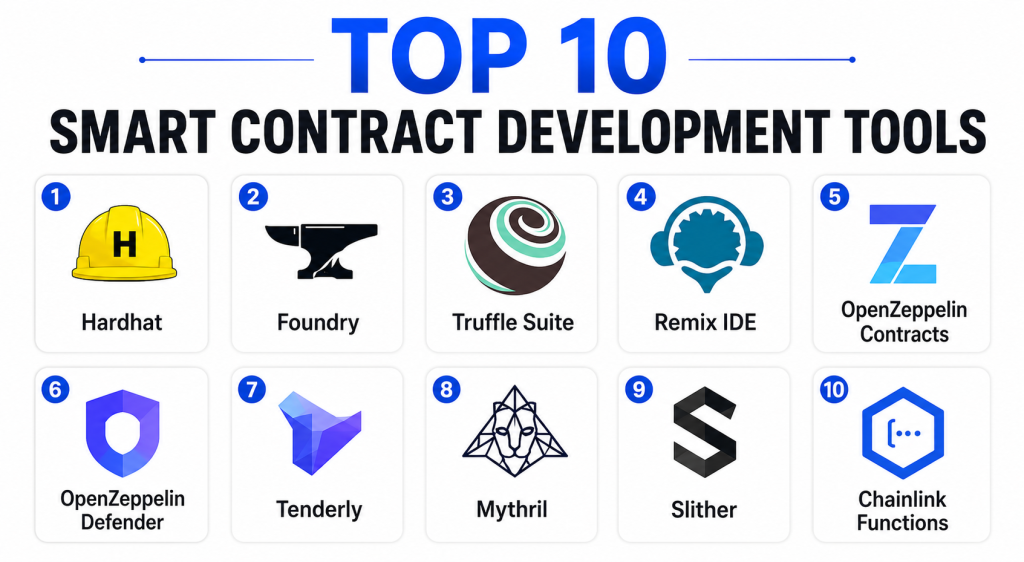
Top 10 Smart Contract Development Tools
1- Hardhat
Short description:
Hardhat is one of the most widely adopted Ethereum development environments. It provides a complete framework for compiling, testing, debugging, and deploying smart contracts. Developers appreciate its flexibility, plugin ecosystem, and strong integration with modern blockchain workflows. It is suitable for startups, enterprise blockchain teams, and independent developers. Hardhat simplifies local blockchain development while supporting advanced deployment pipelines. Its extensive ecosystem makes it a preferred choice for Ethereum-based projects.
Key Features
- Local Ethereum network simulation
- Advanced debugging tools
- Plugin architecture
- Automated testing framework
- Deployment scripting
- Solidity support
- Developer task automation
Pros
- Large developer community
- Strong plugin ecosystem
- Excellent debugging capabilities
Cons
- Ethereum-focused
- Learning curve for beginners
- Requires JavaScript knowledge
Platforms / Deployment
- Windows
- macOS
- Linux
- Self-hosted
Security & Compliance
- RBAC: Varies / N/A
- Audit logs: Varies / N/A
- MFA: Not publicly stated
Integrations & Ecosystem
Hardhat integrates with popular blockchain infrastructure providers and development platforms.
- Ethers.js
- OpenZeppelin
- Infura
- Alchemy
- Tenderly
Support & Community
Extensive documentation, active community forums, numerous tutorials, and strong ecosystem support.
2- Foundry
Short description:
Foundry is a modern smart contract development toolkit built for speed and efficiency. Written in Rust, it provides rapid testing, deployment, and fuzzing capabilities. Developers favor Foundry for high-performance blockchain development environments. Its native tooling reduces dependency complexity while improving execution speed. The platform has experienced significant growth among professional smart contract engineers. It is particularly popular within advanced Ethereum development communities.
Key Features
- Fast compilation
- Solidity-native testing
- Fuzz testing
- Deployment automation
- Script execution
- Debugging utilities
- Forge testing framework
Pros
- Extremely fast
- Excellent testing support
- Strong developer experience
Cons
- Smaller ecosystem than Hardhat
- Advanced learning curve
- Limited beginner resources
Platforms / Deployment
- Windows
- macOS
- Linux
- Self-hosted
Security & Compliance
- Fuzz testing support
- Security-focused testing workflows
- Compliance information not publicly stated
Integrations & Ecosystem
Foundry integrates with modern Ethereum tooling stacks.
- Etherscan
- OpenZeppelin
- Alchemy
- Infura
- CI/CD pipelines
Support & Community
Growing community with strong support among advanced blockchain developers.
3- Truffle Suite
Short description:
Truffle has long been a foundational tool within Ethereum development. It provides development, testing, migration, and deployment functionality in a unified framework. Organizations use Truffle for managing complex smart contract projects. The platform offers structured workflows and mature tooling. Its historical significance and ecosystem support continue making it relevant for many blockchain teams. Truffle remains widely recognized across Web3 development.
Key Features
- Smart contract compilation
- Migration management
- Testing framework
- Deployment automation
- Network management
- Project scaffolding
- Integration support
Pros
- Mature ecosystem
- Enterprise adoption
- Extensive documentation
Cons
- Slower than newer alternatives
- Less modern architecture
- Steeper setup requirements
Platforms / Deployment
- Windows
- macOS
- Linux
Security & Compliance
- Audit workflow support
- Security integrations available
- Compliance details not publicly stated
Integrations & Ecosystem
- Ganache
- OpenZeppelin
- Infura
- MetaMask
- Ethereum networks
Support & Community
Large community with extensive educational resources.
4- Remix IDE
Short description:
Remix IDE is a browser-based smart contract development environment designed for rapid development and testing. It provides an intuitive interface that simplifies blockchain development. Developers use Remix for learning, prototyping, debugging, and deploying contracts. Its accessibility makes it popular among beginners and experienced developers alike. The platform continues to evolve with advanced plugins and debugging capabilities.
Key Features
- Browser-based IDE
- Solidity compiler
- Debugger
- Contract deployment
- Plugin support
- Static analysis
- Testing tools
Pros
- Easy to use
- No installation required
- Excellent for learning
Cons
- Limited enterprise workflow features
- Less suitable for large projects
- Browser dependency
Platforms / Deployment
- Web
- Cloud
Security & Compliance
- Static code analysis
- Security plugins
- Compliance details not publicly stated
Integrations & Ecosystem
- MetaMask
- OpenZeppelin
- Ethereum networks
- Browser wallets
Support & Community
Strong educational community and extensive documentation.
5- OpenZeppelin Contracts
Short description:
OpenZeppelin Contracts provides secure and audited smart contract libraries widely used across the blockchain industry. It enables developers to build standardized blockchain applications using trusted components. The library significantly reduces development risk and accelerates deployment. Organizations rely on OpenZeppelin for security-focused development. Its widespread adoption has made it a foundational component of many Web3 ecosystems.
Key Features
- Audited contract templates
- ERC standards support
- Security modules
- Access controls
- Upgradeable contracts
- Governance modules
- Token frameworks
Pros
- Trusted security reputation
- Industry-standard libraries
- Strong documentation
Cons
- Not a complete IDE
- Limited deployment tools
- Requires integration with other frameworks
Platforms / Deployment
- Cloud
- Self-hosted
Security & Compliance
- Security-focused architecture
- Audited libraries
- Access control mechanisms
Integrations & Ecosystem
- Hardhat
- Foundry
- Remix
- Truffle
- Defender
Support & Community
One of the strongest blockchain developer communities.
6- OpenZeppelin Defender
Short description:
OpenZeppelin Defender helps teams automate smart contract operations and security monitoring. It provides deployment management, administrative controls, transaction automation, and monitoring capabilities. Enterprises use Defender to improve governance and operational security. The platform simplifies blockchain administration while reducing manual intervention.
Key Features
- Transaction automation
- Smart contract monitoring
- Role management
- Security workflows
- Alerting system
- Governance support
- Deployment management
Pros
- Enterprise-focused
- Strong automation
- Security-oriented
Cons
- Additional cost
- Advanced setup requirements
- Best used with OpenZeppelin ecosystem
Platforms / Deployment
- Cloud
Security & Compliance
- RBAC
- Audit logs
- Governance controls
- MFA support
Integrations & Ecosystem
- OpenZeppelin Contracts
- Ethereum networks
- Monitoring platforms
- Wallet infrastructure
Support & Community
Professional support and strong ecosystem documentation.
7- Tenderly
Short description:
Tenderly provides blockchain observability, debugging, monitoring, and simulation capabilities. Development teams use it to understand contract behavior before deployment. Its visualization tools simplify troubleshooting and performance analysis. Tenderly has become a preferred platform for production blockchain monitoring.
Key Features
- Transaction simulation
- Contract monitoring
- Debugging tools
- Alerting
- Performance analytics
- Multi-chain support
- Team collaboration
Pros
- Excellent visibility
- Production monitoring
- User-friendly interface
Cons
- Premium features can be costly
- Not a complete development framework
- Advanced features require onboarding
Platforms / Deployment
- Cloud
Security & Compliance
- RBAC
- Monitoring controls
- Audit capabilities
Integrations & Ecosystem
- Hardhat
- Foundry
- Ethereum
- Polygon
- Arbitrum
Support & Community
Strong commercial support and active user community.
8- Mythril
Short description:
Mythril is a smart contract security analysis tool focused on vulnerability detection. Security professionals and auditors use it to identify blockchain risks before deployment. The platform helps reduce exposure to common contract exploits. Mythril remains a respected security analysis solution.
Key Features
- Vulnerability scanning
- Symbolic execution
- Security analysis
- Risk reporting
- Automated audits
- Ethereum support
- Detection rules
Pros
- Security-focused
- Strong vulnerability detection
- Open-source availability
Cons
- Technical expertise required
- Limited deployment functionality
- Primarily security-focused
Platforms / Deployment
- Windows
- macOS
- Linux
Security & Compliance
- Security analysis engine
- Vulnerability assessment
- Compliance details not publicly stated
Integrations & Ecosystem
- Hardhat
- CI/CD pipelines
- Ethereum development tools
Support & Community
Strong open-source security community.
9- Slither
Short description:
Slither is a static analysis framework designed for Solidity smart contracts. It helps developers identify vulnerabilities, code quality issues, and optimization opportunities. Security teams frequently use Slither during development and audit phases. The tool has become a standard component of secure blockchain development pipelines.
Key Features
- Static analysis
- Vulnerability detection
- Code quality checks
- Custom detectors
- Reporting tools
- CI/CD integration
- Solidity analysis
Pros
- Fast analysis
- Open-source
- Strong security capabilities
Cons
- Technical outputs
- Not beginner-friendly
- Requires interpretation
Platforms / Deployment
- Windows
- macOS
- Linux
Security & Compliance
- Security scanning
- Vulnerability detection
- Compliance information not publicly stated
Integrations & Ecosystem
- Hardhat
- Foundry
- CI/CD systems
- Security workflows
Support & Community
Widely adopted by blockchain security professionals.
10- Chainlink Functions
Short description:
Chainlink Functions enables smart contracts to securely access external data and computation. It expands blockchain capabilities by connecting decentralized applications with off-chain services. Developers use it to build sophisticated applications that require real-world information. Chainlink’s extensive network infrastructure makes it highly relevant for enterprise and Web3 projects.
Key Features
- Off-chain computation
- Data connectivity
- Oracle infrastructure
- API integrations
- Automation support
- Secure execution
- Decentralized architecture
Pros
- Industry-leading oracle ecosystem
- Extensive integrations
- Enterprise relevance
Cons
- Oracle-specific focus
- Additional operational complexity
- Learning curve
Platforms / Deployment
- Cloud
- Hybrid
Security & Compliance
- Decentralized security model
- Network validation mechanisms
- Compliance details vary
Integrations & Ecosystem
- Ethereum
- Polygon
- Avalanche
- APIs
- DeFi platforms
Support & Community
Large blockchain ecosystem and extensive developer resources.
Comparison Table
| Tool Name | Best For | Platform(s) Supported | Deployment | Standout Feature | Public Rating |
|---|---|---|---|---|---|
| Hardhat | Ethereum Development | Windows, macOS, Linux | Self-hosted | Plugin Ecosystem | N/A |
| Foundry | Advanced Developers | Windows, macOS, Linux | Self-hosted | High-Speed Testing | N/A |
| Truffle | Enterprise Projects | Windows, macOS, Linux | Self-hosted | Mature Workflow | N/A |
| Remix IDE | Beginners & Prototyping | Web | Cloud | Browser IDE | N/A |
| OpenZeppelin Contracts | Secure Development | Cross-platform | Hybrid | Audited Libraries | N/A |
| OpenZeppelin Defender | Operations & Governance | Web | Cloud | Automation | N/A |
| Tenderly | Monitoring | Web | Cloud | Transaction Simulation | N/A |
| Mythril | Security Auditing | Windows, macOS, Linux | Self-hosted | Vulnerability Analysis | N/A |
| Slither | Static Analysis | Windows, macOS, Linux | Self-hosted | Security Detection | N/A |
| Chainlink Functions | Oracle Integration | Cloud | Hybrid | External Data Access | N/A |
Evaluation & Scoring of Smart Contract Development Tools
| Tool | Core | Ease | Integrations | Security | Performance | Support | Value | Weighted Total |
|---|---|---|---|---|---|---|---|---|
| Hardhat | 10 | 8 | 10 | 8 | 9 | 10 | 9 | 9.15 |
| Foundry | 9 | 7 | 8 | 8 | 10 | 8 | 9 | 8.50 |
| Truffle | 8 | 8 | 8 | 8 | 7 | 9 | 8 | 8.05 |
| Remix IDE | 8 | 10 | 7 | 7 | 8 | 8 | 10 | 8.45 |
| OpenZeppelin Contracts | 10 | 8 | 10 | 10 | 9 | 10 | 9 | 9.40 |
| OpenZeppelin Defender | 9 | 8 | 8 | 10 | 9 | 9 | 8 | 8.75 |
| Tenderly | 9 | 9 | 8 | 9 | 9 | 9 | 7 | 8.60 |
| Mythril | 8 | 6 | 7 | 10 | 8 | 7 | 8 | 7.80 |
| Slither | 8 | 6 | 8 | 10 | 9 | 8 | 9 | 8.20 |
| Chainlink Functions | 9 | 7 | 10 | 9 | 9 | 9 | 8 | 8.70 |
These scores represent comparative evaluations rather than absolute rankings. Organizations should prioritize criteria aligned with their specific requirements. Security-focused teams may emphasize audit and analysis tools, while application developers may prioritize development frameworks. Enterprise buyers often place greater weight on governance, monitoring, and support capabilities. Running proof-of-concept projects remains the most reliable selection method.
Which Smart Contract Development Tool Is Right for You?
Solo / Freelancer
Remix IDE and Hardhat are excellent starting points. They offer simplicity, strong documentation, and broad community support without requiring large infrastructure investments.
SMB
Hardhat, Foundry, and OpenZeppelin Contracts provide a balanced combination of productivity, security, and scalability suitable for growing blockchain businesses.
Mid-Market
Organizations requiring operational visibility should consider Tenderly and OpenZeppelin Defender alongside development frameworks for improved monitoring and governance.
Enterprise
Large organizations typically benefit from combining Hardhat or Foundry with OpenZeppelin Defender, Tenderly, Slither, and Mythril for secure end-to-end workflows.
Budget vs Premium
Open-source tools like Hardhat, Foundry, Slither, and Mythril provide exceptional value. Premium platforms such as Tenderly and Defender deliver advanced operational capabilities.
Feature Depth vs Ease of Use
Remix prioritizes simplicity. Foundry emphasizes advanced functionality and performance. Hardhat offers a balanced middle ground.
Integrations & Scalability
Hardhat, OpenZeppelin, Tenderly, and Chainlink Functions provide the broadest integration ecosystems and support enterprise-scale deployments.
Security & Compliance Needs
Security-sensitive projects should combine OpenZeppelin Contracts, Slither, Mythril, and Defender to strengthen development and operational controls.
Frequently Asked Questions (FAQs)
1- What is a smart contract development tool?
Smart contract development tools help developers write, test, deploy, monitor, and secure blockchain-based applications. They streamline the development lifecycle and reduce deployment risks through automation and testing capabilities.
2- Which tool is best for beginners?
Remix IDE is generally the most beginner-friendly option because it runs directly in a browser and requires minimal setup. It provides a simple interface for learning Solidity development.
3- Why is smart contract security important?
Smart contracts often control financial assets and business logic. Security vulnerabilities can result in financial losses, operational disruptions, and reputational damage.
4- Can multiple tools be used together?
Yes. Most professional teams combine development frameworks, security analyzers, monitoring platforms, and deployment tools to create comprehensive development pipelines.
5- What is the difference between Hardhat and Foundry?
Hardhat emphasizes flexibility and ecosystem integration, while Foundry focuses on performance and native Solidity workflows. Both are highly respected development environments.
6- Are open-source tools sufficient for enterprise projects?
Many enterprises successfully use open-source tools such as Hardhat, Foundry, Slither, and OpenZeppelin. Additional commercial solutions may be added for governance and monitoring.
7- How do smart contract testing tools improve reliability?
Testing tools validate contract behavior before deployment. They help identify bugs, edge cases, and security vulnerabilities through automated simulations and verification processes.
8- What role do monitoring platforms play?
Monitoring solutions such as Tenderly provide visibility into live contract performance, transaction behavior, and operational anomalies after deployment.
9- How difficult is migration between smart contract tools?
Migration complexity depends on project architecture. Most modern tools support common standards, making transitions manageable with proper planning and testing.
10- What should organizations prioritize when selecting tools?
Organizations should focus on security capabilities, ecosystem support, development efficiency, integration flexibility, scalability, and long-term maintainability.
Conclusion
Smart contract development tools have evolved into comprehensive ecosystems that support coding, testing, deployment, security auditing, monitoring, and governance. No single platform addresses every requirement, which is why successful blockchain teams often combine multiple tools to create a secure and scalable development workflow. Hardhat and Foundry remain leading development frameworks, OpenZeppelin provides trusted security foundations, Tenderly delivers operational visibility, and Mythril and Slither strengthen vulnerability detection. The ideal choice depends on your team’s expertise, project complexity, compliance requirements, and deployment strategy. Rather than selecting a single winner, create a shortlist of two to three tools, conduct a pilot project, evaluate integration compatibility, validate security workflows, and choose the combination that best aligns with your long-term blockchain development goals.
