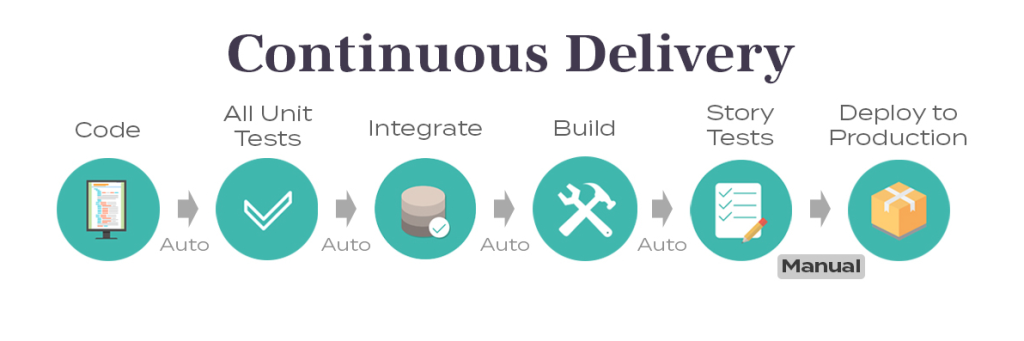
Continuous delivery is a software development practice that enables teams to consistently deliver software updates and changes to production quickly, safely, and in a sustainable manner. It focuses on automating the entire delivery process, from development and testing to deployment and release.
Why We Need Continuous Delivery?
There are many reasons why we need continuous delivery. Here are a few of the most important ones:
- To improve the quality of software. By automating the testing process, we can catch bugs earlier and prevent them from reaching production.
- To reduce the time to market. With continuous delivery, we can release new features and bug fixes more quickly.
- To improve customer satisfaction. By delivering software more frequently, we can give our customers what they want, when they want it.
- To reduce costs. By automating the release process, we can save time and money.
What is the Advantage of Continuous Delivery?
The advantages of continuous delivery include:
1. Faster time to market: Frequent software updates allow organizations to deliver value to customers quickly and stay ahead in the competitive market.
2. Improved quality: Automated testing and deployment processes, along with tight feedback loops, help catch bugs and issues early, resulting in higher quality software.
3. Reduced risk: Continuous delivery practices mitigate the chances of major failures or outages since changes are deployed in smaller increments and can be easily reverted.
4. Increased efficiency: Automation eliminates manual and repetitive tasks, freeing up time for development teams to focus on delivering new features instead of troubleshooting deployments.
5. Enhanced collaboration: Continuous delivery promotes collaboration between development, operations, and other teams, leading to better communication and shared responsibilitie’s.
What is the feature of Continuous Delivery?
The key features of Continuous Delivery include:
- Automated Testing: Continuous Delivery relies on automated testing to ensure that every code change is thoroughly tested before being deployed to production. This includes unit tests, integration tests, and end-to-end tests.
- Continuous Integration: Continuous Delivery involves continuously integrating code changes from multiple developers into a shared repository. This ensures that the latest changes are always available for testing and deployment.
- Infrastructure as Code: Continuous Delivery uses infrastructure as code (IaC) tools to define and manage the infrastructure needed for the application. This allows teams to provision and configure resources automatically, reducing the risk of configuration errors.
- Deployment Pipelines: Continuous Delivery utilizes deployment pipelines to automate the release process. These pipelines consist of a series of stages, including build, test, and deployment, with each stage being triggered automatically when the previous one is successfully completed.
What are the Top 10 Use Cases of Continuous Delivery?
The top 10 use cases of continuous delivery include:
- Software development
- Infrastructure as code
- DevOps
- Agile development
- Cloud computing
- Microservices architecture
- Continuous testing
- Continuous monitoring
- Continuous improvement
- Continuous learning
How to Implement Continuous Delivery?
To implement continuous delivery, follow these steps:
1. Establish a deployment pipeline: Set up a pipeline that automates the process of building, testing, and deploying software changes.
2. Use version control: Implement a version control system to manage code changes and collaborate effectively.
3. Automate testing: Set up automated testing processes for different levels (unit, integration, acceptance, etc.) to ensure software quality.
4. Automate deployment: Automate the deployment process, including infrastructure provisioning, software configurations, and rollbacks if needed.
5. Monitor and log: Implement monitoring and logging mechanisms to keep track of application health and address any issues promptly.
6. Continuously improve: Regularly analyze and optimize the delivery process to identify areas of improvement and implement changes to streamline the workflow.
How to Get Certified in Continuous Delivery?
There are several certifications available for Continuous Delivery professionals. Here are some most popular website for providing Certification courses visit this website for more information: DevOpsSchool.com , scmGalaxy.com , BestDevOps.com , Cotocus.com
How to Learn Continuous Delivery?
Here are some ways to learn continuous delivery:
- Read books and articles. There are many books and articles available on continuous delivery. These can give you a good overview of the topic and introduce you to the key concepts.
- Take online courses. There are many online courses available on continuous delivery. These can teach you the practical skills you need to implement continuous delivery in your organization. Here are some most popular website for providing Certification courses: DevOpsSchool.com , scmGalaxy.com , BestDevOps.com , Cotocus.com
- Attend meetups and conferences. Meetups and conferences are a great way to learn from other practitioners and get involved in the community.
- Get involved in open source projects. There are many open source projects that use continuous delivery. Getting involved in these projects can give you hands-on experience with continuous delivery.
- Talk to people who are using continuous delivery. Talk to people who are already using continuous delivery in their organizations. They can share their experiences and give you advice.
