
Last updated: 28 November 2026
Microservices in media and entertainment matter because the work is uneven. A premiere or a live match can send demand soaring for sign-in and playback while billing or rights management barely moves. Splitting a platform into independently run services lets teams scale, change and protect each part on its own terms.
“Critical” still needs a qualifier. Microservices are valuable for large, complex platforms with several teams and sharply different workloads. They are not required for every streaming app, newsroom or studio tool, and used carelessly they add cost and failure points.
What microservices mean for a media business
A microservices architecture builds an application as a set of small services. Each runs in its own process, communicates through lightweight interfaces, is organized around a business capability and can be deployed separately. Martin Fowler and James Lewis also list decentralized data management, infrastructure automation and design for failure as common traits.
In media, those capabilities might include:
- Audience-facing: identity, subscriptions, catalogue, search, recommendations and playback authorization.
- Supply chain: ingest, quality checks, transcoding, packaging, captions and metadata.
- Commercial: entitlements, advertising decisions, billing and rights windows.
- Operations: monitoring, event scheduling and incident tooling.
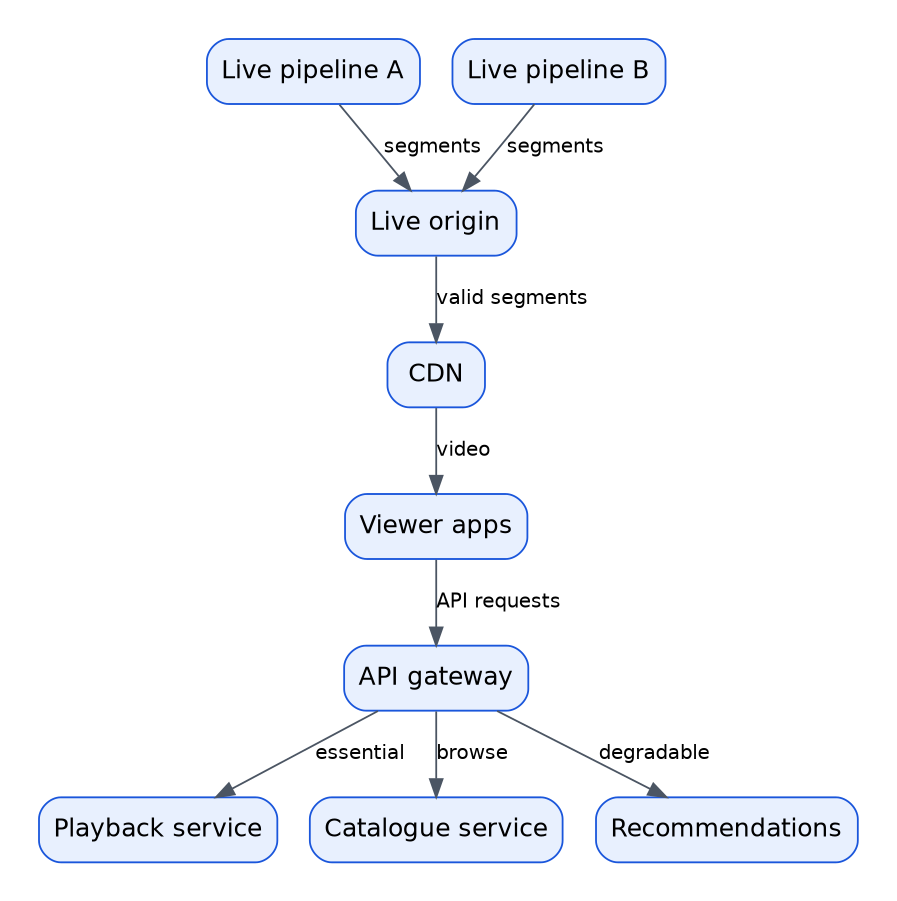
Video bytes are usually a separate concern. A content delivery network (CDN) moves segments to viewers, while application services decide who may watch what and prepare the content.
Why microservices matter in media and entertainment
1. Demand is spiky and uneven
Releases and live events concentrate traffic into short windows. With separate services, you can add capacity to playback authorization without also scaling the royalty reporting job. Autoscaling alone may react too slowly to a sudden surge, so teams also need pre-provisioned headroom and a plan for overload.
2. Some requests matter more than others
A viewer pressing play is more important than a background prefetch. Netflix has described service-level prioritized load shedding, in which individual services reject lower-priority work first when under pressure. User-initiated playback is protected, while prefetch and background tasks are dropped earlier.
Netflix moved this decision beyond its central API gateway so that it also covers traffic between backend services and batch work. The idea is not exclusive to microservices, but clear service boundaries give each team a natural place to define priorities.
3. Live video leaves little room for failure
Netflix’s Live Origin is a useful published example. It is a multi-tenant microservice on Amazon EC2 that sits between the company’s cloud live pipelines and Open Connect, its CDN.
- Redundant regional pipelines run independently. For each segment, the origin checks the candidates and serves a valid one.
- When its storage layer is under stress, it favors requests at the live edge over rewind (DVR) requests.
- Publishing traffic and CDN read traffic run on separate stacks, so pressure on one is less likely to harm the other.
Netflix reported a peak of 65 million concurrent streams for the 2024 Tyson vs. Paul event. That figure describes the event, not proof that microservices alone made it work. Redundancy, storage design, caching and the CDN all play a part.
4. Products change at different speeds
A recommendations team may want to release often. A billing team may need slower, tightly reviewed changes. Independent deployment lets both work at their own pace, provided their interfaces stay compatible. If every release requires five teams to deploy together, you have the overhead without the independence.
5. Production is becoming software-defined
The shift is not limited to streaming apps. The MovieLabs 2030 Vision for media creation treats interoperability as a foundation and promotes software-defined workflows that automate tasks such as moving files, verifying transfers and collecting status updates.
In live production, the European Broadcasting Union (EBU) works with AMWA on the Dynamic Media Facility, a software-defined approach to infrastructure. Its open-source Media eXchange Layer (MXL) is a container-friendly SDK that lets media functions exchange video, audio and ancillary data, including through shared memory. The project’s releases page listed version 1.1.0 as the latest stable release at the time of research.
MXL does not require a microservices design. It does show why modular, replaceable software components are increasingly relevant to broadcasters.
Comparing the architecture options
| Factor | Simple monolith | Modular monolith | Microservices |
|---|---|---|---|
| Deployment | One unit | One unit, clear internal modules | Many independent units |
| Scaling | Whole application | Mostly whole application | Per service |
| Fault isolation | Limited | Limited at runtime | Better, if dependencies are controlled |
| Data consistency | Simplest | Usually simple | Often eventual across services |
| Operational load | Low | Low to moderate | High |
| Typical fit | Prototype, small product | Growing product, few teams | Large platform, many teams, uneven load |
Where microservices are the wrong answer
Fowler calls the extra cost the “microservice premium”: automated deployment, monitoring, failure handling and eventual consistency all demand effort. His advice is not to consider microservices unless a system is too complex to manage as a monolith.
Media offers a well-known caution. In 2023, an Amazon Prime Video team described a tool that checked audio and video quality across thousands of streams. Its first design used distributed serverless components. Orchestration limits and charges, plus the cost of passing video frames through Amazon S3, became problems.
The team combined the components into a single process running on EC2 and ECS, and reported infrastructure cost savings of over 90% with better scaling. This concerned one monitoring service, not all of Prime Video. The lesson is to avoid putting network or storage hops between steps that exchange heavy media data constantly.
Practical example: shed low-priority work first
This hypothetical Python sketch shows the idea behind prioritized load shedding. The thresholds are invented for illustration, and the code has not been tested here.
# Maximum utilisation (0.0 to 1.0) at which each class is still accepted
LIMITS = {
    "playback": 0.90,
    "browse": 0.75,
    "prefetch": 0.60,
}

def admit(request_class, utilisation):
    # Unknown classes get the most restrictive limit
    limit = LIMITS.get(request_class, min(LIMITS.values()))
    return utilisation < limit

for name in ["playback", "browse", "prefetch"]:
    print(name, admit(name, utilisation=0.80))

# Expected: playback True, browse False, prefetch False
A production version needs trustworthy priority labels, smoothed load signals, retry limits and metrics for rejected requests. Many systems reject a growing share of requests as load rises instead of switching at a hard cutoff.
Best practices for media platforms
- Draw boundaries around business capabilities. Keep things that change together in the same service.
- Keep heavy media paths short. Pass references and events between services where possible, and co-locate steps that share raw frames.
- Use asynchronous events for long jobs. Transcoding and quality checks suit queues or workflow engines. Make handlers safe to run twice.
- Design degraded modes. If recommendations fail, show a cached or editorial list and let playback continue.
- Set timeouts, retry budgets and circuit breakers. Unlimited retries can turn a slowdown into an outage.
- Trace requests end to end. You need to know which dependency delayed a stream start.
- Rehearse big events. Load test, inject failures and agree in advance what can be switched off.
Common mistakes and how to fix them
| Symptom | Likely cause | What to try |
|---|---|---|
| Releases must ship together | Tightly coupled services | Version contracts, or merge the services |
| One slow service stalls playback | Long synchronous call chains | Add timeouts and fallbacks; remove nonessential calls |
| Cloud bill rises sharply | Chatty services or repeated data transfers | Measure cost per workflow and co-locate hot paths |
| Entitlements look inconsistent | Unclear data ownership or delayed events | Name one source of truth and define acceptable delay |
| Incidents take hours to locate | Weak observability | Add distributed tracing, service ownership and dependency maps |
A 30-minute hands-on exercise
- Pick one user journey, such as “open the app and start a live event.”
- List every component the request touches.
- Mark each as essential, degradable or deferrable.
- For each degradable item, write the fallback the viewer will see.
- Adapt the sketch above to your classes, then try several utilisation values.
- Choose one dependency and describe what happens if it responds ten times more slowly.
If essential items depend on deferrable ones, fix that before splitting out more services.
How to adopt without a big rewrite
Start by creating clean modules inside the existing application. Extract one capability when there is a measurable reason, such as a distinct scaling pattern, a separate owning team or a need to isolate failure. Set a success measure, such as release frequency, stream start errors or cost per processed hour. Compare results before extracting the next one.
FAQ
Are microservices required for video streaming?
No. A small service can run well as a modular monolith with a managed video platform and a CDN. Microservices become more attractive as teams, features and traffic differences grow.
Do microservices reduce latency?
Not automatically. Each network call adds delay and a possible failure. Good caching, short call paths and delivery design matter.
Do microservices need Kubernetes or serverless?
No. Microservices are an architectural style. Containers, virtual machines and serverless functions are ways to run them, each with different costs and limits.
What is the future outlook?
Expect mixed architectures. Independent services suit many audience and business functions, while compute-heavy or data-heavy media processing may work better when tightly co-located. The durable goal is modularity that lets you change and recover quickly.