Introduction
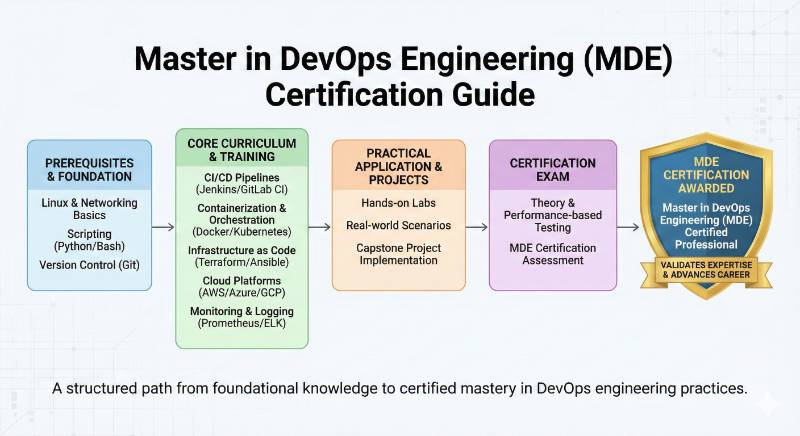
The Master in DevOps Engineering (MDE) is a top-level training program that teaches you how to handle the entire journey of a software project, from the first line of code to its final release. This certification is a game-changer because it doesn’t just teach you how to use a single tool; it teaches you the “Master Mindset” needed to build systems that are fast, secure, and reliable. Whether you are an engineer or a manager, this program gives you the expert skills to lead big projects and solve real-world problems in the global tech industry.
Detailed Breakdown: Master in DevOps Engineering (MDE)
The MDE is more than just a certificate; it is a full transformation of how you think about software.
What it is
The Master in DevOps Engineering (MDE) is a high-level certification that proves you can handle the entire software lifecycle. It isn’t just about knowing one tool like Docker or Jenkins. Instead, it teaches you how to design a system where code flows from a developer’s laptop to a global user base safely and quickly. It combines technical skills with the management logic needed to run large-scale tech teams.
- Provider: Devopsschool
Who should take it
This program is perfect for Software Engineers who want to understand the infrastructure side of things. It is also designed for Systems Administrators who want to learn to code and automate their daily tasks. If you are an Engineering Manager, this certification helps you understand the technical “bottlenecks” that slow down your team. Finally, it is for anyone who wants to reach the “Lead” or “Architect” level in their career.
Skills you’ll gain
- Advanced CI/CD Orchestration: You will learn to build pipelines that not only build code but also run thousands of tests and check for security flaws automatically.
- Infrastructure as Code (IaC): You will move away from manual setup. You’ll learn to write code (using tools like Terraform) that sets up entire data centers in minutes.
- Container Mastery: You will learn how to use Kubernetes to manage hundreds of “containers” (mini-servers) so that your app never goes down, even if a server fails.
- Deep Observability: You will learn to build “dashboards” that show you exactly what is happening inside your app in real-time, helping you fix problems before users even notice.
- Cloud Governance: You will learn how to manage cloud accounts (like AWS or Azure) so that they are secure and don’t cost the company too much money.
Real-world projects you should be able to do after it
- Build a Zero-Downtime Pipeline: Create a system where you can update an app while people are using it without a single second of “site down” time.
- Automated Security Scanning: Build a “gate” that automatically stops any code from being published if it has a security bug.
- Auto-Scaling Global Infrastructure: Design a system that automatically grows when millions of people visit your site and shrinks when they leave to save money.
- Disaster Recovery Site: Set up a system that can automatically move all your data and users to a different part of the world if a major data center fails.
Preparation plan
- The 7-14 Day “Quick Start”: This is for people who are already DevOps experts. Use this time to read the MDE documentation, review the core exam pillars, and take practice tests.
- The 30-Day “Steady Growth”: This is the best path for most working engineers. Spend 1 hour a day. Week 1 is for CI/CD, Week 2 for Containers, Week 3 for Cloud/IaC, and Week 4 for Security and Monitoring.
- The 60-Day “Deep Dive”: If you are new to some of these tools, take two months. Spend the first 30 days building small projects (like a simple Jenkins pipeline) before moving into the advanced MDE material in the second month.
Common mistakes
- Learning Tools, Not Concepts: Don’t just learn “how to click” in Jenkins. Learn why we use CI/CD. Tools change every year, but the concepts stay the same.
- Ignoring the “Dev” in DevOps: Many operations people forget to learn basic coding. You need to be comfortable with scripts to be a Master.
- Skipping Documentation: People often try to watch videos only. A true Master reads the official documentation to understand the “edge cases.”
- Forgetting Security: Many engineers build fast systems that are not safe. Security must be part of your plan from day one.
Best next certification after this
Once you have the MDE, you should specialize. If you love security, go for Certified DevSecOps Professional. If you love making things stable, go for SRE Master. If you want to move into leadership, look at FinOps or Project Management tracks.
MDE Certification Path Table
| Track | Level | Who it’s for | Prerequisites | Skills Covered | Recommended Order |
| MDE Core | Professional | Engineers/Managers | Basic IT Knowledge | CI/CD, K8s, Cloud, IaC | 1st |
| DevSecOps | Specialist | Security Enthusiasts | MDE Core | Vault, Scanning, Compliance | 2nd |
| SRE | Specialist | Ops Experts | MDE Core | SLOs, SLIs, Automation | 2nd |
| MLOps | Specialist | Data Engineers | MDE Core + Python | Model Deployment, Data Drift | 3rd |
| DataOps | Specialist | Data Architects | MDE Core | Data Pipelines, Quality | 3rd |
| FinOps | Specialist | Managers/leads | MDE Core | Cloud Cost, Budgeting | 3rd |
Choose Your Path: 6 Specialized Learning Journeys
DevOps is a huge field. After your MDE foundation, you should choose one of these six paths to become a specialist.
1. The DevOps Path
This is the “Generalist” path. It is about the flow of work. You focus on how to make developers faster and more productive. You will spend your time building tools that automate the “boring stuff” like testing and deploying code.
2. The DevSecOps Path
In my years of experience, I’ve seen companies lose everything because of a single security hole. This path is about making security “invisible.” Instead of having a security team check things at the end, you build security into the code itself.
3. The SRE (Site Reliability Engineering) Path
SRE is about “uptime.” If you hate it when websites go slow or crash, this is for you. You will learn the math of reliability—how much “downtime” is okay and how to build systems that fix themselves when they break.
4. The AIOps/MLOps Path
This is the newest frontier. It’s about using AI to manage your servers, and also about helping Data Scientists deploy their AI models. It is a perfect path for those who like the cutting edge of technology.
5. The DataOps Path
Data is the new oil, but it’s hard to move around. DataOps is about creating pipelines for data that are as fast and reliable as software pipelines. This is vital for companies that rely on Big Data.
6. The FinOps Path
As companies grow, their cloud bills become huge. FinOps is the “Business” side of DevOps. You learn how to track every dollar spent on the cloud and ensure the company is getting the best value for its money.
Role → Recommended Certifications Mapping
Use this list to see which certifications you should prioritize based on the job title you want:
- DevOps Engineer: Focus on the MDE Core. This gives you the full picture of the lifecycle.
- SRE (Site Reliability Engineer): Take MDE Core followed by the SRE Specialist track.
- Platform Engineer: Focus on MDE Core and Infrastructure as Code specialties.
- Cloud Engineer: Combine MDE Core with a professional-level certificate from AWS or Azure.
- Security Engineer: Start with MDE Core and immediately move into DevSecOps.
- Data Engineer: Take MDE Core and then the DataOps specialization.
- FinOps Practitioner: Focus on MDE Core and the Cloud Financial Management (FinOps) track.
- Engineering Manager: Complete the MDE Core and FinOps to lead both people and budgets.
Institutions for MDE Training and Certification
Choosing the right place to learn is just as important as the certificate itself. Here are the top institutions that provide help with MDE:
- DevOpsSchool: They are one of the most established names in the industry. They offer deep-dive, instructor-led training that covers the entire MDE syllabus with lots of hands-on labs and real-world scenarios.
- Cotocus: This institution is excellent for those who want a “consulting” style of learning. They focus on how to solve complex architecture problems that you would find in large multi-national companies.
- Scmgalaxy: A massive community platform that offers a huge library of tutorials and guides. It is a great place for self-learners to get extra resources and community support while preparing for the MDE.
- BestDevOps: They specialize in “Best Practices.” Their courses are great for understanding the industry standards—basically, the “right way” to do things so you don’t have to fix them later.
- DevSecOpsSchool: The premier place for security-focused DevOps. They teach you how to use advanced tools for scanning and securing cloud environments from the ground up.
- SRESchool: This is the best choice if you want to focus specifically on Site Reliability. They teach the Google-style SRE principles that keep massive websites running 24/7.
- AIOpsSchool: If you want to learn how to use Artificial Intelligence in your operations, this school provides the most modern curriculum for AIOps and MLOps.
- DataOpsSchool: They offer specialized tracks for data professionals who want to bring the speed and automation of DevOps to their data engineering and analytics teams.
- FinOpsSchool: The go-to place for learning cloud cost management. They bridge the gap between engineering, finance, and business leadership.
Next Certifications to Take
After you finish your MDE, where should you go? Here are three distinct directions:
- Stay on the Same Track (Vertical): Take the “Expert” or “Lead” versions of your current tools. For example, if you mastered Kubernetes in MDE, go for the “Certified Kubernetes Security Specialist.”
- Cross-Track (Horizontal): If you are a master of DevOps, go learn DevSecOps. Being “multi-lingual” in different areas of the lifecycle makes you very valuable.
- Leadership Track: If you want to stop writing code and start leading people, take a FinOps certification or a Leadership in Engineering course.
General FAQs for DevOps Career
1. How difficult is it to become a DevOps Master?
It is challenging but rewarding. If you have a background in IT, it is about connecting the dots. It takes effort, but it is one of the most stable career paths today.
2. How long does it take to get certified?
Usually, 30 to 60 days of consistent study is enough for a working professional to pass the MDE.
3. Do I need to be a coding genius?
No. You need to understand “logic” and be able to write basic scripts. You are building the “road” for the code, not necessarily writing the “car.”
4. What is the best sequence to learn?
Always start with the basics of Linux and Cloud. Then move to the MDE Core. Once you have the big picture, pick a specialty.
5. Is the MDE valuable in the global market?
Yes. Companies in the US, Europe, and India all use the same tools. The MDE follows global standards, so your skills will work anywhere.
6. Are there prerequisites?
It helps to have 2-3 years of experience in IT, but anyone with a strong desire to learn the modern software lifecycle can start.
7. How much time should I study every day?
1 to 2 hours of focused study is better than a 10-hour marathon once a week. Consistency helps your brain remember the complex parts.
8. Why MDE instead of a tool certificate (like AWS)?
An AWS cert says you know AWS. An MDE says you know how to build a whole business system using any cloud and any tool. It is a much higher level of thinking.
9. Can I transition from a non-tech role to MDE?
It is possible, but you should start with basic “IT Fundamentals” first. The MDE is a professional-level program.
10. Do these certifications expire?
Most professional certs stay valid for 2-3 years. This is because the technology moves so fast that you need to stay updated.
11. What kind of salary can I expect?
In India and globally, DevOps Masters are among the highest-paid engineering roles, often earning significantly more than standard developers.
12. Does MDE cover “Soft Skills”?
Yes. A big part of the MDE is learning how to get different teams (like Dev and Ops) to work together without fighting.
FAQs Specific to MDE (Master in DevOps Engineering)
1. What makes MDE better than other programs?
MDE focuses on “The Master Mindset.” It teaches you how to design systems from scratch, not just how to fix a single error.
2. Is there a lot of hands-on work in MDE?
Yes. The program is built around labs. You will build real pipelines and real clusters as part of your learning.
3. Does MDE help with remote job opportunities?
Absolutely. DevOps is one of the best roles for remote work because you manage everything through code and the cloud.
4. Who provides the MDE certification?
It is provided by DevOpsSchool, which is a globally recognized training and certification body.
5. Is the MDE exam based on theory or practice?
It is a mix, but it leans heavily toward practical scenarios—asking you how you would solve a specific real-world problem.
6. Can I get a refund if I don’t like the course?
You should check the specific policy of the training provider you choose (like DevOpsSchool or Cotocus).
7. Does MDE cover AI tools?
Yes, the modern MDE curriculum includes how to use AI to improve your automation and monitoring.
8. Is there a community for MDE students?
Yes, there are large forums and groups on sites like Scmgalaxy where you can ask questions and network with other Masters.
Conclusion
Becoming a Master in DevOps Engineering (MDE) is about more than just passing an exam; it is about changing your entire approach to technology. The most successful professionals are those who master the full lifecycle of a project, from the first line of code to the final release. This program gives you the confidence to lead teams, build secure systems, and solve complex problems with ease. If you are ready to move from being a worker to being an architect of the future, this certification is the best step you can take to reach the top of your field.
