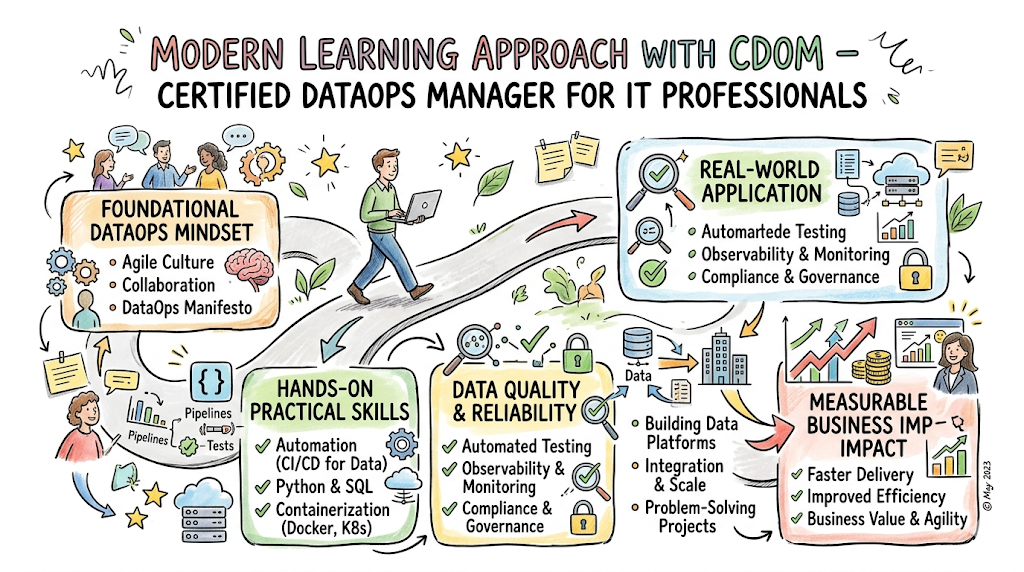
The CDOM – Certified DataOps Manager is a specialized credential designed for professionals who want to bridge the gap between data engineering and operational excellence. This guide is written for engineers, architects, and managers who recognize that data is the backbone of modern enterprise but often lacks the structured operational rigor found in software engineering. As organizations scale their data platforms, the need for a standardized approach to data delivery becomes critical for maintaining speed and quality. This roadmap helps you navigate the complexities of data pipelines, quality control, and team management within the broader context of DevOps and platform engineering. By following this guide, you will gain the clarity needed to decide if this path aligns with your long-term career goals in the evolving cloud-native landscape. You can explore the full curriculum at DataOpsSchool which is the primary platform for this program. Mastery of these concepts is essential for anyone looking to lead data-driven transformations in high-growth environments through the resources provided by DataOpsSchool.
What is the CDOM – Certified DataOps Manager?
The CDOM – Certified DataOps Manager represents a formal validation of a professional’s ability to manage the end-to-end data lifecycle using Agile and DevOps principles. It exists because traditional data management often suffers from silos, manual handoffs, and a lack of automated testing, leading to data debt and broken pipelines. This certification emphasizes real-world, production-focused learning, moving beyond basic SQL or Python scripting into the realm of automated orchestration and monitoring.
It aligns perfectly with modern engineering workflows by treating data as code and infrastructure as a dynamic environment. Enterprise practices now demand that data operations are as reliable as application deployments, and this program provides the framework to achieve that standard. By focusing on the “manager” aspect, it prepares individuals to oversee the cultural and technical shifts necessary for high-velocity data delivery.
Who Should Pursue CDOM – Certified DataOps Manager?
This certification is highly beneficial for data engineers, site reliability engineers (SREs), and cloud professionals who are tasked with maintaining high-availability data platforms. Security and data privacy roles also find significant value here, as DataOps includes critical components of governance and compliance within the pipeline. Beginners looking to enter the data field with a management mindset will find a structured path, while experienced engineers can use it to formalize their transition into leadership.
Engineering managers and technical leaders use the CDOM framework to build and scale high-performing data teams across diverse industries. In both the Indian market and the global tech landscape, professionals who can prove they understand the operational side of data are increasingly prioritized during hiring and internal promotions. It is the ideal path for anyone responsible for the “production” side of data analytics and AI.
Why CDOM – Certified DataOps Manager is Valuable and Beyond
The demand for DataOps expertise is skyrocketing as enterprises realize that moving data to the cloud is only half the battle; managing it efficiently is the real challenge. CDOM provides long-term career longevity by focusing on principles and patterns that remain relevant even as specific tools like Spark, Snowflake, or Airflow evolve. Enterprise adoption of DataOps is no longer optional for companies aiming for AI and machine learning maturity.
This certification helps professionals stay relevant by teaching them how to build resilient systems that can adapt to changing business requirements and technical debt. Ultimately, the return on time and career investment is significant, as it positions you as a leader in a niche but rapidly expanding domain of technical management. It ensures you are not just a tool-user, but a strategic architect of data value chains.
CDOM – Certified DataOps Manager Certification Overview
The certification program is delivered via the official portal and is hosted on the main DataOpsSchool platform. It is structured into distinct certification levels that cater to different stages of professional growth, from individual contributors to strategic managers. The assessment approach is practical, often involving case studies or scenario-based questions that mirror the challenges faced in a production environment.
The ownership of the program lies with industry experts who have distilled years of enterprise data management experience into a cohesive curriculum. This structure ensures that candidates do not just memorize definitions but actually understand how to implement DataOps strategies in complex, multi-cloud organizations. It provides a standardized language for data quality, cycle time, and team collaboration.
CDOM – Certified DataOps Manager Certification Tracks & Levels
The CDOM – Certified DataOps Manager program is divided into foundation, professional, and advanced levels to ensure a logical progression of skills. The foundation level focuses on the core philosophy of DataOps, including version control for data and basic pipeline automation. The professional level dives deeper into orchestration, data quality monitoring, and cross-functional team collaboration.
Advanced levels are designed for those moving into executive or principal roles, focusing on strategy, cost optimization, and organizational change management. These levels align directly with career progression, allowing a junior engineer to eventually become a Head of Data Operations by following the prescribed learning path. Each track is designed to build upon the technical foundations of the previous one while adding layers of strategic oversight.
Complete CDOM – Certified DataOps Manager Certification Table
| Track | Level | Who it’s for | Prerequisites | Skills Covered | Recommended Order |
| Core DataOps | Foundation | Associate Engineers | Basic SQL/Cloud | Data Pipelines, Versioning | First |
| Management | Professional | Senior Engineers/Leads | 3+ Years Experience | Orchestration, Quality | Second |
| Strategy | Advanced | Architects/Managers | Professional Level | Scaling, Governance, ROI | Third |
| Specialty | Security | DevSecOps Engineers | Foundation Level | Data Masking, Compliance | Optional |
| Specialty | Performance | Performance Engineers | Foundation Level | Tuning, Resource Mgmt | Optional |
Detailed Guide for Each CDOM – Certified DataOps Manager Certification
CDOM – Certified DataOps Manager – Foundation Level
What it is
This certification validates a candidate’s understanding of the basic principles of DataOps, focusing on the integration of data engineering and IT operations. It ensures that the professional can speak the language of DataOps and understands the importance of automated workflows.
Who should take it
This is suitable for junior data engineers, system administrators, or recent graduates who want to build a career in data operations. It is also ideal for project managers who need to understand the technical constraints of data teams.
Skills you’ll gain
- Understanding the DataOps Manifesto and core values.
- Basic knowledge of data versioning and environment management.
- Ability to identify bottlenecks in manual data delivery processes.
- Familiarity with CI/CD concepts applied specifically to data pipelines.
Real-world projects you should be able to do
- Create a basic automated data ingestion pipeline using open-source tools.
- Implement version control for a small-scale data warehouse schema.
- Document a data workflow from source to consumption for a business team.
Preparation plan
Explain 7–14 days for theory, 30 days for labs, and 60 days for deep dive strategies.
Common mistakes
Focusing too much on specific tool syntax rather than the underlying principles of flow and quality.
Best next certification after this
- Same-track option: CDOM Professional
- Cross-track option: DevOps Associate
- Leadership option: Project Management
CDOM – Certified DataOps Manager – Professional Level
What it is
The Professional level validates the ability to design and implement complex DataOps frameworks that support multiple stakeholders. It focuses on the “Manager” aspect of the title, emphasizing coordination, monitoring, and problem-solving in production.
Who should take it
This is designed for senior engineers and team leads who are responsible for the reliability and scalability of data platforms. Candidates should have a few years of hands-on experience in data engineering or cloud operations.
Skills you’ll gain
- Advanced orchestration of multi-stage data pipelines.
- Implementation of automated data quality checks and circuit breakers.
- Management of Data as Code environments across development and production.
- Monitoring and observability for data health and pipeline performance.
Real-world projects you should be able to do
- Design a self-healing data pipeline that alerts and reroutes upon failure.
- Implement an automated testing suite for data transformations.
- Establish a multi-tenant data platform with strict access controls.
Preparation plan
Explain 7–14 days for audit, 30 days for project build, and 60 days for advanced architecture.
Common mistakes
Over-engineering the automation before understanding the manual process thoroughly.
Best next certification after this
- Same-track option: CDOM Advanced
- Cross-track option: SRE Professional
- Leadership option: Engineering Manager Certification
CDOM – Certified DataOps Manager – Advanced Level
What it is
The Advanced level is the pinnacle of the CDOM program, validating a professional’s ability to drive organizational-wide DataOps strategy. It covers high-level topics like financial management of data, long-term architectural planning, and team leadership.
Who should take it
This is meant for principal engineers, data architects, and high-level managers who have the authority to change company culture and technical standards. It requires a deep understanding of both technology and business ROI.
Skills you’ll gain
- Strategic planning for data infrastructure and platform scaling.
- Financial operations for data, focusing on cloud cost optimization.
- Leadership skills to foster collaboration between data and business units.
- Governance and compliance management at an enterprise scale.
Real-world projects you should be able to do
- Develop a three-year roadmap for an organization’s transition to a full DataOps model.
- Conduct a cost-benefit analysis of different data storage technologies.
- Implement a global data governance framework across multiple regions.
Preparation plan
Explain 7–14 days for case studies, 30 days for strategy drafting, and 60 days for peer reviews.
Common mistakes
Losing sight of the technical details while focusing only on management and strategy.
Best next certification after this
- Same-track option: Industry Specialized Certs
- Cross-track option: CTO Program
- Leadership option: Executive MBA
Choose Your Learning Path
DevOps Path
Professionals on this path focus on integrating data pipelines into existing application CI/CD flows. You will learn how to treat data migrations and schema changes with the same rigor as code deployments. This path is essential for organizations where the application and data teams are tightly coupled. It ensures that data is never a bottleneck for software release cycles.
DevSecOps Path
The security-focused path emphasizes the “Shift Left” approach for data privacy and compliance. You will learn how to automate data masking, encryption, and access control within the DataOps pipeline. This is critical for industries like finance and healthcare where data security is a top priority. Professionals here ensure that data is not only fast and accurate but also safe and compliant.
SRE Path
The Site Reliability Engineering path focuses on the uptime and performance of data platforms. You will apply SRE principles like Service Level Objectives (SLOs) and Error Budgets to data pipelines. This ensures that data consumers can rely on the consistency and availability of the information they receive. It bridges the gap between infrastructure stability and data flow reliability.
AIOps Path
This path uses artificial intelligence and machine learning to improve the operations of the data platform itself. You will learn how to use predictive analytics to identify pipeline failures before they happen. This path is for those who want to automate the automation, making the DataOps framework smarter and more self-sufficient. It focuses on the operational health of the systems.
MLOps Path
The Machine Learning Operations path focuses specifically on the lifecycle of ML models and the data that feeds them. You will learn how to manage feature stores, model versioning, and the retraining of models based on fresh data. This is a specialized subset of DataOps that is essential for any company deploying production-grade AI. It ensures training data is always high-quality.
DataOps Path
This is the core path for those who want to specialize entirely in the management of data flows. You will become an expert in orchestration, data quality, and team collaboration across the data lifecycle. This path covers everything from ingestion to consumption, focusing on reducing the time from data arrival to business insight. It is the definitive route for becoming a dedicated DataOps Manager.
FinOps Path
The Financial Operations path focuses on the cost of running data platforms in the cloud. You will learn how to track data spending, optimize resource usage, and provide clear ROI for data initiatives. As cloud costs continue to rise, this skill set is becoming invaluable for managers who need to justify their budgets. It combines technical knowledge with financial accountability.
Role → Recommended CDOM – Certified DataOps Manager Certifications
| Role | Recommended Certifications |
| DevOps Engineer | CDOM Foundation, DevOps Professional |
| SRE | CDOM Professional, SRE Professional |
| Platform Engineer | CDOM Professional, Cloud Infrastructure Expert |
| Cloud Engineer | CDOM Foundation, Cloud Architect |
| Security Engineer | CDOM Security specialty, DevSecOps Expert |
| Data Engineer | CDOM Professional, Data Engineering Specialist |
| FinOps Practitioner | CDOM FinOps Path, Cost Management |
| Engineering Manager | CDOM Advanced, Leadership & Management |
Next Certifications to Take After CDOM – Certified DataOps Manager
Same Track Progression
Once you have mastered the CDOM – Certified DataOps Manager levels, you should look toward deep specialization in specific data technologies. This might include becoming an expert in high-scale data streaming platforms or distributed database management. The goal is to move from a general manager to a subject matter expert in a specific operational domain of data. Staying within the track allows you to become the go-to authority for complex data architectural decisions.
Cross-Track Expansion
To broaden your skill set, consider certifications in related fields like DevSecOps or SRE. Understanding how data security and system reliability intersect with DataOps will make you a much more versatile professional. This cross-pollination of skills is highly valued in startup environments where engineers often wear multiple hats. Expanding your knowledge base ensures you can lead multi-disciplinary teams effectively and solve complex, overlapping technical issues.
Leadership & Management Track
For those aiming for the C-suite, the next step after the advanced CDOM level is formal leadership training. This could involve an executive education program or a certification specifically focused on the Chief Data Officer role. You will shift your focus from managing pipelines to managing people, budgets, and business strategy. This track is for those who want to define the future of how their organization uses data at the highest level.
Training & Certification Support Providers for CDOM – Certified DataOps Manager
DevOpsSchool is a premier institution that provides comprehensive training across the entire spectrum of software development and operations. Their curriculum is designed by industry veterans who understand the nuances of modern engineering workflows and the importance of automation. They offer extensive resources for the CDOM – Certified DataOps Manager certification, including hands-on labs and real-world project scenarios. The school is known for its practical approach, ensuring that students can apply what they learn immediately in their professional roles. With a global presence, they cater to a wide range of professionals looking to upskill. Their support system and community engagement make them a top choice for aspiring managers.
Cotocus offers a unique blend of technical training and consulting services, making them an ideal partner for professionals seeking the CDOM – Certified DataOps Manager credential. They focus on delivering high-quality education that is grounded in actual industry challenges and solutions. Their training modules are updated regularly to reflect the latest trends in data management and cloud operations. Cotocus provides personalized mentorship, helping candidates navigate the complexities of the certification process with confidence. Their commitment to student success is evident in their high pass rates and the professional growth of their alumni. By choosing this provider, you gain access to a wealth of knowledge spanning cloud-native technologies.
Scmgalaxy is a well-established platform that serves as a hub for SCM, DevOps, and DataOps knowledge. They provide a vast library of tutorials, articles, and training programs specifically tailored for the CDOM – Certified DataOps Manager certification. Their approach is highly community-driven, encouraging learners to share experiences and solve problems collectively. Scmgalaxy is particularly known for its focus on open-source tools and their integration into enterprise workflows. Their training sessions are designed to be interactive and engaging, moving beyond theory into practical implementation. Professionals who use their services benefit from a deep well of technical resources and a supportive network of peers worldwide.
BestDevOps focuses on providing career-oriented training that helps professionals secure top-tier roles in the tech industry. Their support for the CDOM – Certified DataOps Manager certification includes detailed study guides, mock exams, and career coaching. They emphasize the importance of building a strong portfolio of projects to showcase technical expertise to potential employers. BestDevOps has a reputation for delivering concise and effective training that respects the busy schedules of working professionals. Their instructors are experts who bring years of field experience into the classroom, offering insights that you won’t find in textbooks. For those looking for advancement, this provider offers necessary tools.
Devsecopsschool specializes in the intersection of development, security, and operations, providing a critical perspective for DataOps professionals. Their training for the CDOM – Certified DataOps Manager certification highlights the security aspect of data pipelines, ensuring that safety is built-in from the start. They offer specialized courses that cover data privacy, compliance automation, and secure infrastructure management. Their approach is essential for anyone working in regulated industries where data integrity and security are non-negotiable. Devsecopsschool provides a rigorous curriculum that prepares candidates for the technical and ethical challenges of modern data management. Their graduates are well-equipped to lead secure and efficient initiatives.
Sreschool brings the principles of Site Reliability Engineering to the world of DataOps training. Their support for the CDOM – Certified DataOps Manager certification focuses on platform stability, scalability, and performance monitoring. They teach students how to apply SRE methodologies like SLIs and SLOs to data delivery, ensuring high availability and reliability. The school’s curriculum is highly technical, catering to engineers who want to master the operational side of data infrastructure. Sreschool provides access to sophisticated lab environments where students can practice managing large-scale systems. Their focus on reliability makes them a standout provider for those who want production-ready data operations.
Aiopsschool is at the forefront of the artificial intelligence operations movement, providing specialized training for the next generation of data managers. Their support for the CDOM – Certified DataOps Manager certification includes modules on how to use AI to automate and optimize data workflows. They explore advanced topics like predictive maintenance for pipelines and automated anomaly detection in data sets. The school’s mission is to empower professionals to lead the transition toward self-healing and intelligent data platforms. Their training is ideal for those who want to stay ahead of the curve in AI-driven operations. Aiopsschool offers a forward-thinking curriculum that prepares students for the future.
Dataopsschool is the primary provider for the CDOM – Certified DataOps Manager certification, offering the most direct and comprehensive learning path. They are dedicated solely to the discipline of DataOps, ensuring that their curriculum is deep, focused, and authoritative. Their programs are designed to take a professional from the foundation level all the way to advanced strategic management. Dataopsschool provides a rich ecosystem of learning materials, including interactive labs, peer discussion groups, and expert-led webinars. Their certification is recognized globally as a standard of excellence. By learning directly from the source, candidates ensure they are getting the most accurate information available.
Finopsschool addresses the critical need for financial accountability in the cloud and data operations space. Their training for the CDOM – Certified DataOps Manager certification includes essential modules on cloud cost management and resource optimization. They teach data managers how to bridge the gap between technical operations and financial reporting. This skill set is increasingly vital as organizations look to scale their data initiatives without blowing their budgets. Finopsschool provides practical tools and frameworks for tracking spend and maximizing the ROI of data infrastructure. Their curriculum is designed for professionals who want to add a strategic financial layer to their technical expertise.
Frequently Asked Questions (General)
- How should an organization evaluate the ROI of a CDOM certified manager?A strategic leader evaluates ROI by measuring the reduction in “Data Downtime” and the acceleration of the “Mean Time to Insight.” If a certified manager can decrease pipeline failures by 30% while doubling the speed of data delivery to business units, the certification pays for itself within the first quarter of implementation.
- What is the primary technical hurdle for most CDOM candidates?Most candidates struggle with the transition from “Static Data Management” to “Data as Code.” This requires a shift in mindset from manual database administration to automated, version-controlled infrastructure where every change is tested and audited through a CI/CD pipeline.
- How much time is required to prepare for the professional level?For a senior professional, 30 to 45 days is standard. This time should be split 40/60 between theoretical framework study and practical lab execution, focusing on orchestration tools and monitoring dashboards that provide visibility into pipeline health.
- Are there any prerequisites for the foundation level?While there are no strict mandates, a strategic decision-maker would recommend that candidates have a basic understanding of cloud architecture and SQL. This foundational knowledge ensures that the DataOps principles are applied to a relevant technical context.
- Is the exam format more theoretical or practical?The exam is designed to test decision-making under pressure. It uses scenario-based questions that ask how to handle pipeline failures or data quality drops in a production environment, mirroring the real-world responsibilities of a manager.
- How does this certification align with global hiring trends?Enterprises are moving away from hiring “Data Engineers” and toward “Data Platform Engineers” who understand operations. CDOM signals to the market that you possess the management and operational skills necessary to run a modern, automated data factory.
- Can the CDOM framework be applied to legacy on-premise systems?Yes. While cloud-native is the focus, the core principles of automation, monitoring, and collaboration are platform-agnostic. A strategic manager can use these principles to bring operational rigor to legacy Hadoop or SQL Server environments.
- What is the validity period of the certification?The certification is valid for two years. To maintain it, managers must demonstrate continuous learning or participate in industry projects, ensuring they stay current with the rapidly evolving DataOps and AI landscape.
- Does the certification cover team management and culture?Absolutely. A significant portion of the curriculum is dedicated to breaking down silos between data scientists and IT operations. It provides the “soft skill” frameworks necessary to drive cultural change in traditional organizations.
- How does CDOM handle data security and compliance?It integrates security into the pipeline as an automated step. Managers learn how to implement “Compliance as Code,” ensuring that every piece of data moving through the system meets regulatory standards without slowing down delivery.
- Which tools are most important for the practical labs?While the concepts are vendor-neutral, mastery of tools like Airflow for orchestration, dbt for transformation, and Prometheus for monitoring is highly recommended to pass the practical assessments.
- Is it better to take the DataOps or MLOps path first?From a strategic perspective, DataOps is the foundation. You cannot have successful MLOps without a reliable, high-quality data pipeline. Start with CDOM to build the platform, then specialize in ML lifecycle management.
FAQs on CDOM – Certified DataOps Manager
- How does CDOM address the “Data Debt” problem in large enterprises?A CDOM certified manager addresses data debt by implementing automated testing and versioning at the source. By treating data changes with the same rigor as software releases, they prevent the accumulation of “quick fixes” that lead to long-term system fragility.
- What role does cost optimization play in the CDOM curriculum?Cost management is treated as a core operational metric. Managers are trained to build “Cost-Aware Pipelines” that can automatically scale down resources or alert the team when cloud consumption exceeds predefined thresholds.
- How does DataOps improve the collaboration between Data Scientists and Engineers?It provides a shared environment and a common set of tools. By automating the handoff process, it allows Data Scientists to focus on models while Engineers focus on the robustness of the data delivery system, reducing friction.
- Is there a focus on specific industry regulations like GDPR?Yes. The framework includes strategic guidance on building “Privacy-First” pipelines. It teaches managers how to automate data masking and auditing so that compliance becomes a byproduct of the operational process.
- What is the significance of the “Manager” title in this certification?It signifies that the professional is capable of high-level architectural decision-making and team leadership. It moves beyond the role of a “task-doer” and into the role of a “strategy-driver” for the organization’s data assets.
- How does CDOM handle multi-cloud data strategies?The curriculum focuses on building portable pipelines that can run across different cloud providers. This prevents vendor lock-in and allows the organization to leverage the best services from AWS, Azure, and GCP simultaneously.
- What is the impact of DataOps on the “Time to Market” for AI products?By automating the ingestion and cleaning phases, DataOps significantly reduces the time it takes to get high-quality data into the hands of AI models. This allows organizations to ship AI-driven features much faster than their competitors.
- How does the certification prepare you for handling “Data Quality” at scale?It teaches the implementation of “Data Observability.” This involves monitoring not just the pipeline’s health, but the health of the data itself, identifying anomalies or drift before they impact the business decision-making process.
Final Thoughts: Is CDOM – Certified DataOps Manager Worth It?
As someone who has seen the evolution of data management over the years, I can tell you that the “wild west” era of manual data pipelines is ending. Organizations are no longer satisfied with data that is good enough or delivery cycles that take weeks. They demand the same speed and reliability for their data as they do for their software. This is where the CDOM – Certified DataOps Manager comes into play. It is a rigorous, practical, and highly relevant credential that prepares you for the realities of modern enterprise data.
It is not a magic bullet that will transform your career overnight, but it is a powerful tool in your professional arsenal. If you are willing to put in the work to master the principles of flow, quality, and collaboration, this certification will provide a clear path to leadership. It moves you from being a technical implementer to a strategic asset. In an era where data is the most valuable resource, being the one who knows how to manage its delivery is the ultimate competitive advantage.
