Introduction
Emergency Services Records Management tools help police departments, fire services, EMS providers, dispatch centers, and public safety agencies manage incident reports, case files, call records, evidence details, personnel activity, citations, inspections, and operational documentation in one secure system. In simple terms, these tools help emergency service teams record what happened, who responded, what actions were taken, and what follow-up is required.
These systems are important because public safety teams handle sensitive, high-volume, time-critical information. Manual records, spreadsheets, and disconnected databases can create reporting delays, duplicate data, compliance gaps, and poor coordination between departments. A strong RMS improves accuracy, accountability, field reporting, investigation workflows, and data visibility.
Real-world use cases include police incident reporting, EMS patient care documentation, fire incident records, traffic citations, investigation case management, property and evidence tracking, inspection records, and multi-agency reporting.
Evaluation Criteria for Buyers:
- CAD and dispatch integration
- Mobile field reporting
- Incident and case management depth
- Evidence and property tracking
- Role-based access and audit logs
- Reporting and analytics
- Cloud, on-premise, or hybrid deployment
- Compliance and data security controls
- Ease of staff training
- Multi-agency interoperability
Best for: Police departments, fire departments, EMS agencies, dispatch centers, public safety offices, municipal agencies, regional authorities, and multi-jurisdiction emergency service teams that need secure and structured records management.
Not ideal for: Very small volunteer groups or organizations that only need simple activity logs and do not require advanced compliance, incident reporting, evidence tracking, or CAD integration.
Key Trends in Emergency Services Records Management Tools
- Cloud-first public safety systems: Agencies are increasingly adopting cloud-based RMS platforms to improve accessibility, disaster recovery, and centralized data management.
- Mobile field reporting: Officers, firefighters, and EMS teams need secure mobile access to create and update records directly from the field.
- CAD and RMS convergence: Stronger integration between dispatch and records systems helps reduce duplicate entry and improves incident continuity.
- Digital evidence connectivity: RMS platforms are increasingly connecting with body camera, CCTV, audio, photo, document, and evidence management systems.
- Data analytics for command decisions: Public safety leaders want dashboards for incident trends, response patterns, workload, case status, and resource planning.
- Interoperability across agencies: Multi-jurisdiction collaboration is becoming more important for regional emergency response and shared records.
- Automated workflows: Approval routing, report validation, task assignments, and follow-up reminders reduce administrative workload.
- Security and privacy controls: Encryption, audit trails, user permissions, and access monitoring are now essential due to the sensitive nature of public safety data.
- GIS and location intelligence: Mapping tools help agencies visualize incidents, hotspots, patrol areas, fire risk zones, and response coverage.
- User-friendly reporting: Agencies want systems that reduce paperwork and help field teams complete reports faster with fewer errors.
How We Selected These Tools
- Market relevance: Tools commonly used or recognized in public safety, law enforcement, fire, EMS, and municipal agency environments were prioritized.
- Feature completeness: Each platform was reviewed for incident reporting, case management, CAD integration, evidence support, mobile access, and analytics.
- Operational reliability: Tools suitable for mission-critical public safety workflows were considered stronger.
- Security posture: Role-based access, encryption, audit logs, and sensitive data protection were considered where publicly or commonly known.
- Integration ecosystem: CAD, GIS, mobile data, evidence management, court systems, and reporting integrations were evaluated.
- Agency fit: The list includes solutions for police, fire, EMS, dispatch centers, and multi-agency environments.
- Scalability: Platforms that can support small agencies, regional departments, and larger public safety organizations were prioritized.
- Support and implementation readiness: Vendor support, onboarding, training, and long-term system administration needs were considered.
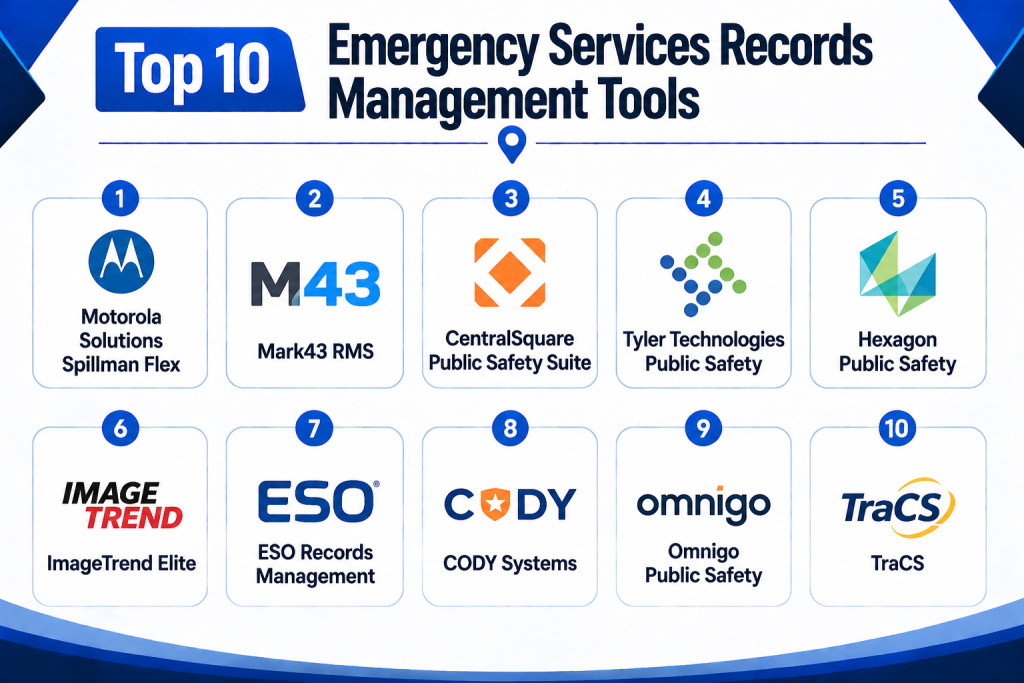
Top 10 Emergency Services Records Management Tools
1- Motorola Solutions Spillman Flex
Short Description:
Motorola Solutions Spillman Flex is a public safety RMS platform designed for law enforcement, fire, EMS, and dispatch environments. It supports incident reporting, case management, CAD integration, field access, property records, and agency-wide data sharing. The platform is especially useful for departments that need an integrated public safety ecosystem instead of disconnected tools. Spillman Flex is often considered by agencies that want dispatch, records, jail, mobile, and analytics workflows to connect more smoothly. It can support small, mid-sized, and larger agencies depending on modules and deployment needs. For public safety teams focused on operational continuity, it offers a strong records management foundation.
Key Features
- Incident and case reporting
- CAD and dispatch integration
- Mobile field reporting support
- Property and evidence tracking
- Agency-wide search and records access
- Workflow and approval routing
- Public safety analytics and reporting
Pros
- Strong fit for integrated public safety environments
- Useful for police, fire, EMS, and dispatch workflows
- Supports connected records and operational visibility
Cons
- Implementation may require planning and training
- Advanced modules may increase total cost
- Smaller agencies may not need the full feature depth
Platforms / Deployment
Web / Windows / iOS / Android
Cloud / On-premise / Hybrid options may vary
Security & Compliance
Role-based access, audit logs, and secure records management features are commonly expected in public safety deployments. Specific certifications should be verified directly with the vendor.
SOC 2 / ISO 27001 / HIPAA: Not publicly stated.
Integrations & Ecosystem
Spillman Flex fits into a broader Motorola public safety ecosystem and can connect records, dispatch, mobile, jail, evidence, and reporting workflows.
- CAD systems
- Mobile data systems
- Evidence and property workflows
- Jail management systems
- GIS and mapping tools
- Reporting and analytics dashboards
Support & Community
Motorola Solutions provides public safety implementation support, training resources, documentation, and customer service. Agencies should evaluate onboarding scope, migration support, and long-term administration needs.
2- Mark43 RMS
Short Description:
Mark43 RMS is a cloud-native records management platform designed for modern law enforcement agencies. It focuses on incident reporting, case management, field reporting, evidence workflows, analytics, and easier user experience for officers and administrators. The platform is especially useful for agencies moving away from older legacy systems and looking for cleaner workflows. Mark43 emphasizes cloud accessibility, structured data, and faster report completion. It is a strong option for police departments that want modern records management with mobile-friendly capabilities. Agencies seeking improved usability and reporting visibility may find Mark43 especially relevant.
Key Features
- Cloud-native incident reporting
- Case and investigation management
- Mobile-friendly field reporting
- Evidence and property workflow support
- Analytics and command dashboards
- CAD integration support
- Configurable workflows and permissions
Pros
- Modern interface for officer adoption
- Strong cloud-based accessibility
- Useful analytics and reporting structure
Cons
- May be costly for smaller agencies
- Migration from legacy systems requires planning
- Best suited for agencies ready for cloud transformation
Platforms / Deployment
Web / iOS / Android
Cloud
Security & Compliance
Mark43 supports enterprise-grade public safety security controls, including permissions and auditability. Specific certifications should be verified directly with the vendor.
SOC 2 / ISO 27001 / HIPAA: Not publicly stated.
Integrations & Ecosystem
Mark43 can integrate with CAD, analytics, evidence, reporting, and public safety data workflows. It is especially useful for agencies building a modern digital public safety stack.
- CAD systems
- Digital evidence workflows
- Mobile data systems
- Reporting tools
- GIS and mapping
- Public safety analytics
Support & Community
Mark43 provides implementation services, training, and customer support for public safety agencies. Buyers should validate data migration, user training, and change management support.
3- CentralSquare Public Safety Suite
Short Description:
CentralSquare Public Safety Suite includes RMS capabilities for law enforcement, fire, EMS, dispatch, and local government public safety operations. It supports incident reporting, CAD integration, mobile access, case management, analytics, and multi-agency collaboration. The platform is useful for agencies that want a connected public safety system across multiple departments. CentralSquare is often considered by municipalities and public safety organizations that need broader operational coverage. It can help reduce duplicate data entry and improve reporting visibility. For agencies seeking connected public safety and local government workflows, CentralSquare is a strong candidate.
Key Features
- Law enforcement RMS
- Fire and EMS records support
- CAD integration
- Mobile field reporting
- Case and incident management
- Analytics and dashboards
- Multi-agency data sharing
Pros
- Broad public safety coverage
- Strong fit for municipalities and regional agencies
- Supports CAD, RMS, and mobile workflows
Cons
- Configuration may require careful planning
- Some agencies may need vendor-led implementation
- Advanced use cases can increase complexity
Platforms / Deployment
Web / Windows / iOS / Android
Cloud / On-premise / Hybrid options may vary
Security & Compliance
CentralSquare supports public safety access controls and secure records workflows. Specific certifications and compliance claims should be verified directly with the vendor.
SOC 2 / ISO 27001 / HIPAA: Not publicly stated.
Integrations & Ecosystem
CentralSquare connects public safety, dispatch, mobile, reporting, and local government workflows. It is practical for agencies wanting one ecosystem across departments.
- CAD systems
- Mobile field applications
- GIS and mapping
- Reporting dashboards
- Evidence workflows
- Local government systems
Support & Community
CentralSquare provides implementation, training, and support services. Agencies should review migration planning, support tiers, and admin training before deployment.
4- Tyler Technologies Public Safety
Short Description:
Tyler Technologies provides public safety software that supports records management, dispatch, mobile reporting, jail management, court connectivity, and municipal workflows. Its RMS capabilities are useful for law enforcement and public safety agencies that need records connected with broader government operations. Tyler is especially relevant for municipalities that already use Tyler systems for courts, finance, or local government operations. The platform can help agencies manage incidents, reports, citations, cases, and operational records. It is a good fit for departments that want RMS data to connect with justice and civic systems. For public sector organizations, Tyler offers a broad ecosystem.
Key Features
- Public safety records management
- Incident and case reporting
- CAD and dispatch integration
- Mobile reporting support
- Court and justice system connectivity
- Reporting and audit trails
- Configurable agency workflows
Pros
- Strong fit for municipal public safety agencies
- Useful connection with broader government systems
- Supports structured reporting and justice workflows
Cons
- Implementation may require vendor support
- Some modules may be complex for smaller agencies
- System fit depends on existing Tyler ecosystem usage
Platforms / Deployment
Web / Windows / iOS / Android
Cloud / On-premise / Hybrid options may vary
Security & Compliance
Tyler public sector systems commonly include permissions, access controls, and audit trails. Specific certifications should be confirmed directly with the vendor.
SOC 2 / ISO 27001 / HIPAA: Not publicly stated.
Integrations & Ecosystem
Tyler’s ecosystem can connect public safety records with courts, finance, municipal systems, dispatch, mobile, and reporting tools.
- CAD systems
- Court management systems
- Mobile data systems
- Municipal databases
- Reporting dashboards
- Justice workflows
Support & Community
Tyler provides onboarding, documentation, training, and public sector support resources. Agencies should confirm implementation timeline, migration services, and long-term support model.
5- Hexagon Public Safety
Short Description:
Hexagon Public Safety provides software for emergency response, dispatch, records, analytics, and public safety operations. Its RMS-related capabilities are useful for agencies that need strong interoperability, geospatial intelligence, and command-level visibility. Hexagon is especially relevant for larger agencies, control rooms, regional public safety operations, and organizations that need CAD, RMS, and GIS-supported workflows. It can support incident records, operational reporting, mobile access, and multi-agency coordination. The platform is best suited for agencies that want advanced operational control and situational awareness. It may be more complex than smaller RMS tools but can be powerful for enterprise environments.
Key Features
- Incident and operational records support
- CAD and emergency response integration
- Mobile data workflows
- GIS and location intelligence
- Multi-agency collaboration
- Analytics and operational dashboards
- Secure public safety data workflows
Pros
- Strong geospatial and public safety operations focus
- Suitable for larger and multi-agency environments
- Supports command-level situational awareness
Cons
- Can require significant implementation planning
- May be too advanced for very small agencies
- Configuration and training needs may be high
Platforms / Deployment
Web / Windows / iOS / Android options may vary
Cloud / On-premise / Hybrid
Security & Compliance
Hexagon public safety systems are designed for secure government and emergency operations. Specific certifications should be verified directly with the vendor.
SOC 2 / ISO 27001 / HIPAA: Not publicly stated.
Integrations & Ecosystem
Hexagon integrates well with dispatch, GIS, command center, mobile, and analytics workflows. It is useful where records management connects with real-time operational intelligence.
- CAD systems
- GIS platforms
- Mobile data tools
- Command center workflows
- Reporting dashboards
- Multi-agency systems
Support & Community
Hexagon provides enterprise implementation and support services for public safety agencies. Buyers should assess training needs, integration complexity, and support coverage.
6- ImageTrend Elite
Short Description:
ImageTrend Elite is widely used in EMS and fire service environments for electronic patient care reporting, incident documentation, analytics, and compliance reporting. It is especially useful for EMS agencies that need structured patient care records, response documentation, quality assurance, and operational reporting. Fire departments can also use ImageTrend tools for incident-related documentation and data submission workflows. The platform is cloud-based and supports mobile access for field teams. It helps agencies capture accurate records from response through reporting. For EMS-focused organizations, ImageTrend is one of the most relevant platforms in this category.
Key Features
- EMS patient care reporting
- Fire and response documentation support
- Mobile field data capture
- Analytics and quality improvement dashboards
- Compliance and data submission workflows
- CAD integration options
- Multi-agency and regional reporting support
Pros
- Strong fit for EMS and fire agencies
- Good mobile reporting capabilities
- Useful analytics for quality improvement
Cons
- Less focused on police RMS workflows
- Advanced reporting may require training
- Configuration depends on agency needs
Platforms / Deployment
Web / iOS / Android
Cloud
Security & Compliance
ImageTrend supports secure healthcare and public safety data workflows. Specific certifications and HIPAA-related documentation should be verified directly with the vendor.
SOC 2 / ISO 27001: Not publicly stated.
Integrations & Ecosystem
ImageTrend connects EMS documentation, CAD data, analytics, reporting, and compliance workflows. It is especially useful for agencies focused on patient care and response documentation.
- CAD systems
- EMS reporting workflows
- Hospital data workflows
- Mobile field applications
- Analytics dashboards
- Regional data systems
Support & Community
ImageTrend provides onboarding, training, documentation, and support for EMS and fire agencies. Buyers should review implementation support for templates, reporting, and integrations.
7- ESO Records Management
Short Description:
ESO provides software for EMS, fire departments, hospitals, and public safety organizations, including electronic patient care reporting, fire records, analytics, and operational data management. ESO is especially useful for emergency medical and fire service agencies that need connected response documentation and performance insights. The platform helps teams capture incident details, patient care records, quality data, and reporting outputs. It is relevant for agencies that want to improve clinical quality, operational visibility, and compliance reporting. ESO’s strength is in EMS and fire data workflows rather than traditional police case management. For medical-response-focused agencies, it is a strong RMS-style option.
Key Features
- EMS electronic patient care reporting
- Fire incident records support
- Analytics and performance dashboards
- Quality improvement workflows
- Mobile field reporting
- Data sharing and reporting support
- Compliance-oriented documentation
Pros
- Strong for EMS and fire operations
- Useful analytics for quality and performance
- Supports field documentation workflows
Cons
- Not designed as a police-first RMS
- Feature fit depends on agency type
- Implementation requires workflow planning
Platforms / Deployment
Web / iOS / Android
Cloud
Security & Compliance
ESO supports secure EMS and public safety data workflows. HIPAA-related requirements should be verified directly with the vendor based on deployment and use case.
SOC 2 / ISO 27001: Not publicly stated.
Integrations & Ecosystem
ESO connects EMS, fire, hospital, and analytics workflows. It is especially useful for agencies focused on response quality and operational improvement.
- CAD systems
- Hospital workflows
- EMS reporting
- Fire records workflows
- Analytics dashboards
- Quality improvement systems
Support & Community
ESO provides implementation support, documentation, and training for EMS and fire agencies. Buyers should review onboarding, data migration, and reporting setup support.
8- CODY Systems
Short Description:
CODY Systems provides public safety software for law enforcement agencies, intelligence teams, and public safety organizations. Its solutions support records management, intelligence analysis, reporting, investigation workflows, and data sharing. CODY is especially useful for agencies that need strong data search, reporting, and investigative record capabilities. It can help teams connect incident records, people, vehicles, property, and case information. The platform is suitable for agencies that need RMS capabilities with a focus on intelligence-led operations. For departments that prioritize data analysis and investigative support, CODY is a practical option to evaluate.
Key Features
- Law enforcement records management
- Incident and case reporting
- Investigative data workflows
- Intelligence and analytical search
- Person, vehicle, and property records
- Reporting and query tools
- Multi-agency data sharing support
Pros
- Strong investigative and intelligence orientation
- Useful for law enforcement record search and analysis
- Supports structured public safety data workflows
Cons
- May be less relevant for EMS-only agencies
- Implementation and configuration may require planning
- Modern UX expectations should be reviewed during demo
Platforms / Deployment
Web / Windows options may vary
Cloud / On-premise / Hybrid options may vary
Security & Compliance
CODY supports public safety data security features such as access control and auditing. Specific certifications should be verified directly with the vendor.
SOC 2 / ISO 27001 / HIPAA: Not publicly stated.
Integrations & Ecosystem
CODY can connect records, intelligence, reporting, investigative workflows, and agency data-sharing processes.
- CAD systems
- Intelligence databases
- Reporting tools
- Investigation workflows
- Multi-agency data systems
- Person and property records
Support & Community
CODY provides public safety-focused support and implementation assistance. Agencies should validate training, data migration, and reporting configuration.
9- Omnigo Public Safety
Short Description:
Omnigo Public Safety provides records management, incident reporting, dispatch, case management, evidence tracking, and safety operations software for law enforcement, education, healthcare, corporate security, and public safety teams. It is useful for agencies and organizations that need incident tracking and safety records in a unified system. Omnigo can support police departments, campus safety, hospitals, security departments, and emergency response operations. The platform is flexible for organizations that need structured incident documentation without always requiring a large traditional RMS stack. It is especially practical for safety teams that need reporting, analytics, and operational accountability. Omnigo is suitable for both public safety and private-sector security environments.
Key Features
- Incident reporting
- Case management
- Dispatch workflow support
- Evidence and property tracking
- Analytics and reporting
- Mobile access options
- Safety operations documentation
Pros
- Flexible for public safety and security teams
- Useful for incident and case tracking
- Can support non-traditional emergency environments
Cons
- May not match every police RMS requirement
- Advanced integrations should be verified
- Fit depends heavily on agency workflow
Platforms / Deployment
Web / iOS / Android options may vary
Cloud / Hybrid options may vary
Security & Compliance
Omnigo supports secure incident and safety records workflows. Specific compliance certifications should be verified directly with the vendor.
SOC 2 / ISO 27001 / HIPAA: Not publicly stated.
Integrations & Ecosystem
Omnigo connects incident reporting, dispatch workflows, case tracking, evidence records, and analytics. It is useful for safety teams that need a broad incident management platform.
- Dispatch workflows
- Evidence tracking
- Case management
- Mobile reporting
- Analytics dashboards
- Safety operations systems
Support & Community
Omnigo provides onboarding and customer support for public safety and security teams. Buyers should review training resources, migration support, and admin configuration needs.
10- TraCS
Short Description:
TraCS is a records and field reporting platform commonly associated with traffic, citation, crash reporting, and law enforcement data collection workflows. It is useful for agencies that need electronic ticketing, crash reports, citations, and field-based data submission. TraCS helps reduce handwritten forms and improves accuracy in traffic enforcement and reporting. It is especially relevant for agencies focused on patrol, traffic safety, and standardized report submission. While it may not replace a full RMS for every agency, it can be an important part of the emergency services records ecosystem. For departments prioritizing traffic and field reporting, TraCS is worth evaluating.
Key Features
- Electronic citation workflows
- Crash report data capture
- Field reporting support
- Traffic enforcement documentation
- Data validation and submission
- Mobile officer workflows
- Integration with agency records processes
Pros
- Strong fit for traffic and patrol reporting
- Reduces manual paperwork
- Supports field-based data capture
Cons
- Not a complete RMS for every agency need
- Best suited for citation and crash workflows
- Integration requirements should be verified
Platforms / Deployment
Windows / Mobile device support may vary
Cloud / On-premise / Hybrid options may vary
Security & Compliance
TraCS implementations generally involve controlled access and secure public safety data handling. Specific security and compliance details depend on deployment and should be verified.
SOC 2 / ISO 27001 / HIPAA: Not publicly stated.
Integrations & Ecosystem
TraCS can connect with state reporting systems, traffic databases, RMS platforms, and mobile officer workflows.
- Citation systems
- Crash reporting systems
- RMS workflows
- Mobile data terminals
- State reporting systems
- Traffic safety databases
Support & Community
Support varies by implementation and agency environment. Buyers should confirm vendor or program support, training materials, and technical assistance availability.
Comparison Table
| Tool Name | Best For | Platform Supported | Deployment | Standout Feature | Public Rating |
|---|---|---|---|---|---|
| Motorola Solutions Spillman Flex | Police, fire, EMS, dispatch agencies | Web, Windows, iOS, Android | Cloud / On-premise / Hybrid options may vary | Integrated public safety RMS ecosystem | N/A |
| Mark43 RMS | Modern law enforcement agencies | Web, iOS, Android | Cloud | Cloud-native police RMS | N/A |
| CentralSquare Public Safety Suite | Municipal and regional public safety agencies | Web, Windows, iOS, Android | Cloud / On-premise / Hybrid options may vary | CAD, RMS, and mobile public safety workflows | N/A |
| Tyler Technologies Public Safety | Municipal police and justice-connected agencies | Web, Windows, iOS, Android | Cloud / On-premise / Hybrid options may vary | Public safety and local government ecosystem | N/A |
| Hexagon Public Safety | Large and multi-agency public safety operations | Web, Windows, iOS, Android options may vary | Cloud / On-premise / Hybrid | Geospatial and command-level public safety workflows | N/A |
| ImageTrend Elite | EMS and fire agencies | Web, iOS, Android | Cloud | EMS and fire reporting with analytics | N/A |
| ESO Records Management | EMS, fire, and healthcare-connected response teams | Web, iOS, Android | Cloud | EMS quality and response documentation | N/A |
| CODY Systems | Law enforcement and intelligence-led agencies | Web, Windows options may vary | Cloud / On-premise / Hybrid options may vary | Investigative records and intelligence workflows | N/A |
| Omnigo Public Safety | Public safety, campus safety, and security teams | Web, iOS, Android options may vary | Cloud / Hybrid options may vary | Incident and case management flexibility | N/A |
| TraCS | Traffic, citation, and crash reporting teams | Windows, mobile support may vary | Cloud / On-premise / Hybrid options may vary | Electronic citation and crash reporting | N/A |
Evaluation & Scoring Table
| Tool Name | Core 25% | Ease 15% | Integrations 15% | Security 10% | Performance 10% | Support 10% | Value 15% | Weighted Total |
| Motorola Solutions Spillman Flex | 9 | 8 | 9 | 8 | 9 | 8 | 8 | 8.50 |
| Mark43 RMS | 9 | 9 | 8 | 8 | 9 | 8 | 8 | 8.55 |
| CentralSquare Public Safety Suite | 9 | 8 | 9 | 8 | 8 | 8 | 8 | 8.40 |
| Tyler Technologies Public Safety | 8 | 7 | 8 | 8 | 8 | 8 | 7 | 7.75 |
| Hexagon Public Safety | 9 | 7 | 9 | 8 | 9 | 8 | 7 | 8.20 |
| ImageTrend Elite | 8 | 8 | 8 | 8 | 8 | 8 | 8 | 8.00 |
| ESO Records Management | 8 | 8 | 8 | 8 | 8 | 8 | 8 | 8.00 |
| CODY Systems | 8 | 7 | 8 | 7 | 8 | 7 | 7 | 7.50 |
| Omnigo Public Safety | 7 | 8 | 7 | 7 | 7 | 8 | 8 | 7.45 |
| TraCS | 7 | 8 | 7 | 7 | 7 | 7 | 8 | 7.35 |
The scoring is comparative and should be used as a shortlist guide, not a final buying decision. Higher scores generally show stronger coverage across records management, integrations, field reporting, security, and operational reliability. However, the best RMS depends on agency type, budget, deployment preference, reporting needs, and existing public safety systems. Agencies should test workflows with real incident records, CAD data, mobile users, and reporting requirements before final selection.
Which Emergency Services RMS Tool Is Right for You?
Solo / Small Agencies
Small agencies and volunteer departments should prioritize ease of use, affordability, simple reporting, and fast onboarding. Omnigo Public Safety, TraCS, ImageTrend Elite, or ESO may be practical depending on whether the agency focuses on general incidents, traffic reporting, EMS, or fire documentation. Smaller teams should avoid overly complex enterprise platforms unless they need full CAD, evidence, and multi-agency integration.
SMB / Local Departments
Local police, fire, and EMS departments need RMS tools that balance functionality, cost, and ease of administration. CentralSquare, Spillman Flex, ImageTrend, ESO, and Omnigo can be strong options depending on agency type. Buyers should focus on mobile reporting, compliance, CAD connection, and reporting accuracy.
Mid-Market Agencies
Mid-sized departments often need stronger integration, evidence tracking, analytics, workflow automation, and multi-user permissions. Mark43, CentralSquare, Spillman Flex, Tyler Technologies, and CODY Systems are worth evaluating. These agencies should prioritize data migration, field adoption, and reporting standardization.
Enterprise / Regional Agencies
Large regional, state, or multi-agency organizations should prioritize scalability, interoperability, advanced security, analytics, multi-agency data sharing, and disaster recovery. Hexagon, Motorola Solutions Spillman Flex, Mark43, CentralSquare, and Tyler Technologies are strong candidates for enterprise evaluation. Large agencies should run structured pilots and review long-term vendor support before committing.
Budget vs Premium
Budget-focused buyers should identify the most urgent workflow first, such as incident reporting, EMS documentation, citation management, or mobile reporting. Premium buyers should look for advanced CAD integration, digital evidence connectivity, analytics, role-based access, GIS mapping, and multi-agency workflows. The lowest-cost system may become expensive later if it creates manual work or poor reporting.
Feature Depth vs Ease of Use
Advanced RMS tools provide strong functionality but may require configuration, training, and change management. Easier platforms may improve adoption but may not support complex agency workflows. The best system should reduce report-writing burden while still meeting compliance and operational needs.
Integrations & Scalability
Agencies should check integration with CAD, mobile data terminals, digital evidence systems, body camera platforms, GIS mapping, court systems, citation tools, jail systems, and state reporting databases. Scalability should include users, locations, departments, incident volume, and long-term storage needs.
Security & Compliance Needs
Emergency services records contain sensitive data about incidents, victims, patients, investigations, evidence, personnel, and response activity. Buyers should review encryption, role-based access, audit logs, data retention, CJIS alignment, HIPAA-related needs for EMS, and access monitoring. Security review should happen before procurement, not after deployment.
Frequently Asked Questions
1- What is Emergency Services Records Management software?
Emergency Services Records Management software is a system used by police, fire, EMS, and public safety agencies to create, manage, store, and retrieve operational records. It helps agencies handle incident reports, cases, citations, response records, evidence details, and compliance documentation. The goal is to improve accuracy, security, and reporting efficiency.
2- Who should use Emergency Services RMS tools?
Police departments, fire departments, EMS agencies, dispatch centers, public safety offices, campus safety teams, and municipal agencies can use RMS tools. These platforms are especially useful for organizations that need secure records, mobile reporting, CAD integration, and structured incident documentation. Multi-agency groups also benefit from shared data workflows.
3- What are the main features of an RMS platform?
Common features include incident reporting, case management, CAD integration, mobile field reporting, evidence tracking, citations, analytics, workflow approvals, audit logs, and reporting dashboards. Some systems also include GIS mapping, digital evidence links, court integrations, and EMS documentation. Feature depth varies by vendor and agency type.
4- How does RMS connect with CAD systems?
CAD systems manage emergency dispatch activity, while RMS systems store the official records after or during the incident lifecycle. Integration helps transfer call details, times, locations, units, and incident numbers from dispatch into records workflows. This reduces duplicate entry and improves data consistency.
5- Can RMS tools support mobile field reporting?
Yes, many modern RMS platforms support mobile reporting through tablets, laptops, phones, or mobile data terminals. Field users can complete reports, access records, update incidents, and submit documentation without returning to the station. Mobile access improves speed but requires strong permissions and security controls.
6- Are Emergency Services RMS tools secure?
RMS tools are designed to protect sensitive public safety data, but security depth varies by vendor and deployment. Buyers should review encryption, role-based access, audit logs, authentication, data retention, and access monitoring. Agencies should also validate compliance needs based on law enforcement, fire, EMS, and healthcare-related workflows.
7- What is the difference between police RMS and EMS RMS?
Police RMS usually focuses on incidents, cases, arrests, citations, investigations, evidence, and law enforcement reporting. EMS RMS or ePCR systems focus on patient care records, medical response documentation, quality improvement, and healthcare-related reporting. Fire RMS may include incident reports, inspections, pre-plans, and resource data.
8- How long does RMS implementation take?
Implementation time depends on agency size, data migration, integrations, training, deployment model, workflows, and reporting requirements. A small agency may adopt faster, while a multi-agency regional rollout needs deeper planning. Agencies should prepare templates, permissions, integrations, and training before launch.
9- What are common mistakes when choosing RMS software?
Common mistakes include choosing based only on price, ignoring user adoption, underestimating data migration, skipping mobile testing, and not validating CAD integration. Some agencies also fail to involve field users early. A good selection process includes demos, workflow testing, security review, and pilot usage.
10- Can RMS platforms manage evidence records?
Many RMS platforms include evidence and property tracking or integrate with digital evidence management systems. This can include chain-of-custody details, item records, storage location, officer notes, and case links. Agencies with body camera, video, audio, and forensic evidence needs may require a dedicated digital evidence platform as well.
Conclusion
Emergency Services Records Management tools are essential for public safety agencies that need accurate, secure, and organized records across police, fire, EMS, dispatch, and regional operations. The right system improves incident reporting, field documentation, case tracking, evidence visibility, compliance, analytics, and inter-agency collaboration. Motorola Solutions Spillman Flex, Mark43 RMS, CentralSquare Public Safety Suite, Tyler Technologies Public Safety, Hexagon Public Safety, ImageTrend Elite, ESO Records Management, CODY Systems, Omnigo Public Safety, and TraCS each serve different emergency services needs. A police department may prioritize case management and evidence workflows, while EMS agencies may need patient care reporting and quality dashboards. The best next step is to shortlist two or three platforms, test them with real incident workflows, validate CAD and mobile integrations, review security requirements, and run a pilot before full deployment.
