Introduction
Claims Fraud Detection Tools are specialized software platforms that help insurers, healthcare payers, and financial services organizations identify, prevent, and manage fraudulent claims. These tools use advanced analytics, machine learning, rules engines, and network analysis to flag suspicious activity, reduce losses, and improve processing accuracy. In and beyond, claims fraud detection is increasingly critical as fraud schemes grow more sophisticated, digital transactions proliferate, and regulatory scrutiny intensifies. Effective fraud detection not only protects an organization’s bottom line but also enhances customer trust and operational efficiency.
Real‑world use cases include:
- Identifying suspicious healthcare insurance claims involving duplicate or upcoded procedures.
- Detecting staged auto accident claims through anomaly scoring and pattern recognition.
- Flagging fraudulent property and casualty claims based on historical data and risk indicators.
- Monitoring claimant behavior and social media signals to uncover coordinated fraud rings.
- Providing real‑time fraud alerts during claims submissions to prevent payouts.
What buyers should evaluate:
- Accuracy of fraud scoring and anomaly detection
- Machine learning and AI capabilities
- Integration with claims processing and core systems
- Real‑time alerting and case management
- Explainability and regulatory compliance support
- Data security and privacy standards
- Scalability across products and lines of business
- Reporting and investigative workflows
- Ease of deployment and configurability
- Vendor support and ecosystem
Best for: insurance fraud investigation teams, claims operations leaders, risk and compliance departments across property & casualty, health, auto, and worker’s compensation insurance.
Not ideal for: small insurers with minimal claim volume or sectors where fraud risk is negligible; basic spreadsheet review may suffice for very small portfolios.
Key Trends in Claims Fraud Detection Tools
- AI‑driven predictive analytics to anticipate fraud tactics and proactively score claims.
- Real‑time detection engines embedded in claims intake processes.
- Graph and network analytics to detect linked fraud rings and collusion.
- Behavioral analytics that model claimant patterns over time.
- Integration with external data sources such as public records and social signals.
- Explainable AI (XAI) to support compliance and auditability.
- Cloud‑native deployments for scalable multi‑region operations.
- Low‑code/no‑code configuration to tailor rules and workflows.
- Automated case management and workflow orchestration for investigators.
- Flexible pricing models including SaaS subscription and usage‑based plans.
How We Selected These Tools (Methodology)
- Evaluated market adoption and mindshare across fraud investigation and insurance markets.
- Assessed feature completeness, including AI scoring, workflow tools, and data enrichment.
- Reviewed performance and reliability in processing high claim volumes and real‑time scoring.
- Verified security posture, including encryption, access control, audit trails, and compliance posture.
- Examined integration ecosystem with core claims systems, data lakes, and external data.
- Considered customer fit across segments, from mid‑sized carriers to large global insurers.
- Analyzed ease of use and configurability for fraud analysts.
- Factored in vendor support, training resources, and community engagement.
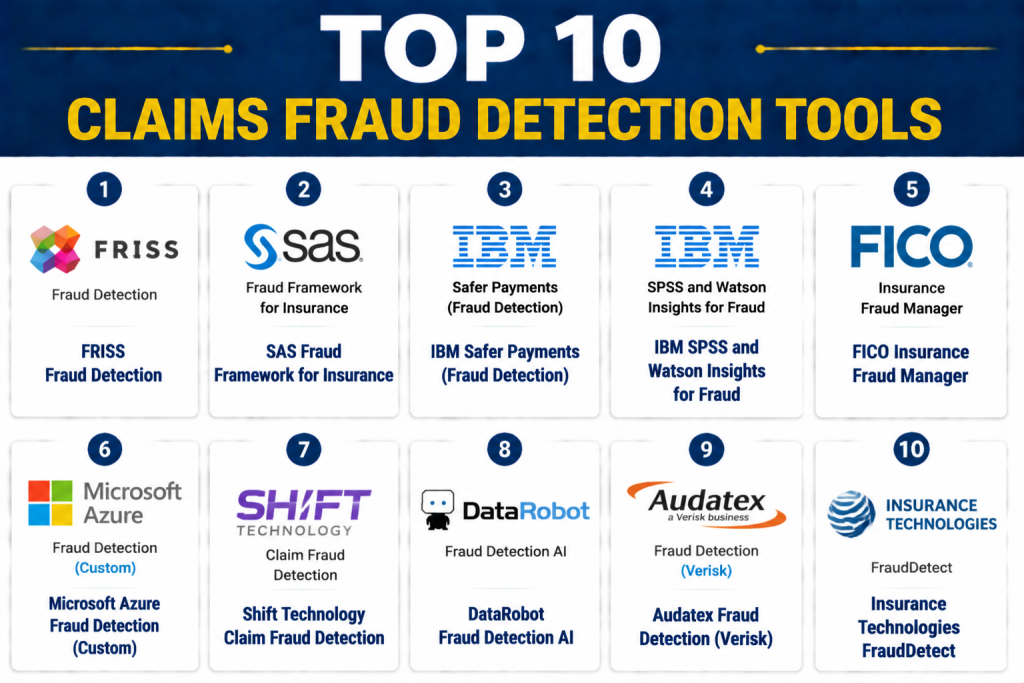
Top 10 Claims Fraud Detection Tools
1 — FRISS Fraud Detection
Short description: FRISS provides a comprehensive fraud detection platform tailored for insurance carriers, combining machine learning, data enrichment, and real‑time scoring to identify anomalies and fraud indicators in claims.
Key Features
- Predictive scoring and anomaly detection
- Rules engine with adaptive learning
- Automated alerting and case assignment
- Integrated investigative dashboards
- External data enrichment
- Integration with claims processing systems
Pros
- Strong industry focus on insurance fraud
- Real‑time scoring supports immediate triage
Cons
- Pricing may be high for smaller insurers
- Initial configuration requires domain expertise
Platforms / Deployment
- Web / Cloud
Security & Compliance
- Encryption, RBAC, audit logs
- Not publicly stated: SOC 2 / ISO 27001
Integrations & Ecosystem
FRISS integrates across claims and risk systems:
- Core claims management systems
- External data sources (public records, telematics)
- Case management systems
- BI and reporting tools
Support & Community
Documentation and onboarding support; professional services available.
2 — SAS Fraud Framework for Insurance
Short description: SAS offers an advanced analytics suite designed to detect insurance fraud using AI, network analysis, and predictive modeling, with strong support for global carriers and complex fraud ecosystems.
Key Features
- Machine learning algorithms and profiling
- Network and link analysis
- Rule‑based engines with adaptive learning
- Real‑time and batch scoring
- Investigator workbench and visualization
- Regulatory reporting support
Pros
- Highly customizable analytics platform
- Strong scalability and enterprise readiness
Cons
- Requires skilled analytics and IT resources
- Cost may be substantial for smaller entities
Platforms / Deployment
- Web / Cloud / Hybrid
Security & Compliance
- Encryption, audit trails, role‑based access
- Not publicly stated: Third‑party certifications
Integrations & Ecosystem
- Core claims systems
- Data warehouses and lakes
- External risk and fraud data feeds
Support & Community
Extensive documentation, global support, and analytics community resources.
3 — IBM Safer Payments (Fraud Detection)
Short description: IBM Safer Payments provides real‑time fraud detection, case management, and analytics for financial and insurance claims, combining rules, machine learning, and entity intelligence.
Key Features
- Real‑time fraud detection engine
- Rules and machine learning models
- Entity resolution and link analysis
- Case management and workflow
- Alert prioritization
- Reporting and dashboards
Pros
- Real‑time detection for high volumes
- Enterprise‑grade security and performance
Cons
- Requires experienced implementation team
- Pricing geared toward large organizations
Platforms / Deployment
- Web / Cloud / Hybrid
Security & Compliance
- Encryption, role‑based access
- Not publicly stated: Specific compliance certifications
Integrations & Ecosystem
- Claims systems
- External identity and risk feeds
- Analytics platforms
Support & Community
Documentation, global support options, and professional services.
4 — IBM SPSS and Watson Insights for Fraud
Short description: Leveraging IBM’s SPSS and Watson AI capabilities, this solution delivers predictive analytics and cognitive insights to enhance fraud modeling and detection across claims.
Key Features
- Predictive modeling and segmentation
- AI‑driven anomaly detection
- Cognitive insights and patterns
- Scenario simulation
- Reporting and visualization
- Integration with workflow tools
Pros
- Strong AI and analytics capabilities
- Flexible modeling options
Cons
- Steep learning curve
- Not a turnkey fraud system alone
Platforms / Deployment
- Web / Cloud / Hybrid
Security & Compliance
- Encryption and audit logs
- Not publicly stated: Compliance frameworks
Integrations & Ecosystem
- Analytics and data platforms
- Claims systems
- External risk indicators
Support & Community
Strong analytics community and IBM support channels.
5 — FICO Insurance Fraud Manager
Short description: FICO Insurance Fraud Manager applies decision analytics, machine learning, and adaptive insights to detect and prioritize suspicious claims, reducing false positives and losses.
Key Features
- Machine learning and scorecards
- Decision rules and logic
- Alert management
- Predictive models for risk scoring
- Investigator toolkit
- Integration with operational systems
Pros
- Deep analytics and scoring capabilities
- Proven track record in insurance markets
Cons
- May require advanced data setups
- Premium pricing
Platforms / Deployment
- Web / Cloud / Hybrid
Security & Compliance
- Encryption, role‑based access
- Not publicly stated: ISO / SOC certifications
Integrations & Ecosystem
- Claims management systems
- Data enrichment and third‑party sources
- Case management platforms
Support & Community
Vendor documentation and professional services.
6 — Microsoft Azure Fraud Detection (Custom)
Short description: Built on Azure’s AI, analytics, and machine learning services, this solution enables custom fraud detection workflows tailored to claims processing and risk profiles.
Key Features
- Custom AI and ML models
- Anomaly detection pipelines
- Integration with Azure Synapse and data lakes
- Real‑time event processing
- Alerting and dashboards
- Model training and retraining workflows
Pros
- Highly customizable and cloud‑native
- Scalable with enterprise data environments
Cons
- Requires data science and development expertise
- Not a turnkey insurance product
Platforms / Deployment
- Web / Cloud
Security & Compliance
- Encryption, IAM, audit logs
- HIPAA, Not publicly stated: SOC 2 / ISO 27001
Integrations & Ecosystem
- Azure data services
- Claims and policy systems
- Telemetry and IoT (where applicable)
Support & Community
Azure documentation, professional services, and community forums.
7 — Shift Technology Claim Fraud Detection
Short description: Shift Technology provides a dedicated claims fraud detection platform using AI to analyze patterns, flag high‑risk claims, and automate investigative workflows for insurers.
Key Features
- AI‑driven fraud scoring
- Network and pattern detection
- Explainable insights for investigators
- Workflow automation
- Integration with claims systems
- Multi‑line support (health, auto, P&C)
Pros
- Focused on insurance claim fraud
- Explainable AI supports compliance
Cons
- Requires data preparation
- Premium pricing for full feature sets
Platforms / Deployment
- Web / Cloud
Security & Compliance
- Encryption, audit trails
- Not publicly stated: Certifications
Integrations & Ecosystem
- Core claims systems
- Analytics and data platforms
- External risk feeds
Support & Community
Documentation and professional support.
8 — DataRobot Fraud Detection AI
Short description: DataRobot provides an automated machine learning platform that enables insurers to build, deploy, and monitor fraud detection models without heavy coding.
Key Features
- Automated model building
- Explainable AI
- Integration with claims data pipelines
- Alerts and scoring dashboards
- Deployment and monitoring tools
- Retraining workflows
Pros
- Democratizes ML model creation
- Explainable insights for analysts
Cons
- Requires ML pipeline expertise
- Indirect fraud focus (custom builds required)
Platforms / Deployment
- Web / Cloud
Security & Compliance
- Encryption and audit logs
- Not publicly stated: HIPAA / SOC 2 / ISO
Integrations & Ecosystem
- Data sources and warehouses
- Claims and policy systems
- Monitoring and alerting tools
Support & Community
Comprehensive documentation and AI/ML community.
9 — Audatex Fraud Detection (Verisk)
Short description: Audatex, from Verisk, provides fraud detection tools focused on auto and property claims, using analytics and pattern detection tailored to collision repair and insurance workflows.
Key Features
- Analytics for auto claims
- Rule‑based and AI scoring
- Integration with repair data
- Alert dashboards
- Workflow prioritization
- Historical benchmarking
Pros
- Strong domain expertise in auto/property claims
- Data enriched by industry benchmarks
Cons
- Focused on specific lines (auto/property)
- Limited broader insurance support
Platforms / Deployment
- Web / Cloud
Security & Compliance
- Encryption, audit logs
- Not publicly stated: Certifications
Integrations & Ecosystem
- Repair and estimating systems
- Claims management platforms
- Benchmark databases
Support & Community
Documentation and industry support.
10 — Insurance Technologies FraudDetect
Short description: FraudDetect by Insurance Technologies offers claims fraud analytics with rule engines, anomaly scoring, and automated alerts aimed at small to mid‑sized insurers.
Key Features
- Rule‑based fraud detection
- Anomaly scoring
- Alerts and case flags
- Integration with core claims systems
- Dashboards and reports
- Configurable workflows
Pros
- Designed for smaller insurers
- Easy to configure rules
Cons
- Less sophisticated AI
- Limited advanced analytics
Platforms / Deployment
- Web / Cloud
Security & Compliance
- Encryption and logs
- Not publicly stated: Certifications
Integrations & Ecosystem
- Core claims platforms
- Reporting systems
- Notification frameworks
Support & Community
Documentation and support services.
Comparison Table (Top 10)
| Tool Name | Best For | Platform(s) Supported | Deployment | Standout Feature | Public Rating |
|---|---|---|---|---|---|
| FRISS | Insurance carriers | Web | Cloud | Real‑time scoring | N/A |
| SAS Fraud Framework | Enterprise carriers | Web | Cloud / Hybrid | Predictive analytics | N/A |
| IBM Safer Payments | Large insurers | Web | Cloud / Hybrid | Real‑time detection | N/A |
| IBM SPSS & Watson | Analytics teams | Web | Cloud / Hybrid | AI insights | N/A |
| FICO Insurance FM | Insurance carriers | Web | Cloud / Hybrid | Decision analytics | N/A |
| Azure Fraud | Custom solutions | Web | Cloud | Cloud AI analytics | N/A |
| Shift Technology | Insurance fraud focus | Web | Cloud | Explainable AI | N/A |
| DataRobot AI | Machine learning teams | Web | Cloud | Automated ML | N/A |
| Audatex Fraud | Auto/property claims | Web | Cloud | Domain expertise | N/A |
| FraudDetect | SMB insurers | Web | Cloud | Rule‑based alerts | N/A |
Evaluation & Scoring of Claims Fraud Detection Tools
| Tool Name | Core (25%) | Ease (15%) | Integrations (15%) | Security (10%) | Performance (10%) | Support (10%) | Value (15%) | Weighted Total |
|---|---|---|---|---|---|---|---|---|
| FRISS | 9 | 8 | 9 | 8 | 9 | 8 | 7 | 8.3 |
| SAS Fraud Framework | 9 | 7 | 8 | 8 | 9 | 8 | 7 | 8.1 |
| IBM Safer Payments | 9 | 7 | 8 | 8 | 9 | 8 | 7 | 8.1 |
| IBM SPSS & Watson | 8 | 7 | 7 | 7 | 8 | 7 | 7 | 7.4 |
| FICO IFM | 9 | 7 | 8 | 8 | 9 | 7 | 7 | 8.1 |
| Azure Fraud | 8 | 7 | 7 | 8 | 8 | 7 | 7 | 7.6 |
| Shift Technology | 9 | 8 | 8 | 8 | 9 | 8 | 7 | 8.3 |
| DataRobot | 8 | 7 | 7 | 7 | 8 | 7 | 7 | 7.5 |
| Audatex Fraud | 7 | 7 | 7 | 7 | 7 | 7 | 7 | 7.1 |
| FraudDetect | 7 | 8 | 7 | 7 | 7 | 7 | 7 | 7.2 |
Interpreting the Scores: Weighted scores compare core features, ease of use, integrations, security, performance, support, and value. Tools with higher weighted totals provide a stronger balance of real‑time detection, analytics, and operational support, but organizational context — such as claim volume, data maturity, and fraud risk — should guide selection.
Which Claims Fraud Detection Tool Is Right for You?
Solo / Freelancer
- Not typically relevant unless building specialized claim analytics tools; smaller portfolios may use basic anomaly detection.
SMB Insurers
- Insurance Technologies FraudDetect and Audatex Fraud provide rule‑based and domain‑specialized options for smaller carriers.
Mid‑Market
- Azure Fraud (custom solutions), FRISS, or DataRobot offer flexible, cloud‑native platforms with strong analytics and integration.
Enterprise
- SAS Fraud Framework, IBM Safer Payments, FRISS, and Shift Technology provide enterprise‑grade fraud detection, real‑time scoring, and investigative workflows for global operations.
Budget vs Premium
- SMB carriers can adopt rule‑based tools; enterprise carriers benefit from AI‑driven and real‑time platforms with operational workflows.
Feature Depth vs Ease of Use
- Enterprise tools offer deep analytics and automation but require training; mid‑market tools balance ease and capability.
Integrations & Scalability
- Large insurers need deep integration with claims processors, data lakes, and external feeds; smaller carriers may use simpler API integrations.
Security & Compliance Needs
- Ensure encryption, audit logs, IAM, with HIPAA and industry security expectations for claims data.
Frequently Asked Questions (FAQs)
1— What pricing models are typical?
SaaS subscription, usage‑based API calls, or enterprise licensing. Pricing often scales with claim volume and feature tiers.
2— How long does implementation take?
SMB deployments can start in weeks; enterprise deployments with complex data systems may take 3–6 months.
3— Can these tools integrate with core claims systems?
Yes, leading tools provide connectors or APIs for integration with policy and claims management systems.
4— Are AI features essential?
AI features improve detection and reduce false positives; smaller carriers may begin with rule‑based systems.
5— Do tools support real‑time claims scoring?
Yes, many platforms provide real‑time fraud scoring during claim intake.
6— How secure are these platforms?
Security includes encryption, IAM, audit logs, and compliance with data protection standards (e.g., HIPAA where applicable).
7— Can these tools scale across lines of business?
Yes, top tools support multi‑line fraud detection (auto, health, P&C, worker’s comp).
8— Are anomaly scores explainable?
Explainable AI features help investigators understand why a claim was flagged, aiding compliance.
9— What common mistakes should insurers avoid?
Avoid lack of data quality, ignoring explainability, and underestimating integration complexity.
10— Do these tools provide dashboards for investigators?
Yes, most include investigator workbenches and dashboards for fraud case review.
Conclusion
Claims Fraud Detection Tools are critical to protecting insurers from losses, improving operational efficiency, and enhancing customer trust in a landscape of rising fraud sophistication. Enterprise solutions like FRISS and Shift Technology offer AI‑driven real‑time scoring and investigative workflows, while platforms like DataRobot and Azure Fraud provide flexibility for custom analytics and cloud scalability.shortlist tools that align with your claim volume, fraud risk profile, and integration landscape; run pilots to validate detection accuracy; and ensure robust security, compliance, and investigator support before enterprise rollout.
