Introduction
Cyber Insurance Risk Platforms are specialized software solutions designed to help insurers, brokers, risk managers, and enterprises assess, manage, and underwrite cyber risk. In plain English, these platforms analyze an organization’s cybersecurity posture to determine potential loss exposure, provide scoring and insights, and support pricing and underwriting decisions for cyber insurance products.
In , cyber insurance is no longer optional — it’s a strategic necessity. With increasing ransomware attacks, data breaches, regulatory fines, and evolving global compliance standards, carriers and policyholders rely on automated, data-driven risk modeling to underwrite accurately, mitigate threats, and protect balance sheets.
Real-world use cases include:
- Underwriting Risk Assessments: Automatically evaluating applicant security posture based on scans, questionnaires, and threat intelligence.
- Portfolio Risk Monitoring: Providing continuous oversight of insureds’ risk levels and alerting to degradation.
- Exposure Analysis: Quantifying potential financial loss from cyber incidents for pricing and reserves.
- Renewal and Score Tracking: Tracking changes in security posture over policy periods to adjust premiums or terms.
- Risk Mitigation Guidance: Offering actionable recommendations to reduce vulnerability and improve scores.
What buyers should evaluate:
- Accuracy of risk scoring and modeling
- Integration with third‑party threat intelligence and vulnerability data
- Support for underwriting workflows and automation
- Portfolio monitoring and alerting capabilities
- Predictive analytics and scenario planning
- Regulatory and compliance reporting (e.g., GDPR, HIPAA)
- API integrations with broker/carrier systems
- Cloud scalability and remote access
- Mobile app or dashboard support
- Security and data governance controls
Best for: Cyber insurers, brokers with cyber portfolios, risk management departments, and large enterprises pursuing cyber insurance or risk reduction.
Not ideal for: Small insurers or brokers with minimal cyber exposure who may manage risk manually or through basic scorecards.
Key Trends in Cyber Insurance Risk Platforms
- AI‑Driven Risk Scoring: Machine learning models that evaluate security posture, threat landscape, and incident history in real time.
- Continuous Monitoring: Automated scanning and risk updates outside of annual renewals to catch changes in exposure.
- Threat Intelligence Integration: Real‑time feeds from global threat actors, known vulnerabilities, and exploit patterns.
- Predictive Loss Modeling: Simulating breach scenarios to estimate potential financial exposure and guide underwriting.
- Portfolio Risk Heatmaps: Visual dashboards showing risk distribution across insured portfolios.
- Automated Underwriting Workflows: Reducing manual data entry with smart questionnaires and scoring rigs.
- Regulatory Compliance Modules: Built‑in controls aligned with data protection laws like GDPR, HIPAA, and PCI DSS.
- Secure APIs: Integration with carrier policy systems, broker CRMs, and third‑party risk feeds.
- Cloud‑Native and SaaS Delivery: Scalable platforms accessible from anywhere, with automated updates.
- Flexible Pricing Models: Subscription pricing, per‑risk scoring, or usage‑based models tied to the number of assets scanned.
How We Selected These Tools (Methodology)
- Evaluated market adoption and mindshare in cyber insurance and enterprise risk markets.
- Assessed feature completeness, including risk scoring, portfolio monitoring, and analytics.
- Reviewed reliability and performance signals — uptime, speed of scoring, and data currency.
- Analyzed security posture signals, such as encryption standards, access controls, and audit capabilities.
- Considered integrations/ecosystem — APIs, threat feeds, carrier/broker system connectors.
- Measured customer fit across segments, from insurers to risk management teams in enterprises.
- Included AI, automation, and predictive modeling capabilities as core evaluation criteria.
- Evaluated support, documentation, onboarding, and community strength.
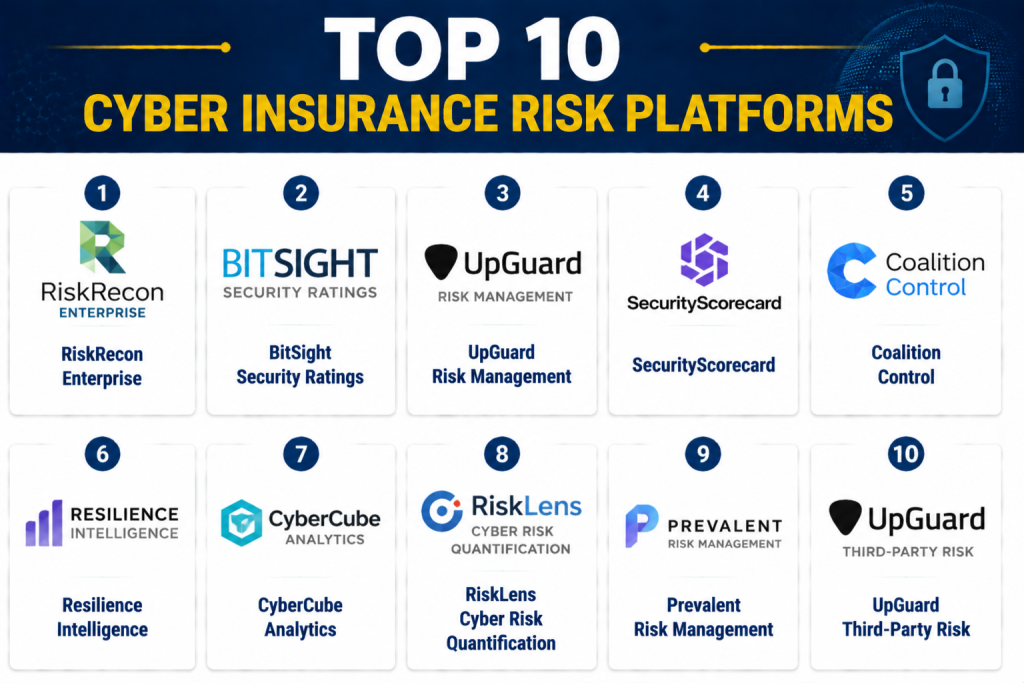
Top 10 Cyber Insurance Risk Platforms
1 — RiskRecon Enterprise
Short description: RiskRecon Enterprise provides comprehensive cyber risk ratings and continuous monitoring, helping insurers and enterprises evaluate cybersecurity posture and monitor changes over time. It focuses on mapping technical security controls to business risk.
Key Features
- Continuous monitoring of external attack surface
- Automated risk scoring and benchmarking
- Integration with threat intelligence feeds
- Portfolio dashboards and alerts
- Risk change detection
- Exportable risk scorecards
Pros
- Continuous risk visibility
- Strong benchmarking capabilities
Cons
- Score interpretation may require expertise
- Integration setup may require IT support
Platforms / Deployment
- Web / Cloud
Security & Compliance
- Not publicly stated
Integrations & Ecosystem
RiskRecon integrates with multiple risk feeds and enterprise systems:
- API connectivity for risk data
- Integration with SIEM and threat intelligence sources
- Exportable outputs for carrier underwriting tools
Support & Community
- Professional onboarding and documentation
- Vendor support tiers
- Moderate industry user community
2 — BitSight Security Ratings
Short description: BitSight provides independent, data‑driven security ratings for organizations and portfolios, used widely for cyber underwriting, third‑party risk management, and continuous monitoring.
Key Features
- Security ratings based on external indicators
- Third‑party risk assessment
- Portfolio tracking and alerts
- Benchmarking and historical trend analysis
- Reporting and compliance insights
Pros
- Mature scoring model with broad industry adoption
- Great for benchmarking across peers
Cons
- May require additional context beyond scores
- Some carriers supplement with internal data sources
Platforms / Deployment
- Web / Cloud
Security & Compliance
- Not publicly stated
Integrations & Ecosystem
- API for rating data feeds
- Integrations with GRC and risk platforms
- Exportable reports for underwriting tools
Support & Community
- Documentation and webinars
- Professional support options
- Large user base in cyber risk and underwriting
3 — UpGuard Risk Management
Short description: UpGuard Risk Management offers cyber risk assessments, continuous monitoring, and breach exposure insights for insurers and enterprises evaluating third parties or insured organizations.
Key Features
- Detailed risk assessments
- Continuous external monitoring
- Breach exposure and data leak insights
- Policy evidence and reporting
- Vendor risk scoring
- Alerting and trend tracking
Pros
- Strong focus on breach exposure data
- Useful for third‑party risk alongside cyber insurance risk
Cons
- Advanced features can be complex
- Smaller ecosystem integrations
Platforms / Deployment
- Web / Cloud
Security & Compliance
- Not publicly stated
Integrations & Ecosystem
- API connectivity
- Integration with vendor risk and GRC platforms
- Exportable analytics
Support & Community
- Vendor documentation
- Support tiers and onboarding
- Smaller community compared to enterprise scoring tools
4 — SecurityScorecard
Short description: SecurityScorecard provides risk ratings and continuous monitoring, helping insurers and enterprises assess cyber risk, monitor portfolios, and benchmark performance against peers.
Key Features
- Global security risk ratings
- Continuous monitoring and alerts
- Portfolio and heatmap dashboards
- Third‑party risk assessment
- Compliance and reporting templates
- Mobile app access
Pros
- Broad scanning coverage
- Easy portfolio visualization
Cons
- Scores may need internal context
- Some enterprise features require add‑ons
Platforms / Deployment
- Web / iOS / Android
- Cloud
Security & Compliance
- Not publicly stated
Integrations & Ecosystem
- APIs for rating feeds
- SIEM and GRC integration
- Exportable risk reports
Support & Community
- Knowledge base and documentation
- Support tiers
- Large security ratings community
5 — Coalition Control
Short description: Coalition Control combines cyber risk assessment, continuous monitoring, incident response planning, and aggregated data used by carriers and insureds for underwriting and risk reduction.
Key Features
- Risk assessment questionnaires
- Continuous vulnerability scanning
- Incident response guidance
- Insurance proof dashboards
- Trend analytics
- Alerts and reports
Pros
- Focus on risk reduction, not just scoring
- Built‑in response guidance
Cons
- Questionnaire dependency may lengthen assessments
- Less granular external risk scoring than pure risk rating tools
Platforms / Deployment
- Web / Cloud
Security & Compliance
- Not publicly stated
Integrations & Ecosystem
- Carrier and risk platform integrations
- API support for incident and scanning data
- Alerts and notification systems
Support & Community
- Vendor docs and onboarding
- Customer support tiers
- Small user community
6 — Resilience Intelligence
Short description: Resilience Intelligence focuses on quantifying cyber risk in financial terms and modeling potential losses, ideal for underwriting and pricing in cyber insurance.
Key Features
- Financial risk modeling
- Scenario analysis
- Loss exposure estimations
- Continuous monitoring alerts
- Custom risk reports
- Policy analytics
Pros
- Strong focus on financial quantification
- Useful for pricing and reserve planning
Cons
- Requires actuarial or risk modeling expertise
- Smaller ecosystem for third‑party data
Platforms / Deployment
- Web / Cloud
Security & Compliance
- Not publicly stated
Integrations & Ecosystem
- API connectivity
- Integration with underwriting systems
- Custom report exports
Support & Community
- Professional support
- Documentation
- Small specialized user community
7 — CyberCube Analytics
Short description: CyberCube Analytics provides cyber insurance risk modeling, portfolio analytics, and loss estimation tailored for carriers and reinsurers to support underwriting decisions.
Key Features
- Actuarial risk models
- Exposure and loss analytics
- Portfolio heatmaps
- Scenario simulations
- Benchmarking and trends
- API access
Pros
- Built for insurance underwriting
- Comprehensive modeling and simulations
Cons
- Enterprise features may be expensive
- Requires specialized training
Platforms / Deployment
- Web / Cloud
Security & Compliance
- Not publicly stated
Integrations & Ecosystem
- API connectivity
- Integration with carrier underwriting systems
- Custom data exports
Support & Community
- Vendor support
- Training programs
- Large insurance risk community
8 — RiskLens Cyber Risk Quantification
Short description: RiskLens specializes in cyber risk quantification, converting technical risk into financial terms and supporting underwriting, pricing, and enterprise risk decisions.
Key Features
- Financial risk quantification
- Cyber loss modeling
- Scenario analysis
- Portfolio dashboards
- Compliance reporting
- Brokerage and carrier workflows
Pros
- Strong financial emphasis for underwriting
- Aligns with enterprise risk frameworks
Cons
- Focused on quantification; not full risk scoring
- Advanced setup
Platforms / Deployment
- Web / Cloud
Security & Compliance
- Not publicly stated
Integrations & Ecosystem
- API access
- Data export for underwriting systems
- Risk dashboards
Support & Community
- Vendor documentation
- Support tiers
- Specialized user community
9 — Prevalent Risk Management
Short description: Prevalent focuses on third‑party cyber risk, which also informs cyber insurance exposure, with continuous monitoring, automated assessments, and risk scoring.
Key Features
- Third‑party risk assessments
- Continuous risk monitoring
- Automated evidence collection
- Scorecards and benchmarking
- Alerts and dashboards
- Reporting
Pros
- Strong third‑party context for broader risk
- Automated evidence collection
Cons
- Indirect focus on cyber insurance underwriting
- Not optimized for pricing models
Platforms / Deployment
- Web / Cloud
Security & Compliance
- Not publicly stated
Integrations & Ecosystem
- API for risk data feeds
- SIEM and GRC connectors
- Reporting exports
Support & Community
- Documentation
- Vendor support
- Small user community
10 — UpGuard Third‑Party Risk
Short description: UpGuard Third‑Party Risk combines external cyber assessments with vendor risk management, useful for insurers evaluating supply chain and vendor exposure as part of cyber portfolios.
Key Features
- External risk assessments
- Vendor risk dashboards
- Breach exposure alerts
- Reporting and scorecards
- Integration with internal tools
- Alerting systems
Pros
- Useful for supply chain risk
- Clear dashboards and alerts
Cons
- Not tailored to direct underwriting workflows
- Requires context for scoring interpretation
Platforms / Deployment
- Web / Cloud
Security & Compliance
- Not publicly stated
Integrations & Ecosystem
- Third‑party risk integrations
- API connectivity
- Alerting and reporting
Support & Community
- Documentation
- Vendor support
- Small community
Comparison Table (Top 10)
| Tool Name | Best For | Platform(s) Supported | Deployment | Standout Feature | Public Rating |
|---|---|---|---|---|---|
| RiskRecon Enterprise | Underwriters & risk managers | Web/Cloud | Cloud | Continuous risk visibility | N/A |
| BitSight Security Ratings | Brokers & insurers | Web/Cloud | Cloud | Mature industry risk ratings | N/A |
| UpGuard Risk Management | Enterprise risk & third‑party | Web/Cloud | Cloud | Breach exposure insights | N/A |
| SecurityScorecard | Portfolio monitoring | Web/iOS/Android | Cloud | Broad coverage risk ratings | N/A |
| Coalition Control | Risk mitigation + scoring | Web/Cloud | Cloud | Combined risk tools + guidance | N/A |
| Resilience Intelligence | Underwriting & loss modeling | Web/Cloud | Cloud | Financial risk modeling | N/A |
| CyberCube Analytics | Cyber insurers & reinsurers | Web/Cloud | Cloud | Actuarial modeling & scenarios | N/A |
| RiskLens CRQ | Quantification & underwriting | Web/Cloud | Cloud | Financial quantification focus | N/A |
| Prevalent Risk Management | Third‑party risk portfolios | Web/Cloud | Cloud | Automated evidence collection | N/A |
| UpGuard Third‑Party Risk | Supply chain risk context | Web/Cloud | Cloud | Vendor risk visibility | N/A |
Evaluation & Scoring
| Tool Name | Core (25%) | Ease (15%) | Integrations (15%) | Security (10%) | Performance (10%) | Support (10%) | Value (15%) | Weighted Total |
|---|---|---|---|---|---|---|---|---|
| RiskRecon Enterprise | 9 | 7 | 8 | 7 | 8 | 7 | 7 | 7.9 |
| BitSight Security Ratings | 9 | 7 | 8 | 7 | 8 | 7 | 7 | 7.9 |
| UpGuard Risk Management | 8 | 8 | 7 | 7 | 7 | 6 | 7 | 7.5 |
| SecurityScorecard | 8 | 8 | 8 | 7 | 8 | 7 | 7 | 7.8 |
| Coalition Control | 7 | 7 | 7 | 7 | 7 | 6 | 7 | 7.1 |
| Resilience Intelligence | 8 | 7 | 7 | 7 | 7 | 6 | 7 | 7.4 |
| CyberCube Analytics | 9 | 7 | 8 | 7 | 8 | 7 | 6 | 7.7 |
| RiskLens CRQ | 9 | 7 | 7 | 7 | 7 | 6 | 7 | 7.5 |
| Prevalent Risk Management | 7 | 8 | 7 | 7 | 7 | 6 | 7 | 7.1 |
| UpGuard Third‑Party Risk | 7 | 8 | 7 | 7 | 7 | 6 | 7 | 7.1 |
Interpretation: Higher weighted totals indicate stronger alignment with 2026+ cyber insurance risk assessment needs, including continuous monitoring, predictive analytics, portfolio risk visibility, and integration support. Scores are comparative across the top 10 platforms.
Which Cyber Insurance Risk Platform Tool Is Right for You?
Solo / Freelancer
Single underwriters or boutique brokers can benefit from UpGuard Risk Management or UpGuard Third‑Party Risk for breach exposure insights and simple scores without full enterprise complexity.
SMB
Mid‑size agencies looking for portfolio tracking and benchmarking should consider SecurityScorecard or Prevalent Risk Management for automated monitoring and alerts.
Mid‑Market
Carriers and brokers with growing cyber portfolios benefit from RiskRecon Enterprise or BitSight Security Ratings for rigorous external risk scoring and benchmarking.
Enterprise
Large insurers and reinsurance firms should evaluate CyberCube Analytics, RiskLens CRQ, or Resilience Intelligence for advanced financial modeling, predictive analytics, and scenario planning.
Budget vs Premium
Budget‑conscious organizations can start with SecurityScorecard or UpGuard Risk Management, while premium enterprise features like loss modeling and actuarial analytics come from CyberCube Analytics or RiskLens CRQ.
Feature Depth vs Ease of Use
Enterprise solutions provide deep analytics, financial forecasting, and portfolio modeling, while simpler platforms prioritize ease of onboarding and core risk scoring.
Integrations & Scalability
Large carriers and brokers require API integration with underwriting ecosystems — supported by RiskRecon, BitSight, and CyberCube Analytics.
Security & Compliance Needs
Organizations handling sensitive underwriting data must prioritize encryption, audit logs, secure onboarding, and compliance with global data protection standards.
Frequently Asked Questions (FAQs)
1- What pricing models exist for cyber risk platforms?
Pricing varies — many vendors offer SaaS subscription models, per‑risk scoring fees, or enterprise contracts tied to portfolio size.
2- How long does implementation take?
Smaller deployments can be live in weeks; enterprise integrations, especially with underwriting systems, may take months.
3- Do these platforms integrate with carrier systems?
Yes, most top tools provide APIs for integration with policy management, underwriting, and analytics systems.
4- Are AI and predictive analytics included?
Many modern platforms incorporate AI for risk scoring, predictive loss modeling, and threat forecasting.
5- Can these tools handle portfolio monitoring?
Yes, continuous monitoring and alerting are core features for carriers and agencies managing many insured entities.
6- How secure are these platforms?
Enterprise solutions provide encryption, access controls, and logging; specific certifications are often “Not publicly stated.”
7- Are mobile apps supported?
Several platforms offer mobile dashboards or responsive web access for on‑the‑go insights.
8- Can small brokers benefit?
Yes, lighter solutions like UpGuard and SecurityScorecard work well for smaller portfolios.
9- How do these tools impact underwriting?
They reduce manual risk assessment, provide data‑driven insights, and improve pricing accuracy.
10- Do these platforms help with compliance?
Many offer reporting aligned with GDPR, HIPAA, and industry standards to demonstrate due diligence.
Conclusion
Cyber Insurance Risk Platforms are essential for modern underwriting, continuous monitoring, and portfolio risk management. Small brokers and underwriters may find value in platforms like UpGuard Risk Management for breach insights and scoring, while mid‑market agencies benefit from SecurityScorecard and Prevalent Risk Management for automated portfolio tracking. Enterprise carriers and reinsurers should consider RiskRecon Enterprise, BitSight Security Ratings, or advanced modeling platforms like CyberCube Analytics and RiskLens CRQ for financial quantification, scenario analysis, and predictive workflows.Selecting the right platform depends on your team’s size, integration needs, analytical depth, and risk modeling maturity. Start by shortlisting , pilot underwriting and portfolio monitoring workflows, validate threat intelligence and scoring accuracy, and scale deployment based on operational success.
