Introduction
IoT Security Platforms are specialized solutions that protect connected devices, networks, and the data flowing between them. These platforms provide centralized visibility, threat detection, device authentication, and automated response capabilities to secure IoT ecosystems from cyberattacks, unauthorized access, and operational disruptions. In plain terms, they ensure that IoT devices—from industrial sensors to consumer gadgets—operate securely and reliably.
In , securing IoT infrastructure is more critical than ever. The proliferation of connected devices in manufacturing, healthcare, energy, and smart cities increases the attack surface. Platforms now leverage AI-driven analytics, automated remediation, and edge monitoring to detect and respond to threats in real time. Organizations adopting these solutions gain operational resilience, compliance adherence, and confidence in their digital ecosystems.
Real-world use cases include:
- Securing industrial IoT devices in smart factories against malware and operational sabotage.
- Protecting healthcare IoT devices from unauthorized access and ensuring patient data privacy.
- Monitoring connected vehicles, logistics sensors, and fleet management systems for anomalies.
- Safeguarding smart city infrastructure such as traffic systems and utility networks.
- Ensuring compliance with regulations like GDPR, HIPAA, and SOC 2 for enterprise IoT deployments.
Evaluation Criteria for Buyers:
- Device and network coverage
- AI-driven threat detection
- Automated remediation and response
- Policy enforcement and segmentation
- Security compliance certifications
- Deployment flexibility (cloud, on-prem, hybrid)
- Integration with existing IT and security ecosystems
- Performance and scalability
- Usability and monitoring dashboards
- Vendor support and community engagement
Best for: Enterprises, SMBs, industrial operators, healthcare organizations, smart city administrators, and security teams responsible for IoT infrastructure.
Not ideal for: Organizations with minimal IoT presence or highly constrained device networks. Smaller setups may benefit from simpler endpoint-level security tools.
Key Trends in IoT Security Platforms
- AI-powered threat detection for real-time anomaly identification.
- Automated remediation across thousands of devices without manual intervention.
- Edge security monitoring for low-latency threat detection.
- Zero-trust frameworks and micro-segmentation to isolate compromised devices.
- Converged IT/OT security for industrial and smart infrastructure.
- Stronger compliance support for SOC 2, ISO 27001, GDPR, and HIPAA.
- Cloud-native and hybrid deployment models for scalability.
- Integration with SIEM, ITSM, and cloud management platforms.
- Subscription and device-based pricing models for flexible scaling.
- Developer-friendly SDKs for secure device onboarding and customization.
How We Selected These Tools (Methodology)
- Assessed market adoption and vendor mindshare.
- Evaluated feature completeness: device coverage, analytics, and response capabilities.
- Reviewed performance and reliability across real-world deployments.
- Verified security posture: encryption, access control, and audit logging.
- Analyzed integration ecosystem with SIEMs, ITSM, and cloud services.
- Considered customer fit across SMB, mid-market, and enterprise segments.
- Prioritized platforms with AI-driven analytics and predictive threat detection.
- Examined support and community engagement for onboarding and troubleshooting.
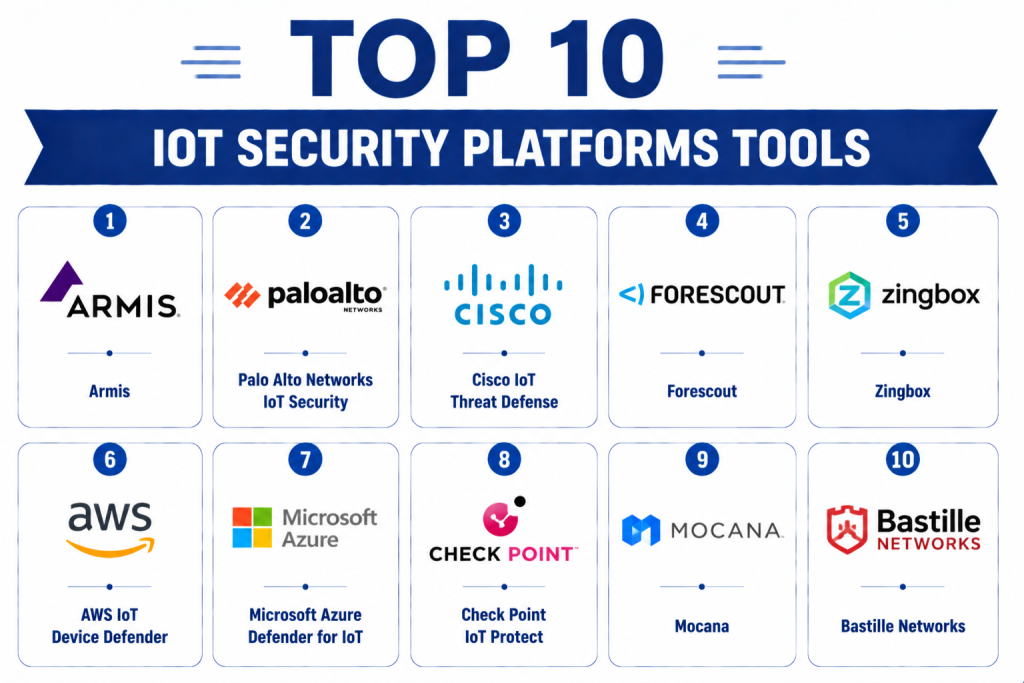
Top 10 IoT Security Platforms Tools
1- Armis
Short description: Armis provides agentless security for enterprise IoT, OT, and unmanaged devices. It is ideal for manufacturing, healthcare, and enterprise networks requiring real-time device visibility and automated threat response.
Key Features
- Continuous device discovery and inventory
- Real-time threat detection using AI analytics
- Automated risk assessment for IoT devices
- Integration with SIEM and ITSM platforms
- Network traffic analysis for anomaly detection
- Policy enforcement and segmentation
Pros
- Agentless monitoring reduces deployment complexity
- Comprehensive IoT, OT, and IT coverage
- Strong AI-based threat intelligence
Cons
- Requires integration expertise for advanced workflows
- Premium pricing for enterprise features
- Limited native remediation for some legacy devices
Platforms / Deployment
- Web, Cloud
Security & Compliance
- SSO/SAML, MFA, encryption, audit logs
- SOC 2, ISO 27001, GDPR
Integrations & Ecosystem
Supports SIEM, ITSM, and NAC solutions.
- Splunk, ServiceNow, Palo Alto Networks
- Cisco ISE
- Microsoft Defender integration
Support & Community
Comprehensive documentation, enterprise-grade support, active user community.
2- Palo Alto Networks IoT Security
Short description: Secures IoT devices across enterprise networks using Prisma Access, focusing on threat prevention, segmentation, and regulatory compliance.
Key Features
- Device classification and profiling
- Threat prevention via next-gen firewalls
- Policy-based network segmentation
- Cloud security integration
- Automated incident response
Pros
- Strong enterprise-grade threat intelligence
- Deep integration with Palo Alto ecosystem
- Compliance support across multiple standards
Cons
- High complexity for small teams
- Limited visibility for unmanaged devices outside firewall scope
Platforms / Deployment
- Cloud, Hybrid
Security & Compliance
- SSO/SAML, encryption
- SOC 2, ISO 27001, GDPR
Integrations & Ecosystem
Integrates with Palo Alto firewall, Cortex XDR, SIEM tools.
- Cortex XSOAR
- Splunk
- ServiceNow
Support & Community
Enterprise-level support, knowledge base, active community forums.
3- Cisco IoT Threat Defense
Short description: Provides visibility, segmentation, and threat detection for IoT devices, optimized for industrial environments and enterprise networks.
Key Features
- IoT device discovery and inventory
- Threat detection using Cisco Talos intelligence
- Network micro-segmentation
- Policy enforcement across IT/OT
- Secure device communication
Pros
- Comprehensive threat intelligence
- Industrial IoT and OT coverage
- Deep network security integration
Cons
- Best with Cisco infrastructure
- Steep learning curve for smaller teams
Platforms / Deployment
- Cloud, Hybrid
Security & Compliance
- Encryption, audit logs
- SOC 2, ISO 27001, GDPR
Integrations & Ecosystem
Integrates with Cisco SecureX, SIEMs, NAC, OT controllers.
- SecureX
- Cisco ISE
- Splunk
Support & Community
Enterprise-grade support and industrial IoT community engagement.
4- Forescout
Short description: Provides agentless visibility, control, and automated response for IoT, OT, and IT devices with dynamic risk assessment.
Key Features
- Continuous device visibility and classification
- Real-time compliance monitoring
- Automated threat response
- Policy-driven network access control
- SIEM and endpoint integration
Pros
- Broad device coverage without agents
- Dynamic risk-based policies
- Enterprise-grade scalability
Cons
- Complex UI for new users
- Integration setup may require resources
Platforms / Deployment
- Cloud, On-premises, Hybrid
Security & Compliance
- SSO/SAML, encryption
- SOC 2, ISO 27001, GDPR
Integrations & Ecosystem
Supports SIEM, NAC, ITSM, and cloud tools.
- ServiceNow
- Splunk
- Palo Alto Networks
Support & Community
Comprehensive documentation, enterprise support, active user forums.
5- Zingbox
Short description: AI-driven IoT security platform focusing on device behavior analysis, threat detection, and anomaly management for enterprise networks.
Key Features
- Behavior-based anomaly detection
- Real-time risk assessment
- Device profiling and inventory
- Automated alerts
- Integration with SIEMs
Pros
- AI-driven detection improves accuracy
- Low operational overhead due to agentless design
- Enterprise IoT focus
Cons
- Limited advanced response capabilities
- Smaller ecosystem compared to legacy vendors
Platforms / Deployment
- Cloud
Security & Compliance
- Encryption, audit logs
- Not publicly stated for SOC 2/ISO 27001
Integrations & Ecosystem
Supports SIEM, ITSM, and API-based integrations.
- Splunk
- ServiceNow
- Custom APIs
Support & Community
Good documentation, enterprise support tiers.
6- AWS IoT Device Defender
Short description: AWS-native platform for IoT security, enabling continuous monitoring, auditing, and alerting.
Key Features
- Continuous auditing of IoT configurations
- Behavioral anomaly detection
- Automated alerts
- Policy enforcement
- Integration with AWS cloud services
Pros
- Tight AWS integration
- Scalable for large IoT deployments
- Pay-as-you-go pricing
Cons
- Limited outside AWS environments
- Requires AWS expertise
Platforms / Deployment
- Cloud (AWS)
Security & Compliance
- Encryption, IAM policies
- SOC 2, ISO 27001, GDPR
Integrations & Ecosystem
AWS IoT Core, CloudWatch, CloudTrail integration.
- AWS IoT Core
- CloudWatch
- CloudTrail
Support & Community
AWS support plans, large community, extensive documentation.
7- Microsoft Azure Defender for IoT
Short description: Protects enterprise IoT and OT devices with threat intelligence, network monitoring, and analytics.
Key Features
- Device discovery and inventory
- Threat intelligence alerts
- Anomaly detection
- Automated mitigation recommendations
- Integration with Azure Security Center
Pros
- Seamless Azure integration
- Strong threat analytics
- OT and IoT coverage
Cons
- Best for Azure-heavy environments
- Learning curve for non-Azure networks
Platforms / Deployment
- Cloud (Azure)
Security & Compliance
- SSO/SAML, encryption
- SOC 2, ISO 27001, GDPR
Integrations & Ecosystem
Integrates with Azure Sentinel, Security Center, SIEM tools.
- Azure Sentinel
- Security Center
- SIEM integrations
Support & Community
Microsoft support plans, strong developer community.
8- Check Point IoT Protect
Short description: Real-time threat prevention, device profiling, and network security for IoT devices.
Key Features
- Device discovery and classification
- Threat prevention using Check Point firewalls
- Policy-based access control
- Continuous monitoring and alerts
Pros
- Enterprise-grade threat prevention
- Unified security for IT and IoT
- Policy automation
Cons
- Limited flexibility for small IoT deployments
- Requires Check Point familiarity
Platforms / Deployment
- Cloud, On-premises
Security & Compliance
- SSO/SAML, encryption
- Not publicly stated for SOC 2/ISO 27001
Integrations & Ecosystem
Integrates with Check Point firewalls, SIEM, and ITSM.
- SIEM integration
- ServiceNow
- APIs
Support & Community
Strong enterprise support, moderate community.
9- Mocana
Short description: Secures connected and embedded devices with device-level security, authentication, and secure communications.
Key Features
- Embedded device security
- Device authentication and identity
- Secure firmware updates
- Policy enforcement
- IoT management platform integration
Pros
- Strong device-level protection
- Suitable for industrial IoT
- Flexible deployment
Cons
- Smaller market presence
- Limited analytics
Platforms / Deployment
- On-premises, Cloud
Security & Compliance
- Encryption, secure boot
- Not publicly stated
Integrations & Ecosystem
Integrates with device management platforms and APIs.
- IoT management tools
- Custom APIs
- Cloud connectors
Support & Community
Enterprise support, limited community visibility.
10- Bastille Networks
Short description: Enterprise IoT security via radio-frequency monitoring, device discovery, and wireless threat detection.
Key Features
- RF-based IoT device discovery
- Wireless threat detection
- Automated policy enforcement
- Continuous monitoring
- Enterprise dashboard integration
Pros
- Unique RF-based monitoring
- Real-time threat detection
- Effective for wireless-heavy deployments
Cons
- Specialized use case
- Limited non-wireless device support
Platforms / Deployment
- Cloud, On-premises
Security & Compliance
- Encryption, audit logs
- Not publicly stated
Integrations & Ecosystem
Supports SIEMs, ITSM, dashboards.
- Splunk
- ServiceNow
- Custom APIs
Support & Community
Enterprise support, moderate documentation.
Comparison Table (Top 10)
| Tool Name | Best For | Platform(s) Supported | Deployment | Standout Feature | Public Rating |
|---|---|---|---|---|---|
| Armis | Enterprise IoT | Web | Cloud | Agentless visibility | N/A |
| Palo Alto Networks IoT Security | Enterprise | Web | Cloud / Hybrid | Firewall integration | N/A |
| Cisco IoT Threat Defense | Industrial IoT | Web | Cloud / Hybrid | Talos threat intelligence | N/A |
| Forescout | Enterprise/SMB | Web | Cloud / On-prem / Hybrid | Agentless risk assessment | N/A |
| Zingbox | Enterprise | Web | Cloud | AI-based anomaly detection | N/A |
| AWS IoT Device Defender | AWS users | Web | Cloud | Cloud-native security | N/A |
| Azure Defender for IoT | Azure-heavy | Web | Cloud | Threat intelligence analytics | N/A |
| Check Point IoT Protect | Enterprise | Web | Cloud / On-prem | Policy automation | N/A |
| Mocana | Embedded IoT | Web | Cloud / On-prem | Device-level protection | N/A |
| Bastille Networks | Wireless IoT | Web | Cloud / On-prem | RF-based device monitoring | N/A |
Evaluation & Scoring of IoT Security Platforms
| Tool Name | Core (25%) | Ease (15%) | Integrations (15%) | Security (10%) | Performance (10%) | Support (10%) | Value (15%) | Weighted Total |
|---|---|---|---|---|---|---|---|---|
| Armis | 9 | 8 | 8 | 9 | 8 | 8 | 7 | 8.4 |
| Palo Alto Networks IoT Security | 9 | 7 | 7 | 9 | 8 | 8 | 6 | 8.0 |
| Cisco IoT Threat Defense | 8 | 7 | 8 | 9 | 8 | 8 | 6 | 7.9 |
| Forescout | 8 | 7 | 8 | 8 | 8 | 7 | 7 | 7.8 |
| Zingbox | 8 | 7 | 7 | 8 | 7 | 7 | 6 | 7.4 |
| AWS IoT Device Defender | 7 | 8 | 7 | 8 | 8 | 7 | 7 | 7.5 |
| Azure Defender for IoT | 7 | 7 | 7 | 8 | 8 | 7 | 7 | 7.4 |
| Check Point IoT Protect | 7 | 7 | 6 | 7 | 7 | 7 | 6 | 6.9 |
| Mocana | 6 | 7 | 6 | 7 | 7 | 6 | 6 | 6.6 |
| Bastille Networks | 6 | 6 | 6 | 7 | 6 | 6 | 6 | 6.3 |
Interpretation: Scores provide a comparative evaluation of each platform. Higher totals indicate stronger capabilities; individual category scores highlight relative strengths such as core features, security, or integrations.
Which IoT Security Platform Is Right for You?
Solo / Freelancer
- Lightweight projects may use AWS IoT Device Defender or Mocana for rapid deployment and minimal infrastructure.
SMB
- Platforms like Forescout or Armis offer robust coverage with scalable, cloud-friendly deployment.
Mid-Market
- Cisco IoT Threat Defense or Palo Alto Networks provide analytics, automated response, and segmentation for growing networks.
Enterprise
- Armis, Azure Defender for IoT, and Check Point IoT Protect support large-scale deployments with advanced threat intelligence.
Budget vs Premium
- Cloud-native solutions are cost-effective for SMBs; premium platforms provide AI analytics and multi-site capabilities.
Feature Depth vs Ease of Use
- Armis and Forescout balance comprehensive features with usability; Cisco and Palo Alto may require dedicated teams.
Integrations & Scalability
- Select platforms with APIs and SIEM/ITSM connectivity to ensure seamless scaling.
Security & Compliance Needs
- Enterprises and regulated industries should prioritize SOC 2, ISO 27001, and GDPR-compliant platforms.
Frequently Asked Questions (FAQs)
1- What pricing models are available for IoT Security Platforms?
Pricing is typically subscription-based per device or user. Cloud-native options may offer pay-as-you-go, while enterprise licenses are multi-year.
2- How long does onboarding take?
Deployment ranges from a few days for cloud platforms to several weeks for enterprise-grade or hybrid deployments.
3- Can these platforms scale to thousands of devices?
Yes, most leading platforms support tens of thousands of devices with centralized monitoring.
4- Do they provide real-time threat detection?
Yes, AI-driven platforms detect anomalies and threats in real-time across IoT, OT, and IT networks.
5- Are AI and machine learning capabilities standard?
AI and ML are increasingly standard, especially for predictive threat detection and anomaly monitoring.
6- How do platforms handle device onboarding?
Platforms often use automated discovery, agentless monitoring, or device certificates for secure onboarding.
7- What are common adoption mistakes?
Overlooking integration complexity, insufficient staff training, or underestimating predictive analytics limitations.
8- Can these platforms meet compliance requirements?
Yes, leading platforms comply with SOC 2, ISO 27001, GDPR, HIPAA, and industry-specific regulations.
9- Are multi-site and global deployments supported?
Enterprise-grade platforms like Armis, Cisco, and Azure Defender support distributed and multi-site deployments.
10- What are alternatives for smaller deployments?
Smaller operations may use cloud-native dashboards, lightweight monitoring tools, or endpoint-level security solutions.
Conclusion
IoT Security Platforms are essential for protecting devices, networks, and data in an increasingly connected world. Choosing the “best” platform depends on scale, complexity, compliance requirements, and existing infrastructure. SMBs may prefer cloud-native solutions, while enterprises benefit from multi-site, AI-driven platforms.
