Introduction
Industrial IoT Analytics Platforms are specialized software solutions designed to collect, process, and analyze data generated by industrial IoT devices and sensors. These platforms help organizations gain actionable insights, optimize operations, detect anomalies, and improve decision-making across manufacturing plants, utilities, logistics, and other industrial environments. By aggregating data from connected devices, machines, and production lines, these platforms enable predictive maintenance, process optimization, and operational efficiency.
In Industrial IoT Analytics Platforms are more critical than ever. Organizations face increasing complexity in industrial networks, more sophisticated cyber threats, and rising demands for operational efficiency and sustainability. Advanced AI and machine learning capabilities now allow for predictive insights and autonomous decision-making in real time, improving reliability and reducing downtime.
Real-world use cases include:
- Predictive maintenance for manufacturing equipment to reduce downtime and extend asset life.
- Monitoring and optimizing energy consumption in smart factories and industrial facilities.
- Detecting anomalies in production lines to prevent defects or safety incidents.
- Real-time supply chain monitoring to enhance logistics efficiency.
- Ensuring compliance with safety, environmental, and regulatory standards.
Evaluation Criteria for Buyers:
- Device and sensor coverage
- Real-time and historical data analysis capabilities
- Predictive analytics and AI integration
- Dashboard and visualization flexibility
- Integration with existing MES, ERP, and IT systems
- Deployment flexibility (cloud, on-premises, hybrid)
- Data security, privacy, and compliance
- Scalability and multi-site support
- Ease of use and user adoption
- Vendor support and community resources
Best for: Industrial manufacturers, energy and utilities companies, logistics and transportation providers, industrial automation teams, and IT/OT security teams requiring actionable insights from IoT data.
Not ideal for: Organizations with minimal IoT deployment or limited industrial operations; smaller setups may prefer lightweight IoT monitoring tools over full-scale analytics platforms.
Key Trends in Industrial IoT Analytics Platforms
- Increasing adoption of AI-driven predictive and prescriptive analytics for operational efficiency.
- Integration of cloud-native and edge computing for real-time processing and latency reduction.
- Enhanced interoperability with ERP, MES, and industrial automation systems.
- Automated anomaly detection and root-cause analysis for critical equipment.
- Focus on data security, encryption, and compliance with ISO, SOC 2, GDPR, and industry-specific standards.
- Scalable deployment models supporting multi-site industrial operations.
- Democratization of analytics with self-service dashboards and low-code interfaces.
- Integration of sustainability metrics for energy and environmental impact monitoring.
- Subscription and device-based pricing models for more flexible scaling.
- Incorporation of digital twins to simulate and optimize industrial processes.
How We Selected These Tools (Methodology)
- Assessed market adoption and recognition among industrial enterprises.
- Evaluated feature completeness, including data ingestion, analytics, visualization, and alerting.
- Reviewed performance and reliability metrics across large-scale deployments.
- Verified security posture, including encryption, authentication, and compliance standards.
- Considered integration capabilities with ERP, MES, SCADA, and IT systems.
- Examined customer fit across SMB, mid-market, and enterprise industrial environments.
- Prioritized platforms with AI/ML capabilities and predictive analytics features.
- Considered support ecosystem, including documentation, community, and onboarding services.
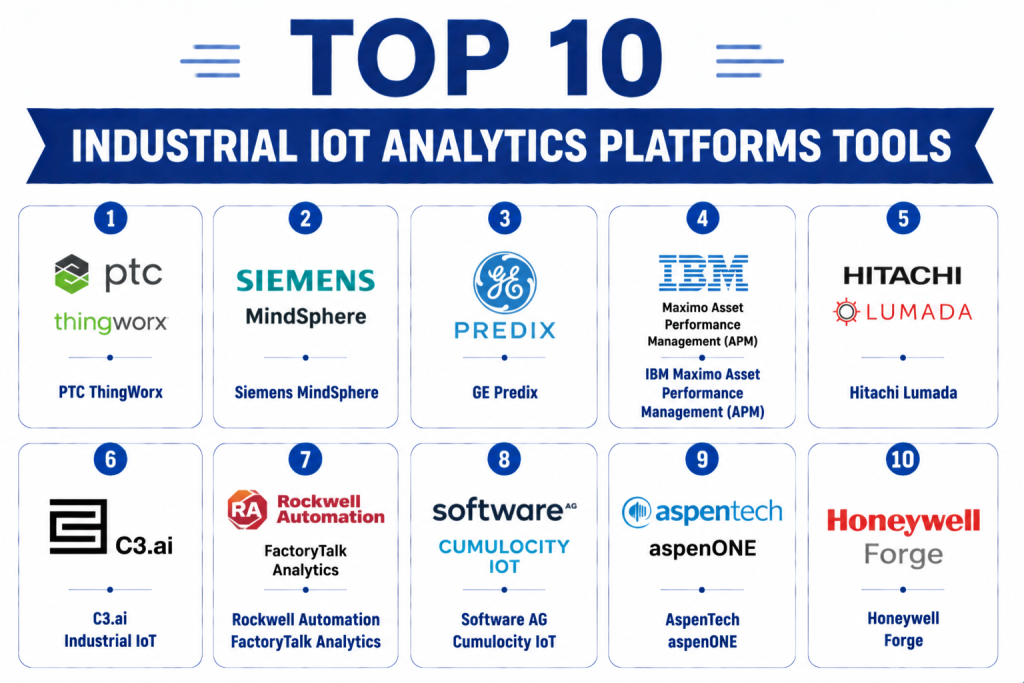
Top 10 Industrial IoT Analytics Platforms Tools
1- PTC ThingWorx
Short description: ThingWorx provides an end-to-end industrial IoT platform for building, deploying, and analyzing connected devices. It is suited for manufacturers, smart factories, and enterprises needing advanced analytics and rapid application development.
Key Features
- Visual modeling and drag-and-drop app development
- Predictive and prescriptive analytics
- Asset and production line monitoring
- IoT connectivity and integration frameworks
- Augmented reality for maintenance and operations
- Scalability across global industrial operations
Pros
- Rapid deployment of IoT applications
- Strong predictive analytics capabilities
- Extensive ecosystem for industrial integrations
Cons
- Complex licensing and pricing
- May require dedicated development resources
- Learning curve for non-technical users
Platforms / Deployment
- Web, Cloud / On-premises / Hybrid
Security & Compliance
- SSO/SAML, encryption, audit logs
- SOC 2, ISO 27001, GDPR
Integrations & Ecosystem
Supports ERP, MES, SCADA, and industrial automation systems.
- SAP, Oracle, Microsoft Dynamics
- MQTT, OPC UA, REST APIs
- Industrial AR tool integrations
Support & Community
Comprehensive documentation, developer community, enterprise support tiers.
2- Siemens MindSphere
Short description: MindSphere is Siemens’ industrial IoT analytics platform offering cloud-based connectivity, data management, and advanced analytics for industrial operations.
Key Features
- Cloud-native data ingestion and storage
- Advanced analytics with AI/ML capabilities
- Device and asset monitoring
- Predictive maintenance and energy optimization
- Open APIs for third-party integration
Pros
- Strong industrial IoT focus
- Scalable for multi-site deployments
- Extensive analytics toolset
Cons
- Best suited for Siemens-centric environments
- Can be complex for smaller deployments
- Cloud dependency may concern some organizations
Platforms / Deployment
- Web, Cloud
Security & Compliance
- Encryption, SSO
- ISO 27001, SOC 2, GDPR
Integrations & Ecosystem
Connects with ERP, SCADA, and industrial devices.
- SAP, MES platforms
- OPC UA, REST APIs
- Industrial automation systems
Support & Community
Enterprise-grade support, global user forums, documentation-rich portal.
3- GE Predix
Short description: Predix is GE’s industrial IoT platform designed for asset performance management, predictive analytics, and operational efficiency across heavy industries.
Key Features
- Asset performance and condition monitoring
- Predictive analytics and anomaly detection
- Industrial-grade data ingestion
- Integration with SCADA and MES
- Customizable dashboards and reports
Pros
- Tailored for heavy industrial applications
- Strong analytics capabilities
- Proven in large-scale industrial deployments
Cons
- High learning curve
- Primarily suitable for large enterprises
- Implementation may require consulting support
Platforms / Deployment
- Web, Cloud
Security & Compliance
- Encryption, role-based access
- SOC 2, ISO 27001
Integrations & Ecosystem
Integrates with MES, ERP, SCADA, and industrial devices.
- SAP, Oracle
- OPC UA, MQTT
- Asset management systems
Support & Community
Enterprise support, detailed documentation, industrial forums.
4- IBM Maximo Asset Performance Management (APM)
Short description: IBM Maximo APM combines industrial IoT analytics with asset management to optimize operations, reduce downtime, and improve maintenance efficiency.
Key Features
- Predictive maintenance and analytics
- Asset lifecycle management
- IoT sensor integration
- Condition monitoring and alerts
- Dashboard visualization and reporting
Pros
- End-to-end asset and analytics integration
- Strong enterprise credibility
- AI-driven predictive insights
Cons
- Complexity in deployment
- Higher cost for small enterprises
- Integration setup may be time-intensive
Platforms / Deployment
- Web, Cloud / On-premises
Security & Compliance
- SSO/SAML, encryption
- SOC 2, ISO 27001, GDPR
Integrations & Ecosystem
Supports ERP, SCADA, and IoT devices.
- SAP, Oracle, Microsoft Dynamics
- OPC UA, REST APIs
- IoT device connectors
Support & Community
Comprehensive support and documentation, active enterprise community.
5- Hitachi Lumada
Short description: Lumada is Hitachi’s industrial IoT platform focused on operational intelligence, predictive analytics, and digital twin implementations for smart manufacturing.
Key Features
- Real-time operational monitoring
- Predictive analytics with AI
- Digital twin creation
- IoT connectivity across heterogeneous devices
- Customizable dashboards
Pros
- Strong industrial focus
- Advanced AI and digital twin support
- Flexible deployment options
Cons
- Requires specialized expertise
- Limited support for non-Hitachi ecosystems
- Premium pricing
Platforms / Deployment
- Web, Cloud / Hybrid
Security & Compliance
- Encryption, audit logs
- ISO 27001, SOC 2
Integrations & Ecosystem
Supports ERP, SCADA, MES, and IoT devices.
- SAP, Oracle, MES systems
- MQTT, OPC UA
- Industrial automation connectors
Support & Community
Enterprise support, global documentation, moderate community.
6- C3.ai Industrial IoT
Short description: C3.ai provides AI-driven industrial analytics and IoT monitoring, focusing on predictive maintenance, asset optimization, and operational insights.
Key Features
- Predictive and prescriptive analytics
- Asset and sensor monitoring
- AI-powered anomaly detection
- Scalable multi-site deployment
- Real-time dashboards
Pros
- Strong AI integration
- Suitable for multi-site enterprises
- Flexible analytics pipelines
Cons
- Best suited for large-scale deployments
- Higher cost and implementation complexity
- Limited prebuilt integrations for small operators
Platforms / Deployment
- Web, Cloud
Security & Compliance
- Encryption, SSO
- Not publicly stated
Integrations & Ecosystem
Supports ERP, MES, SCADA, and custom APIs.
- SAP, Oracle, MES platforms
- MQTT, OPC UA
- Custom API connectors
Support & Community
Enterprise-grade support, documentation available, smaller community footprint.
7- Rockwell Automation FactoryTalk Analytics
Short description: FactoryTalk Analytics provides data collection, visualization, and advanced analytics for industrial operations, helping manufacturers optimize processes and reduce downtime.
Key Features
- Real-time operational dashboards
- Predictive maintenance insights
- Data aggregation from PLCs and sensors
- Integration with MES and SCADA
- Anomaly detection and reporting
Pros
- Deep integration with Rockwell industrial devices
- Real-time monitoring and alerts
- Optimized for manufacturing operations
Cons
- Limited flexibility outside Rockwell ecosystem
- Steep learning curve for smaller teams
- On-premises dependency for some features
Platforms / Deployment
- Web, On-premises / Hybrid
Security & Compliance
- Encryption, access control
- ISO 27001, SOC 2
Integrations & Ecosystem
Integrates with MES, SCADA, and ERP systems.
- Rockwell PLCs
- MES/ERP connectors
- OPC UA, REST APIs
Support & Community
Enterprise support, strong documentation, community forums.
8- Software AG Cumulocity IoT
Short description: Cumulocity IoT provides a platform for device management, real-time analytics, and predictive maintenance for industrial IoT deployments.
Key Features
- Device lifecycle management
- Predictive analytics
- Real-time monitoring and alerts
- Connectivity to heterogeneous devices
- Dashboard visualization
Pros
- Flexible deployment options
- Scalable for industrial sites
- Supports heterogeneous devices
Cons
- Integration with legacy systems may require effort
- Premium licensing for full feature set
- Learning curve for complex analytics
Platforms / Deployment
- Web, Cloud / Hybrid
Security & Compliance
- Encryption, SSO
- SOC 2, ISO 27001
Integrations & Ecosystem
Supports ERP, MES, SCADA, and cloud services.
- SAP, Oracle
- MQTT, OPC UA
- APIs for automation
Support & Community
Comprehensive support, active documentation, community presence.
9- AspenTech aspenONE
Short description: AspenTech provides industrial analytics solutions for process industries, enabling predictive maintenance, production optimization, and process simulation.
Key Features
- Process monitoring and optimization
- Predictive maintenance analytics
- Real-time dashboards
- Integration with industrial control systems
- Simulation and modeling
Pros
- Tailored for process industries
- Strong analytics and simulation capabilities
- Proven track record in heavy industries
Cons
- Best suited for process-intensive industries
- Licensing complexity
- Implementation may require consultancy
Platforms / Deployment
- Web, Cloud / On-premises
Security & Compliance
- Encryption, access control
- Not publicly stated
Integrations & Ecosystem
Supports MES, ERP, and SCADA systems.
- MES/ERP connectors
- OPC UA
- Simulation interfaces
Support & Community
Enterprise support, documentation, moderate community engagement.
10- Honeywell Forge
Short description: Honeywell Forge provides enterprise industrial analytics, predictive maintenance, and operations optimization for manufacturing, energy, and industrial facilities.
Key Features
- Asset performance monitoring
- Predictive analytics for maintenance
- Real-time dashboards and reporting
- Integration with industrial devices
- Optimization and KPI tracking
Pros
- End-to-end industrial analytics
- Strong predictive maintenance capabilities
- Scalable for global industrial operations
Cons
- Limited flexibility outside Honeywell devices
- Premium pricing
- Learning curve for small teams
Platforms / Deployment
- Web, Cloud / Hybrid
Security & Compliance
- Encryption, access control
- SOC 2, ISO 27001
Integrations & Ecosystem
Supports MES, ERP, SCADA, and cloud analytics.
- MES/ERP connectors
- OPC UA, MQTT
- API-based integrations
Support & Community
Enterprise support, extensive documentation, active community for Honeywell solutions.
Comparison Table (Top 10)
| Tool Name | Best For | Platform(s) Supported | Deployment | Standout Feature | Public Rating |
|---|---|---|---|---|---|
| PTC ThingWorx | Manufacturers | Web | Cloud / On-prem / Hybrid | Rapid app development | N/A |
| Siemens MindSphere | Industrial operations | Web | Cloud | Cloud-native analytics | N/A |
| GE Predix | Heavy industry | Web | Cloud | Asset performance monitoring | N/A |
| IBM Maximo APM | Asset-intensive enterprises | Web | Cloud / On-prem | Predictive maintenance | N/A |
| Hitachi Lumada | Smart factories | Web | Cloud / Hybrid | Digital twin support | N/A |
| C3.ai Industrial IoT | Multi-site enterprises | Web | Cloud | AI-powered predictive analytics | N/A |
| Rockwell Automation FactoryTalk | Manufacturing operations | Web | On-prem / Hybrid | Real-time monitoring | N/A |
| Software AG Cumulocity IoT | IoT device management | Web | Cloud / Hybrid | Heterogeneous device support | N/A |
| AspenTech aspenONE | Process industries | Web | Cloud / On-prem | Simulation & modeling | N/A |
| Honeywell Forge | Industrial optimization | Web | Cloud / Hybrid | Asset performance analytics | N/A |
Evaluation & Scoring of Industrial IoT Analytics Platforms
| Tool Name | Core (25%) | Ease (15%) | Integrations (15%) | Security (10%) | Performance (10%) | Support (10%) | Value (15%) | Weighted Total |
|---|---|---|---|---|---|---|---|---|
| PTC ThingWorx | 9 | 8 | 8 | 9 | 8 | 8 | 7 | 8.4 |
| Siemens MindSphere | 8 | 7 | 8 | 9 | 8 | 8 | 7 | 8.0 |
| GE Predix | 8 | 7 | 7 | 8 | 8 | 7 | 7 | 7.7 |
| IBM Maximo APM | 8 | 7 | 7 | 9 | 8 | 8 | 6 | 7.8 |
| Hitachi Lumada | 8 | 7 | 7 | 8 | 8 | 7 | 7 | 7.7 |
| C3.ai Industrial IoT | 8 | 7 | 7 | 8 | 8 | 7 | 6 | 7.5 |
| Rockwell Automation FactoryTalk | 7 | 7 | 7 | 8 | 8 | 7 | 6 | 7.3 |
| Software AG Cumulocity IoT | 7 | 7 | 7 | 8 | 7 | 7 | 6 | 7.2 |
| AspenTech aspenONE | 7 | 6 | 6 | 7 | 7 | 6 | 6 | 6.6 |
| Honeywell Forge | 8 | 7 | 7 | 8 | 8 | 7 | 6 | 7.5 |
Interpretation: Higher weighted totals indicate stronger overall platform capabilities. Category scores reveal relative strengths in analytics, integrations, or security.
Which Industrial IoT Analytics Platform Is Right for You?
Solo / Freelancer
- Lightweight industrial projects or prototypes may benefit from C3.ai or Honeywell Forge for quick deployment and minimal infrastructure.
SMB
- Platforms like PTC ThingWorx or Software AG Cumulocity IoT offer flexibility, self-service dashboards, and integration options without excessive complexity.
Mid-Market
- GE Predix, IBM Maximo APM, or Hitachi Lumada provide comprehensive analytics and predictive maintenance for growing industrial operations.
Enterprise
- Siemens MindSphere, Rockwell Automation FactoryTalk, and Honeywell Forge deliver scalable, multi-site analytics and advanced AI-powered insights.
Budget vs Premium
- Smaller teams can leverage cloud-native options like Cumulocity IoT or Honeywell Forge for cost-effective scaling.
- Premium enterprise analytics with digital twins and predictive AI is available in PTC ThingWorx, MindSphere, and Lumada.
Feature Depth vs Ease of Use
- Platforms like ThingWorx and MindSphere balance feature richness with usability.
- AspenTech and GE Predix offer deep analytics but require specialized expertise.
Integrations & Scalability
- Choose platforms with robust APIs and connectors for ERP, MES, and SCADA systems to scale industrial operations.
Security & Compliance Needs
- Enterprise and regulated industries should prioritize platforms with SOC 2, ISO 27001, and GDPR compliance, such as ThingWorx, MindSphere, and IBM Maximo APM.
Frequently Asked Questions (FAQs)
1- What are typical pricing models for Industrial IoT Analytics Platforms?
Pricing is usually subscription-based, per device or per site. Some cloud-native platforms offer pay-as-you-go models, while enterprise licenses may be multi-year and customized.
2- How long does implementation take?
Implementation ranges from a few weeks for cloud-based solutions to several months for complex, multi-site enterprise deployments.
3- Can these platforms handle thousands of sensors?
Yes, leading platforms are designed for high scalability, supporting thousands of connected devices and multi-site industrial deployments.
4- Do they support real-time analytics?
Most platforms provide real-time data ingestion and visualization, enabling rapid anomaly detection and predictive insights.
5- Are AI and predictive analytics standard?
AI-driven predictive analytics is increasingly standard, particularly in platforms like C3.ai, ThingWorx, and Lumada.
6- How do these platforms integrate with existing industrial systems?
They provide APIs, connectors, and prebuilt integrations with ERP, MES, SCADA, and industrial automation platforms.
7- What are common mistakes when adopting these platforms?
Mistakes include underestimating integration complexity, ignoring user training, or overestimating predictive accuracy without sufficient historical data.
8- Are these platforms secure for sensitive industrial data?
Yes, leading platforms implement encryption, role-based access, SSO/SAML, audit logs, and comply with SOC 2, ISO 27001, or GDPR standards.
9- Can they support multi-site global operations?
Most enterprise-grade platforms support distributed deployments, multi-site monitoring, and centralized analytics dashboards.
10- What alternatives exist for smaller operations?
Smaller manufacturers or startups may use lightweight IoT monitoring solutions, open-source analytics tools, or cloud-native device dashboards.
Conclusion
Industrial IoT Analytics Platforms empower organizations to turn device data into actionable insights, enabling predictive maintenance, operational efficiency, and regulatory compliance. The “best” platform depends on your industrial scale, deployment complexity, integration needs, and security requirements. Smaller teams may prioritize ease of use and cloud deployment, while enterprises need scalability, AI-driven analytics, and multi-site capabilities.
