Introduction
Workflow Orchestration Tools are software platforms designed to automate, coordinate, and monitor complex workflows across multiple systems, teams, or environments. They provide a centralized way to define tasks, enforce business logic, manage dependencies, and ensure that processes run efficiently without manual intervention.
In , workflow orchestration is critical as organizations increasingly rely on multi-cloud infrastructures, distributed teams, and AI-driven processes. These tools streamline operations, reduce errors, and accelerate time-to-market for business-critical processes. Modern platforms now incorporate AI and ML to optimize execution, detect anomalies, and predict process bottlenecks, making orchestration smarter and more proactive.
Real-world use cases include:
- Automating ETL pipelines for data analytics and reporting.
- Coordinating AI/ML model training and deployment workflows.
- Streamlining business processes across HR, finance, and IT systems.
- Orchestrating CI/CD pipelines in software development environments.
- Integrating multi-cloud infrastructure tasks into a single workflow dashboard.
Evaluation Criteria for Buyers:
- Task dependency management and scheduling
- Multi-cloud and hybrid environment support
- Real-time monitoring and alerting
- Ease of workflow design and visualization
- AI-driven optimization and anomaly detection
- Integration capabilities with SaaS and on-prem systems
- Scalability for large and complex workflows
- Security, RBAC, and audit logs
- Deployment flexibility (cloud, on-prem, hybrid)
- Vendor support and community ecosystem
Best for: IT teams, data engineers, DevOps professionals, AI/ML teams, enterprises managing complex multi-system workflows, and organizations automating business processes.
Not ideal for: Small teams with simple or single-system processes that do not require multi-step orchestration; lightweight automation tools may suffice.
Key Trends in Workflow Orchestration Tools
- AI-driven workflow optimization for predictive scheduling and resource allocation.
- Automation of multi-cloud and hybrid workflows with centralized control.
- Integration of observability and anomaly detection within workflow pipelines.
- Event-driven orchestration triggered by real-time system changes.
- Enhanced security and compliance support with RBAC, SSO, and audit logging.
- Serverless orchestration for cost-efficient, dynamic scaling.
- Low-code and no-code interfaces for broader organizational adoption.
- Integration with AI/ML pipelines for automated model training and deployment.
- Microservices and container-native orchestration support.
- Flexible subscription and usage-based pricing models for scalability.
How We Selected These Tools (Methodology)
- Evaluated market adoption and brand recognition among enterprises.
- Reviewed feature completeness for task management, scheduling, and monitoring.
- Assessed reliability and performance signals in production deployments.
- Verified security posture, including encryption, access controls, and compliance.
- Considered integration capabilities with SaaS, APIs, and on-prem systems.
- Checked customer fit across SMB, mid-market, and enterprise organizations.
- Prioritized platforms with AI/ML optimization and predictive features.
- Examined support and community engagement for onboarding and troubleshooting.
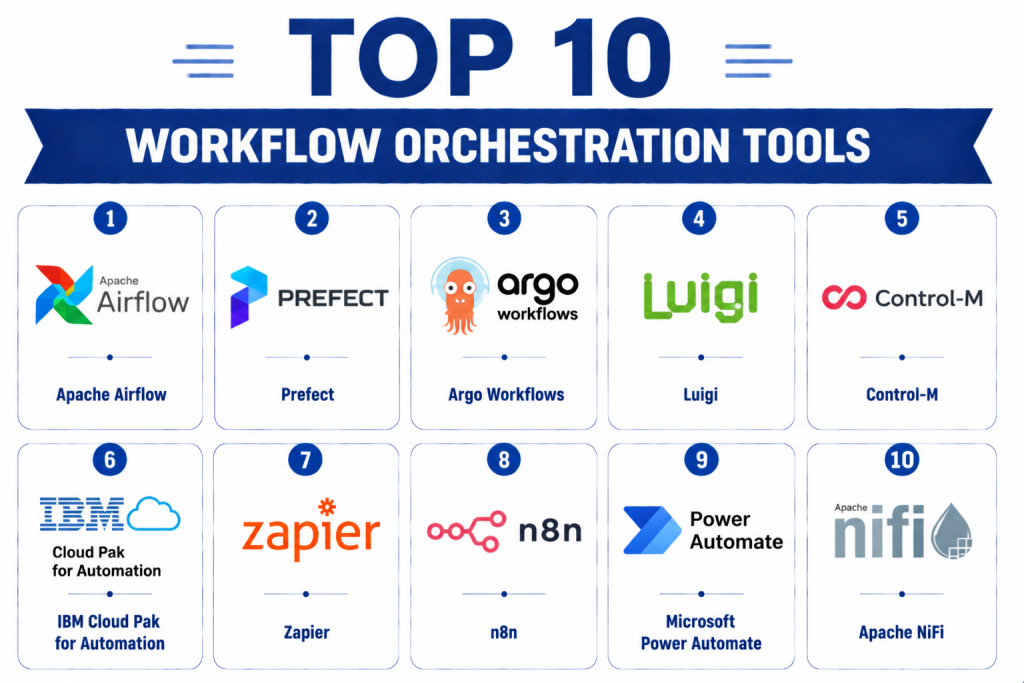
Top 10 Workflow Orchestration Tools
1- Apache Airflow
Short description: Apache Airflow is an open-source platform for authoring, scheduling, and monitoring workflows programmatically. It is widely used for data engineering, analytics pipelines, and ETL processes across enterprises.
Key Features
- DAG-based workflow management
- Scheduler and task dependency management
- Extensive integrations via operators and hooks
- Real-time monitoring and logging
- Scalable executor frameworks
- Customizable UI and dashboards
Pros
- Open-source and widely adopted
- Highly extensible via Python APIs
- Strong community support
Cons
- Requires development expertise
- Limited low-code/no-code capabilities
Platforms / Deployment
- Linux / Cloud / On-prem
Security & Compliance
- RBAC, audit logs
- Not publicly stated for certifications
Integrations & Ecosystem
Integrates with cloud services, databases, and message queues.
- AWS, GCP, Azure
- Hadoop, Spark
- PostgreSQL, MySQL
Support & Community
Extensive documentation, active open-source community, commercial support via vendors.
2- Prefect
Short description: Prefect provides workflow orchestration for data pipelines and business processes with a focus on developer-friendly APIs, cloud orchestration, and hybrid execution.
Key Features
- Cloud and on-prem execution
- Task and DAG orchestration
- Failure handling and retries
- Observability dashboards
- API-first workflow definitions
Pros
- Python-native and developer-friendly
- Cloud and hybrid support
- Strong monitoring and logging
Cons
- Advanced enterprise features require cloud subscription
- Limited visual low-code features
Platforms / Deployment
- Web / Linux / Cloud / Hybrid
Security & Compliance
- RBAC, SSO/SAML, audit logs
- SOC 2 for cloud service
Integrations & Ecosystem
Supports data and SaaS integrations.
- AWS, GCP, Azure
- Snowflake, Databricks
- Slack, Jira
Support & Community
Active community, commercial support plans, detailed docs.
3- Argo Workflows
Short description: Argo Workflows is a Kubernetes-native workflow engine that manages containerized jobs, designed for CI/CD pipelines and AI/ML training workloads in cloud-native environments.
Key Features
- Kubernetes-native execution
- DAG-based container workflow management
- Parallel execution and fan-in/fan-out support
- Scalable and multi-cluster capable
- Workflow templating and YAML-based definitions
Pros
- Optimized for cloud-native container workloads
- Supports CI/CD and ML pipelines
- Open-source and extensible
Cons
- Requires Kubernetes expertise
- No native low-code interface
Platforms / Deployment
- Linux / Cloud / Kubernetes
Security & Compliance
- RBAC via Kubernetes
- Not publicly stated
Integrations & Ecosystem
- GitOps workflows
- TensorFlow, PyTorch ML pipelines
- Prometheus monitoring
Support & Community
Open-source community, active GitHub discussions, commercial support via vendors.
4- Luigi
Short description: Luigi is an open-source Python library for building complex pipelines of batch jobs, often used for ETL processes and data workflows in enterprise environments.
Key Features
- Python-based pipeline definition
- Dependency and task management
- Scheduler and workflow monitoring
- Retry and failure handling
- Simple UI for workflow visualization
Pros
- Lightweight and simple
- Python-native and flexible
- Suitable for batch jobs
Cons
- Limited cloud-native capabilities
- Minimal low-code interface
Platforms / Deployment
- Linux / Cloud / On-prem
Security & Compliance
- User-based access control
- Not publicly stated
Integrations & Ecosystem
- Databases: PostgreSQL, MySQL
- Cloud services: AWS, GCP
- ETL connectors and APIs
Support & Community
Open-source community, extensive tutorials, commercial support via partners.
5- Control-M
Short description: Control-M is a commercial workflow orchestration platform focused on enterprise IT automation, batch processing, and cross-system orchestration.
Key Features
- Centralized job scheduling
- Event-driven workflows
- SLA and exception monitoring
- Multi-platform support
- Prebuilt integrations for enterprise applications
Pros
- Enterprise-grade reliability
- Comprehensive monitoring and alerts
- Strong compliance and audit capabilities
Cons
- Commercial license required
- Higher cost for smaller teams
Platforms / Deployment
- Windows, Linux / Cloud / On-prem
Security & Compliance
- RBAC, SSO/SAML, encryption
- SOC 2, ISO 27001
Integrations & Ecosystem
Supports ERP, databases, cloud, and messaging platforms.
- SAP, Oracle
- AWS, Azure
- Slack, ServiceNow
Support & Community
Vendor support, detailed documentation, user forums.
6- IBM Cloud Pak for Automation
Short description: IBM’s enterprise orchestration suite automates workflows, integrates AI capabilities, and manages multi-cloud processes across IT and business systems.
Key Features
- Intelligent workflow automation
- AI-driven decision support
- Multi-cloud orchestration
- Centralized monitoring and dashboards
- Prebuilt connectors for enterprise applications
Pros
- Enterprise-grade features and AI integration
- Strong scalability for global operations
- End-to-end orchestration
Cons
- Complex setup
- Premium pricing
Platforms / Deployment
- Linux, Windows / Cloud / Hybrid
Security & Compliance
- SSO/SAML, RBAC, audit logs
- SOC 2, ISO 27001
Integrations & Ecosystem
- ERP, CRM, and AI systems
- Cloud services: AWS, Azure, GCP
- APIs for custom workflows
Support & Community
Enterprise support, extensive documentation, consulting services.
7- Zapier
Short description: Zapier is a no-code workflow orchestration platform enabling automation between SaaS applications for marketing, sales, and business process automation.
Key Features
- Drag-and-drop workflow creation
- Prebuilt app integrations
- Multi-step automations
- Real-time triggers and actions
- Error handling and logging
Pros
- No-code interface, accessible to non-technical users
- Fast deployment
- Large app integration ecosystem
Cons
- Not suited for large-scale, on-prem IT workflows
- Limited AI/ML optimization
Platforms / Deployment
- Web / Cloud
Security & Compliance
- OAuth, encryption
- Not publicly stated
Integrations & Ecosystem
- 5,000+ SaaS integrations
- Webhooks and APIs
- Slack, Gmail, Salesforce
Support & Community
Comprehensive tutorials, active community, support tiers.
8- n8n
Short description: n8n is an open-source workflow automation tool with low-code capabilities, enabling orchestration across SaaS, APIs, and custom systems.
Key Features
- Node-based workflow design
- Open-source extensibility
- API integration and webhooks
- Conditional branching
- Cloud or self-hosted deployment
Pros
- Flexible and developer-friendly
- Low-code interface for business users
- Open-source with community contributions
Cons
- Requires self-hosting for full control
- Limited enterprise support
Platforms / Deployment
- Web / Cloud / Self-hosted
Security & Compliance
- RBAC, encryption
- Not publicly stated
Integrations & Ecosystem
- REST, GraphQL APIs
- SaaS connectors: Slack, Airtable, Gmail
- Custom scripts and webhooks
Support & Community
Active open-source community, documentation, forums.
9- Microsoft Power Automate
Short description: Microsoft’s no-code orchestration tool integrates deeply with Microsoft 365 and Azure, automating workflows across enterprise systems.
Key Features
- Drag-and-drop workflow builder
- Prebuilt templates for common processes
- Multi-step workflows with branching
- Cloud and on-premise integration
- AI and RPA capabilities
Pros
- Strong Microsoft ecosystem integration
- No-code for business users
- RPA and AI integration
Cons
- Limited for non-Microsoft environments
- Pricing scales with enterprise features
Platforms / Deployment
- Web / Cloud / Windows
Security & Compliance
- SSO/SAML, RBAC, audit logs
- SOC 2, ISO 27001
Integrations & Ecosystem
- Microsoft 365, Azure
- SQL Server, Dynamics
- APIs for custom connectors
Support & Community
Enterprise support, Microsoft documentation, active forums.
10- Apache NiFi
Short description: Apache NiFi is an open-source data workflow orchestration tool designed for data flow automation, streaming, and integration across enterprise systems.
Key Features
- Visual data flow design
- Real-time monitoring and metrics
- Data provenance tracking
- Flow versioning and rollback
- Multi-source integration
Pros
- Open-source and scalable
- Strong for ETL and data streaming
- Visual workflow builder
Cons
- Primarily data-centric, less suitable for business process automation
- Requires technical expertise
Platforms / Deployment
- Linux / Cloud / On-prem
Security & Compliance
- RBAC, encryption, audit logs
- Not publicly stated
Integrations & Ecosystem
- REST APIs, Kafka, MQTT
- Databases: PostgreSQL, MySQL
- Cloud storage: AWS S3, Azure Blob
Support & Community
Open-source community, documentation, forums.
Comparison Table (Top 10)
| Tool Name | Best For | Platform(s) Supported | Deployment | Standout Feature | Public Rating |
|---|---|---|---|---|---|
| Apache Airflow | Data pipelines | Linux | Cloud / On-prem | DAG-based orchestration | N/A |
| Prefect | Hybrid workflows | Linux / Web | Cloud / Hybrid | Python-native APIs | N/A |
| Argo Workflows | Kubernetes workloads | Linux | Cloud / Kubernetes | Container orchestration | N/A |
| Luigi | Batch pipelines | Linux | Cloud / On-prem | Lightweight Python pipelines | N/A |
| Control-M | Enterprise IT | Windows / Linux | Cloud / On-prem | Centralized IT automation | N/A |
| IBM Cloud Pak | Enterprise automation | Linux / Windows | Cloud / Hybrid | AI-driven orchestration | N/A |
| Zapier | SaaS automation | Web | Cloud | No-code SaaS integration | N/A |
| n8n | Low-code automation | Web | Cloud / Self-hosted | Open-source extensibility | N/A |
| Microsoft Power Automate | Enterprise SaaS | Web / Windows | Cloud / Windows | Microsoft ecosystem integration | N/A |
| Apache NiFi | Data streaming | Linux | Cloud / On-prem | Visual data flow orchestration | N/A |
Evaluation & Scoring of Workflow Orchestration Tools
| Tool Name | Core (25%) | Ease (15%) | Integrations (15%) | Security (10%) | Performance (10%) | Support (10%) | Value (15%) | Weighted Total |
|---|---|---|---|---|---|---|---|---|
| Apache Airflow | 9 | 7 | 8 | 7 | 8 | 7 | 8 | 7.9 |
| Prefect | 8 | 8 | 8 | 7 | 8 | 7 | 8 | 7.9 |
| Argo Workflows | 8 | 7 | 8 | 7 | 8 | 7 | 7 | 7.6 |
| Luigi | 7 | 7 | 7 | 7 | 7 | 7 | 7 | 7.0 |
| Control-M | 9 | 7 | 8 | 8 | 9 | 8 | 7 | 8.1 |
| IBM Cloud Pak | 9 | 7 | 8 | 8 | 9 | 8 | 7 | 8.1 |
| Zapier | 7 | 9 | 8 | 7 | 7 | 7 | 8 | 7.7 |
| n8n | 8 | 8 | 8 | 7 | 8 | 7 | 8 | 7.9 |
| Power Automate | 8 | 8 | 8 | 8 | 8 | 7 | 7 | 7.8 |
| Apache NiFi | 8 | 7 | 8 | 7 | 8 | 7 | 7 | 7.5 |
Interpretation: Weighted totals provide a comparative view of platform strengths. Scores highlight core features, integrations, and usability for enterprise and developer workflows.
Which Workflow Orchestration Tool Is Right for You?
Solo / Freelancer
- Zapier or n8n for SaaS automation and lightweight workflows.
SMB
- Prefect or Apache Airflow for small-scale data pipelines and multi-system automation.
Mid-Market
- Argo Workflows or Luigi for Kubernetes and batch-oriented orchestration.
Enterprise
- Control-M, IBM Cloud Pak, and Microsoft Power Automate for large-scale IT and business process automation.
Budget vs Premium
- Open-source tools like Airflow, Luigi, and n8n provide cost-effective solutions; commercial platforms offer enterprise-grade features and support.
Feature Depth vs Ease of Use
- Zapier and Power Automate emphasize ease of use; Control-M and IBM Cloud Pak provide deeper orchestration capabilities.
Integrations & Scalability
- Prefect, Argo, and Airflow offer high extensibility and scalability across cloud and on-prem deployments.
Security & Compliance Needs
- Enterprises requiring audit trails and SOC 2/ISO compliance should favor Control-M, IBM Cloud Pak, or Power Automate.
Frequently Asked Questions (FAQs)
1- What pricing models do these tools use?
Open-source tools are free; commercial platforms use subscription, per-user, or usage-based pricing.
2- How long does implementation take?
Small workflows can deploy in days; enterprise-grade systems may require weeks.
3- Can these tools integrate with multiple SaaS platforms?
Yes, most platforms support SaaS, APIs, and custom connectors.
4- Are AI or ML features standard?
Some platforms, like IBM Cloud Pak and Power Automate, provide AI-driven optimization, but not all open-source tools include AI.
5- Can these tools handle multi-cloud workflows?
Yes, Prefect, Argo, and n8n are designed for hybrid and multi-cloud orchestration.
6- Do they support low-code/no-code interfaces?
Zapier, Power Automate, and n8n provide visual workflow builders suitable for non-developers.
7- What are common mistakes when adopting workflow orchestration tools?
Neglecting training, overcomplicating workflows, or choosing a platform not aligned with IT infrastructure.
8- How is security managed?
Enterprise platforms support RBAC, SSO/SAML, encryption, and audit logs; open-source tools require configuration.
9- Are these platforms scalable?
Yes, cloud-native and enterprise solutions scale to handle hundreds of workflows and multi-tenant environments.
10- What are alternatives for smaller teams?
Native automation in SaaS apps, simple cron jobs, or lightweight ETL tools may suffice.
Conclusion
Workflow Orchestration Tools streamline multi-system processes, automate complex tasks, and provide visibility into business and data pipelines. The “best” platform depends on scale, technical expertise, cloud strategy, and workflow complexity. Open-source tools like Airflow and n8n offer flexibility, while enterprise platforms like Control-M, IBM Cloud Pak, and Power Automate provide advanced monitoring, security, and support.
