Introduction
Edge AI Inference Platforms are software solutions that enable AI models to run locally on devices at the edge of networks, rather than relying solely on cloud processing. This allows for real-time AI inference, lower latency, and reduced bandwidth usage while maintaining privacy and security.
These platforms are increasingly important as organizations deploy AI-powered devices for autonomous vehicles, robotics, smart factories, and IoT networks. Edge AI ensures that critical decisions can be made instantly on-device while still providing integration with central analytics for management and monitoring.
Real-world use cases include:
- Autonomous vehicles making real-time navigation decisions
- Smart cameras performing facial recognition on-device
- Industrial robots performing quality inspection with AI
- IoT sensors performing anomaly detection locally
- Retail and logistics devices providing AI-driven analytics without cloud dependency
Evaluation criteria for buyers include:
- Support for multiple AI frameworks and models
- Device compatibility and hardware acceleration
- Real-time inference performance
- Integration with cloud management and analytics platforms
- Security and privacy enforcement
- Scalability across edge devices
- Model deployment, monitoring, and updates
- Automation of device orchestration
- Logging, auditing, and compliance capabilities
- Cost efficiency and deployment flexibility
Best for: AI engineers, IoT developers, enterprises deploying AI at scale, and industries requiring real-time intelligence on edge devices.
Not ideal for: Organizations relying solely on cloud inference or small-scale AI applications without latency requirements.
Key Trends in Edge AI Inference Platforms
- Hardware-accelerated AI inference using GPUs, TPUs, and NPUs
- Deployment of containerized AI models at edge nodes
- Automated model updates and version management
- AI-powered predictive maintenance on industrial devices
- Multi-cloud and hybrid integration for centralized monitoring
- Enhanced encryption and certificate-based device security
- Low-latency processing for critical applications
- Device telemetry and real-time monitoring dashboards
- Subscription-based and usage-based pricing models
- Interoperability with IoT and industrial edge platforms
How We Selected These Tools
- Evaluated market adoption and industry usage
- Reviewed completeness of features including real-time AI inference and edge orchestration
- Assessed performance and reliability across heterogeneous edge devices
- Analyzed security posture including encryption and device authentication
- Considered integrations with cloud, IoT, and enterprise AI frameworks
- Assessed suitability across small, mid-market, and enterprise deployments
- Reviewed scalability and hardware compatibility
- Evaluated vendor support, documentation, and developer community
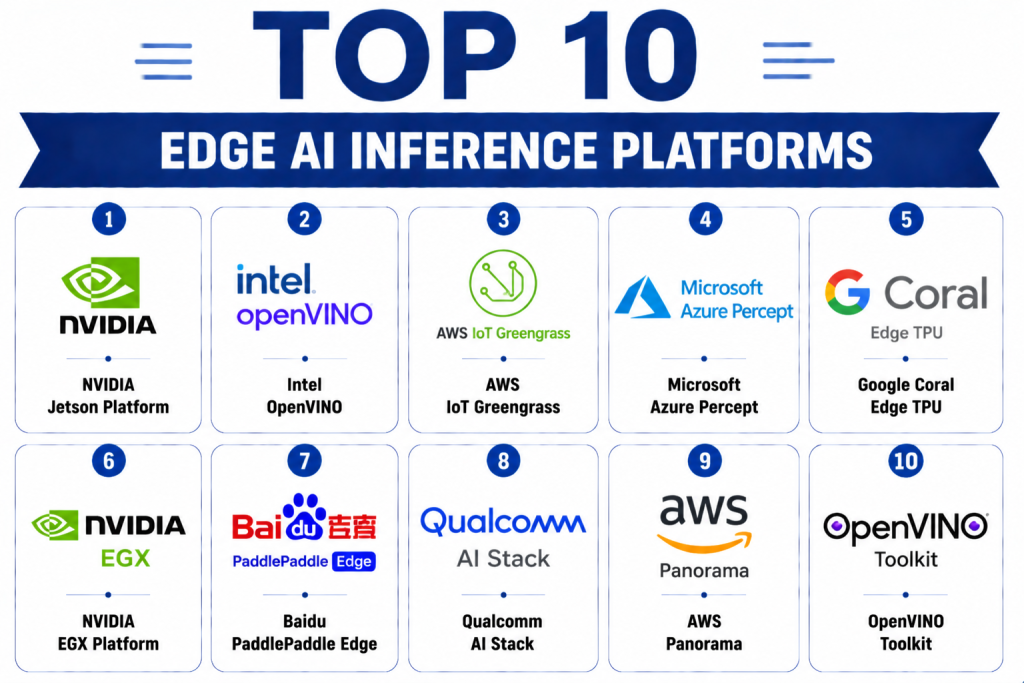
Top 10 Edge AI Inference Platforms
1- NVIDIA Jetson Platform
Short description: Edge AI platform providing GPUs and software tools to run real-time AI inference on robotics, autonomous vehicles, and IoT devices.
Key Features
- GPU-accelerated AI inference
- Supports TensorRT and multiple frameworks
- Real-time data processing
- Device management tools
- OTA model updates
Pros
- High performance for AI workloads
- Strong developer ecosystem
Cons
- Higher hardware cost
- Requires expertise for optimization
Platforms / Deployment
- Linux / NVIDIA Jetson devices
- Edge / On-device
Security & Compliance
- Secure boot, device encryption
- Not publicly stated
Integrations & Ecosystem
- CUDA and AI frameworks
- Robotics and IoT integration
- APIs and SDKs
Support & Community
- NVIDIA developer support
- Community forums
2- Intel OpenVINO
Short description: Open-source toolkit for optimizing and deploying AI models on Intel CPUs, VPUs, and FPGAs for edge inference.
Key Features
- Model optimization and acceleration
- Supports deep learning frameworks
- Low-latency inference
- Device orchestration
- Deployment on heterogeneous Intel hardware
Pros
- Flexible and open-source
- Optimized for Intel hardware
Cons
- Limited GPU acceleration
- Advanced optimization may require expertise
Platforms / Deployment
- Windows / Linux
- Edge / On-device
Security & Compliance
- Device encryption support
- Not publicly stated
Integrations & Ecosystem
- Intel hardware ecosystem
- Cloud analytics integration
- APIs for model deployment
Support & Community
- Intel developer support
- Open-source community
3- AWS IoT Greengrass
Short description: Edge AI platform enabling local AI model inference, device orchestration, and secure data processing with AWS integration.
Key Features
- Local AI model inference
- OTA updates and device management
- Secure communication
- Integration with AWS cloud services
- Real-time monitoring
Pros
- Tight AWS ecosystem integration
- Scales for enterprise IoT
Cons
- AWS dependency
- Subscription-based pricing
Platforms / Deployment
- Linux / Windows
- Cloud / Edge
Security & Compliance
- Encryption, IAM, RBAC
- SOC 2, ISO 27001
Integrations & Ecosystem
- AWS IoT services
- ML model pipelines
- APIs for automation
Support & Community
- AWS support tiers
- Developer forums
4- Microsoft Azure Percept
Short description: AI edge platform designed to deploy models, perform inference locally, and integrate with Azure cloud services for management and analytics.
Key Features
- Real-time inference on edge devices
- Integration with Azure AI and ML
- Device monitoring and OTA updates
- Security and identity management
- Analytics and visualization dashboards
Pros
- Easy integration with Azure cloud
- Supports AI acceleration hardware
Cons
- Azure-centric ecosystem
- Premium features may require subscription
Platforms / Deployment
- Linux / Windows
- Cloud / Edge
Security & Compliance
- Encryption, device authentication
- ISO 27001, SOC 2
Integrations & Ecosystem
- Azure AI and IoT Edge
- APIs and SDKs
- Device telemetry integration
Support & Community
- Microsoft enterprise support
- Developer community
5- Google Coral Edge TPU
Short description: Edge AI platform providing hardware and software for low-power, high-performance inference on embedded devices.
Key Features
- Edge TPU acceleration
- Supports TensorFlow Lite models
- Low-latency real-time inference
- Model deployment tools
- OTA updates
Pros
- Energy-efficient inference
- Optimized for embedded AI
Cons
- Limited to TPU-compatible models
- Smaller enterprise ecosystem
Platforms / Deployment
- Linux / Embedded devices
- Edge / On-device
Security & Compliance
- Device-level encryption
- Not publicly stated
Integrations & Ecosystem
- TensorFlow ecosystem
- IoT sensors
- APIs for deployment
Support & Community
- Google developer support
- Community forums
6- NVIDIA EGX Platform
Short description: Enterprise-grade edge AI platform supporting multi-GPU inference, real-time analytics, and large-scale device management.
Key Features
- Multi-GPU support
- Edge and cloud integration
- Real-time AI analytics
- Device orchestration and monitoring
- OTA model updates
Pros
- High-performance edge inference
- Scales for enterprise deployment
Cons
- High cost
- Complex setup
Platforms / Deployment
- Linux / NVIDIA GPU devices
- Edge / Hybrid
Security & Compliance
- Encryption and RBAC
- SOC 2, ISO 27001
Integrations & Ecosystem
- NVIDIA AI frameworks
- Robotics and IoT integration
- APIs and SDKs
Support & Community
- Enterprise support
- Developer community
7- Baidu PaddlePaddle Edge
Short description: Edge AI platform optimized for deploying deep learning models locally for low-latency inference in IoT and industrial devices.
Key Features
- Local model inference
- Supports multiple AI frameworks
- OTA updates and monitoring
- Edge device orchestration
- Analytics dashboards
Pros
- Optimized for deep learning at edge
- Flexible deployment options
Cons
- Smaller global ecosystem
- Documentation primarily focused on Chinese market
Platforms / Deployment
- Linux / Windows
- Edge / Cloud
Security & Compliance
- Encryption support
- Not publicly stated
Integrations & Ecosystem
- APIs for edge integration
- IoT devices and cloud services
- SDKs for model deployment
Support & Community
- Vendor support
- Community forums
8- Qualcomm AI Stack
Short description: Edge AI inference platform leveraging Qualcomm processors and SDKs for real-time AI on IoT and mobile devices.
Key Features
- Hardware-accelerated AI inference
- Real-time processing
- Device provisioning and management
- OTA updates
- Edge deployment for mobile and IoT
Pros
- Efficient low-power inference
- Strong hardware support
Cons
- Requires Qualcomm hardware
- Enterprise-scale deployment may require additional tooling
Platforms / Deployment
- Linux / Android
- Edge / On-device
Security & Compliance
- Device encryption
- Not publicly stated
Integrations & Ecosystem
- Mobile and IoT integration
- AI frameworks
- APIs and SDKs
Support & Community
- Qualcomm developer support
- Documentation and forums
9- AWS Panorama
Short description: Edge AI platform enabling video and computer vision inference locally with integration into AWS analytics.
Key Features
- Real-time video and CV inference
- Device provisioning
- OTA updates
- Cloud analytics integration
- Policy-based security
Pros
- Optimized for computer vision
- Tight AWS ecosystem integration
Cons
- AWS-centric deployment
- Premium subscription
Platforms / Deployment
- Linux / Windows
- Edge / Cloud
Security & Compliance
- Encryption and RBAC
- SOC 2, ISO 27001
Integrations & Ecosystem
- AWS IoT and ML pipelines
- APIs for automation
- Edge device integration
Support & Community
- AWS enterprise support
- Developer forums
10- OpenVINO Toolkit
Short description: Intel platform for optimizing and deploying AI models at the edge, supporting CPU, GPU, VPU, and FPGA inference.
Key Features
- Model optimization for edge
- Multi-hardware support
- Real-time inference
- Device orchestration
- Deployment tools
Pros
- Flexible hardware support
- Open-source toolkit
Cons
- Requires technical expertise
- Limited cloud orchestration
Platforms / Deployment
- Linux / Windows
- Edge / On-device
Security & Compliance
- Not publicly stated
Integrations & Ecosystem
- Intel hardware and software ecosystem
- APIs for IoT and cloud integration
- AI frameworks
Support & Community
- Intel developer support
- Open-source community
Comparison Table (Top 10 Edge AI Inference Platforms)
| Tool Name | Best For | Platform(s) Supported | Deployment | Standout Feature | Public Rating |
|---|---|---|---|---|---|
| NVIDIA Jetson Platform | Robotics & IoT | Linux / NVIDIA devices | Edge / On-device | GPU-accelerated inference | N/A |
| Intel OpenVINO | Intel hardware edge | Linux / Windows | Edge / On-device | Multi-hardware optimization | N/A |
| AWS IoT Greengrass | Enterprise IoT | Linux / Windows | Cloud / Edge | AWS ecosystem integration | N/A |
| Microsoft Azure Percept | Cloud-edge AI | Linux / Windows | Cloud / Edge | Azure AI integration | N/A |
| Google Coral Edge TPU | Embedded IoT | Linux / Embedded devices | Edge / On-device | Low-power TPU inference | N/A |
| NVIDIA EGX Platform | Enterprise & Industrial | Linux / NVIDIA GPU devices | Edge / Hybrid | Multi-GPU edge inference | N/A |
| Baidu PaddlePaddle Edge | Deep learning edge | Linux / Windows | Edge / Cloud | Low-latency deep learning | N/A |
| Qualcomm AI Stack | Mobile & IoT devices | Linux / Android | Edge / On-device | Hardware-accelerated AI | N/A |
| AWS Panorama | Computer vision | Linux / Windows | Edge / Cloud | Real-time CV inference | N/A |
| OpenVINO Toolkit | Intel-based edge | Linux / Windows | Edge / On-device | Model optimization toolkit | N/A |
Evaluation & Scoring of Edge AI Inference Platforms
| Tool Name | Core (25%) | Ease (15%) | Integrations (15%) | Security (10%) | Performance (10%) | Support (10%) | Value (15%) | Weighted Total (0–10) |
|---|---|---|---|---|---|---|---|---|
| NVIDIA Jetson Platform | 9 | 7 | 8 | 7 | 9 | 7 | 7 | 7.9 |
| Intel OpenVINO | 8 | 7 | 7 | 7 | 8 | 7 | 7 | 7.4 |
| AWS IoT Greengrass | 9 | 7 | 9 | 9 | 9 | 8 | 7 | 8.6 |
| Microsoft Azure Percept | 8 | 7 | 8 | 8 | 8 | 7 | 7 | 7.8 |
| Google Coral Edge TPU | 7 | 8 | 6 | 7 | 7 | 7 | 7 | 7.0 |
| NVIDIA EGX Platform | 9 | 7 | 8 | 8 | 9 | 8 | 7 | 8.2 |
| Baidu PaddlePaddle Edge | 7 | 7 | 7 | 7 | 7 | 7 | 7 | 7.0 |
| Qualcomm AI Stack | 7 | 8 | 6 | 7 | 7 | 7 | 7 | 6.9 |
| AWS Panorama | 8 | 7 | 8 | 8 | 8 | 7 | 7 | 7.8 |
| OpenVINO Toolkit | 7 | 7 | 6 | 7 | 7 | 7 | 7 | 6.8 |
Interpretation: Weighted totals provide a comparative view of real-time inference capabilities, integrations, and edge performance across platforms.
Which Edge AI Inference Platform Is Right for You?
Solo / Freelancer
Google Coral Edge TPU or OpenVINO for small-scale, low-power edge AI projects.
SMB
Intel OpenVINO or NVIDIA Jetson for mid-scale deployments and prototype edge devices.
Mid-Market
AWS IoT Greengrass or Microsoft Azure Percept for enterprise-connected edge AI and orchestration.
Enterprise
NVIDIA EGX, AWS Panorama, or Baidu PaddlePaddle Edge for high-scale, low-latency AI inference across industrial or smart city deployments.
Budget vs Premium
Open-source and low-cost hardware solutions for budget deployments. Premium platforms provide scale, security, and enterprise-grade features.
Feature Depth vs Ease of Use
Complex AI deployments benefit from EGX, Greengrass, or Azure Percept. Smaller projects can leverage Coral Edge TPU or OpenVINO.
Integrations & Scalability
Enterprise deployments need integration with cloud, IoT, and analytics systems for seamless scaling.
Security & Compliance Needs
High-security use cases require encryption, RBAC, SSO, and audit logging support found in AWS and NVIDIA enterprise platforms.
Frequently Asked Questions (FAQs)
1- What is an Edge AI Inference Platform?
It is software that enables AI models to perform inference locally on devices, reducing latency and cloud dependency.
2- Can these platforms scale for large deployments?
Yes, enterprise-grade solutions like NVIDIA EGX and AWS Greengrass can manage thousands of devices.
3- Do they support multiple AI frameworks?
Most platforms support TensorFlow, PyTorch, ONNX, and other common AI frameworks.
4- Are OTA updates included?
Yes, platforms like AWS Greengrass, Azure Percept, and NVIDIA EGX allow OTA model and software updates.
5- Can small-scale projects use these platforms?
Yes, OpenVINO and Coral Edge TPU are ideal for prototyping or small edge AI deployments.
6- How secure are these platforms?
Enterprise platforms provide encryption, RBAC, secure boot, and compliance features like SOC 2 or ISO 27001.
7- Are they suitable for industrial AI applications?
Yes, EGX, Greengrass, and PaddlePaddle Edge are designed for real-time industrial AI inference.
8- Do these platforms offer real-time monitoring?
Yes, dashboards, telemetry, and analytics allow monitoring of edge device performance.
9- Is specialized hardware required?
Some platforms like Coral Edge TPU and NVIDIA EGX require compatible GPUs or TPUs for optimal performance.
10- What are common adoption challenges?
Challenges include hardware compatibility, deployment complexity, model optimization, and secure edge orchestration.
Conclusion
Edge AI Inference Platforms enable real-time AI on devices, improving latency, privacy, and operational efficiency. Small projects may leverage low-cost or open-source solutions, while enterprises require scalable, secure, and integrated platforms. Shortlist , run pilot projects, and validate integration and security before full deployment.
