Introduction
ELT Orchestration Tools are platforms that automate and coordinate Extract, Load, Transform (ELT) data pipelines, enabling organizations to move raw data from sources into target systems and perform transformations at scale. Unlike traditional ETL, ELT pushes transformations to the data warehouse, leveraging its compute power and minimizing intermediate processing.
In , ELT orchestration has become critical as businesses rely on multi-cloud, multi-source data environments. Efficient orchestration ensures that analytics, AI/ML pipelines, and business intelligence workflows run reliably, securely, and on schedule. Modern tools now integrate AI for anomaly detection, predictive execution, and resource optimization, enhancing data operations efficiency.
Real-world use cases include:
- Synchronizing multiple SaaS sources into a cloud data warehouse for analytics.
- Orchestrating ML feature engineering workflows across distributed datasets.
- Automating transformations for marketing, finance, and operational data pipelines.
- Monitoring data quality and applying automated remediation steps.
- Ensuring compliance in healthcare, finance, and regulated industries through automated pipeline controls.
Evaluation Criteria for Buyers:
- Support for batch, streaming, and hybrid pipelines
- Dependency and scheduling management
- Monitoring, logging, and alerting
- Integration with cloud, SaaS, and on-prem systems
- Scalability across large datasets
- AI/ML-driven optimization and anomaly detection
- Security and compliance features (RBAC, audit logs)
- Deployment flexibility (cloud, on-prem, hybrid)
- Ease of use and visualization
- Vendor support and community ecosystem
Best for: Data engineers, analytics teams, DevOps teams, and enterprises managing complex multi-source data pipelines across cloud and on-prem environments.
Not ideal for: Small teams with simple data flows or single-source pipelines; lightweight ETL solutions may be sufficient.
Key Trends in ELT Orchestration Tools
- AI-driven anomaly detection and predictive pipeline scheduling.
- Cloud-native orchestration with hybrid and multi-cloud support.
- Event-driven pipelines triggered by real-time data changes.
- Integrated observability dashboards with lineage tracking.
- Automated data quality checks and error remediation.
- Serverless orchestration and autoscaling for cost efficiency.
- Low-code/no-code workflow builders for broader adoption.
- Direct orchestration of AI/ML feature engineering and training pipelines.
- Microservices and container-native pipeline execution support.
- Flexible subscription and usage-based pricing models.
How We Selected These Tools (Methodology)
- Evaluated market adoption and enterprise usage.
- Reviewed feature completeness: scheduling, dependency management, monitoring.
- Assessed performance and reliability in production-grade pipelines.
- Verified security posture, including access control, encryption, and compliance.
- Checked integration ecosystem with data warehouses, SaaS, and APIs.
- Considered customer fit across SMB, mid-market, and enterprise use cases.
- Prioritized AI/ML optimization and failure prediction capabilities.
- Examined support and community engagement for onboarding and troubleshooting.
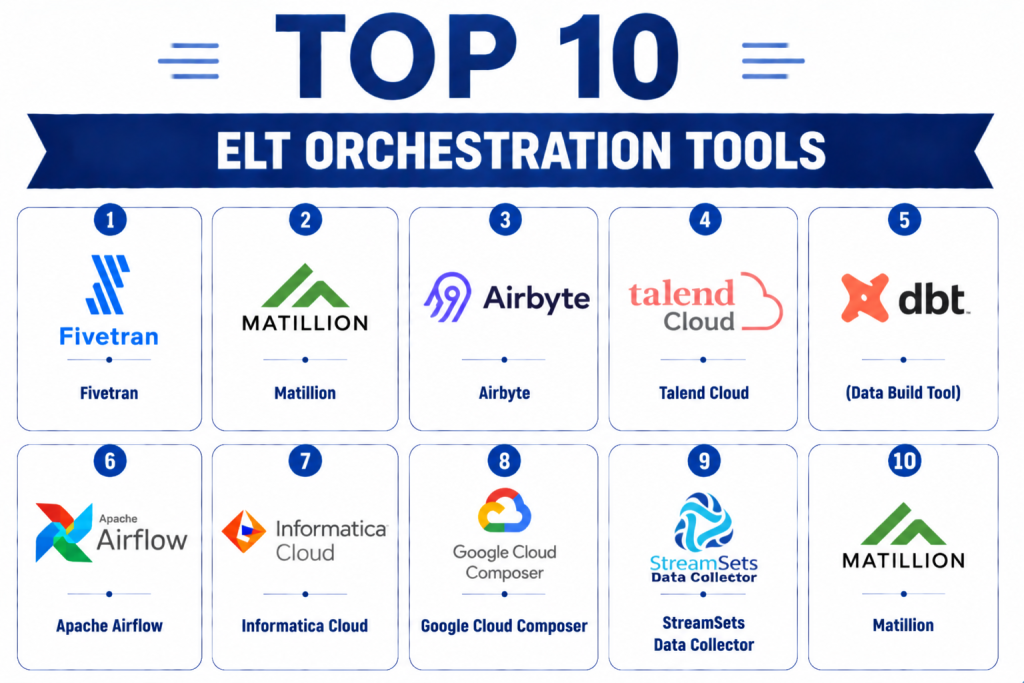
Top 10 ELT Orchestration Tools
1- Fivetran
Short description: Fivetran automates ELT workflows by providing prebuilt connectors for data extraction, loading, and transformation in cloud data warehouses. It is ideal for organizations needing rapid integration with minimal maintenance.
Key Features
- Prebuilt connectors to 200+ sources
- Automated schema management
- Real-time pipeline monitoring
- Cloud data warehouse transformations
- Incremental data syncs
- Error detection and retry mechanisms
Pros
- Quick setup with minimal engineering
- Fully managed and cloud-native
- Scalable across multiple data sources
Cons
- Limited customization beyond predefined connectors
- Cloud-only solution may not fit on-prem use cases
Platforms / Deployment
- Web / Cloud
Security & Compliance
- RBAC, encryption
- SOC 2, GDPR
Integrations & Ecosystem
Integrates with Snowflake, BigQuery, Redshift, and BI tools.
- Tableau, Looker
- dbt for transformations
- Slack alerts
Support & Community
Enterprise-grade support, documentation, active user community.
2- Matillion
Short description: Matillion provides cloud-native ELT orchestration with visual workflows, enabling complex transformations and data integration across cloud data platforms.
Key Features
- Low-code visual workflow builder
- Multi-cloud ELT orchestration
- Real-time monitoring and scheduling
- Transformations executed inside the data warehouse
- Error handling and logging
- Support for large datasets
Pros
- Intuitive low-code interface
- Cloud-native and scalable
- Supports complex transformations
Cons
- Commercial license required
- Limited for on-prem workloads
Platforms / Deployment
- Cloud / Linux
Security & Compliance
- RBAC, encryption
- SOC 2, ISO 27001
Integrations & Ecosystem
- Snowflake, BigQuery, Redshift
- APIs and SaaS connectors
- BI tools: Tableau, Power BI
Support & Community
Vendor support, detailed documentation, community forums.
3- Airbyte
Short description: Airbyte is an open-source ELT platform offering connectors for diverse sources and enabling orchestration into modern data warehouses and lakes.
Key Features
- Open-source connectors for 200+ sources
- Custom connector development
- Incremental and full refresh support
- Cloud and on-prem deployment options
- Monitoring and logging dashboards
Pros
- Open-source and highly extensible
- Flexible deployment options
- Active community contributions
Cons
- Requires technical expertise to configure
- Some advanced connectors are paid
Platforms / Deployment
- Linux / Cloud / On-prem
Security & Compliance
- Encryption, RBAC
- Not publicly stated for SOC 2/ISO 27001
Integrations & Ecosystem
- Snowflake, BigQuery, Redshift
- APIs and webhooks
- dbt integration
Support & Community
Open-source community, active documentation, commercial support via Airbyte Cloud.
4- Talend Cloud
Short description: Talend Cloud provides ELT orchestration with low-code features, data transformation, and pipeline monitoring across cloud and hybrid environments.
Key Features
- Drag-and-drop workflow design
- Cloud and hybrid orchestration
- Data quality checks and validations
- Scheduler and dependency management
- Real-time monitoring and alerts
Pros
- Low-code interface for business users
- Supports batch and streaming pipelines
- Enterprise-grade compliance
Cons
- Commercial licensing
- Advanced features require enterprise plan
Platforms / Deployment
- Cloud / Linux / Windows
Security & Compliance
- RBAC, SSO, encryption
- SOC 2, ISO 27001
Integrations & Ecosystem
- Cloud services: AWS, Azure, GCP
- BI tools: Tableau, Power BI
- SaaS: Salesforce, HubSpot
Support & Community
Enterprise support, documentation, community forums.
5- dbt (Data Build Tool)
Short description: dbt orchestrates ELT transformations inside the warehouse, offering testing, versioning, and modular pipeline management for analytics engineers.
Key Features
- SQL-based transformations
- Version control integration
- Testing and validation framework
- Dependency management for DAGs
- Documentation generation
Pros
- Developer-friendly and modular
- Supports modern cloud data warehouses
- CI/CD integration for analytics workflows
Cons
- Focused on transformations; requires orchestration layer
- Limited streaming capabilities
Platforms / Deployment
- Linux / Cloud / On-prem
Security & Compliance
- RBAC via connected warehouse
- Not publicly stated
Integrations & Ecosystem
- Snowflake, BigQuery, Redshift
- Git integration
- Workflow orchestrators: Airflow, Prefect
Support & Community
Open-source community, enterprise support via dbt Labs.
6- Apache Airflow
Short description: Apache Airflow schedules ELT workflows using DAGs, supporting complex dependency management and monitoring pipelines in cloud and on-prem environments.
Key Features
- DAG-based workflow design
- Scheduler and task dependency management
- Real-time monitoring and logging
- Extensible via Python APIs
- Scalable execution frameworks
- Error handling and retries
Pros
- Open-source and widely adopted
- Flexible and extensible
- Mature ecosystem
Cons
- Requires technical expertise
- Minimal low-code interface
Platforms / Deployment
- Linux / Cloud / On-prem
Security & Compliance
- RBAC, audit logs
- Not publicly stated
Integrations & Ecosystem
- Cloud platforms: AWS, GCP, Azure
- Databases: PostgreSQL, MySQL
- BI tools and frameworks
Support & Community
Large open-source community, documentation, commercial support via partners.
7- Informatica Cloud
Short description: Informatica Cloud provides managed ELT orchestration with monitoring, transformations, and integrations across SaaS, on-prem, and cloud platforms.
Key Features
- Visual pipeline builder
- Real-time monitoring and alerts
- Cloud and on-prem orchestration
- Data quality validation
- Multi-source connectivity
Pros
- Enterprise-grade reliability
- Supports hybrid cloud workflows
- Prebuilt connectors
Cons
- Commercial pricing
- Complexity for small teams
Platforms / Deployment
- Web / Cloud / On-prem
Security & Compliance
- RBAC, encryption
- SOC 2, ISO 27001
Integrations & Ecosystem
- Cloud: AWS, Azure, GCP
- Databases: Snowflake, Redshift
- BI tools: Tableau, Power BI
Support & Community
Enterprise support, detailed documentation, community forums.
8- Google Cloud Composer
Short description: Managed workflow orchestration built on Apache Airflow, Composer simplifies ELT orchestration across Google Cloud services and pipelines.
Key Features
- Managed Airflow execution
- DAG-based workflows
- Cloud-native scaling
- Integration with GCP data services
- Monitoring and alerting dashboards
Pros
- Fully managed service
- Seamless GCP integration
- Scales automatically
Cons
- Limited to Google Cloud ecosystem
- Cost scales with usage
Platforms / Deployment
- Linux / Cloud
Security & Compliance
- RBAC, SSO/SAML
- SOC 2, ISO 27001, GDPR
Integrations & Ecosystem
- BigQuery, Dataflow, Cloud Storage
- APIs and GCP services
- Third-party connectors
Support & Community
Google enterprise support, documentation, forums.
9- StreamSets Data Collector
Short description: StreamSets orchestrates data pipelines with real-time transformations, error handling, and monitoring for hybrid environments.
Key Features
- Real-time and batch pipeline orchestration
- Error handling and retries
- Data lineage and monitoring
- Cloud and on-prem deployments
- API and SaaS integrations
Pros
- Supports streaming ELT pipelines
- Visual pipeline builder
- Hybrid environment support
Cons
- Commercial pricing
- Learning curve for advanced workflows
Platforms / Deployment
- Linux / Cloud / On-prem
Security & Compliance
- RBAC, encryption
- SOC 2, ISO 27001
Integrations & Ecosystem
- Databases and cloud platforms
- APIs and webhooks
- BI tools and data warehouses
Support & Community
Enterprise support, documentation, active user community.
10- Matillion
Short description: Matillion provides cloud-native ELT orchestration with visual pipelines, transformation capabilities, and integration with cloud data platforms.
Key Features
- Visual workflow builder
- Cloud-native ELT orchestration
- Monitoring, logging, and alerts
- Transformation execution in data warehouse
- Scheduler and dependency management
Pros
- Low-code interface
- Cloud-native and scalable
- Supports complex transformations
Cons
- Commercial license required
- Limited on-prem capabilities
Platforms / Deployment
- Cloud / Linux
Security & Compliance
- RBAC, encryption
- SOC 2, ISO 27001
Integrations & Ecosystem
- Snowflake, BigQuery, Redshift
- SaaS connectors
- BI tools and APIs
Support & Community
Vendor support, documentation, community forums.
Comparison Table (Top 10)
| Tool Name | Best For | Platform(s) Supported | Deployment | Standout Feature | Public Rating |
|---|---|---|---|---|---|
| Fivetran | SaaS connectors | Web | Cloud | Fully managed pipelines | N/A |
| Matillion | Cloud transformations | Linux | Cloud | Visual low-code builder | N/A |
| Airbyte | Open-source integrations | Linux | Cloud / On-prem | Extensible connectors | N/A |
| Talend | Hybrid ELT | Linux / Windows | Cloud / Hybrid | Low-code interface | N/A |
| dbt | Transformations in warehouse | Linux | Cloud / On-prem | SQL-based modular workflows | N/A |
| Apache Airflow | Pipeline scheduling | Linux | Cloud / On-prem | DAG orchestration | N/A |
| Informatica Cloud | Enterprise orchestration | Web | Cloud / On-prem | End-to-end monitoring | N/A |
| Cloud Composer | GCP-native pipelines | Linux | Cloud | Managed Airflow service | N/A |
| StreamSets | Streaming & batch ELT | Linux | Cloud / On-prem | Real-time monitoring | N/A |
| Matillion | Cloud ELT | Linux | Cloud | Warehouse-native transformations | N/A |
Evaluation & Scoring of ELT Orchestration Tools
| Tool Name | Core (25%) | Ease (15%) | Integrations (15%) | Security (10%) | Performance (10%) | Support (10%) | Value (15%) | Weighted Total |
|---|---|---|---|---|---|---|---|---|
| Fivetran | 9 | 8 | 8 | 8 | 8 | 8 | 7 | 8.2 |
| Matillion | 8 | 8 | 8 | 8 | 8 | 7 | 7 | 7.9 |
| Airbyte | 8 | 7 | 8 | 7 | 8 | 7 | 8 | 7.8 |
| Talend | 8 | 8 | 8 | 8 | 8 | 7 | 7 | 7.9 |
| dbt | 8 | 7 | 7 | 7 | 8 | 7 | 8 | 7.7 |
| Apache Airflow | 9 | 7 | 8 | 7 | 8 | 7 | 8 | 7.9 |
| Informatica Cloud | 8 | 7 | 8 | 8 | 8 | 7 | 7 | 7.8 |
| Cloud Composer | 8 | 8 | 8 | 8 | 8 | 7 | 7 | 7.8 |
| StreamSets | 8 | 7 | 8 | 8 | 8 | 7 | 7 | 7.8 |
| Matillion | 8 | 8 | 8 | 8 | 8 | 7 | 7 | 7.9 |
Interpretation: Weighted scores compare ELT orchestration platforms by core features, integrations, ease of use, and enterprise suitability. Higher scores indicate stronger overall capabilities.
Which ELT Orchestration Tool Is Right for You?
Solo / Freelancer
- Airbyte or dbt for open-source flexibility and low-cost experimentation.
SMB
- Fivetran or Matillion for quick cloud-native deployments with minimal engineering.
Mid-Market
- Apache Airflow, StreamSets, or Talend for multi-source, hybrid pipelines.
Enterprise
- Informatica Cloud, Cloud Composer, and Matillion for large-scale, monitored ELT orchestration.
Budget vs Premium
- Open-source solutions offer cost efficiency; commercial tools provide advanced monitoring, transformations, and support.
Feature Depth vs Ease of Use
- Airbyte and dbt offer developer-centric depth; Matillion and Talend balance low-code interfaces with enterprise features.
Integrations & Scalability
- Fivetran, Airflow, and Cloud Composer scale across cloud, hybrid, and multi-warehouse environments.
Security & Compliance Needs
- Enterprises needing audit, RBAC, SOC 2, and ISO 27001 compliance should select Informatica Cloud, Matillion, or Cloud Composer.
Frequently Asked Questions (FAQs)
1- What pricing models are common for ELT orchestration tools?
Open-source tools are free; commercial solutions often use subscription, per-source, or enterprise licensing.
2- How long does implementation take?
Small-scale pipelines deploy in days; enterprise-grade systems require weeks of setup.
3- Can these tools manage both batch and streaming pipelines?
Yes, most top tools support hybrid workloads.
4- Are AI/ML features included for optimization?
Some platforms include AI-driven anomaly detection and predictive scheduling; others rely on integrations.
5- Do these tools support multi-cloud orchestration?
Yes, modern ELT orchestrators like Fivetran, Airflow, and Cloud Composer can orchestrate cross-cloud pipelines.
6- Are low-code or no-code workflows available?
Yes, Matillion, Talend, and Fivetran offer visual workflow designers.
7- What are common adoption mistakes?
Neglecting monitoring, misaligned source/target planning, or ignoring schema changes.
8- How is security handled?
Enterprise platforms include RBAC, SSO/SAML, encryption, and audit logging.
9- Can these tools scale for large datasets?
Yes, they scale horizontally in cloud and hybrid environments.
10- What are alternatives for small teams?
Simple SaaS connectors, cron jobs, or lightweight ETL tools may suffice for minimal pipelines.
Conclusion
ELT Orchestration Tools automate, monitor, and optimize data pipelines across complex, multi-source, multi-cloud environments. Open-source platforms like Airbyte and dbt provide flexibility and cost efficiency, while commercial tools like Fivetran, Matillion, and Cloud Composer offer enterprise-grade monitoring, transformations, and support.
