Introduction
Data Transformation Tools are software platforms that convert raw data into structured formats suitable for analysis, reporting, and integration into other systems. They simplify data cleaning, enrichment, aggregation, and formatting tasks, enabling organizations to make data-driven decisions effectively.
These tools are critical for organizations that handle large volumes of data from diverse sources, including databases, APIs, IoT devices, and SaaS applications. By streamlining data preparation and transformation, businesses can improve analytics accuracy, enhance operational efficiency, and accelerate AI/ML workflows.
Real-world use cases include:
- Integrating data from multiple business applications into a unified warehouse
- Preparing datasets for machine learning or predictive analytics
- Cleaning and normalizing large-scale IoT or sensor data
- Automating ETL processes for reporting and dashboards
- Transforming legacy system data for migration to modern cloud platforms
Evaluation criteria for buyers include:
- Ease of use and low-code/no-code capabilities
- Connectivity to multiple data sources
- Support for real-time or batch processing
- Scalability and performance
- Data quality and validation features
- Transformation logic flexibility and scripting
- Security and compliance controls
- Integration with BI and analytics tools
- Automation and workflow orchestration
- Pricing and total cost of ownership
Best for: Data engineers, analysts, IT teams, and enterprises handling complex or large-scale datasets.
Not ideal for: Small businesses with limited data processing needs or organizations relying on manual spreadsheet workflows.
Key Trends in Data Transformation Tools
- AI-driven data mapping and anomaly detection
- Real-time streaming data transformation
- Low-code/no-code transformation pipelines
- Cloud-native deployment with auto-scaling capabilities
- Integration with modern data warehouses and lakehouse architectures
- Advanced data validation and quality assurance
- Support for structured, semi-structured, and unstructured data
- Automated ETL workflow orchestration
- Flexible pricing models and subscription-based deployments
- Enhanced security including encryption, RBAC, and audit logging
How We Selected These Tools
- Evaluated market adoption and enterprise usage
- Reviewed feature completeness and transformation capabilities
- Assessed performance, scalability, and reliability
- Verified security and compliance capabilities
- Considered integrations with cloud platforms, BI tools, and analytics stacks
- Checked support for multiple data formats and sources
- Analyzed workflow automation and orchestration support
- Evaluated vendor support, community presence, and documentation
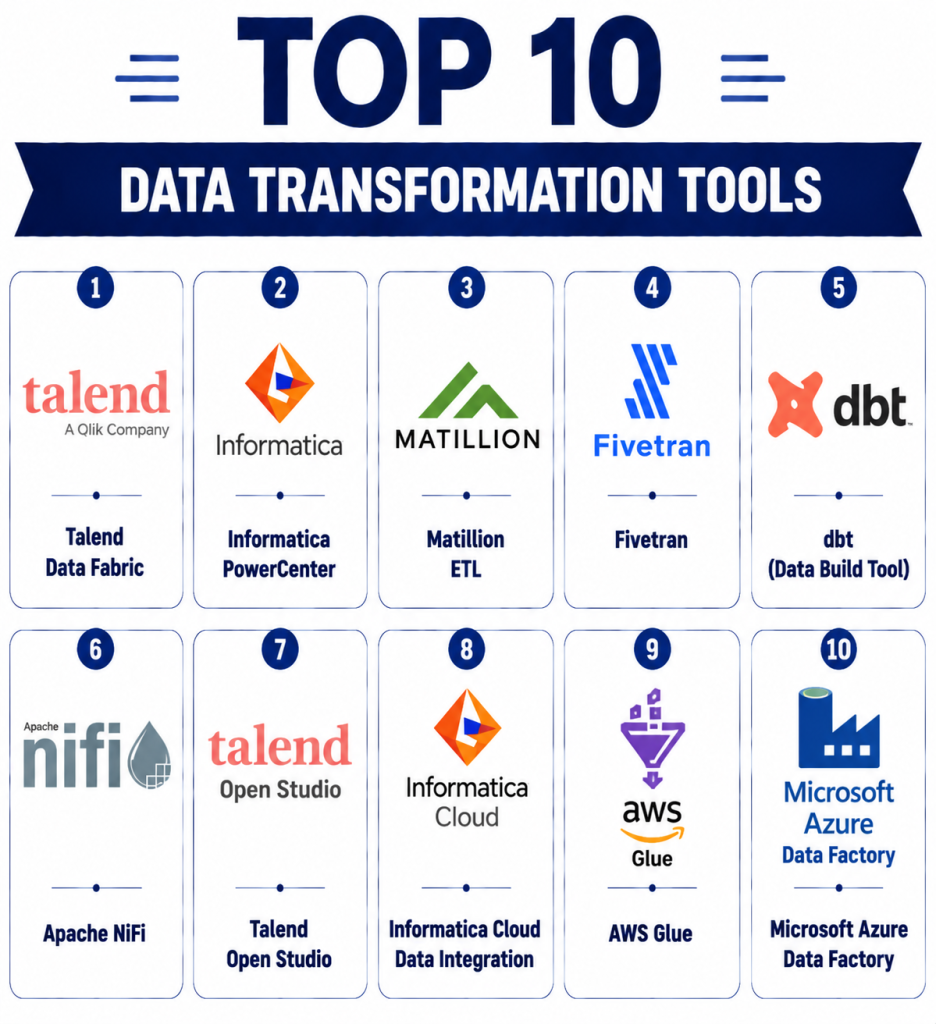
Top 10 Data Transformation Tools
1- Talend Data Fabric
Short description: Talend Data Fabric is a comprehensive data integration and transformation platform for enterprises. It simplifies ETL processes and supports real-time and batch processing for structured and unstructured data.
Key Features
- Visual data pipeline designer
- Real-time and batch data processing
- Pre-built connectors for cloud and on-premises sources
- Data quality and validation tools
- API and microservices integration
Pros
- Unified platform for integration and transformation
- Strong enterprise support and scalability
Cons
- Higher learning curve for complex transformations
- Enterprise licensing costs
Platforms / Deployment
- Windows / Linux / macOS
- Cloud / On-premises / Hybrid
Security & Compliance
- SSO/SAML, encryption, audit logs
- SOC 2 / ISO 27001
Integrations & Ecosystem
- Connects with Snowflake, Redshift, Azure, and Google BigQuery
- REST API integration
- Supports workflow orchestration
- Extensible via custom components
Support & Community
- Professional support tiers
- Active user community and documentation
2- Informatica PowerCenter
Short description: Informatica PowerCenter is an enterprise-grade data integration and transformation tool. It is widely used for ETL workflows, supporting complex data mapping and transformations across large datasets.
Key Features
- Graphical ETL workflow designer
- Batch and real-time processing
- Metadata management
- Data profiling and validation
- Support for heterogeneous sources
Pros
- Robust enterprise features
- Scalable for large data volumes
Cons
- Expensive licensing
- Requires skilled developers for advanced features
Platforms / Deployment
- Windows / Linux / macOS
- Cloud / On-premises / Hybrid
Security & Compliance
- RBAC, encryption, SSO
- Not publicly stated
Integrations & Ecosystem
- Supports major data warehouses and cloud platforms
- APIs for automation
- Extensible with custom connectors
Support & Community
- Vendor support packages
- Community forums and documentation
3- Matillion ETL
Short description: Matillion ETL is a cloud-native data transformation platform designed for cloud data warehouses. It enables rapid transformation and orchestration of data pipelines using a low-code interface.
Key Features
- Visual job designer
- Cloud-native processing
- Pre-built connectors for major sources
- Scheduling and orchestration
- Data quality checks
Pros
- Optimized for cloud data warehouses
- Low-code interface for faster development
Cons
- Cloud-only deployment
- Limited on-premises support
Platforms / Deployment
- Cloud (AWS, Azure, GCP)
Security & Compliance
- SSO, encryption, audit logging
- Not publicly stated
Integrations & Ecosystem
- Connectors to Salesforce, Snowflake, Redshift
- Workflow automation
- Extensible through APIs
Support & Community
- Vendor support
- Documentation and online tutorials
4- Fivetran
Short description: Fivetran is a fully managed ETL and ELT platform that automates data extraction, transformation, and loading from multiple sources to cloud data warehouses.
Key Features
- Fully automated data pipelines
- Incremental data updates
- Pre-built connectors
- Schema drift handling
- Monitoring and logging
Pros
- Minimal maintenance required
- Rapid setup and integration
Cons
- Less flexibility in custom transformations
- Cloud-only deployment
Platforms / Deployment
- Cloud (AWS, Azure, GCP)
Security & Compliance
- Encryption at rest and in transit
- SOC 2 compliance
Integrations & Ecosystem
- Integrates with Snowflake, BigQuery, Redshift
- APIs for monitoring and alerts
- Connectors to SaaS platforms
Support & Community
- Professional support tiers
- Knowledge base and community
5- dbt (Data Build Tool)
Short description: dbt is a transformation tool that enables data analysts and engineers to perform analytics engineering directly within cloud data warehouses using SQL.
Key Features
- SQL-based transformations
- Version control integration
- Automated testing and documentation
- Modular workflow design
- CI/CD pipeline integration
Pros
- Great for analytics engineering
- Open-source core with cloud options
Cons
- Requires SQL knowledge
- No native ETL extraction features
Platforms / Deployment
- Linux / macOS
- Cloud / On-premises
Security & Compliance
- SSO, RBAC
- Not publicly stated
Integrations & Ecosystem
- Integrates with Snowflake, BigQuery, Redshift
- GitHub/GitLab for version control
- Workflow orchestration with Airflow
Support & Community
- Strong open-source community
- Paid cloud support
6- Apache NiFi
Short description: Apache NiFi is an open-source data integration and transformation platform designed for real-time streaming and batch processing.
Key Features
- Drag-and-drop flow design
- Real-time streaming transformations
- Extensive processor library
- Data provenance tracking
- Security controls and access management
Pros
- Open-source and flexible
- Excellent for real-time data
Cons
- Requires configuration expertise
- Steeper learning curve
Platforms / Deployment
- Linux / Windows / macOS
- On-premises / Cloud
Security & Compliance
- SSL, authentication, RBAC
- Not publicly stated
Integrations & Ecosystem
- Connects with Kafka, AWS S3, HDFS
- APIs for automation
- Extensible via custom processors
Support & Community
- Community support
- Extensive documentation
7- Talend Open Studio
Short description: Talend Open Studio is a free, open-source data integration and transformation tool, suitable for small to medium-scale data workflows.
Key Features
- Visual job designer
- Pre-built connectors
- Data quality components
- Batch processing support
- Extensible with custom scripts
Pros
- Free and open-source
- Easy to get started
Cons
- Limited enterprise features
- Performance constraints for large datasets
Platforms / Deployment
- Linux / Windows / macOS
- On-premises / Cloud
Security & Compliance
- Not publicly stated
Integrations & Ecosystem
- Cloud storage connectors
- APIs for automation
- Extensible via Java components
Support & Community
- Community support
- Documentation available
8- Informatica Cloud Data Integration
Short description: Informatica Cloud provides a managed data transformation solution with ETL/ELT, workflow automation, and connectivity to cloud applications.
Key Features
- Cloud-native integration
- Pre-built connectors
- Scheduling and orchestration
- Monitoring and alerting
- Data quality features
Pros
- Enterprise-grade cloud solution
- Supports diverse SaaS applications
Cons
- Commercial licensing
- Cloud-only deployment
Platforms / Deployment
- Cloud
Security & Compliance
- SSO, RBAC, encryption
- SOC 2 / ISO 27001
Integrations & Ecosystem
- Salesforce, Workday, Snowflake connectors
- APIs for automation
- Workflow orchestration
Support & Community
- Enterprise support
- Documentation and tutorials
9- AWS Glue
Short description: AWS Glue is a fully managed ETL and data transformation service that automates schema discovery, job scheduling, and transformation workflows.
Key Features
- Serverless ETL
- Schema discovery and cataloging
- Job scheduling and automation
- Supports structured and semi-structured data
- Integration with AWS ecosystem
Pros
- Serverless, minimal maintenance
- Seamless integration with AWS services
Cons
- Cloud-only
- Limited outside AWS ecosystem
Platforms / Deployment
- Cloud (AWS)
Security & Compliance
- IAM, encryption, audit logging
- SOC 2 / ISO 27001
Integrations & Ecosystem
- Redshift, S3, Athena, RDS
- APIs for workflow integration
- Event-driven triggers
Support & Community
- AWS enterprise support
- Community forums
10- Microsoft Azure Data Factory
Short description: Azure Data Factory is a cloud-based data integration service for orchestrating and transforming data across diverse sources with ETL/ELT pipelines.
Key Features
- Visual workflow designer
- Data transformation activities
- Real-time and batch processing
- Connectors to multiple data stores
- Monitoring and alerting
Pros
- Deep integration with Azure ecosystem
- Supports large-scale data pipelines
Cons
- Azure-focused
- Licensing costs
Platforms / Deployment
- Cloud (Azure)
Security & Compliance
- Azure AD, encryption, RBAC
- SOC 2 / ISO 27001
Integrations & Ecosystem
- Azure SQL, Blob Storage, Synapse
- APIs for automation
- Integration with Power BI
Support & Community
- Enterprise support
- Documentation and tutorials
Comparison Table (Top 10 Data Transformation Tools)
| Tool Name | Best For | Platform(s) Supported | Deployment | Standout Feature | Public Rating |
|---|---|---|---|---|---|
| Talend Data Fabric | Enterprise ETL | Linux / Windows / macOS | Cloud / Hybrid | Unified platform | N/A |
| Informatica PowerCenter | Enterprise ETL | Linux / Windows / macOS | Cloud / Hybrid | Robust enterprise features | N/A |
| Matillion ETL | Cloud data warehouses | Cloud (AWS, Azure, GCP) | Cloud | Low-code transformations | N/A |
| Fivetran | Automated ETL pipelines | Cloud | Cloud | Fully managed connectors | N/A |
| dbt | Analytics engineering | Linux / macOS | Cloud / On-prem | SQL-based transformations | N/A |
| Apache NiFi | Real-time streaming | Linux / Windows / macOS | Cloud / On-prem | Flow-based processing | N/A |
| Talend Open Studio | Small/medium projects | Linux / Windows / macOS | Cloud / On-prem | Free open-source | N/A |
| Informatica Cloud Data Integration | SaaS integration | Cloud | Cloud | Cloud-native connectors | N/A |
| AWS Glue | AWS workloads | Cloud (AWS) | Cloud | Serverless ETL | N/A |
| Azure Data Factory | Azure ecosystem | Cloud (Azure) | Cloud | Cloud orchestration | N/A |
Evaluation & Scoring of Data Transformation Tools
| Tool Name | Core (25%) | Ease (15%) | Integrations (15%) | Security (10%) | Performance (10%) | Support (10%) | Value (15%) | Weighted Total (0–10) |
|---|---|---|---|---|---|---|---|---|
| Talend Data Fabric | 9 | 8 | 9 | 8 | 8 | 8 | 8 | 8.5 |
| Informatica PowerCenter | 9 | 7 | 8 | 8 | 8 | 8 | 7 | 8.0 |
| Matillion ETL | 8 | 8 | 8 | 7 | 7 | 7 | 8 | 7.7 |
| Fivetran | 7 | 9 | 7 | 7 | 7 | 7 | 8 | 7.6 |
| dbt | 8 | 8 | 8 | 7 | 7 | 7 | 7 | 7.5 |
| Apache NiFi | 8 | 7 | 8 | 7 | 7 | 7 | 7 | 7.3 |
| Talend Open Studio | 7 | 8 | 7 | 6 | 6 | 6 | 8 | 7.0 |
| Informatica Cloud Data Integration | 8 | 7 | 8 | 7 | 7 | 7 | 7 | 7.4 |
| AWS Glue | 8 | 8 | 8 | 7 | 7 | 7 | 7 | 7.5 |
| Azure Data Factory | 8 | 8 | 8 | 7 | 7 | 7 | 7 | 7.5 |
Interpretation: The weighted total provides a comparative measure of capabilities, ease of use, integrations, and overall value across tools. Higher scores indicate more robust, enterprise-ready functionality.
Which Data Transformation Tool Is Right for You?
Solo / Freelancer
Talend Open Studio or dbt for small-scale data pipelines and analytics projects.
SMB
Matillion ETL or Fivetran for cloud-based, semi-automated transformation workflows.
Mid-Market
Talend Data Fabric or Informatica Cloud Data Integration for larger volumes and multi-source integrations.
Enterprise
Informatica PowerCenter, AWS Glue, or Azure Data Factory for enterprise-scale pipelines and real-time transformations.
Budget vs Premium
Open-source tools suit cost-conscious users; premium platforms offer enhanced support, scalability, and enterprise integrations.
Feature Depth vs Ease of Use
Complex pipelines benefit from Talend Data Fabric or Informatica PowerCenter; simpler workflows are faster with Matillion or Fivetran.
Integrations & Scalability
Cloud-native tools provide seamless connectivity to SaaS apps, data warehouses, and lakehouse platforms.
Security & Compliance Needs
Enterprise tools include encryption, RBAC, SSO, and audit logging to meet compliance requirements.
Frequently Asked Questions (FAQs)
1- What is a data transformation tool?
It converts raw data into structured, usable formats for analytics, reporting, or integration with other systems.
2- Can these tools handle real-time streaming data?
Yes, tools like Apache NiFi and Talend support real-time and batch transformations.
3- Are open-source transformation tools reliable?
Yes, platforms like dbt, Apache NiFi, and Talend Open Studio are widely used in production workflows.
4- Do these tools integrate with cloud data warehouses?
Most tools integrate with Snowflake, Redshift, BigQuery, Azure Synapse, and similar platforms.
5- Can small businesses benefit from these platforms?
Yes, open-source and cloud-native tools are ideal for SMBs with moderate data processing needs.
6- What security features are included?
Enterprise-grade tools include encryption, RBAC, SSO, and audit logging for compliance.
7- Do these tools support ETL and ELT?
Yes, they provide both ETL and ELT workflows for batch and real-time processing.
8- Is coding knowledge required?
Low-code/no-code platforms reduce the need for extensive coding; SQL or Python may still be useful.
9- How scalable are these platforms?
Enterprise platforms scale to large datasets, multi-node clusters, and multi-cloud deployments.
10- How do I choose the right data transformation tool?
Consider data volume, sources, real-time needs, cloud preference, security requirements, and support availability.
Conclusion
Data Transformation Tools are essential for preparing data for analytics, AI/ML, and operational insights. Open-source options serve small-scale projects, while enterprise platforms provide scalability, automation, and advanced integrations. Organizations should shortlist , run pilot workflows, and validate security, scalability, and integrations before wide deployment.
