Introduction
Vector Search Tooling refers to specialized search platforms that leverage vector embeddings to perform similarity-based retrieval across large datasets. Unlike traditional keyword search, vector search enables semantic understanding, allowing retrieval based on meaning, context, and relationships in unstructured data.
These platforms are essential for AI-driven applications, semantic search, recommendation engines, and enterprise knowledge management. They allow organizations to search images, text, audio, and video using embeddings, providing more accurate results in complex datasets.
Real-world use cases include:
- Semantic search across documents, knowledge bases, and wikis.
- AI-powered recommendation engines for e-commerce and media.
- Image and video similarity search for digital asset management.
- Chatbots and virtual assistants that understand context.
- Fraud detection and anomaly detection in unstructured datasets.
Evaluation Criteria for Buyers:
- Embedding model support (text, image, audio)
- Query performance and low-latency similarity search
- Scalability for billions of vectors
- Integration with ML pipelines and BI tools
- Deployment flexibility (cloud, on-prem, hybrid)
- Security, access control, and compliance
- Visualization and analytics for search results
- API support and SDK availability
- Multi-language or domain-specific embeddings
- Vendor support and community strength
Best for: AI/ML engineers, data scientists, and enterprises managing large unstructured datasets needing semantic search and similarity-based retrieval.
Not ideal for: Organizations with only keyword-based search needs or small datasets where vector search provides limited benefit.
Key Trends in Vector Search Tooling
- AI-optimized embeddings for semantic search and similarity retrieval
- Multi-modal search across text, images, audio, and video
- Integration with generative AI pipelines
- Hybrid cloud and multi-region deployments
- Real-time index updates and low-latency querying
- Knowledge graph integration for contextual search
- Low-code/no-code interfaces for analysts
- Security enhancements including encryption, RBAC, and SSO
- Advanced analytics and search performance monitoring
- Flexible consumption-based pricing models
How We Selected These Tools (Methodology)
- Evaluated market adoption and enterprise usage
- Assessed feature completeness including embeddings and multi-modal support
- Verified performance, scalability, and latency benchmarks
- Checked security posture: RBAC, SSO, encryption
- Reviewed integration ecosystem with ML, AI, and analytics tools
- Considered fit for SMB, mid-market, and enterprise
- Prioritized platforms with AI and vector embedding capabilities
- Evaluated support, documentation, and community engagement
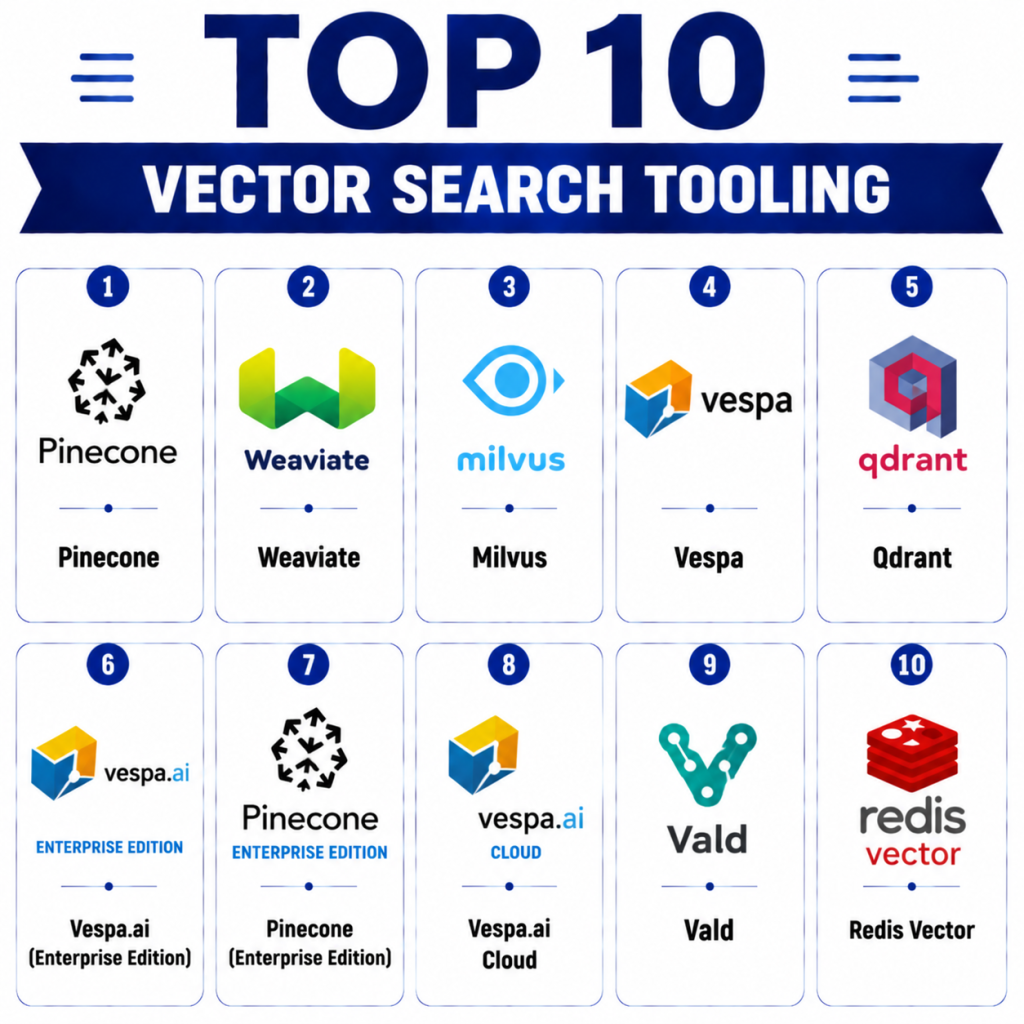
Top 10 Vector Search Tooling
1- Pinecone
Short description: Pinecone provides a fully managed vector database for similarity search. It supports billions of embeddings and integrates with ML pipelines for semantic search.
Key Features
- Cloud-native, fully managed vector DB
- Low-latency similarity search
- Real-time updates and batch indexing
- Multi-region deployment
- APIs for Python, Java, and REST
- Integration with ML frameworks
Pros
- Scalable and easy to deploy
- High performance for large datasets
- Simple developer experience
Cons
- Cloud-only deployment
- Enterprise features may require licensing
Platforms / Deployment
- Cloud
Security & Compliance
- Encryption at rest and in transit
- RBAC and SSO
- Not publicly stated for formal certifications
Integrations & Ecosystem
- ML frameworks: TensorFlow, PyTorch
- BI tools
- REST API and Python SDK
Support & Community
- Documentation, enterprise support, active developer community
2- Weaviate
Short description: Weaviate is an open-source vector search engine with native machine learning support, enabling semantic search across text, image, and structured data.
Key Features
- Multi-modal embedding support
- Graph and vector hybrid search
- Real-time updates
- REST and GraphQL APIs
- ML model integration
- Scalable clustering
Pros
- Open-source and extensible
- Multi-modal support
- Flexible deployment options
Cons
- Complex setup for large clusters
- Commercial support required for enterprise features
Platforms / Deployment
- Linux / Cloud / On-prem / Hybrid
Security & Compliance
- RBAC, encryption
- Not publicly stated
Integrations & Ecosystem
- ML frameworks
- REST and GraphQL APIs
- Cloud storage connectors
Support & Community
- Open-source community, enterprise support, documentation
3- Milvus
Short description: Milvus is a high-performance open-source vector database optimized for AI applications, supporting billions of vectors with GPU acceleration.
Key Features
- GPU-accelerated similarity search
- Multi-modal embeddings support
- Horizontal scalability
- Real-time and batch indexing
- REST, Python, and Java SDKs
- Hybrid cloud deployment
Pros
- Extremely fast similarity search
- Supports large-scale vector datasets
- Open-source flexibility
Cons
- Setup requires technical expertise
- Enterprise support is optional
Platforms / Deployment
- Linux / Cloud / On-prem / Hybrid
Security & Compliance
- Encryption support
- Not publicly stated
Integrations & Ecosystem
- ML frameworks
- Python and Java SDKs
- Cloud connectors
Support & Community
- Open-source community, commercial enterprise support
4- Vespa
Short description: Vespa is a real-time serving engine combining vector search and full-text search for semantic retrieval and recommendation systems.
Key Features
- Hybrid vector and keyword search
- Real-time ranking and recommendation
- Scalable multi-node clusters
- REST and Java APIs
- Machine learning integration
- Analytics and monitoring
Pros
- Combines vector search with traditional search
- Real-time predictions and ranking
- High scalability
Cons
- Complex configuration
- Learning curve for query tuning
Platforms / Deployment
- Linux / Cloud / On-prem / Hybrid
Security & Compliance
- RBAC, encryption
- Not publicly stated
Integrations & Ecosystem
- ML frameworks
- REST and Java APIs
- Analytics dashboards
Support & Community
- Enterprise support, documentation, active developer community
5- Qdrant
Short description: Qdrant is an open-source vector search engine designed for semantic search and recommendation use cases, with high-speed indexing and retrieval.
Key Features
- Fast similarity search
- Multi-modal embeddings
- REST and gRPC APIs
- Scalable clustering
- Real-time updates
- Cloud and on-prem deployment
Pros
- Lightweight and fast
- Open-source with community support
- Easy integration with AI pipelines
Cons
- Limited enterprise features in open-source version
- Smaller ecosystem than some competitors
Platforms / Deployment
- Linux / Cloud / On-prem / Hybrid
Security & Compliance
- Encryption and access control
- Not publicly stated
Integrations & Ecosystem
- Python SDK
- ML frameworks
- REST and gRPC APIs
Support & Community
- Documentation, community forums, enterprise support available
6- Vespa.ai (Enterprise Edition)
Short description: Enterprise version of Vespa providing full vector and semantic search capabilities with enterprise-grade security, monitoring, and support.
Key Features
- Real-time vector and keyword search
- Advanced analytics and monitoring
- Multi-cloud deployment
- ML model integration
- Enterprise security compliance
Pros
- Enterprise-grade support
- Scalable for multi-region deployments
- Real-time vector ranking
Cons
- Enterprise licensing required
- Setup complexity
Platforms / Deployment
- Linux / Cloud / On-prem / Hybrid
Security & Compliance
- RBAC, SSO, encryption
- SOC 2, ISO 27001
Integrations & Ecosystem
- ML pipelines
- REST APIs
- Analytics dashboards
Support & Community
- Enterprise support, documentation, community engagement
7- Pinecone (Enterprise Edition)
Short description: Enterprise Pinecone adds SLA-backed, multi-region support with enhanced monitoring and analytics for vector search applications.
Key Features
- Multi-region deployment
- SLA-backed uptime
- Real-time vector updates
- Enhanced analytics
- Enterprise monitoring and logging
Pros
- Fully managed and SLA-backed
- Multi-region support
- High performance
Cons
- Premium pricing
- Cloud-only deployment
Platforms / Deployment
- Cloud
Security & Compliance
- RBAC, encryption, SSO
- SOC 2, ISO 27001
Integrations & Ecosystem
- ML frameworks
- BI and analytics tools
- REST API
Support & Community
- Enterprise support, documentation, developer forums
8- Vespa.ai Cloud
Short description: Cloud-hosted Vespa offering managed vector search with elastic scaling and integrated AI-based ranking.
Key Features
- Managed cloud service
- Elastic scaling
- Real-time vector and keyword queries
- Analytics and monitoring dashboards
- REST API support
Pros
- Easy cloud deployment
- Elastic and scalable
- Managed service reduces operations
Cons
- Limited customization
- Cloud-only
Platforms / Deployment
- Cloud
Security & Compliance
- Encryption, RBAC
- Not publicly stated
Integrations & Ecosystem
- ML pipelines
- REST APIs
- Analytics connectors
Support & Community
- Documentation, managed support
9- Vald
Short description: Vald is an open-source distributed vector search engine focused on Kubernetes-native deployments for large-scale semantic search.
Key Features
- Kubernetes-native
- Distributed vector indexing
- Multi-node clustering
- REST and gRPC APIs
- Auto-scaling
Pros
- Kubernetes-native and scalable
- Open-source flexibility
- GPU acceleration support
Cons
- Requires Kubernetes expertise
- Enterprise features may need custom setup
Platforms / Deployment
- Linux / Cloud / On-prem / Hybrid
Security & Compliance
- RBAC and encryption
- Not publicly stated
Integrations & Ecosystem
- ML pipelines
- Python and REST APIs
- Kubernetes ecosystem tools
Support & Community
- Open-source community, documentation, enterprise support options
10- Redis Vector
Short description: Redis Vector adds vector similarity search to Redis, enabling semantic search and AI applications using in-memory performance.
Key Features
- In-memory vector search
- Low-latency retrieval
- Multi-modal embedding support
- REST and client SDKs
- Scalable clustering
Pros
- Extremely fast due to in-memory engine
- Integrates with existing Redis infrastructure
- Easy to deploy
Cons
- Memory-intensive
- Limited advanced AI features
Platforms / Deployment
- Linux, Windows / Cloud / On-prem / Hybrid
Security & Compliance
- RBAC, encryption
- Not publicly stated
Integrations & Ecosystem
- ML frameworks
- REST API and SDKs
- Redis modules ecosystem
Support & Community
- Enterprise support, documentation, active community
Comparison Table (Top 10)
| Tool Name | Best For | Platform(s) Supported | Deployment | Standout Feature | Public Rating |
|---|---|---|---|---|---|
| Pinecone | Semantic embeddings | Cloud | Cloud | Fully managed vector DB | N/A |
| Weaviate | Multi-modal semantic | Linux | Cloud / On-prem / Hybrid | AI-native embeddings | N/A |
| Milvus | High-performance vector | Linux | Cloud / On-prem / Hybrid | GPU acceleration | N/A |
| Vespa | Hybrid semantic & keyword | Linux | Cloud / On-prem / Hybrid | Real-time ranking | N/A |
| Qdrant | Semantic search | Linux | Cloud / On-prem / Hybrid | Fast vector retrieval | N/A |
| Vespa Enterprise | Enterprise vector search | Linux | Cloud / On-prem / Hybrid | Advanced monitoring | N/A |
| Pinecone Enterprise | SLA-backed vector DB | Cloud | Cloud | Multi-region support | N/A |
| Vespa Cloud | Managed vector search | Cloud | Cloud | Elastic scaling | N/A |
| Vald | Kubernetes-native vector | Linux | Cloud / On-prem / Hybrid | Distributed indexing | N/A |
| Redis Vector | In-memory vector search | Linux, Windows | Cloud / On-prem / Hybrid | Low-latency retrieval | N/A |
Evaluation & Scoring of Vector Search Platforms
| Tool Name | Core (25%) | Ease (15%) | Integrations (15%) | Security (10%) | Performance (10%) | Support (10%) | Value (15%) | Weighted Total |
|---|---|---|---|---|---|---|---|---|
| Pinecone | 9 | 9 | 8 | 8 | 9 | 8 | 7 | 8.5 |
| Weaviate | 8 | 8 | 8 | 7 | 8 | 7 | 7 | 7.7 |
| Milvus | 9 | 7 | 8 | 7 | 9 | 7 | 7 | 8.0 |
| Vespa | 9 | 7 | 8 | 8 | 9 | 7 | 7 | 8.1 |
| Qdrant | 8 | 8 | 7 | 7 | 8 | 7 | 7 | 7.7 |
| Vespa Enterprise | 9 | 7 | 8 | 8 | 9 | 8 | 7 | 8.2 |
| Pinecone Enterprise | 9 | 8 | 8 | 8 | 9 | 8 | 7 | 8.3 |
| Vespa Cloud | 8 | 8 | 8 | 7 | 8 | 7 | 7 | 7.8 |
| Vald | 8 | 7 | 8 | 7 | 8 | 7 | 7 | 7.6 |
| Redis Vector | 8 | 8 | 7 | 7 | 9 | 7 | 7 | 7.7 |
Interpretation: Weighted totals compare platforms on embeddings, performance, integrations, and enterprise readiness. Higher scores indicate better suitability for large-scale semantic and AI-powered search.
Which Vector Search Tool Is Right for You?
Solo / Freelancer
- Redis Vector or Qdrant for experimentation and smaller-scale projects.
SMB
- Milvus or Weaviate for AI-enabled semantic search pipelines.
Mid-Market
- Vespa, Pinecone, or Qdrant Enterprise for hybrid and multi-source search.
Enterprise
- Vespa Enterprise, Pinecone Enterprise for scalable, low-latency vector search at enterprise scale.
Budget vs Premium
- Open-source options reduce costs; premium enterprise platforms offer SLA, monitoring, and advanced analytics.
Feature Depth vs Ease of Use
- Milvus and Vespa provide deep AI vector capabilities; Pinecone emphasizes ease of use and managed infrastructure.
Integrations & Scalability
- Enterprise platforms scale across cloud, hybrid, and multi-region deployments.
Security & Compliance Needs
- RBAC, SSO/SAML, encryption, and audit logging provided by enterprise platforms.
Frequently Asked Questions (FAQs)
1- What pricing models are typical?
Open-source tools are free; enterprise solutions charge based on nodes, storage, or usage with subscription plans.
2- How long does deployment take?
Small-scale setups deploy in hours; enterprise vector search may require days to integrate pipelines and sources.
3- Do these platforms support multi-modal data?
Yes, many platforms handle text, image, audio, and embeddings for unified similarity search.
4- Can they integrate with AI/ML pipelines?
Yes, all top platforms offer Python/REST APIs and connectors to ML frameworks like TensorFlow or PyTorch.
5- Are vector queries fast?
GPU acceleration, in-memory storage, and optimized indices provide low-latency search for billions of vectors.
6- Can business users leverage them?
Some platforms provide dashboards, low-code APIs, and visualization for analysts to run semantic queries.
7- What are common adoption challenges?
Complex embeddings, infrastructure setup, GPU requirements, and query tuning are typical challenges.
8- How is security managed?
Enterprise platforms provide RBAC, encryption, SSO/SAML, and audit logs to meet compliance needs.
9- Can these tools integrate with BI and analytics tools?
Yes, REST APIs and SDKs allow seamless integration with dashboards and reporting systems.
10- What are alternatives for small datasets?
For small datasets, traditional keyword search or relational databases may suffice, reducing complexity.
Conclusion
Vector Search Tooling enables semantic and similarity-based retrieval across text, image, and multi-modal data. Open-source platforms like Milvus and Qdrant are suitable for experimentation and cost-sensitive projects, while enterprise solutions like Pinecone Enterprise and Vespa Enterprise offer low-latency, scalable, and secure search.
