Introduction
Active Learning Tooling refers to platforms or frameworks that optimize the data labeling and model training process by selectively querying the most informative data points for human annotation. Instead of labeling all data, active learning focuses on instances that improve model performance the most, reducing labeling effort and cost while enhancing model accuracy.
Active learning tools are critical for organizations developing AI and ML models with limited labeled data or high annotation costs. By leveraging model uncertainty and human feedback loops, these tools help create more accurate models efficiently.
Real-world use cases include:
- Selecting high-impact samples for NLP sentiment or intent annotation
- Optimizing labeling for computer vision datasets in autonomous vehicles
- Active querying of medical imaging data for diagnostic AI systems
- Reducing redundant labels in large-scale enterprise data pipelines
- Improving search and recommendation model training with minimal human effort
What buyers should evaluate:
- Integration with ML pipelines and MLOps workflows
- Support for multi-modal data (text, image, audio, video)
- Human-in-the-loop feedback mechanisms
- Active learning query strategies (uncertainty sampling, entropy, diversity)
- Annotation management and reviewer workflows
- Scalability for enterprise datasets
- Security and compliance
- Analytics and reporting dashboards
- Cost and licensing model
Best for: AI/ML teams, data scientists, enterprises needing high-quality models with limited labeled data, and research organizations optimizing training efficiency.
Not ideal for: Small datasets where full annotation is feasible, or cases where traditional supervised learning without selective querying is sufficient.
Key Trends in Active Learning Tooling
- AI-Assisted Sampling: Models suggest the most informative data points to label, reducing human effort.
- Multi-Modal Active Learning: Support for text, image, audio, video, and sensor data.
- Integration with HITL Platforms: Human review complements algorithmic selection.
- Scalable Pipelines: Designed for enterprise datasets and cloud-based workloads.
- Automated Feedback Loops: Labeled data retrains models continuously.
- Query Strategy Variety: Entropy, margin, and diversity sampling enhance model learning.
- Collaborative Annotation: Reviewer management and consensus scoring.
- Security & Compliance: RBAC, encryption, audit logs.
- Analytics Dashboards: Track annotation efficiency, model improvement, and cost savings.
- Flexible Deployment & Pricing: Cloud, on-prem, or hybrid solutions with usage-based models.
How We Selected These Tools (Methodology)
- Market adoption and visibility in AI/ML communities
- Feature completeness for active learning workflows
- Reliability under large-scale annotation loads
- Security posture, encryption, and access control features
- Integration capability with ML pipelines and MLOps tools
- Support for multiple data modalities
- Ease of use and reviewer experience
- Analytics, reporting, and quality assurance capabilities
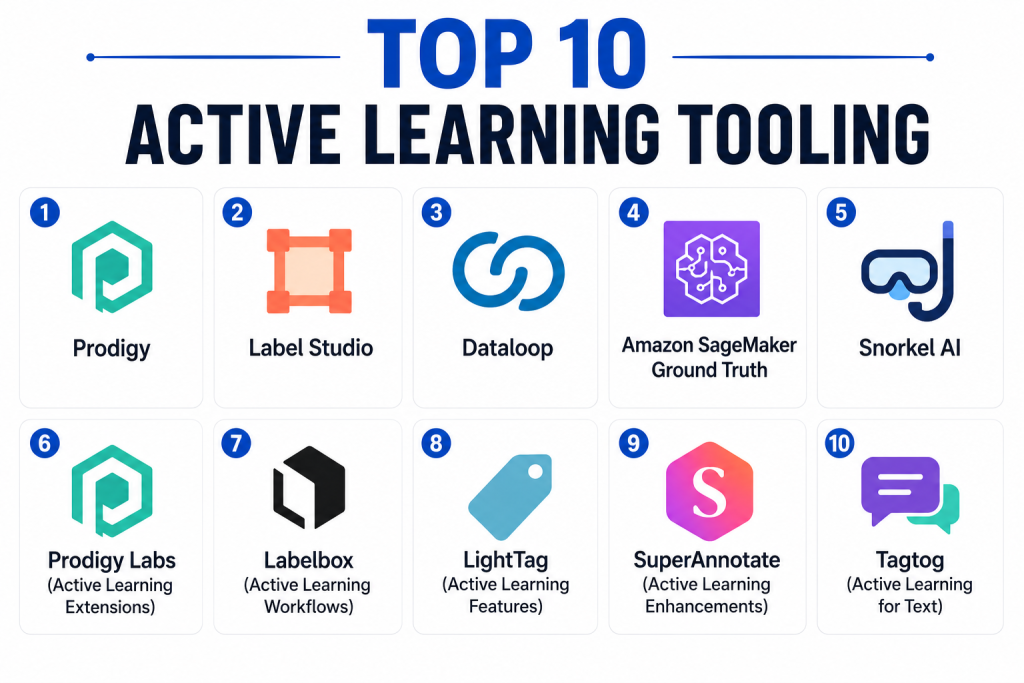
Top 10 Active Learning Tooling
1- Prodigy
Short description:
Prodigy is a Python-based active learning annotation tool that supports NLP and vision tasks. It enables users to script custom labeling workflows, prioritize informative samples, and iteratively train models efficiently.
Key Features:
- Scriptable, customizable labeling workflows
- Active learning integration for selective sampling
- Multi-task support (text and images)
- Export tools for model retraining
- Lightweight and flexible
- Python SDK and integration
Pros:
- Fast and highly customizable for research and production
- Ideal for NLP, computer vision, and semi-structured tasks
Cons:
- Requires Python knowledge
- Not full enterprise platform
Platforms / Deployment:
Linux, Windows / Self-hosted
Security & Compliance:
Varies / Not publicly stated
Integrations & Ecosystem:
- Python SDK
- REST API integration
- Custom model pipelines
Support & Community:
Documentation, tutorials, and active user community
2- Label Studio
Short description:
Label Studio is an open-source active learning and labeling tool supporting text, image, audio, and video. It provides customizable annotation interfaces and integrates with active learning pipelines to optimize labeling efficiency.
Key Features:
- Customizable labeling interfaces
- Multi-modal annotation support
- Human-in-the-loop workflows
- Model-assisted pre-labeling
- Export/import functionality
- API and SDK access
Pros:
- Open-source and flexible
- Multi-modal support for diverse projects
Cons:
- Enterprise features may require additional setup
- Learning curve for complex workflows
Platforms / Deployment:
Linux, Windows / Cloud / Self-hosted
Security & Compliance:
Varies / Not publicly stated
Integrations & Ecosystem:
- Python SDK
- REST APIs
- ML pipeline connectors
Support & Community:
Strong open-source community and documentation
3- Dataloop
Short description:
Dataloop combines active learning with human-in-the-loop labeling for real-time feedback. It supports image, video, and text datasets, enabling scalable enterprise annotation workflows.
Key Features:
- Active learning-driven sample selection
- Real-time human review loops
- Automated consensus scoring
- Multi-modal annotation
- API and SDK access
- Analytics dashboards
Pros:
- Effective for large-scale labeling projects
- Integrated quality assurance
Cons:
- Cloud-focused deployment
- Pricing varies / N/A
Platforms / Deployment:
Web / Cloud
Security & Compliance:
RBAC, encryption; certifications vary / N/A
Integrations & Ecosystem:
- Python and REST APIs
- ML pipelines
- Data storage connectors
Support & Community:
Documentation and enterprise support available
4- Amazon SageMaker Ground Truth
Short description:
SageMaker Ground Truth is AWS’s managed labeling service supporting active learning to reduce annotation costs. It integrates directly with AWS ML services for continuous model retraining.
Key Features:
- Automated labeling suggestions
- Quality control dashboards
- Multi-modal support
- Active learning for selective labeling
- Integration with AWS ML tools
- Auditing and logs
Pros:
- Deep AWS ecosystem integration
- Managed workflows with high-quality control
Cons:
- AWS-dependent
- Cost scales with data usage
Platforms / Deployment:
Web / Cloud
Security & Compliance:
Encryption, IAM controls; SOC 2, GDPR
Integrations & Ecosystem:
- AWS ML suite
- S3 storage
- SDKs and APIs
Support & Community:
AWS documentation and enterprise support
5- Snorkel AI
Short description:
Snorkel AI is a programmatic labeling and active learning framework that allows users to generate training data using labeling functions, weak supervision, and model-guided sample selection.
Key Features:
- Programmatic labeling functions
- Active learning for model improvement
- Multi-modal support
- Data quality metrics
- Integration with ML frameworks
- Export for training pipelines
Pros:
- Reduces manual labeling
- Scales efficiently with large datasets
Cons:
- Requires technical expertise
- Primarily research-focused
Platforms / Deployment:
Linux / Self-hosted / Cloud
Security & Compliance:
Varies / Not publicly stated
Integrations & Ecosystem:
- Python SDK
- REST APIs
- ML pipeline connectors
Support & Community:
Documentation, open-source community
6- Prodigy Labs (Active Learning Extensions)
Short description:
Prodigy Labs extends Prodigy with specialized active learning modules for advanced NLP and vision tasks, supporting uncertainty sampling and model-in-the-loop labeling.
Key Features:
- Active learning extensions
- Uncertainty-based query strategies
- Custom labeling pipelines
- Model retraining integration
- Analytics dashboards
- Python API
Pros:
- Ideal for research experimentation
- Flexible workflow scripting
Cons:
- Requires Python expertise
- Limited enterprise support
Platforms / Deployment:
Linux, Windows / Self-hosted
Security & Compliance:
Varies / Not publicly stated
Integrations & Ecosystem:
- Python SDK
- REST APIs
Support & Community:
Community documentation and tutorials
7- Labelbox (Active Learning Workflows)
Short description:
Labelbox supports active learning by integrating model predictions with human review, optimizing data selection, and reducing labeling costs for enterprise-scale projects.
Key Features:
- Model-assisted labeling
- Human-in-the-loop review
- Active learning prioritization
- Multi-modal support
- Role-based workflows
- API and SDK access
Pros:
- Scalable enterprise workflows
- Integrated analytics
Cons:
- Premium enterprise cost
- Complexity in setup
Platforms / Deployment:
Web / Cloud / Hybrid
Security & Compliance:
RBAC, encryption; certifications vary / N/A
Integrations & Ecosystem:
- REST APIs
- ML frameworks
- SDK connectors
Support & Community:
Enterprise support and documentation
8- LightTag (Active Learning Features)
Short description:
LightTag provides team-based text annotation with active learning modules to prioritize labeling for high-impact samples in NLP pipelines.
Key Features:
- Active learning query strategies
- Team collaboration
- Quality scoring
- API integration
- Analytics dashboards
- Annotation guidelines
Pros:
- Ideal for collaborative NLP workflows
- Analytics for quality
Cons:
- Limited to text
- Cloud-only deployment
Platforms / Deployment:
Web / Cloud
Security & Compliance:
RBAC, encryption; certifications vary / N/A
Integrations & Ecosystem:
- REST APIs
- NLP pipelines
Support & Community:
Documentation and support tiers
9- SuperAnnotate (Active Learning Enhancements)
Short description:
SuperAnnotate integrates active learning with multi-modal annotation, providing AI-assisted pre-labeling, reviewer workflows, and analytics for large datasets.
Key Features:
- AI-assisted pre-labeling
- Active learning selection
- Multi-modal annotation
- QA workflows
- Team collaboration
- API access
Pros:
- Scalable and high quality
- Strong QA features
Cons:
- Enterprise pricing
- Requires training
Platforms / Deployment:
Web / Cloud
Security & Compliance:
RBAC, encryption; certifications vary / N/A
Integrations & Ecosystem:
- ML frameworks
- SDKs and APIs
- Data connectors
Support & Community:
Documentation and enterprise support
10- Tagtog (Active Learning for Text)
Short description:
Tagtog offers text annotation with optional active learning strategies, collaborative review, and quality scoring for NLP pipelines.
Key Features:
- Active learning strategies
- Collaborative text labeling
- Inter-annotator metrics
- API support
- Export options
- Role management
Pros:
- Excellent for text data
- Collaborative features
Cons:
- Text-only
- Cloud deployment
Platforms / Deployment:
Web / Cloud
Security & Compliance:
RBAC, encryption; certifications vary / N/A
Integrations & Ecosystem:
- REST API
- NLP pipelines
Support & Community:
Documentation and team support
Comparison Table (Top 10)
| Tool Name | Best For | Platform(s) Supported | Deployment | Standout Feature | Public Rating |
|---|---|---|---|---|---|
| Prodigy | NLP & Vision | Linux/Windows | Self-hosted | Scriptable & active learning | N/A |
| Label Studio | Multi-modal | Linux/Windows | Cloud/Self-hosted | Flexible & open-source | N/A |
| Dataloop | Enterprise HITL | Web | Cloud | Real-time review & active learning | N/A |
| SageMaker GT | AWS integration | Web | Cloud | Managed AWS active learning | N/A |
| Snorkel AI | Programmatic labeling | Linux | Cloud/Self-hosted | Weak supervision & active learning | N/A |
| Prodigy Labs | NLP & Vision | Linux/Windows | Self-hosted | Active learning modules | N/A |
| Labelbox | Enterprise HITL | Web | Cloud/Hybrid | Model-assisted labeling | N/A |
| LightTag | NLP Teams | Web | Cloud | Team-based active learning | N/A |
| SuperAnnotate | Multi-modal | Web | Cloud | QA & AI-assisted pre-labeling | N/A |
| Tagtog | Text annotation | Web | Cloud | Collaborative active learning | N/A |
Evaluation & Scoring of Active Learning Tooling
| Tool Name | Core (25%) | Ease (15%) | Integrations (15%) | Security (10%) | Performance (10%) | Support (10%) | Value (15%) | Weighted Total |
|---|---|---|---|---|---|---|---|---|
| Prodigy | 9 | 8 | 8 | 7 | 8 | 7 | 8 | 8.0 |
| Label Studio | 8 | 7 | 8 | 7 | 8 | 7 | 8 | 7.7 |
| Dataloop | 8 | 8 | 7 | 8 | 8 | 7 | 7 | 7.7 |
| SageMaker GT | 8 | 8 | 8 | 9 | 8 | 8 | 7 | 8.0 |
| Snorkel AI | 8 | 7 | 8 | 7 | 8 | 7 | 7 | 7.5 |
| Prodigy Labs | 7 | 7 | 7 | 7 | 7 | 7 | 7 | 7.0 |
| Labelbox | 9 | 8 | 8 | 8 | 8 | 8 | 7 | 8.1 |
| LightTag | 8 | 8 | 7 | 7 | 7 | 7 | 7 | 7.5 |
| SuperAnnotate | 8 | 7 | 8 | 7 | 8 | 7 | 7 | 7.7 |
| Tagtog | 7 | 8 | 7 | 7 | 7 | 7 | 7 | 7.1 |
Scores are comparative and reflect capabilities in core features, ease, integrations, security, performance, support, and value.
Which Active Learning Tool Is Right for You?
Solo / Freelancer
- Prodigy and Label Studio are ideal for research and small projects with flexible workflows.
SMB
- Dataloop or SuperAnnotate suit small teams needing collaborative workflows and QA.
Mid-Market
- Labelbox or SageMaker GT provide enterprise-grade active learning and pipeline integration.
Enterprise
- Scale to Labelbox Enterprise, SageMaker Ground Truth, or Dataloop for large datasets, security, and auditing.
Budget vs Premium
- Open-source tools reduce cost but require technical expertise; premium tools offer automation, SLA, and advanced analytics.
Feature Depth vs Ease of Use
- Labelbox and SageMaker GT offer deep features; Prodigy and Tagtog are simpler for faster adoption.
Integrations & Scalability
- Enterprise tools integrate with ML pipelines and cloud storage; open-source tools require more setup.
Security & Compliance Needs
- Enterprise-grade platforms offer RBAC, encryption, and audit logs for regulated domains.
Frequently Asked Questions (FAQs)
1 — What pricing models are common?
Tools offer subscription, per-seat, or usage-based pricing. Open-source options are free but require hosting and support management.
2 — How long does setup take?
Small projects may start within hours; enterprise-scale integrations can take several days to weeks.
3 — Do these tools integrate with ML pipelines?
Yes — REST APIs, Python SDKs, and webhooks allow seamless model retraining loops.
4 — Can teams collaborate effectively?
Yes — role-based workflows, queues, and review dashboards support enterprise collaboration.
5 — Are there quality assurance metrics?
Yes — inter-annotator agreement, consensus scoring, and reviewer performance tracking.
6 — Can labeling be semi-automated?
AI-assisted pre-labeling and active learning reduce manual workload and improve efficiency.
7 — What data types are supported?
Text, image, video, audio, and 3D data are supported by top platforms.
8 — Do these platforms handle security?
Enterprise tools include RBAC, encryption, audit logs, and compliance capabilities.
9 — Are these tools suitable for small teams?
Yes — Prodigy and Label Studio are ideal for small datasets and research projects.
10 — What alternatives exist for small datasets?
Spreadsheets or simple scripts may suffice for trivial datasets without HITL tooling.
Conclusion
Active Learning Tooling reduces labeling costs and improves model accuracy by prioritizing the most informative data for annotation. Open-source tools like Prodigy and Label Studio suit small teams, while enterprise platforms like Labelbox and SageMaker Ground Truth scale for large datasets.
