Introduction
Model Explainability Tools are specialized software platforms designed to provide transparency into how AI and machine learning models make decisions. In plain terms, these tools help data teams understand why a model predicted a certain outcome, identify biases, and ensure that AI-driven decisions are interpretable and trustworthy. With AI adoption accelerating across industries in , explainability has become critical to maintain stakeholder confidence, meet regulatory standards, and ensure ethical AI practices.
Real-world use cases include:
- Auditing AI models in financial services to explain credit approval or risk scores.
- Monitoring recruitment algorithms to prevent demographic biases.
- Ensuring fairness in healthcare diagnostics or treatment recommendations.
- Verifying AI recommendations in marketing personalization or ad targeting.
- Conducting regulatory reporting and compliance checks for AI in government applications.
Evaluation Criteria for Buyers often include:
- Model transparency and interpretability features
- Bias and fairness detection capabilities
- Integration with existing ML/AI pipelines
- Real-time monitoring and alerting
- Usability and visualization dashboards
- Security and compliance (e.g., SOC 2, ISO 27001, GDPR, HIPAA)
- Scalability across enterprise deployments
- Support for multi-model and multi-framework environments
- Documentation and audit trail management
- Cost, value, and deployment flexibility
Best for: Data scientists, AI/ML engineers, compliance officers, and enterprise teams in regulated industries such as finance, healthcare, and public sector organizations.
Not ideal for: Small teams or startups deploying simple models where interpretability and compliance requirements are minimal or where generic ML frameworks suffice.
Key Trends in Model Explainability Tools
- Adoption of automated explainability methods for complex AI models (including multi-modal and generative AI).
- Integration of bias and fairness detection dashboards within enterprise ML pipelines.
- Continuous model monitoring for drift detection and interpretability.
- Increasing importance of regulatory compliance features due to AI governance frameworks.
- Shift toward cloud-native, hybrid, and multi-cloud deployment models.
- Enhanced interoperability with major ML frameworks such as TensorFlow, PyTorch, and scikit-learn.
- Use of AI-assisted recommendations to improve model fairness and mitigate risks.
- Development of role-based access and audit logging for secure model governance.
- Pricing models moving to subscription-based and usage-based tiers for flexibility.
- Growing focus on explainability for generative AI and recommendation systems.
How We Selected These Tools (Methodology)
- Evaluated market adoption and mindshare in enterprise and developer communities.
- Assessed feature completeness covering interpretability, fairness, and monitoring.
- Analyzed reliability and performance signals from production deployments.
- Considered security posture including encryption, SSO/MFA, and auditability.
- Reviewed integration and ecosystem support with popular ML frameworks.
- Measured customer fit across SMB, mid-market, and enterprise segments.
- Checked scalability for multi-model, multi-cloud deployments.
- Evaluated support quality and community engagement for onboarding and troubleshooting.
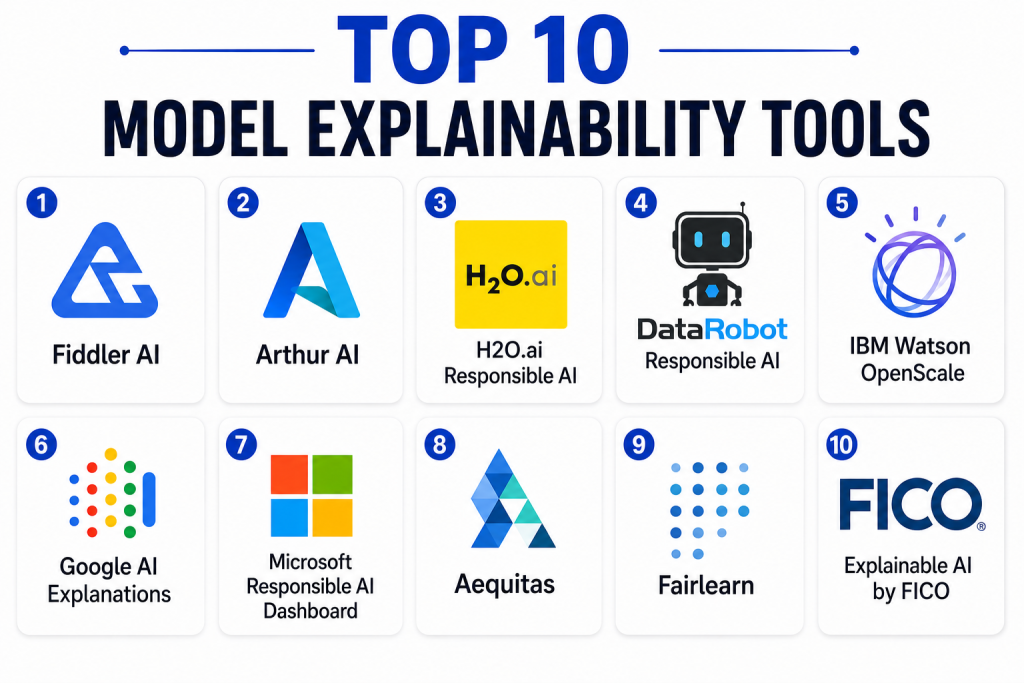
Top 10 Model Explainability Tools
1- Fiddler AI
Short description: Fiddler AI enables model monitoring, explainability, and bias detection for enterprise AI applications. It helps teams understand model predictions, detect drift, and maintain compliance across multiple ML pipelines.
Key Features
- Real-time model performance monitoring
- Bias and fairness dashboards
- Feature importance explainability
- Audit trails and compliance reporting
- Alerts for model drift
- Integration with cloud ML pipelines
Pros
- Strong enterprise focus on fairness and transparency
- Comprehensive dashboards for actionable insights
Cons
- Requires technical expertise to customize
- Enterprise deployment complexity may be high
Platforms / Deployment
- Web / Cloud / Hybrid
Security & Compliance
- SSO, MFA, encryption, audit logs
- SOC 2, ISO 27001, GDPR
Integrations & Ecosystem
Integrates with leading ML frameworks and data platforms:
- TensorFlow, PyTorch, scikit-learn
- Snowflake, Databricks
- REST APIs
- Slack and email alerts
Support & Community
- Extensive documentation and onboarding support
- Active enterprise-focused community
2- Arthur AI
Short description: Arthur AI offers continuous AI monitoring and explainability, ensuring models remain accurate, fair, and compliant with enterprise standards.
Key Features
- Real-time model monitoring
- Bias and drift detection
- Explainability reports
- Automated alerts
- Multi-cloud support
Pros
- Intuitive dashboards for multiple stakeholders
- Robust monitoring across complex pipelines
Cons
- Pricing can be high for small teams
- Initial integration requires effort
Platforms / Deployment
- Web / Cloud
Security & Compliance
- SSO, encryption, audit logs
- Not publicly stated for certifications
Integrations & Ecosystem
- TensorFlow, PyTorch, scikit-learn
- AWS, Azure, GCP
- API and webhook support
Support & Community
- Documentation and enterprise support tiers
- Active community forums
3- H2O.ai Responsible AI
Short description: H2O.ai Responsible AI provides explainability, fairness evaluation, and monitoring tools, integrated with H2O.ai’s open-source ML platform for enterprise use.
Key Features
- Model explainability frameworks
- Fairness assessments
- Model drift monitoring
- Visualization dashboards
- Automated reporting
Pros
- Open-source integration
- Active community support
Cons
- Enterprise features require paid plans
- Advanced usage requires H2O expertise
Platforms / Deployment
- Web / Windows / Linux / Cloud
Security & Compliance
- Not publicly stated
Integrations & Ecosystem
- H2O.ai platform
- Python and R SDKs
- REST APIs
Support & Community
- Active open-source community
- Documentation and enterprise support available
4- DataRobot Responsible AI
Short description: Provides enterprise-grade monitoring, bias detection, and interpretability for AI models to ensure transparency and compliance in production environments.
Key Features
- Automated model audit
- Fairness and bias detection
- Continuous monitoring
- Regulatory compliance reporting
- Multi-cloud deployment support
Pros
- Enterprise-ready dashboards
- Comprehensive monitoring
Cons
- Steep learning curve
- Cost may be high for smaller organizations
Platforms / Deployment
- Web / Cloud / Hybrid
Security & Compliance
- SOC 2, ISO 27001
- Encryption, audit logs, RBAC
Integrations & Ecosystem
- Python, R
- MLflow, Kubeflow
- APIs for custom workflows
Support & Community
- Enterprise support tiers
- Extensive documentation
5- IBM Watson OpenScale
Short description: IBM Watson OpenScale provides AI fairness, transparency, and monitoring solutions for regulated enterprises, helping maintain compliance and explainable AI.
Key Features
- Fairness and bias detection
- Explainable AI reports
- Continuous model monitoring
- Drift detection
- Regulatory compliance dashboards
Pros
- Strong regulatory and compliance capabilities
- Enterprise-grade monitoring
Cons
- Complexity may deter small teams
- Primarily IBM ecosystem-focused
Platforms / Deployment
- Web / Cloud / Hybrid
Security & Compliance
- SSO, encryption, audit logs
- SOC 2, ISO 27001, GDPR
Integrations & Ecosystem
- IBM Cloud Pak integration
- Python SDK
- REST APIs
Support & Community
- Enterprise support and professional services
6- Google AI Explanations
Short description: Google AI Explanations delivers interpretability tools for TensorFlow and Google Cloud AI models, helping developers explain predictions and detect bias.
Key Features
- Feature attribution
- TensorFlow integration
- Bias detection metrics
- Explainability dashboards
- API for programmatic access
Pros
- Strong TensorFlow ecosystem support
- Developer-friendly
Cons
- Limited enterprise reporting
- Focused on Google stack
Platforms / Deployment
- Web / Cloud
Security & Compliance
- Google Cloud security standards
- Not publicly stated for certifications
Integrations & Ecosystem
- TensorFlow, TFX
- GCP AI services
- REST APIs
Support & Community
- Google Cloud support and documentation
- Developer community
7- Microsoft Responsible AI Dashboard
Short description: Provides Azure-based monitoring, explainability, and fairness tools for enterprise AI deployments to maintain accountability and compliance.
Key Features
- Bias detection and monitoring
- Explainability dashboards
- Integration with Azure ML
- Automated alerts
- Compliance reporting
Pros
- Strong enterprise integration
- Azure ecosystem compatibility
Cons
- Limited support outside Azure
- Learning curve for small teams
Platforms / Deployment
- Web / Cloud
Security & Compliance
- Azure security standards
- GDPR, SOC 2 for enterprise
Integrations & Ecosystem
- Azure ML
- Python SDKs
- API and PowerBI support
Support & Community
- Enterprise support
- Documentation and community forums
8- Aequitas
Short description: Open-source fairness audit toolkit to detect bias and promote ethical AI deployments for developers and researchers.
Key Features
- Bias metrics for subgroups
- Fairness reporting
- Python API
- Integration with ML pipelines
- Visualization support
Pros
- Open-source and free
- Flexible and developer-oriented
Cons
- Lacks enterprise dashboards
- No real-time monitoring
Platforms / Deployment
- Python / Linux / Cloud (Varies)
Security & Compliance
- Not publicly stated
Integrations & Ecosystem
- Scikit-learn, TensorFlow, PyTorch
Support & Community
- GitHub community and documentation
9- Fairlearn
Short description: Open-source Python toolkit for fairness assessment and mitigation in ML models, suitable for developers and researchers seeking ethical AI solutions.
Key Features
- Fairness metrics and mitigation
- Python library integration
- Visualization tools for subgroup analysis
- Pipeline support
Pros
- Developer-friendly
- Active academic and open-source community
Cons
- Limited enterprise capabilities
- No built-in monitoring
Platforms / Deployment
- Python / Cloud / Local
Security & Compliance
- Not publicly stated
Integrations & Ecosystem
- Scikit-learn, PyTorch, TensorFlow
Support & Community
- GitHub documentation and community support
10- Explainable AI by FICO
Short description: Offers interpretability, transparency, and compliance tools for enterprise AI models, particularly for financial and risk management applications.
Key Features
- Explainability dashboards
- Bias detection
- Compliance reporting
- Model drift alerts
- Integration with risk management systems
Pros
- Enterprise-grade finance-focused features
- Strong regulatory compliance
Cons
- Specialized focus limits general ML use
- Onboarding complexity
Platforms / Deployment
- Web / Cloud / Hybrid
Security & Compliance
- SOC 2, encryption, audit logs
- GDPR
Integrations & Ecosystem
- Risk management software
- Python SDK, REST APIs
- Enterprise reporting systems
Support & Community
- Professional support and consulting services
Comparison Table (Top 10)
| Tool Name | Best For | Platform(s) Supported | Deployment | Standout Feature | Public Rating |
|---|---|---|---|---|---|
| Fiddler AI | Enterprise monitoring | Web | Cloud / Hybrid | Bias dashboards | N/A |
| Arthur AI | Monitoring + explainability | Web | Cloud | Real-time alerts | N/A |
| H2O.ai Responsible AI | Open-source integration | Web / Windows / Linux | Cloud | Fairness + explainability | N/A |
| DataRobot Responsible AI | Enterprise ML pipelines | Web | Cloud / Hybrid | Continuous monitoring | N/A |
| IBM Watson OpenScale | Regulated industries | Web | Cloud / Hybrid | AI auditing | N/A |
| Google AI Explanations | TensorFlow models | Web | Cloud | Feature attribution | N/A |
| Microsoft Responsible AI Dashboard | Azure deployments | Web | Cloud | Azure ML integration | N/A |
| Aequitas | Developer audits | Python | Varies | Open-source bias metrics | N/A |
| Fairlearn | Developer/researcher | Python | Cloud / Local | Mitigation algorithms | N/A |
| Explainable AI by FICO | Finance risk models | Web | Cloud / Hybrid | Regulatory reporting | N/A |
Evaluation & Scoring of Model Explainability Tools
| Tool Name | Core (25%) | Ease (15%) | Integrations (15%) | Security (10%) | Performance (10%) | Support (10%) | Value (15%) | Weighted Total |
|---|---|---|---|---|---|---|---|---|
| Fiddler AI | 9 | 8 | 8 | 9 | 9 | 8 | 8 | 8.7 |
| Arthur AI | 8 | 8 | 7 | 8 | 8 | 7 | 7 | 7.8 |
| H2O.ai Responsible AI | 8 | 7 | 8 | 7 | 8 | 7 | 8 | 7.8 |
| DataRobot Responsible AI | 9 | 8 | 8 | 8 | 9 | 8 | 7 | 8.4 |
| IBM Watson OpenScale | 9 | 7 | 7 | 9 | 8 | 7 | 7 | 8.0 |
| Google AI Explanations | 7 | 8 | 7 | 7 | 7 | 6 | 8 | 7.4 |
| Microsoft Responsible AI Dashboard | 8 | 7 | 8 | 8 | 8 | 7 | 7 | 7.8 |
| Aequitas | 7 | 7 | 6 | 6 | 7 | 6 | 9 | 6.9 |
| Fairlearn | 7 | 7 | 6 | 6 | 7 | 6 | 8 | 6.8 |
| Explainable AI by FICO | 8 | 7 | 7 | 9 | 8 | 7 | 6 | 7.6 |
Interpretation: Weighted scores compare relative strengths across features, ease, integrations, security, performance, support, and value. Higher totals indicate better overall suitability for enterprise or regulated deployments.
Which Model Explainability Tool Is Right for You?
Solo / Freelancer
Open-source tools like Aequitas and Fairlearn are ideal for experimentation and small-scale projects.
SMB
Arthur AI and H2O.ai Responsible AI balance usability with robust interpretability for growing teams.
Mid-Market
Fiddler AI and DataRobot Responsible AI provide comprehensive monitoring and explainability features.
Enterprise
IBM Watson OpenScale and Explainable AI by FICO ensure full compliance, auditability, and scalable monitoring.
Budget vs Premium
Open-source tools are cost-effective, while enterprise platforms provide additional features and support at higher pricing.
Feature Depth vs Ease of Use
Fiddler AI and DataRobot offer rich features with moderate learning curve, while open-source tools favor flexibility over user-friendly dashboards.
Integrations & Scalability
Enterprise platforms support multi-cloud and hybrid deployments; open-source tools are developer-friendly but require integration work.
Security & Compliance Needs
High-regulation industries benefit from IBM, FICO, and Microsoft dashboards; smaller teams can rely on lightweight solutions with manual controls.
Frequently Asked Questions (FAQs)
1- What pricing models do Model Explainability tools use?
Enterprise platforms often use subscription or usage-based pricing. Open-source tools are free but may require internal support for deployment.
2- How long does onboarding typically take?
Open-source tools can be implemented within days, whereas enterprise platforms may require weeks for training and integration.
3- What are common mistakes when using these tools?
Ignoring model drift, failing to track bias, and skipping audit documentation are frequent pitfalls.
4- Are these tools secure?
Enterprise solutions offer encryption, SSO, MFA, and audit logs. Open-source tools rely on deployment security practices.
5- Can these tools scale for large organizations?
Yes, enterprise-grade platforms like Fiddler AI, IBM Watson OpenScale, and DataRobot scale to large multi-model deployments.
6- How well do they integrate with existing ML pipelines?
Most integrate with TensorFlow, PyTorch, scikit-learn, and MLOps frameworks. Open-source tools need custom integration.
7- Is switching between tools difficult?
Migration depends on model and pipeline compatibility. APIs and standardized formats ease the process.
8- Are there alternatives to dedicated explainability tools?
Some MLOps platforms offer basic explainability, but dedicated tools provide deeper transparency and bias detection.
9- How frequently should models be audited?
Continuous monitoring is recommended; periodic audits should occur quarterly for high-risk applications.
10- Do these tools support regulatory compliance?
Enterprise tools provide compliance reports for GDPR, SOC 2, ISO 27001. Open-source solutions require manual implementation.
Conclusion
Model Explainability Tools are essential for organizations deploying AI responsibly and ethically. Choosing the right tool depends on team size, budget, compliance needs, and the complexity of AI models. Small teams may benefit from open-source solutions like Aequitas or Fairlearn, while enterprises require platforms such as Fiddler AI, IBM Watson OpenScale, or DataRobot for robust monitoring, explainability, and regulatory compliance. A practical approach is to shortlist , run pilot programs focusing on transparency and bias detection, and validate integration with existing pipelines to ensure responsible AI practices without disrupting operations.
