Introduction
AI Red Teaming Tools are specialized platforms that simulate adversarial attacks and stress-test AI models to identify vulnerabilities and weaknesses before deployment. In simple terms, these tools act like a “friendly hacker” team that probes AI systems for risks, allowing organizations to improve security, robustness, and reliability. In , AI is increasingly deployed in sensitive domains such as finance, healthcare, autonomous systems, and marketing, making proactive red teaming essential to prevent misuse, data breaches, or system failures.
Real-world use cases include:
- Stress-testing autonomous vehicle perception systems for safety-critical scenarios.
- Simulating adversarial attacks on financial AI to prevent fraud and algorithmic manipulation.
- Evaluating AI-driven content recommendation and ad targeting platforms against malicious input.
- Auditing healthcare AI models for robustness and reliability under atypical conditions.
- Performing security validation on enterprise AI pipelines and multi-cloud deployments.
Evaluation Criteria for Buyers often include:
- Coverage of adversarial scenarios and threat types
- Integration with ML/AI pipelines and MLOps frameworks
- Real-time monitoring and alerting
- Support for multiple model types and architectures
- Reporting, visualization, and audit capabilities
- Scalability for enterprise-grade testing
- Automation for continuous red teaming
- Security and access controls (SSO, MFA, RBAC)
- Compliance readiness (SOC 2, ISO 27001, GDPR, HIPAA)
- Cost-effectiveness and support ecosystem
Best for: AI/ML engineers, security teams, data scientists, and enterprise risk teams in regulated industries such as finance, healthcare, and autonomous vehicles.
Not ideal for: Small teams or projects deploying low-risk models with minimal compliance requirements or pre-validated cloud AI solutions.
Key Trends in AI Red Teaming Tools
- Integration of automated red teaming pipelines within MLOps workflows.
- Development of AI-assisted attack generation to simulate realistic adversarial scenarios.
- Enhanced explainability and reporting for identified vulnerabilities.
- Focus on regulatory compliance and audit-ready red teaming reports.
- Support for cloud-native, hybrid, and multi-cloud deployment models.
- Integration with security platforms for unified risk assessment.
- Real-time vulnerability alerts and automated mitigation recommendations.
- Expansion to generative AI and recommendation system testing.
- Usage-based and subscription pricing models for flexible deployment.
- Cross-framework interoperability supporting TensorFlow, PyTorch, and scikit-learn.
How We Selected These Tools (Methodology)
- Evaluated market adoption and mindshare among enterprises and developer communities.
- Assessed feature completeness covering attack simulation, mitigation, and reporting.
- Analyzed reliability and performance signals from production deployments.
- Reviewed security posture including encryption, SSO/MFA, RBAC, and auditability.
- Checked integration and ecosystem compatibility with ML pipelines.
- Considered customer fit across SMB, mid-market, and enterprise segments.
- Assessed scalability for multi-model, multi-cloud AI deployments.
- Evaluated support quality and community engagement for onboarding and troubleshooting.
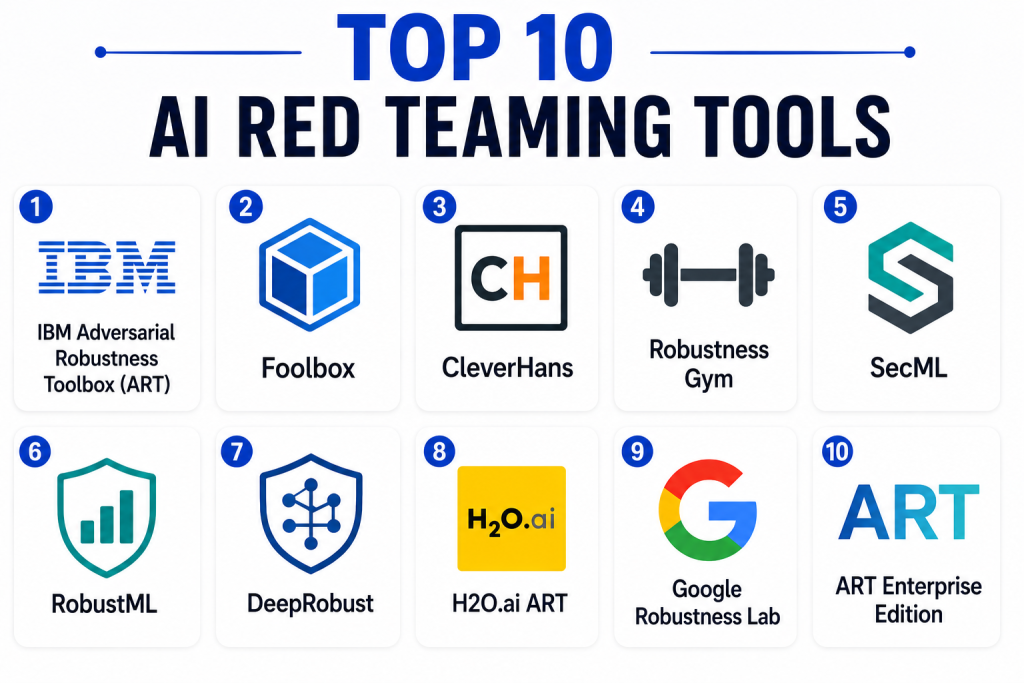
Top 10 AI Red Teaming Tools
1- IBM Adversarial Robustness Toolbox (ART)
Short description: IBM ART is an enterprise-grade tool that allows AI teams to simulate attacks, evaluate model vulnerabilities, and implement defenses. It is ideal for risk and security teams validating production AI models.
Key Features
- Wide range of adversarial attacks (white-box, black-box, gradient-based)
- Defense and mitigation strategies
- Robustness metrics and scoring
- Multi-framework support (TensorFlow, PyTorch, Keras)
- Integration with MLOps pipelines
- Automated reporting and dashboards
Pros
- Enterprise-ready with comprehensive coverage
- Supports continuous monitoring and mitigation
Cons
- Learning curve can be steep
- Enterprise deployment may require IBM ecosystem integration
Platforms / Deployment
- Web / Cloud / Hybrid / Python
Security & Compliance
- SOC 2, encryption, audit logs
- SSO and RBAC
Integrations & Ecosystem
- TensorFlow, PyTorch, Keras
- REST APIs for automation
- Integration with MLOps and CI/CD pipelines
Support & Community
- Enterprise support tiers
- Documentation, tutorials, and professional services
2- Foolbox
Short description: Foolbox is an open-source Python library that allows developers to craft adversarial attacks and test model robustness, suitable for experimentation and academic research.
Key Features
- Gradient-based, score-based, and decision-based attacks
- Model evaluation metrics for robustness
- Visualization of adversarial examples
- Supports TensorFlow, PyTorch, and JAX
- Easy-to-use Python API
Pros
- Free and flexible for experimentation
- Developer-friendly for academic research
Cons
- Limited enterprise dashboards
- No real-time monitoring
Platforms / Deployment
- Python / Linux / Cloud / Local
Security & Compliance
- Not publicly stated
Integrations & Ecosystem
- TensorFlow, PyTorch, JAX
- Python ML pipelines
Support & Community
- GitHub documentation
- Open-source community support
3- CleverHans
Short description: CleverHans is an open-source library for adversarial machine learning, providing attack and defense frameworks for developers and researchers.
Key Features
- White-box and black-box attacks
- Defense and mitigation strategies
- Supports TensorFlow and PyTorch
- Benchmarking and evaluation tools
- Python API integration
Pros
- Open-source and free
- Strong academic and research community
Cons
- Enterprise support limited
- Requires Python expertise
Platforms / Deployment
- Python / Linux / Cloud / Local
Security & Compliance
- Not publicly stated
Integrations & Ecosystem
- TensorFlow, PyTorch
- Integration with ML pipelines
Support & Community
- GitHub and open-source documentation
4- Robustness Gym
Short description: Robustness Gym is designed to evaluate NLP model robustness, focusing on adversarial scenarios in text-based AI applications. It helps developers benchmark and stress-test AI models.
Key Features
- NLP-focused adversarial testing
- Integration with Hugging Face transformers
- Attack and defense simulation
- Benchmarking and evaluation metrics
- Visualization and reporting tools
Pros
- Tailored for NLP models
- Open-source and easy to experiment with
Cons
- Limited to text/NLP models
- Requires technical expertise
Platforms / Deployment
- Python / Cloud / Local
Security & Compliance
- Not publicly stated
Integrations & Ecosystem
- Hugging Face transformers
- PyTorch and TensorFlow
Support & Community
- Open-source GitHub documentation
- Developer community support
5- SecML
Short description: SecML is an open-source Python framework for adversarial robustness testing, supporting attack simulations, defense strategies, and robustness evaluation for ML models.
Key Features
- Multiple attack methods including evasion and poisoning
- Supports scikit-learn, TensorFlow, PyTorch
- Robustness scoring and evaluation
- Extensible for custom attacks
- Visualization tools
Pros
- Flexible and developer-friendly
- Free and open-source
Cons
- Limited enterprise support
- No real-time monitoring
Platforms / Deployment
- Python / Linux / Cloud
Security & Compliance
- Not publicly stated
Integrations & Ecosystem
- TensorFlow, PyTorch, scikit-learn
- Python pipelines
Support & Community
- GitHub and open-source community
6- RobustML
Short description: RobustML provides enterprise-ready adversarial testing and automated reporting, targeting AI teams deploying models in production across regulated environments.
Key Features
- Multi-model adversarial simulations
- Real-time vulnerability alerts
- Automated robustness reports
- Supports deep learning and ensemble models
- Integration with MLOps pipelines
Pros
- Enterprise-focused features
- Comprehensive attack coverage
Cons
- Setup complexity
- Limited open-source community
Platforms / Deployment
- Web / Cloud / Hybrid
Security & Compliance
- SOC 2, encryption, RBAC
Integrations & Ecosystem
- TensorFlow, PyTorch
- API integration for automation
Support & Community
- Enterprise support and documentation
7- DeepRobust
Short description: DeepRobust is an open-source Python library for testing deep learning models against adversarial attacks, supporting both NLP and computer vision applications.
Key Features
- Attack and defense frameworks
- Multi-domain model support
- Robustness metrics and scoring
- Python API for pipeline integration
- Visualization of adversarial examples
Pros
- Open-source and flexible
- Supports multiple model types
Cons
- No enterprise dashboards
- No real-time monitoring
Platforms / Deployment
- Python / Linux / Cloud / Local
Security & Compliance
- Not publicly stated
Integrations & Ecosystem
- TensorFlow, PyTorch
- scikit-learn pipelines
Support & Community
- GitHub and open-source community
8- H2O.ai ART
Short description: H2O.ai ART offers attack and defense simulations integrated with H2O.ai’s ML platform for enterprise and research robustness evaluations.
Key Features
- Attack simulations
- Defense strategies
- Robustness metrics
- Multi-framework support
- Visualization dashboards
Pros
- Enterprise and research-ready
- Open-source integration
Cons
- Paid features for enterprise deployments
- Requires H2O.ai knowledge
Platforms / Deployment
- Web / Python / Cloud
Security & Compliance
- Not publicly stated
Integrations & Ecosystem
- TensorFlow, PyTorch
- H2O.ai platform and pipelines
Support & Community
- Open-source community and enterprise support
9- Google Robustness Lab
Short description: Google Robustness Lab provides automated adversarial testing and evaluation for ML models, focusing on large-scale and cloud-native AI pipelines.
Key Features
- Automated attack generation
- Robustness metrics
- Multi-framework support
- Visualization dashboards
- Continuous evaluation pipelines
Pros
- Developer-friendly for cloud AI
- Scalable for large datasets
Cons
- Limited enterprise support
- Focused on Google ecosystem
Platforms / Deployment
- Web / Cloud
Security & Compliance
- Google Cloud security standards
- Not publicly stated
Integrations & Ecosystem
- TensorFlow, PyTorch
- GCP AI services
Support & Community
- Google Cloud documentation and developer forums
10- ART Enterprise Edition
Short description: The enterprise edition of IBM ART includes enhanced monitoring, reporting, and compliance features for regulated organizations deploying AI in production.
Key Features
- Advanced attack simulations
- Real-time monitoring
- Compliance-ready dashboards
- Multi-framework support
- Automated reporting
Pros
- Enterprise-grade robustness features
- Regulatory-ready for production AI
Cons
- High cost
- IBM ecosystem integration required
Platforms / Deployment
- Web / Cloud / Hybrid
Security & Compliance
- SOC 2, ISO 27001, encryption, audit logs
Integrations & Ecosystem
- TensorFlow, PyTorch, Keras
- MLOps pipeline integration
- REST APIs
Support & Community
- Enterprise support and consulting services
Comparison Table (Top 10)
| Tool Name | Best For | Platform(s) Supported | Deployment | Standout Feature | Public Rating |
|---|---|---|---|---|---|
| IBM ART | Enterprise security | Web / Python | Cloud / Hybrid | Attack & defense coverage | N/A |
| Foolbox | Developer experimentation | Python | Cloud / Local | Attack simulation library | N/A |
| CleverHans | Research & dev | Python | Cloud / Local | Multi-framework attacks | N/A |
| Robustness Gym | NLP testing | Python | Cloud / Local | NLP adversarial benchmarks | N/A |
| SecML | Developer research | Python | Cloud | Flexible attack strategies | N/A |
| RobustML | Enterprise AI pipelines | Web | Cloud / Hybrid | Real-time vulnerability detection | N/A |
| DeepRobust | Deep learning experimentation | Python | Cloud / Local | Multi-domain robustness | N/A |
| H2O.ai ART | Enterprise & research | Web / Python | Cloud | Attack & defense simulations | N/A |
| Google Robustness Lab | Cloud AI evaluation | Web / Cloud | Cloud | Automated attack generation | N/A |
| ART Enterprise Edition | Regulated enterprises | Web / Python | Cloud / Hybrid | Compliance-ready robustness | N/A |
Evaluation & Scoring of AI Red Teaming Tools
| Tool Name | Core (25%) | Ease (15%) | Integrations (15%) | Security (10%) | Performance (10%) | Support (10%) | Value (15%) | Weighted Total |
|---|---|---|---|---|---|---|---|---|
| IBM ART | 9 | 8 | 8 | 9 | 9 | 8 | 7 | 8.4 |
| Foolbox | 8 | 8 | 7 | 6 | 7 | 6 | 9 | 7.5 |
| CleverHans | 8 | 7 | 7 | 6 | 7 | 6 | 9 | 7.4 |
| Robustness Gym | 7 | 8 | 7 | 6 | 7 | 6 | 8 | 7.1 |
| SecML | 7 | 7 | 7 | 6 | 7 | 6 | 9 | 7.1 |
| RobustML | 8 | 7 | 8 | 8 | 8 | 7 | 7 | 7.8 |
| DeepRobust | 7 | 7 | 7 | 6 | 7 | 6 | 9 | 7.1 |
| H2O.ai ART | 8 | 7 | 8 | 7 | 8 | 7 | 8 | 7.7 |
| Google Robustness Lab | 8 | 8 | 7 | 7 | 8 | 7 | 8 | 7.8 |
| ART Enterprise Edition | 9 | 8 | 8 | 9 | 9 | 8 | 7 | 8.4 |
Interpretation: Weighted totals compare relative strengths in core features, usability, integrations, security, performance, support, and value. Higher scores indicate stronger suitability for enterprise and high-risk AI deployments.
Which AI Red Teaming Tool Is Right for You?
Solo / Freelancer
Open-source tools like Foolbox, CleverHans, and DeepRobust are ideal for experimentation and research projects.
SMB
SecML and Robustness Gym provide practical testing capabilities with flexibility for text and vision models.
Mid-Market
RobustML and H2O.ai ART offer comprehensive evaluation, reporting, and robustness metrics for production-level AI pipelines.
Enterprise
IBM ART and ART Enterprise Edition provide full-scale compliance, monitoring, and mitigation features for regulated environments.
Budget vs Premium
Open-source tools minimize costs but require technical expertise, while enterprise solutions offer dashboards, reporting, and compliance at higher price points.
Feature Depth vs Ease of Use
Enterprise platforms offer comprehensive depth and automated reporting; open-source tools favor flexibility and developer experimentation.
Integrations & Scalability
Enterprise solutions integrate with multi-cloud MLOps pipelines; open-source frameworks need custom integration to scale.
Security & Compliance Needs
High-regulation industries benefit from IBM ART or ART Enterprise Edition. Research or low-risk projects can leverage open-source tools.
Frequently Asked Questions (FAQs)
1- What pricing models do AI Red Teaming tools use?
Enterprise tools usually adopt subscription or usage-based pricing. Open-source tools are free but require internal deployment and support.
2- How long does onboarding take?
Open-source frameworks can be implemented in days. Enterprise solutions may require weeks for integration, training, and workflow configuration.
3- What common mistakes should teams avoid?
Ignoring attack diversity, skipping mitigation validation, and failing to maintain reporting or audit trails are frequent errors.
4- Are these tools secure?
Enterprise platforms provide encryption, SSO/MFA, RBAC, and audit logs. Open-source tools rely on secure deployment practices.
5- Can these tools scale for large AI deployments?
Yes, enterprise-grade solutions support multiple models, multi-cloud environments, and large-scale pipelines.
6- How do these tools integrate with ML pipelines?
Most enterprise tools integrate with TensorFlow, PyTorch, and scikit-learn. Open-source frameworks require manual pipeline integration.
7- Is switching between tools difficult?
Migration depends on model architecture and pipelines. Standardized APIs and documentation ease the transition.
8- Are there alternatives to dedicated red teaming tools?
Some MLOps platforms include basic adversarial testing, but dedicated tools provide deeper evaluation and mitigation.
9- How frequently should AI systems be red-teamed?
Continuous monitoring is ideal. Periodic red-team evaluations should occur quarterly for critical models.
10- Do these tools support compliance requirements?
Enterprise solutions often provide SOC 2, ISO 27001, and GDPR-ready reporting. Open-source tools require manual compliance workflows.
Conclusion
AI Red Teaming Tools are crucial for testing and securing AI systems in high-stakes applications. Selection depends on team size, budget, model complexity, and regulatory requirements. Open-source frameworks like Foolbox, CleverHans, and DeepRobust are suitable for research and experimentation, while enterprise solutions like IBM ART and ART Enterprise Edition provide full-scale monitoring, compliance, and automated reporting. A practical approach is to shortlist , run pilot red-team exercises, and validate integration with existing pipelines to ensure robust and secure AI deployment in and beyond.
