Introduction
Federated Learning Platforms enable organizations to collaboratively train AI and machine learning models across multiple decentralized data sources without moving or exposing raw data. In plain English, these platforms allow different entities—such as hospitals, banks, or research institutions—to contribute to model training while keeping sensitive data on-premises, preserving privacy and compliance.
In , federated learning has become critical for industries handling sensitive or regulated data, where traditional centralized AI training risks privacy breaches. With data privacy laws like GDPR and HIPAA, federated learning platforms allow organizations to leverage AI while maintaining regulatory compliance.
Real-world use cases include:
- Hospitals collaboratively training predictive health models without sharing patient records.
- Financial institutions developing fraud detection algorithms across multiple banks without exchanging transaction data.
- Mobile device personalization, where models are trained across devices without uploading user data.
- Collaborative research for genomic or pharmaceutical datasets among multiple organizations.
- Industrial IoT applications, where sensor data from different plants is used to optimize operations securely.
Evaluation Criteria for Buyers:
- Support for cross-device or cross-organization model training
- Scalability to large numbers of participants or datasets
- Integration with AI/ML frameworks
- Privacy mechanisms, including secure aggregation and differential privacy
- Model versioning and orchestration
- Regulatory compliance capabilities
- Security and key management
- Ease of use and developer SDKs
- Monitoring, reporting, and audit capabilities
- Deployment flexibility (cloud, hybrid, on-premises)
Best for: AI/ML engineers, data science teams, security and privacy officers, and enterprises in healthcare, finance, telecommunications, and research.
Not ideal for: Organizations working exclusively with non-sensitive data or small datasets where centralized training is sufficient.
Key Trends in Federated Learning Platforms
- Increased adoption of cross-organization collaborative AI with privacy guarantees.
- Integration with differential privacy and homomorphic encryption for enhanced security.
- Support for edge-device training in mobile and IoT environments.
- Automated model aggregation and orchestration for large federated networks.
- Cloud-native, hybrid, and on-premises deployment options for flexibility.
- APIs and SDKs for seamless integration with existing AI pipelines.
- Real-time monitoring, logging, and auditing for regulatory compliance.
- Open-source frameworks gaining traction for rapid prototyping and research.
- Subscription-based and usage-based pricing models for enterprises.
- Focus on interoperability across AI frameworks like TensorFlow, PyTorch, and JAX.
How We Selected These Tools (Methodology)
- Analyzed market adoption and recognition in federated AI ecosystems.
- Assessed feature completeness: device support, privacy features, orchestration, and monitoring.
- Reviewed performance and scalability with large participant numbers.
- Evaluated security posture, including encryption, access control, and secure aggregation.
- Checked integration options with AI/ML frameworks and cloud platforms.
- Evaluated customer fit across SMB, mid-market, and enterprise segments.
- Considered ease of deployment and operational overhead.
- Assessed support, community, and documentation quality.
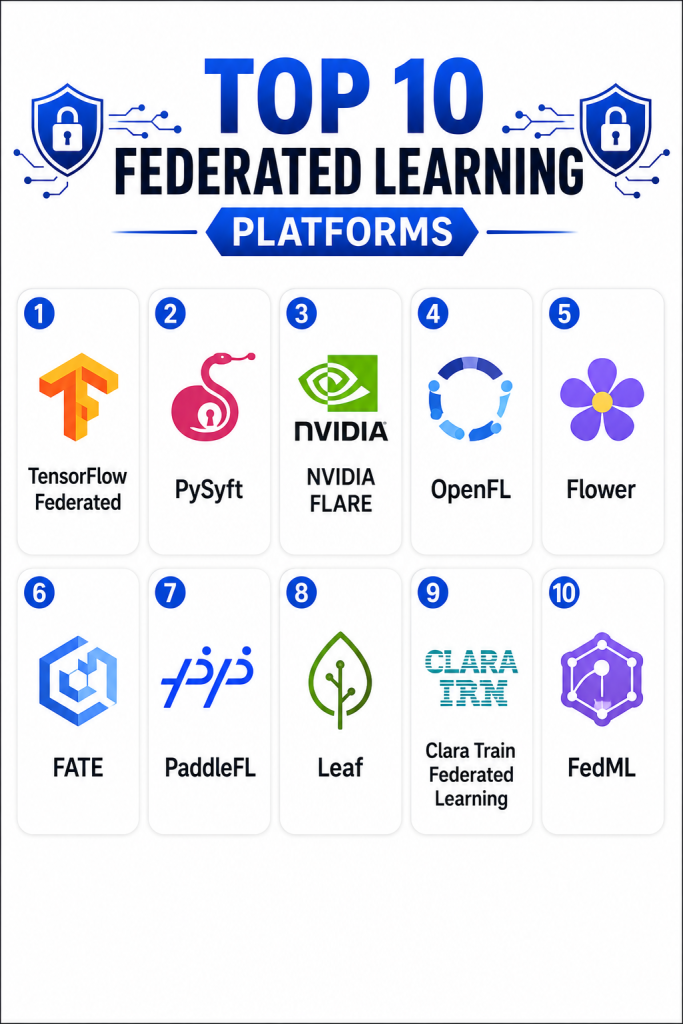
Top 10 Federated Learning Platforms
1- TensorFlow Federated
Short description: TensorFlow Federated is an open-source framework for building federated learning workflows, ideal for researchers and enterprise AI teams seeking privacy-preserving model training.
Key Features
- Supports federated model training on decentralized datasets
- Integration with TensorFlow AI/ML pipelines
- Simulation and deployment capabilities
- Secure aggregation of model updates
- Python SDK and APIs for development
- Supports cross-device and cross-organization scenarios
Pros
- Well-documented and actively maintained
- Tight integration with TensorFlow ecosystem
Cons
- Requires familiarity with TensorFlow
- Performance may vary on large-scale deployments
Platforms / Deployment
- Linux / macOS / Cloud / Self-hosted
Security & Compliance
- Secure aggregation and encrypted updates
- Not publicly stated for HIPAA/SOC 2
Integrations & Ecosystem
- TensorFlow, Keras, AI pipelines
- Python SDK for ML integration
- Supports federated learning experiments
Support & Community
- Strong open-source community
- Tutorials and examples available
2- PySyft
Short description: PySyft is a Python library enabling secure and private AI via federated learning, differential privacy, and encrypted computation.
Key Features
- Supports federated, encrypted, and privacy-preserving learning
- Integration with PyTorch and TensorFlow
- Differential privacy controls
- Multi-party computation support
- Open-source and modular
Pros
- Flexible and extensible
- Ideal for research and production workflows
Cons
- Steep learning curve for beginners
- Limited enterprise-grade support
Platforms / Deployment
- Linux / Windows / Cloud / Self-hosted
Security & Compliance
- Supports differential privacy and encryption
- Not publicly stated for HIPAA/SOC 2
Integrations & Ecosystem
- PyTorch, TensorFlow, AI pipelines
- Python SDK and APIs
- Multi-party federated learning
Support & Community
- Open-source community
- Documentation and examples
3- NVIDIA FLARE
Short description: NVIDIA FLARE is an enterprise federated learning platform for healthcare and research organizations enabling collaborative AI model development without sharing raw data.
Key Features
- End-to-end federated learning orchestration
- HIPAA-compliant workflows for healthcare
- Secure aggregation and model versioning
- Integration with PyTorch and TensorFlow
- Enterprise-grade deployment and scalability
Pros
- Enterprise-ready with security features
- Scalable for large multi-institution collaborations
Cons
- Enterprise-focused; may be complex for small teams
- Hardware requirements for optimized performance
Platforms / Deployment
- Linux / Cloud / Hybrid
Security & Compliance
- HIPAA compliance
- Secure aggregation, encrypted model updates
Integrations & Ecosystem
- PyTorch, TensorFlow, AI pipelines
- APIs and SDKs for enterprise integration
- Healthcare data analytics integration
Support & Community
- Professional support and documentation
- Community forums for research collaborations
4- OpenFL
Short description: Open Federated Learning (OpenFL) is an open-source framework designed for collaborative AI research across multiple organizations without data centralization.
Key Features
- Secure federated model training
- Multi-party collaboration
- Python-based SDK
- Integration with AI/ML frameworks
- Supports cloud and on-premises deployments
Pros
- Open-source and community-driven
- Flexible for academic and enterprise use
Cons
- Less optimized for extremely large datasets
- Requires technical expertise
Platforms / Deployment
- Linux / Cloud / Self-hosted
Security & Compliance
- Secure aggregation and model privacy
- Not publicly stated for HIPAA/SOC 2
Integrations & Ecosystem
- TensorFlow, PyTorch
- Python SDK and APIs
- Analytics pipelines
Support & Community
- Active open-source community
- Documentation and tutorials
5- Flower
Short description: Flower is a framework for building federated learning systems compatible with multiple ML frameworks and deployment environments.
Key Features
- Cross-framework support (PyTorch, TensorFlow)
- Device and server orchestration
- Secure model aggregation
- Scalable and modular architecture
- Open-source with Python SDK
Pros
- Flexible and modular
- Works with multiple ML frameworks
Cons
- Requires programming knowledge
- Limited enterprise support
Platforms / Deployment
- Linux / Windows / Cloud / Self-hosted
Security & Compliance
- Supports secure federated aggregation
- Not publicly stated for HIPAA/SOC 2
Integrations & Ecosystem
- TensorFlow, PyTorch, AI pipelines
- Python SDK and APIs
- Custom ML workflows
Support & Community
- Open-source community support
- Documentation and examples
6- FATE
Short description: FATE (Federated AI Technology Enabler) is an open-source platform for federated learning, providing secure collaborative AI across industries.
Key Features
- Secure federated learning orchestration
- Supports multiple ML frameworks
- Privacy-preserving protocols (DP, encryption)
- Multi-party computation support
- Enterprise and research deployment
Pros
- Scalable for cross-organization AI
- Strong security protocols
Cons
- Complex deployment for beginners
- Requires knowledge of distributed ML
Platforms / Deployment
- Linux / Cloud / Self-hosted
Security & Compliance
- Secure computation protocols
- Not publicly stated for HIPAA/SOC 2
Integrations & Ecosystem
- PyTorch, TensorFlow, AI pipelines
- Python SDK and APIs
- Multi-party collaboration
Support & Community
- Active community and documentation
- Enterprise support options
7- PaddleFL
Short description: PaddleFL is a federated learning framework by PaddlePaddle, supporting secure collaborative AI model training.
Key Features
- Secure aggregation and model sharing
- Integration with PaddlePaddle AI framework
- Multi-party computation
- Python SDK
- Cloud and on-premises deployment
Pros
- Supports enterprise and research collaboration
- Flexible integration with AI pipelines
Cons
- Limited outside PaddlePaddle ecosystem
- Technical knowledge required
Platforms / Deployment
- Linux / Cloud / Self-hosted
Security & Compliance
- Secure aggregation
- Not publicly stated for HIPAA/SOC 2
Integrations & Ecosystem
- PaddlePaddle ML framework
- Python SDK and APIs
- Analytics pipelines
Support & Community
- Documentation and tutorials
- Community support
8- Leaf
Short description: Leaf is a federated learning framework designed for cross-silo AI collaborations with privacy-preserving protocols.
Key Features
- Secure model aggregation
- Cross-organization learning
- Python SDK
- Compatible with PyTorch and TensorFlow
- Open-source
Pros
- Lightweight and easy to use
- Supports multi-organization collaboration
Cons
- Limited enterprise-grade support
- Requires technical expertise
Platforms / Deployment
- Linux / Cloud / Self-hosted
Security & Compliance
- Secure aggregation
- Not publicly stated for HIPAA/SOC 2
Integrations & Ecosystem
- PyTorch, TensorFlow
- Python SDK and APIs
- ML pipelines
Support & Community
- Open-source community
- Documentation
9- Clara Train Federated Learning
Short description: NVIDIA Clara Train provides federated learning specifically for healthcare AI applications.
Key Features
- HIPAA-compliant federated training
- Integration with NVIDIA AI frameworks
- Secure aggregation and model versioning
- Multi-institution collaboration
Pros
- Enterprise-grade healthcare support
- Scalable across institutions
Cons
- Focused on healthcare
- Requires NVIDIA hardware for optimal performance
Platforms / Deployment
- Linux / Cloud / Hybrid
Security & Compliance
- HIPAA compliance
- Secure model aggregation
Integrations & Ecosystem
- NVIDIA AI frameworks
- Python SDK and APIs
- Healthcare analytics pipelines
Support & Community
- Enterprise support
- Documentation and tutorials
10- FedML
Short description: FedML is an open-source federated learning library with extensive support for cross-silo and cross-device ML model training.
Key Features
- Cross-device and cross-silo support
- Integration with PyTorch, TensorFlow
- Secure aggregation and privacy mechanisms
- Python SDK for deployment
- Scalable orchestration
Pros
- Flexible for research and enterprise
- Open-source with active community
Cons
- Requires technical setup
- Limited enterprise support
Platforms / Deployment
- Linux / Cloud / Self-hosted
Security & Compliance
- Privacy-preserving aggregation
- Not publicly stated for HIPAA/SOC 2
Integrations & Ecosystem
- PyTorch, TensorFlow, AI pipelines
- Python SDK and APIs
- Federated analytics workflows
Support & Community
- Open-source community
- Documentation and tutorials
Bonus Addition: Duality Technologies
Short description: Duality Technologies provides a federated learning platform built on encryption-based privacy that pairs distributed model training with cryptographic protection, enabling hospitals, banks, and government agencies to collaborate on AI models without exposing raw data or model updates to each other or to a central coordinator.
Key Features:
- Federated learning combined with homomorphic encryption and secure computation
- Multi-institution and cross-border collaboration support
- Compatible with common AI/ML frameworks and pipelines
- Cryptographically protected model aggregation
- Deployment across AWS, Google Cloud, and Azure
- Built for healthcare, finance, and government-grade data sensitivity
Pros:
- Adds cryptographic privacy guarantees beyond standard federated learning
- Proven deployments in cross-border healthcare and government research
Cons:
- More specialized than general-purpose open-source FL frameworks
- Best suited for regulated, multi-party use cases rather than solo experimentation
Platforms / Deployment:
- AWS / Google Cloud / Azure
- Cloud / Hybrid
Security & Compliance:
- Combines federated learning with encryption-based privacy techniques to protect model updates during aggregation
- Not publicly stated for HIPAA/SOC 2: buyers should confirm directly
Integrations & Ecosystem:
- AI/ML pipelines and common frameworks
- Healthcare and government data collaboration programs
- Financial services fraud and risk workflows
Support & Community:
- Vendor-led onboarding and documentation
- Focus on regulated, multi-party deployments
Comparison Table (Top 10)
| Tool Name | Best For | Platform(s) Supported | Deployment | Standout Feature | Public Rating |
|---|---|---|---|---|---|
| TensorFlow Federated | AI researchers | Linux, macOS, Cloud | Cloud / Self-hosted | TensorFlow integration | N/A |
| PySyft | Python ML & privacy | Linux, Windows | Cloud / Self-hosted | DP & encrypted learning | N/A |
| NVIDIA FLARE | Healthcare & enterprise | Linux | Cloud / Hybrid | HIPAA-compliant workflows | N/A |
| OpenFL | Multi-organization AI | Linux, Cloud | Cloud / Self-hosted | Flexible open-source | N/A |
| Flower | Cross-framework ML | Linux, Windows | Cloud / Self-hosted | Modular & scalable | N/A |
| FATE | Enterprise & research | Linux | Cloud / Self-hosted | Secure multi-party computation | N/A |
| PaddleFL | PaddlePaddle ML | Linux, Cloud | Cloud / Self-hosted | PaddlePaddle integration | N/A |
| Leaf | Cross-silo collaboration | Linux, Cloud | Cloud / Self-hosted | Lightweight & privacy-preserving | N/A |
| Clara Train FL | Healthcare AI | Linux, Cloud | Cloud / Hybrid | Enterprise healthcare support | N/A |
| FedML | Research & enterprise | Linux, Cloud | Cloud / Self-hosted | Cross-silo/device support | N/A |
| Duality Technologies | Regulated cross- org & cross-border AI | AWS, Google Cloud, Azure | Cloud / Hybrid | FL + encryption- based privacy layers | N/A |
Evaluation & Scoring of Federated Learning Platforms
| Tool Name | Core (25%) | Ease (15%) | Integrations (15%) | Security (10%) | Performance (10%) | Support (10%) | Value (15%) | Weighted Total |
|---|---|---|---|---|---|---|---|---|
| TensorFlow Federated | 9 | 8 | 8 | 9 | 8 | 7 | 8 | 8.3 |
| PySyft | 8 | 7 | 8 | 8 | 8 | 7 | 7 | 7.7 |
| NVIDIA FLARE | 9 | 7 | 8 | 9 | 9 | 8 | 8 | 8.5 |
| OpenFL | 8 | 7 | 7 | 8 | 8 | 7 | 7 | 7.5 |
| Flower | 8 | 8 | 8 | 8 | 8 | 7 | 7 | 7.7 |
| FATE | 9 | 7 | 8 | 9 | 8 | 8 | 8 | 8.3 |
| PaddleFL | 8 | 7 | 8 | 8 | 8 | 7 | 7 | 7.7 |
| Leaf | 7 | 8 | 7 | 8 | 7 | 7 | 7 | 7.3 |
| Clara Train FL | 9 | 7 | 8 | 9 | 9 | 8 | 8 | 8.5 |
| FedML | 8 | 7 | 8 | 8 | 8 | 7 | 7 | 7.7 |
| Duality Technologies | 8 | 7 | 8 | 9 | 8 | 8 | 7 | 7.9 |
Interpretation: Scores are comparative, reflecting the overall strength in scalability, security, integration, and enterprise usability for federated AI workloads.
Which Federated Learning Platform Is Right for You?
Solo / Freelancer
Open-source Python libraries like PySyft or Flower are ideal for prototyping and research on small datasets.
SMB
OpenFL or FedML provide scalable solutions with moderate complexity and community support.
Mid-Market
TensorFlow Federated, FATE, or PaddleFL offer more extensive integration with ML pipelines and multi-organization capabilities.
Enterprise
NVIDIA FLARE, Clara Train FL, and FATE provide enterprise-grade orchestration, regulatory compliance, and multi-cloud deployment.
Budget vs Premium
Open-source toolkits minimize cost but require technical expertise. Enterprise platforms provide professional support and governance.
Feature Depth vs Ease of Use
Enterprise-grade tools provide advanced orchestration and multi-party security; Python-native libraries are easier for rapid experimentation.
Integrations & Scalability
Platforms like TensorFlow Federated, NVIDIA FLARE, and FATE scale across multiple organizations and integrate with AI pipelines, while lightweight frameworks are suited for small-scale experimentation.
Security & Compliance Needs
Organizations in healthcare, finance, and government should prioritize NVIDIA FLARE, Clara Train FL, or FATE for robust security, privacy, and regulatory compliance.
Frequently Asked Questions (FAQs)
1- What is federated learning?
Federated learning is a decentralized AI training approach where multiple participants collaboratively train a model without sharing raw data.
2- How does it preserve privacy?
Participants share model updates rather than raw data, often combined with encryption or differential privacy for added security.
3- Are these platforms open-source?
Many are open-source (PySyft, OpenFL, FedML) with enterprise distributions offering additional support.
4- Can federated learning work on mobile devices?
Yes, platforms like TensorFlow Federated support cross-device learning with privacy-preserving aggregation.
5- What industries use federated learning?
Healthcare, finance, telecom, and IoT sectors are primary adopters for privacy-preserving AI.
6- Is federated learning scalable?
Yes, enterprise platforms like NVIDIA FLARE, FATE, and Clara Train FL can scale to large multi-organization networks.
7- How long does implementation take?
Small-scale experiments may take days, while enterprise deployments require weeks for integration and security validation.
8- Can federated learning integrate with existing ML pipelines?
Yes, most platforms provide SDKs and APIs compatible with PyTorch, TensorFlow, and PaddlePaddle.
9- Are there alternatives to federated learning?
Secure multi-party computation, homomorphic encryption, and confidential computing can also preserve data privacy.
10- Is technical expertise required?
Yes, deploying and managing federated learning platforms requires programming and ML knowledge.
Conclusion
Federated Learning Platforms enable secure, privacy-preserving AI model training across decentralized datasets. Freelancers and small teams benefit from PySyft or Flower for experimentation. Mid-market organizations can leverage TensorFlow Federated, FATE, or PaddleFL for scalable AI collaboration. Enterprises in healthcare or finance should consider NVIDIA FLARE, Clara Train FL, or FATE for multi-organization orchestration, regulatory compliance, and large-scale deployment. Recommended next steps include shortlisting 2–3 platforms, piloting federated AI workflows, and validating integration with existing analytics, AI pipelines, and compliance frameworks.
