Introduction
Web3 node infrastructure helps developers and businesses connect applications to blockchain networks without manually running and maintaining every node themselves. In simple terms, these platforms provide blockchain RPC endpoints, APIs, indexing, archive data, transaction tools, analytics, node hosting, and reliability layers for decentralized applications.
For modern Web3 products, node infrastructure matters because user experience depends on fast reads, reliable writes, low latency, uptime, chain coverage, and secure API access. A slow or unreliable node layer can break wallets, DeFi apps, NFT platforms, games, analytics dashboards, and enterprise blockchain workflows.
Real-World Use Cases
- Building DeFi applications that require reliable blockchain reads and writes
- Powering wallet apps with fast transaction and balance data
- Running NFT marketplaces with metadata and activity tracking
- Supporting enterprise blockchain monitoring and audit workflows
- Scaling Web3 games, tokenized asset platforms, and on-chain analytics products
What Buyers Should Evaluate
- Supported chains and network coverage
- RPC performance and uptime
- Archive node availability
- WebSocket and streaming capabilities
- API rate limits and pricing model
- Security controls and access management
- Monitoring, logging, and analytics
- Developer documentation and SDKs
- Enterprise support options
- Compliance and data protection posture
Best for: Web3 developers, blockchain startups, DeFi teams, NFT platforms, gaming studios, crypto wallets, analytics companies, DAOs, and enterprises building blockchain-connected applications.
Not ideal for: Small websites that do not need blockchain connectivity, teams with very low transaction volume, or organizations that prefer fully centralized databases and traditional cloud APIs instead of decentralized network access.
Key Trends in Web3 Node Infrastructure
- Multi-chain infrastructure is becoming standard: Developers increasingly expect one provider to support Ethereum, Layer-2 networks, Solana, Polygon, Arbitrum, Optimism, Avalanche, Base, and other active ecosystems.
- AI-assisted debugging is emerging: Some platforms are adding smarter error analysis, transaction simulation, API diagnostics, and anomaly detection to reduce developer troubleshooting time.
- Real-time data streaming is growing: Web3 applications increasingly need mempool monitoring, event streams, webhook alerts, and real-time contract activity rather than basic RPC access only.
- Enterprise security expectations are rising: Teams now look for API key controls, role-based access, audit logs, SSO, SOC 2 signals, IP allowlisting, and usage monitoring before selecting infrastructure vendors.
- Archive data demand is increasing: DeFi analytics, tax tools, compliance platforms, and risk systems need historical blockchain data at scale.
- Decentralized RPC alternatives are gaining attention: Projects are exploring distributed RPC networks to reduce dependency on a single centralized provider.
- Pricing transparency matters more: Buyers compare request units, compute credits, archive charges, WebSocket limits, dedicated node pricing, and enterprise contract flexibility.
- Dedicated and enterprise-grade nodes remain important: High-volume trading, institutional custody, and mission-critical applications often require dedicated nodes, guaranteed capacity, and premium support.
- Observability is now a buyer requirement: Teams want dashboards for latency, error rates, request volume, method usage, and chain-specific performance.
- Compliance-driven blockchain access is expanding: Enterprises increasingly need infrastructure that can support auditability, controlled access, and regulated digital asset workflows.
How We Selected These Tools (Methodology)
- Evaluated overall market adoption and developer mindshare.
- Prioritized platforms widely recognized for blockchain RPC, APIs, hosted nodes, or Web3 infrastructure.
- Considered chain coverage across Ethereum, EVM networks, Solana, and other major ecosystems.
- Assessed feature completeness, including archive access, WebSockets, APIs, analytics, and dedicated nodes.
- Reviewed reliability signals such as uptime positioning, scaling options, and infrastructure maturity.
- Considered security posture signals such as access controls, audit logs, SSO, and enterprise options where publicly stated.
- Looked at integrations with wallets, dApps, indexers, analytics tools, DeFi systems, and developer frameworks.
- Balanced choices across enterprise-grade platforms, developer-first APIs, decentralized infrastructure, and specialist providers.
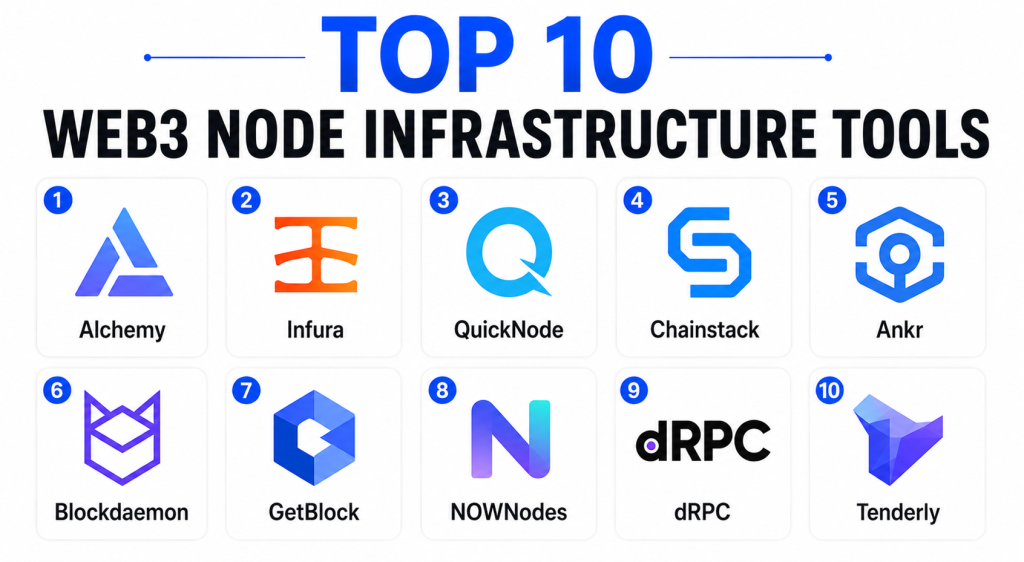
Top 10 Web3 Node Infrastructure Tools
1 — Alchemy
Short description:
Alchemy is a widely used Web3 infrastructure platform for developers building blockchain applications at scale. It provides RPC access, enhanced APIs, transaction tools, debugging capabilities, NFT APIs, and developer dashboards. The platform is especially strong for Ethereum and major Layer-2 ecosystems. Startups, enterprises, DeFi teams, NFT applications, and gaming projects use Alchemy to avoid running complex blockchain infrastructure internally. Its developer experience is one of its strongest advantages, especially for teams that need production-grade APIs and monitoring. Alchemy is a strong fit for teams that want more than basic node access and need a complete Web3 development stack.
Key Features
- Blockchain RPC endpoints for major networks
- Enhanced APIs for NFTs, token data, and transactions
- Developer dashboards and usage analytics
- WebSocket support for real-time blockchain events
- Transaction simulation and debugging tools
- Scalable infrastructure for production dApps
- Support for major Ethereum Layer-2 ecosystems
Pros
- Strong developer experience with polished dashboards and APIs.
- Broad ecosystem adoption across Web3 startups and applications.
- Useful advanced APIs beyond standard RPC access.
Cons
- Pricing can become more important as usage scales.
- Advanced usage may require careful request optimization.
- Some enterprise features may require custom plans.
Platforms / Deployment
- Web
- Cloud
- API-based deployment
Security & Compliance
- API key management
- Access controls
- Usage monitoring
- Enterprise security options vary by plan
- Compliance certifications: Not publicly stated here
Integrations & Ecosystem
Alchemy integrates well with common Web3 development workflows and blockchain application stacks. It is often used alongside frontend frameworks, smart contract tools, analytics systems, and wallet integrations.
- Ethereum and Layer-2 ecosystems
- NFT platforms
- DeFi applications
- Web3 SDKs
- Smart contract development tools
- Wallet-based applications
Support & Community
Alchemy has strong documentation, tutorials, developer guides, community resources, and enterprise support options. Its ecosystem presence makes it easier for new developers to find examples and implementation help.
2 — Infura
Short description:
Infura is one of the most established Web3 infrastructure providers and is closely associated with Ethereum and IPFS development. It provides scalable API access to blockchain networks so developers can build decentralized applications without managing their own node infrastructure. Infura is commonly used by wallets, DeFi projects, NFT platforms, and enterprise blockchain teams. Its reliability history and association with Consensys make it a familiar choice for Ethereum-first teams. Developers value Infura for straightforward API access, documentation, and ecosystem maturity. It is especially suitable for projects that need trusted Ethereum infrastructure with predictable developer workflows.
Key Features
- Ethereum and Web3 API access
- IPFS API support
- Scalable RPC infrastructure
- Developer dashboard
- WebSocket support
- Integration with Consensys ecosystem
- Multi-network blockchain access
Pros
- Mature and widely adopted infrastructure provider.
- Strong fit for Ethereum-first development.
- Good documentation and developer onboarding.
Cons
- Some teams may want broader advanced tooling.
- Heavy usage can require paid plans or enterprise arrangements.
- Dependency on centralized hosted infrastructure may concern decentralization-focused teams.
Platforms / Deployment
- Web
- Cloud
- API-based deployment
Security & Compliance
- API key controls
- Project-level access management
- Security features vary by plan
- Compliance certifications: Not publicly stated here
Integrations & Ecosystem
Infura fits naturally into Ethereum and Consensys-driven development environments. It is commonly used for dApps, wallet backends, smart contract tools, and IPFS-connected applications.
- Ethereum dApps
- IPFS workflows
- MetaMask-related ecosystems
- Smart contract tools
- Wallet applications
- Web3 backend services
Support & Community
Infura has mature documentation, developer support content, community resources, and enterprise options. Its long market presence makes it easier to find developer examples and troubleshooting guidance.
3 — QuickNode
Short description:
QuickNode is a high-performance blockchain infrastructure platform focused on fast RPC access, wide chain support, APIs, analytics, and developer tools. It is widely used by teams that care about latency, reliability, and scaling blockchain applications across multiple networks. QuickNode supports a broad range of blockchain ecosystems and offers add-ons that help developers extend functionality. It serves startups, DeFi teams, NFT projects, analytics providers, gaming platforms, and enterprise blockchain applications. Its strength lies in performance-oriented infrastructure and a strong marketplace-style ecosystem. QuickNode is a strong option for teams that need low-latency access and flexible infrastructure choices.
Key Features
- Multi-chain RPC infrastructure
- Dedicated and shared node access
- WebSocket support
- Analytics and performance monitoring
- Add-on marketplace
- Archive data availability
- API tools for developers
Pros
- Strong performance positioning.
- Broad blockchain network coverage.
- Useful add-ons for extending infrastructure capabilities.
Cons
- Cost structure should be reviewed carefully for high-volume workloads.
- Some advanced configurations may require technical expertise.
- Feature depth can vary by supported chain.
Platforms / Deployment
- Web
- Cloud
- API-based deployment
- Dedicated node options
Security & Compliance
- API key controls
- Endpoint security options
- Team and account management features vary by plan
- Compliance certifications: Not publicly stated here
Integrations & Ecosystem
QuickNode integrates with many Web3 development stacks and supports a wide variety of blockchain use cases. Its add-on ecosystem can help teams expand functionality without building every component in-house.
- DeFi applications
- NFT platforms
- Web3 games
- Analytics dashboards
- Wallet applications
- Developer frameworks
Support & Community
QuickNode provides documentation, support resources, developer guides, and paid support options. Its educational content and ecosystem tooling are useful for teams moving from prototype to production.
4 — Chainstack
Short description:
Chainstack is a blockchain infrastructure platform designed for managed nodes, dedicated nodes, shared nodes, and enterprise-grade Web3 access. It supports public and permissioned blockchain networks, making it useful for both Web3 startups and enterprise blockchain teams. Chainstack focuses on deployment flexibility, performance, and operational control. Teams can use it for dApps, analytics, DeFi, custody, payments, and enterprise blockchain projects. It is especially useful for organizations that want more infrastructure control than simple shared RPC endpoints. Chainstack is a strong fit for teams that need reliable node deployment across multiple chains and environments.
Key Features
- Managed blockchain nodes
- Dedicated and shared node options
- Multi-chain support
- Archive node availability
- Monitoring and metrics
- Enterprise deployment options
- API-based blockchain access
Pros
- Good fit for enterprise and infrastructure-heavy teams.
- Flexible deployment options.
- Strong managed node capabilities.
Cons
- May be more technical than beginner-focused platforms.
- Pricing and setup should be evaluated for each workload.
- Some advanced enterprise needs may require custom configuration.
Platforms / Deployment
- Web
- Cloud
- Hybrid
- Dedicated node deployment
Security & Compliance
- Access controls
- Infrastructure monitoring
- Enterprise security options
- Some compliance details vary by plan
- Compliance certifications: Not publicly stated here
Integrations & Ecosystem
Chainstack fits well with applications that need reliable blockchain node infrastructure and operational visibility. It supports developer, enterprise, and analytics-oriented workflows.
- Blockchain analytics tools
- Enterprise systems
- DeFi backends
- Wallet infrastructure
- Smart contract platforms
- Monitoring workflows
Support & Community
Chainstack provides documentation, onboarding materials, managed infrastructure support, and enterprise-focused assistance. It is suitable for teams that need infrastructure guidance and production support.
5 — Ankr
Short description:
Ankr provides Web3 infrastructure services including RPC endpoints, node services, staking infrastructure, and decentralized infrastructure capabilities. It is widely recognized among developers building blockchain applications across multiple networks. Ankr focuses on making blockchain access easier and more cost-efficient while supporting a broad ecosystem of chains. It is used by developers, DeFi teams, Web3 startups, and infrastructure builders. The platform is especially relevant for teams seeking multi-chain API access and decentralized infrastructure positioning. Ankr is a practical choice for projects that need broad Web3 connectivity without operating every node internally.
Key Features
- Multi-chain RPC access
- Node infrastructure services
- Staking infrastructure
- Developer APIs
- Decentralized infrastructure model
- Web3 application support
- Broad network coverage
Pros
- Strong multi-chain coverage.
- Useful for developers and infrastructure teams.
- Combines RPC access with broader Web3 infrastructure services.
Cons
- Feature experience may vary by network.
- Enterprise requirements may need careful validation.
- Documentation depth may vary across product areas.
Platforms / Deployment
- Web
- Cloud
- API-based deployment
- Node infrastructure services
Security & Compliance
- API access controls
- Infrastructure security controls
- Compliance certifications: Not publicly stated
Integrations & Ecosystem
Ankr supports a wide range of Web3 use cases through RPC access and infrastructure services. It can be used by dApps, staking providers, and multi-chain applications.
- DeFi applications
- Staking platforms
- Wallets
- Multi-chain dApps
- Developer tools
- Blockchain analytics systems
Support & Community
Ankr has an active Web3 community, developer documentation, and support resources. It is especially known among developers working with multi-chain infrastructure.
6 — Blockdaemon
Short description:
Blockdaemon is an institutional-grade blockchain infrastructure provider focused on node operations, staking infrastructure, APIs, and enterprise blockchain access. It is often considered by financial institutions, custodians, exchanges, payment providers, and large organizations needing reliable blockchain connectivity. Blockdaemon offers infrastructure for many blockchain networks and supports operational needs beyond basic RPC. Its positioning is more enterprise and institutional than beginner developer tooling. The platform is a strong fit for regulated or high-value digital asset operations. Teams that need governance, reliability, and professional infrastructure support often include Blockdaemon in their shortlist.
Key Features
- Institutional node infrastructure
- Staking infrastructure
- API access
- Multi-chain support
- Dedicated infrastructure options
- Monitoring and operational tooling
- Enterprise support
Pros
- Strong fit for institutional blockchain operations.
- Broad infrastructure capabilities beyond basic RPC.
- Good option for staking and node operations.
Cons
- May be more expensive than developer-first providers.
- Not always ideal for small hobby projects.
- Enterprise workflows may require onboarding and planning.
Platforms / Deployment
- Web
- Cloud
- Hybrid
- Dedicated infrastructure options
Security & Compliance
- Enterprise security controls
- Access management
- Monitoring and operational controls
- Compliance details: Varies / Not publicly stated
Integrations & Ecosystem
Blockdaemon supports institutional blockchain operations and integrates into enterprise-grade digital asset workflows.
- Custody platforms
- Exchanges
- Staking systems
- Financial services workflows
- Blockchain analytics
- Institutional APIs
Support & Community
Blockdaemon offers professional support, enterprise onboarding, and infrastructure expertise. It is better suited for serious production teams than casual experimentation.
7 — GetBlock
Short description:
GetBlock provides blockchain node access through APIs and RPC endpoints across multiple networks. It is designed for developers and businesses that need quick blockchain connectivity without running nodes manually. GetBlock supports shared and dedicated node options, making it useful for both early-stage and production applications. Teams can use it for wallets, DeFi dashboards, NFT platforms, exchanges, and analytics tools. It is often considered by buyers looking for multi-chain access with flexible node options. GetBlock is a practical choice for teams that want straightforward Web3 infrastructure with broad network support.
Key Features
- Multi-chain RPC endpoints
- Shared node access
- Dedicated node options
- API-based connectivity
- WebSocket support on supported networks
- Archive access where available
- Developer dashboard
Pros
- Broad blockchain network support.
- Straightforward node access model.
- Useful for startups and developers needing quick setup.
Cons
- Advanced developer tooling may be less extensive than larger platforms.
- Support and performance should be tested by region.
- Enterprise controls may vary by plan.
Platforms / Deployment
- Web
- Cloud
- API-based deployment
- Dedicated node options
Security & Compliance
- API key management
- Endpoint access controls
- Compliance certifications: Not publicly stated
Integrations & Ecosystem
GetBlock can support many standard blockchain development workflows through RPC and API access.
- Wallet applications
- DeFi dashboards
- NFT platforms
- Exchanges
- Analytics tools
- Web3 backend services
Support & Community
GetBlock provides documentation and support resources. Community strength is moderate compared with the largest infrastructure ecosystems, but the platform is practical for many developer workflows.
8 — NOWNodes
Short description:
NOWNodes provides blockchain-as-a-service infrastructure with API access to full nodes, explorers, and blockchain data. It is aimed at developers, exchanges, wallets, custody platforms, and businesses that need access to many blockchain networks. NOWNodes focuses on making node access available without requiring internal DevOps teams to run and maintain blockchain infrastructure. It is useful for projects that need multi-asset or multi-chain connectivity. The platform can support wallets, payment systems, DeFi tools, and analytics applications. NOWNodes is a solid option for teams that need broad coverage and simple API-based blockchain access.
Key Features
- API access to blockchain nodes
- Multi-chain support
- Full node connectivity
- Explorer data access
- WebSocket support where available
- Scalable API plans
- Developer-focused setup
Pros
- Broad asset and network coverage.
- Useful for wallet, exchange, and payment workflows.
- Simple API-based approach.
Cons
- Advanced tooling may be less deep than premium developer platforms.
- Performance should be benchmarked for target chains.
- Enterprise security details may require validation.
Platforms / Deployment
- Web
- Cloud
- API-based deployment
Security & Compliance
- API key controls
- Infrastructure security measures
- Compliance certifications: Not publicly stated
Integrations & Ecosystem
NOWNodes supports blockchain access for many product categories, especially applications requiring multiple chains and asset types.
- Wallets
- Crypto exchanges
- Payment platforms
- Analytics dashboards
- Custody tools
- Blockchain explorers
Support & Community
NOWNodes provides documentation and customer support resources. It is best suited for teams that want practical API access without heavy infrastructure ownership.
9 — dRPC
Short description:
dRPC is a Web3 infrastructure provider focused on decentralized RPC access and reliable blockchain connectivity. It is relevant for developers who want alternatives to fully centralized RPC dependency while still needing practical API performance. dRPC supports multiple chains and aims to provide scalable blockchain access for dApps, wallets, DeFi products, and developer teams. Its positioning is useful for teams concerned about infrastructure resilience and provider centralization. It can fit both early-stage Web3 projects and teams looking to diversify their RPC architecture. dRPC is worth considering when decentralization and redundancy are important selection criteria.
Key Features
- Decentralized RPC infrastructure
- Multi-chain access
- API endpoints
- Scalable request handling
- Web3 application support
- Performance-focused routing
- Developer dashboard
Pros
- Appeals to teams seeking decentralized infrastructure options.
- Useful for RPC redundancy strategies.
- Supports common Web3 application needs.
Cons
- Smaller ecosystem than long-established providers.
- Enterprise features should be validated before purchase.
- Documentation and support depth may vary by use case.
Platforms / Deployment
- Web
- Cloud
- API-based deployment
Security & Compliance
- API key management
- Infrastructure access controls
- Compliance certifications: Not publicly stated
Integrations & Ecosystem
dRPC fits into standard Web3 backend architectures and can be used as a primary or secondary RPC provider.
- dApps
- Wallets
- DeFi tools
- NFT platforms
- Blockchain analytics
- Redundant RPC systems
Support & Community
dRPC has a growing developer presence. Support resources are suitable for Web3 teams, but buyers should validate SLA, response time, and enterprise support needs.
10 — Tenderly
Short description:
Tenderly is not just a traditional node provider; it is a Web3 development, monitoring, simulation, and debugging platform that also supports infrastructure needs around blockchain application operations. It is especially valuable for smart contract developers, DeFi teams, and protocols that need visibility into transactions, errors, simulations, alerts, and production behavior. Tenderly helps teams understand what is happening on-chain and reduce risk before and after deployment. It is commonly used alongside RPC providers and developer stacks. The platform is best for teams that need operational intelligence, simulation, and debugging depth. Tenderly is a strong choice for serious smart contract teams that care about reliability and developer productivity.
Key Features
- Transaction simulation
- Smart contract monitoring
- Debugging tools
- Alerts and observability
- Web3 development workflows
- API access
- Production monitoring support
Pros
- Excellent debugging and simulation capabilities.
- Strong value for smart contract engineering teams.
- Helpful for reducing operational risk.
Cons
- Not a pure generic node provider for every use case.
- May be used alongside another RPC provider.
- Advanced workflows require technical blockchain expertise.
Platforms / Deployment
- Web
- Cloud
- API-based deployment
Security & Compliance
- Team access controls
- Monitoring and audit-style visibility
- Compliance certifications: Not publicly stated
Integrations & Ecosystem
Tenderly fits into smart contract development and production monitoring workflows. It is useful across testing, deployment, incident response, and on-chain debugging.
- Smart contract frameworks
- DeFi protocols
- Developer APIs
- Monitoring systems
- Alerting workflows
- Ethereum-compatible networks
Support & Community
Tenderly has strong documentation and a respected developer-focused community. It is especially useful for engineering teams building and maintaining complex smart contracts.
Comparison Table (Top 10)
| Tool Name | Best For | Platform(s) Supported | Deployment | Standout Feature | Public Rating |
|---|---|---|---|---|---|
| Alchemy | Developer-first Web3 apps | Web, API | Cloud | Enhanced APIs and developer tooling | N/A |
| Infura | Ethereum and IPFS projects | Web, API | Cloud | Mature Ethereum infrastructure | N/A |
| QuickNode | Low-latency multi-chain apps | Web, API | Cloud / Dedicated | Performance-focused RPC and add-ons | N/A |
| Chainstack | Managed node infrastructure | Web, API | Cloud / Hybrid | Flexible node deployment | N/A |
| Ankr | Multi-chain RPC and staking infrastructure | Web, API | Cloud | Broad Web3 infrastructure services | N/A |
| Blockdaemon | Institutional blockchain infrastructure | Web, API | Cloud / Hybrid | Enterprise node and staking operations | N/A |
| GetBlock | Simple multi-chain node access | Web, API | Cloud / Dedicated | Shared and dedicated node options | N/A |
| NOWNodes | Wallets, exchanges, payment apps | Web, API | Cloud | Broad blockchain API coverage | N/A |
| dRPC | Decentralized RPC access | Web, API | Cloud | Decentralized RPC approach | N/A |
| Tenderly | Smart contract monitoring and debugging | Web, API | Cloud | Simulation and observability | N/A |
Evaluation & Scoring of Web3 Node Infrastructure
| Tool Name | Core (25%) | Ease (15%) | Integrations (15%) | Security (10%) | Performance (10%) | Support (10%) | Value (15%) | Weighted Total (0–10) |
|---|---|---|---|---|---|---|---|---|
| Alchemy | 10 | 9 | 10 | 8 | 9 | 9 | 8 | 9.1 |
| Infura | 9 | 8 | 9 | 8 | 8 | 9 | 8 | 8.5 |
| QuickNode | 10 | 8 | 9 | 8 | 10 | 9 | 8 | 9.0 |
| Chainstack | 9 | 8 | 8 | 9 | 9 | 8 | 8 | 8.5 |
| Ankr | 8 | 8 | 8 | 8 | 8 | 8 | 9 | 8.2 |
| Blockdaemon | 9 | 7 | 8 | 9 | 9 | 9 | 7 | 8.4 |
| GetBlock | 8 | 8 | 7 | 7 | 8 | 7 | 8 | 7.7 |
| NOWNodes | 8 | 8 | 7 | 7 | 8 | 7 | 8 | 7.7 |
| dRPC | 8 | 8 | 7 | 7 | 8 | 7 | 8 | 7.7 |
| Tenderly | 8 | 9 | 8 | 8 | 8 | 8 | 8 | 8.2 |
These scores are comparative and should not be treated as universal truth. A trading application may prioritize latency and reliability, while an enterprise may prioritize governance, access controls, and support. A developer team may value debugging, APIs, and documentation more than raw infrastructure control. Always validate shortlisted providers using your own target chains, regions, request methods, and production traffic patterns.
Which Web3 Node Infrastructure Tool Is Right for You?
Solo / Freelancer
For solo developers, Alchemy, Infura, QuickNode, and GetBlock are practical starting points. They provide fast onboarding, hosted APIs, and enough documentation to build wallets, NFT apps, dashboards, and small dApps without managing nodes manually.
SMB
Small and growing Web3 teams should consider Alchemy, QuickNode, Chainstack, and Ankr. These platforms provide a balance of usability, multi-chain access, production reliability, and scaling options without forcing teams to build internal infrastructure teams too early.
Mid-Market
Mid-market companies often need stronger observability, performance controls, and predictable scaling. QuickNode, Chainstack, Alchemy, and Blockdaemon are good fits depending on whether the priority is developer tooling, node deployment control, institutional infrastructure, or multi-chain performance.
Enterprise
Enterprises should evaluate Blockdaemon, Chainstack, Alchemy, Infura, and QuickNode. The final choice should depend on security controls, support commitments, chain coverage, dedicated capacity, audit requirements, and integration with existing cloud, identity, and monitoring systems.
Budget vs Premium
Budget-conscious teams can start with shared RPC and API plans from providers such as Ankr, GetBlock, NOWNodes, or entry-level plans from larger platforms. Premium buyers should consider QuickNode, Alchemy, Chainstack, or Blockdaemon when they need dedicated nodes, higher limits, support SLAs, and production-grade observability.
Feature Depth vs Ease of Use
If ease of use matters most, Alchemy, Infura, and QuickNode are strong choices because they are developer-friendly and well documented. If feature depth matters more, Chainstack, Blockdaemon, and Tenderly provide stronger value for infrastructure control, institutional workflows, and smart contract debugging.
Integrations & Scalability
For broad ecosystem integrations, Alchemy, QuickNode, and Infura are strong options. For scalable node deployment and infrastructure control, Chainstack and Blockdaemon are better suited. For smart contract observability and simulations, Tenderly is especially useful alongside a primary RPC provider.
Security & Compliance Needs
Security-focused teams should evaluate Blockdaemon, Chainstack, Alchemy, QuickNode, and Infura carefully. Important checks include API key governance, IP restrictions, SSO, audit logs, uptime commitments, incident response, encryption practices, role-based access, and compliance documentation.
Frequently Asked Questions (FAQs)
1- What is Web3 node infrastructure?
Web3 node infrastructure provides hosted blockchain access through RPC endpoints, APIs, dedicated nodes, archive data, WebSockets, and monitoring tools. It allows developers to connect applications to blockchain networks without running all node infrastructure internally.
2- Why do developers use node infrastructure providers?
Developers use providers to save time, reduce DevOps complexity, improve uptime, and access multiple blockchain networks quickly. Running nodes internally can be expensive, operationally complex, and difficult to scale across chains.
3- What is an RPC endpoint in Web3?
An RPC endpoint is an API connection that lets an application read blockchain data or submit transactions to a blockchain network. Wallets, dApps, DeFi platforms, and analytics tools commonly rely on RPC endpoints.
4- Are Web3 node infrastructure platforms expensive?
Pricing varies by request volume, chain, archive access, WebSocket usage, dedicated node needs, and support level. Many platforms offer entry-level plans, but production workloads should be tested carefully for cost predictability.
5- What is the difference between shared and dedicated nodes?
Shared nodes are used by multiple customers and are usually easier and cheaper to start with. Dedicated nodes provide isolated capacity, more control, and better predictability for high-volume or mission-critical workloads.
6- What should teams check before switching providers?
Teams should test latency, uptime, supported methods, rate limits, archive data availability, WebSocket behavior, pricing, security controls, and support responsiveness. A staged migration is safer than switching production traffic all at once.
7- Which provider is best for Ethereum development?
Alchemy, Infura, QuickNode, Chainstack, and Tenderly are strong choices for Ethereum-related development. The best fit depends on whether the team needs basic RPC, enhanced APIs, debugging, archive data, or enterprise support.
8- Do Web3 node providers support multiple blockchains?
Yes, most leading providers support multiple blockchains and Layer-2 networks. However, chain coverage, performance, archive availability, and API depth can vary significantly by provider.
9- Is decentralized RPC better than centralized RPC?
Decentralized RPC can improve resilience and reduce dependency on one provider, but centralized providers may offer mature tooling, support, dashboards, and enterprise contracts. Many teams use a hybrid or fallback strategy.
10- What are common mistakes when choosing node infrastructure?
Common mistakes include choosing only by price, ignoring rate limits, failing to benchmark latency, not testing archive needs, overlooking WebSocket limits, and skipping security review. Production teams should test with real traffic patterns before committing.
Conclusion
Web3 node infrastructure is one of the most important technical layers behind modern blockchain applications. The right provider can improve speed, reliability, developer productivity, user experience, and operational confidence. Alchemy and QuickNode are strong developer-first choices, Infura remains a mature Ethereum and IPFS option, Chainstack offers flexible managed infrastructure, and Blockdaemon is well suited for institutional blockchain operations. Ankr, GetBlock, NOWNodes, and dRPC provide practical multi-chain access, while Tenderly adds deep value for smart contract monitoring and debugging. There is no single best platform for every team. The best choice depends on your supported chains, traffic volume, security needs, budget, latency requirements, and internal engineering capacity. A smart next step is to shortlist two or three providers, benchmark them with your real workloads, validate integrations and security controls, and then run a production-style pilot before final selection.
