Introduction
Open banking platforms help banks, fintech companies, lenders, accounting apps, payment providers, and digital businesses securely connect to customer-permissioned financial data through APIs. In simple terms, they make it possible for users to connect bank accounts, verify balances, share transaction history, initiate payments, confirm income, support lending decisions, and build personalized financial products.
Open banking matters now because financial services are becoming more API-driven, consent-based, and embedded inside everyday digital experiences. Customers expect faster onboarding, instant bank verification, real-time payments, and personalized financial insights. At the same time, businesses need stronger compliance, privacy controls, uptime, data coverage, and reliable bank connectivity.
Real-world use cases include:
- Bank account verification for fintech apps
- Personal finance and budgeting tools
- Lending, income, and affordability checks
- Pay-by-bank and account-to-account payments
- Business finance, accounting, and cash-flow automation
What buyers should evaluate:
- Bank and institution coverage
- Data quality and refresh reliability
- Payment initiation capabilities
- Consent and privacy controls
- API documentation and developer experience
- Regional regulatory support
- Fraud and risk controls
- Pricing model and transaction costs
- Support and onboarding quality
- Scalability and uptime expectations
Best for: Fintech startups, banks, lenders, payment companies, accounting platforms, wealth apps, insurance providers, marketplaces, and enterprises building financial data or payment experiences.
Not ideal for: Businesses with no need for bank data access, very small teams that only need manual financial uploads, or companies operating in markets where open banking connectivity is limited and bank-direct partnerships are more practical.
Key Trends in Open Banking Platforms
- Open finance is expanding beyond bank accounts into investments, pensions, insurance, payroll, lending, and broader financial data access.
- AI-driven financial insights are increasing as platforms use normalized transaction data for categorization, affordability analysis, cash-flow forecasting, and risk scoring.
- Pay-by-bank adoption is growing as merchants, fintechs, and payment providers look for lower-cost alternatives to card rails.
- Consent management is becoming more important because regulators and users expect clear permissions, data minimization, revocation, and auditability.
- Multi-provider connectivity strategies are rising as fintechs reduce dependency on one aggregator and improve coverage resilience.
- Real-time data expectations are increasing for lending, credit, fraud detection, and account verification workflows.
- Regional compliance complexity is growing because open banking standards differ across the UK, EU, US, Latin America, Australia, India, and other markets.
- Embedded finance platforms are adopting open banking APIs to offer lending, payments, wealth, and financial wellness features inside non-bank products.
- Bank-grade security reviews are becoming standard for vendors handling account data, payment initiation, and regulated financial workflows.
- Developer experience remains a major differentiator because faster integration, cleaner APIs, webhooks, sandbox tools, and better documentation reduce launch time.
How We Selected These Tools
The platforms in this guide were selected using the following practical evaluation criteria:
- Market adoption and recognition among fintechs, banks, and financial technology teams
- Breadth and reliability of bank connectivity across key regions
- Feature completeness across data access, payments, identity, account verification, and risk use cases
- Security posture signals such as encryption, consent controls, auditability, and permission management
- Developer experience, API quality, sandbox availability, and integration documentation
- Support for regional compliance requirements and open banking standards
- Ecosystem fit for startups, SMBs, enterprises, banks, and regulated financial institutions
- Scalability for high-volume API usage, real-time workflows, and enterprise-grade financial applications
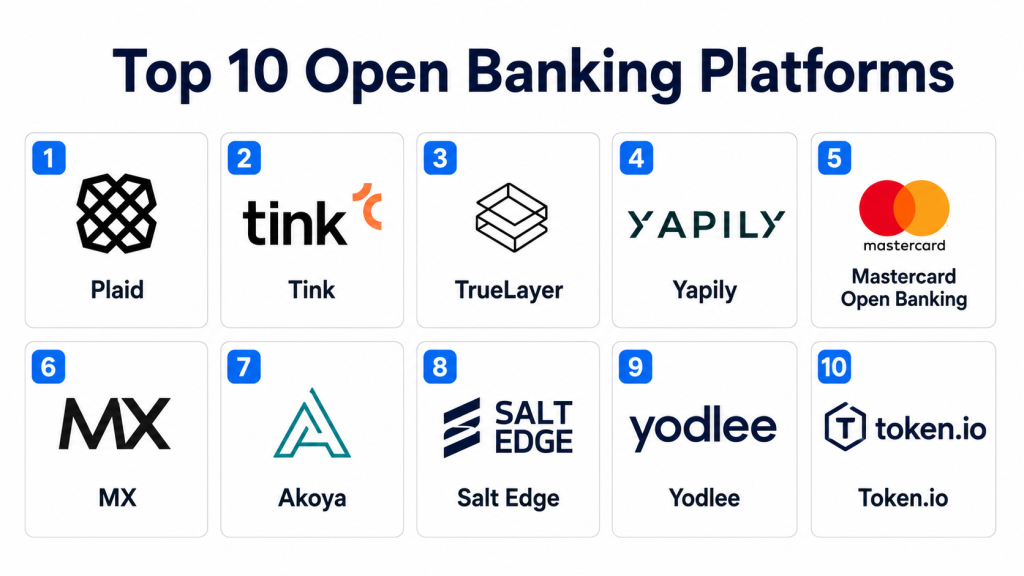
Top 10 Open Banking Platforms
1- Plaid
Short description:
Plaid is one of the most widely recognized open banking and financial data connectivity platforms, especially in North America. It helps fintech apps, lenders, personal finance tools, payment providers, and digital businesses connect user bank accounts and access permissioned financial data. Plaid supports use cases such as account verification, transaction enrichment, income verification, identity checks, liabilities, assets, and payments-related workflows. It is particularly useful for companies that want fast developer onboarding and broad financial institution connectivity. Plaid is often a strong fit for startups and enterprises building consumer-facing fintech experiences. Buyers should still evaluate regional coverage, pricing, and fallback strategy based on their target market.
Key Features
- Bank account linking and verification
- Transaction data access and categorization
- Identity, income, assets, and liabilities data products
- Developer-friendly APIs and sandbox tools
- Webhooks and event-based updates
- Payment and transfer-related capabilities
- Financial data enrichment workflows
Pros
- Strong developer experience and API documentation
- Broad market recognition and ecosystem adoption
- Useful across many fintech use cases
Cons
- Pricing can increase with scale and product mix
- Coverage and data quality may vary by institution and region
- Some enterprises may need multi-provider redundancy
Platforms / Deployment
- Web
- Cloud
Security & Compliance
- Consent-based account connectivity
- Read-only data access for many data products
- Encryption: Not publicly stated
- SOC 2 / ISO 27001: Not publicly stated
Integrations & Ecosystem
Plaid integrates into fintech, lending, payments, accounting, personal finance, and embedded finance workflows through APIs and developer tools.
- Fintech apps
- Lending platforms
- Payment workflows
- Accounting tools
- Personal finance apps
- Developer APIs
Support & Community
Plaid has strong documentation, developer resources, sandbox tools, and a large fintech developer community. Support options may vary by plan and customer size.
2- Tink
Short description:
Tink is an open banking platform focused on financial data, account aggregation, payment initiation, and financial insights. It is widely used by banks, fintech companies, lenders, and financial service providers across Europe and other supported regions. Tink helps businesses connect to bank data, verify accounts, initiate payments, and build personalized financial experiences. It is especially valuable for companies operating in markets shaped by open banking regulation and payment initiation standards. Tink is well suited for enterprises and fintechs that need both data connectivity and payment capabilities. Buyers should evaluate coverage, supported markets, and specific product availability for their region.
Key Features
- Account information services
- Payment initiation capabilities
- Transaction categorization
- Account verification
- Financial data aggregation
- Developer APIs
- Risk and affordability insights
Pros
- Strong European open banking focus
- Useful combination of data and payment products
- Suitable for banks and fintech businesses
Cons
- Regional availability should be checked carefully
- Enterprise onboarding may require planning
- Not always the best fit for US-only fintechs
Platforms / Deployment
- Web
- Cloud
Security & Compliance
- Consent-based access
- Strong customer authentication support where applicable
- GDPR alignment may apply in European workflows
- Additional certifications: Not publicly stated
Integrations & Ecosystem
Tink supports open banking use cases across fintech, banking, payments, lending, and financial management products.
- Bank APIs
- Payment workflows
- Lending platforms
- Personal finance tools
- Banking applications
- Developer APIs
Support & Community
Tink provides documentation, implementation support, and enterprise onboarding resources. Its ecosystem is strongest among European fintechs, banks, and regulated financial service providers.
3- TrueLayer
Short description:
TrueLayer is an open banking platform focused on account connectivity, payment initiation, verification, and financial data access. It is especially known for enabling account-to-account payments and pay-by-bank experiences in supported markets. TrueLayer serves fintechs, merchants, marketplaces, lenders, investment apps, and financial platforms. It is a strong option for businesses that need open banking payments alongside account data capabilities. The platform is particularly relevant in the UK and Europe where open banking payment rails are more developed. Buyers should evaluate market coverage, payment conversion needs, and integration requirements.
Key Features
- Pay-by-bank payment capabilities
- Account information APIs
- Account verification
- Payment initiation services
- Developer-friendly API tools
- User consent workflows
- Real-time financial data access
Pros
- Strong fit for open banking payments
- Useful for merchants, fintechs, and marketplaces
- Good developer experience for payment flows
Cons
- Regional coverage matters significantly
- Not always ideal for purely data-only use cases
- Payment workflows may require regulatory and operational planning
Platforms / Deployment
- Web
- Cloud
Security & Compliance
- Consent-based access
- Strong customer authentication support where applicable
- Encryption: Not publicly stated
- Compliance certifications: Not publicly stated
Integrations & Ecosystem
TrueLayer integrates with financial apps, payment flows, marketplaces, and fintech platforms that need bank connectivity and account-to-account payments.
- Bank APIs
- Payment gateways
- Fintech applications
- Marketplaces
- Lending platforms
- Developer APIs
Support & Community
TrueLayer provides developer documentation, support resources, and implementation guidance. Its community is strong among open banking payment builders and fintech teams in supported markets.
4- Yapily
Short description:
Yapily is an open banking infrastructure platform that provides API access to financial data and payment initiation services. It is built for fintechs, enterprises, lenders, accounting platforms, and financial service providers that need reliable open banking connectivity. Yapily focuses on infrastructure-level access rather than building consumer-facing financial apps. It is particularly relevant for organizations that need scalable APIs, account information, payments, and data connectivity across supported European markets. Yapily is often evaluated by companies that want deep control over user experience and financial workflows. Buyers should assess supported countries, bank coverage, and implementation effort.
Key Features
- Account information APIs
- Payment initiation services
- Open banking infrastructure
- Consent-based financial data access
- Developer APIs
- Financial data connectivity
- Multi-market coverage
Pros
- Strong infrastructure-first positioning
- Useful for fintechs and enterprises building custom products
- Supports both data and payment use cases
Cons
- Requires technical implementation capability
- Coverage varies by market
- Less suited for teams wanting a fully packaged app
Platforms / Deployment
- Web
- Cloud
Security & Compliance
- Consent-based API access
- Strong customer authentication support where required
- Compliance details vary by region
- Additional certifications: Not publicly stated
Integrations & Ecosystem
Yapily fits into fintech, lending, accounting, payments, and embedded finance stacks through API-based infrastructure.
- Bank APIs
- Payment initiation workflows
- Accounting platforms
- Lending applications
- Fintech products
- Developer tools
Support & Community
Yapily provides documentation, onboarding resources, and support for technical teams. Its strongest community is among fintech developers and enterprise API teams.
5- Mastercard Open Banking
Short description:
Mastercard Open Banking, including capabilities associated with Finicity in the US market, supports account data access, verification, lending, payments, and financial decisioning workflows. It is designed for financial institutions, lenders, fintechs, payment providers, and enterprises that need trusted financial data connectivity. The platform is useful for income verification, account verification, credit decisioning, personal finance, and embedded financial services. Mastercard’s broader payments and financial services ecosystem makes it relevant for enterprise buyers. It is particularly strong for organizations seeking financial data connectivity with an established global payments brand. Buyers should evaluate regional product availability and integration requirements.
Key Features
- Account verification
- Financial data aggregation
- Income and employment-related insights
- Lending and decisioning support
- Payment-related capabilities
- API-based connectivity
- Enterprise financial data workflows
Pros
- Strong enterprise and financial services positioning
- Useful for lending and verification use cases
- Backed by a large payments ecosystem
Cons
- Product availability may vary by region
- Enterprise engagement may require longer procurement
- May be more complex than startup-focused tools
Platforms / Deployment
- Web
- Cloud
Security & Compliance
- Consent-based financial data access
- Access controls
- Auditability: Varies / N/A
- Certifications: Not publicly stated
Integrations & Ecosystem
Mastercard Open Banking integrates into lending, payment, banking, and enterprise financial workflows.
- Banks and financial institutions
- Lending platforms
- Payment systems
- Personal finance tools
- Enterprise APIs
- Decisioning workflows
Support & Community
Mastercard offers enterprise support, implementation assistance, and partner ecosystem access. Community strength is strongest among financial institutions, lenders, and enterprise fintech teams.
6- MX
Short description:
MX is a financial data platform focused on open finance, data connectivity, data enhancement, money experience tools, and financial insights. It serves banks, credit unions, fintechs, and digital financial service providers. MX helps organizations connect financial accounts, normalize transaction data, improve categorization, and deliver better financial experiences. It is especially relevant for institutions that want to combine data aggregation with customer-facing financial wellness and insights. MX is often evaluated by banks and financial institutions modernizing digital banking experiences. Buyers should assess its fit based on data enrichment, user experience, and connectivity needs.
Key Features
- Financial data aggregation
- Transaction cleansing and categorization
- Open finance APIs
- Personal financial management tools
- Account connectivity
- Insights and analytics
- Institution-focused financial experiences
Pros
- Strong data enrichment capabilities
- Good fit for banks and credit unions
- Useful for financial wellness and customer insights
Cons
- May be less lightweight for simple fintech MVPs
- Enterprise implementation may require planning
- Regional and institution coverage should be validated
Platforms / Deployment
- Web
- Cloud
Security & Compliance
- Consent-based data access
- Access controls
- Security details: Varies / N/A
- Certifications: Not publicly stated
Integrations & Ecosystem
MX integrates with banks, credit unions, fintech applications, digital banking platforms, and data-driven financial products.
- Digital banking systems
- Fintech apps
- Financial wellness tools
- Lending workflows
- APIs
- Data enrichment pipelines
Support & Community
MX provides customer support, documentation, onboarding, and enterprise assistance. Its strongest community is among banks, credit unions, and financial wellness product teams.
7- Akoya
Short description:
Akoya is an open finance data access network designed to connect financial institutions, fintechs, and data recipients through secure, permissioned data sharing. It focuses on API-based access and consent-driven financial data exchange. Akoya is especially relevant in the US market, where financial data access continues moving toward standardized, permission-based models. The platform is useful for organizations that want bank-supported data connectivity and stronger control over data-sharing permissions. It is often evaluated by financial institutions and fintechs building compliant open finance workflows. Buyers should evaluate coverage, data types, and integration fit for their specific use case.
Key Features
- Permissioned financial data access
- API-based open finance connectivity
- Bank and fintech data exchange
- Consent and authorization workflows
- Data recipient support
- Secure data-sharing infrastructure
- Institution-focused connectivity model
Pros
- Strong fit for permission-based open finance
- Relevant for US financial data access strategies
- Useful for bank-supported ecosystem connections
Cons
- Coverage and use-case fit should be validated
- May not replace broader aggregators in every scenario
- Best suited for teams with defined open finance strategy
Platforms / Deployment
- Web
- Cloud
Security & Compliance
- Consent-based access
- API-based permission controls
- Auditability: Varies / N/A
- Certifications: Not publicly stated
Integrations & Ecosystem
Akoya connects financial institutions and fintech data recipients through a secure open finance network.
- Banks
- Credit unions
- Fintech applications
- Data recipients
- API workflows
- Open finance programs
Support & Community
Akoya provides support and onboarding for financial institutions and data recipients. Its community is strongest among US open finance ecosystem participants.
8- Salt Edge
Short description:
Salt Edge is an open banking and open finance platform that provides data aggregation, payment initiation, compliance tools, and bank connectivity. It serves fintechs, lenders, banks, accounting platforms, and financial service providers. Salt Edge is useful for businesses that need access to financial data and payment capabilities across supported markets. It also offers solutions for banks working on compliance and open banking enablement. The platform is relevant for teams seeking both customer-facing financial data access and bank-side open banking infrastructure. Buyers should review regional coverage and product fit carefully.
Key Features
- Account data aggregation
- Payment initiation support
- Open banking compliance solutions
- Bank connectivity APIs
- Transaction categorization
- Customer consent workflows
- Financial data enrichment
Pros
- Covers both fintech and bank-side open banking needs
- Useful mix of data, payments, and compliance products
- Broad open banking positioning
Cons
- Coverage depth can vary by country and institution
- Implementation may require technical planning
- Product fit depends heavily on region
Platforms / Deployment
- Web
- Cloud
Security & Compliance
- Consent-based access
- PSD2-oriented workflows in applicable markets
- Encryption: Not publicly stated
- Additional certifications: Not publicly stated
Integrations & Ecosystem
Salt Edge integrates with financial applications, banks, lenders, accounting platforms, and payment workflows.
- Banks
- Fintech apps
- Payment workflows
- Accounting platforms
- Lending tools
- APIs
Support & Community
Salt Edge provides documentation, onboarding resources, and support for banks and fintech companies. Community strength varies by market but is notable in open banking and open finance use cases.
9- Yodlee
Short description:
Yodlee is a long-standing financial data aggregation and analytics platform used by financial institutions, fintechs, wealth platforms, and financial service providers. It supports account aggregation, data enrichment, financial insights, and analytics-driven use cases. Yodlee is relevant for businesses that need mature financial data connectivity and historical experience in aggregation. It can support personal finance, wealth, lending, banking, and data intelligence workflows. The platform is often considered by organizations that want established financial data infrastructure. Buyers should evaluate data freshness, institution coverage, pricing, and integration complexity.
Key Features
- Financial data aggregation
- Account connectivity
- Transaction categorization
- Analytics and insights
- Wealth and personal finance workflows
- API-based integrations
- Financial data intelligence
Pros
- Long market presence in financial data aggregation
- Useful for wealth, banking, and financial insight products
- Broad financial data use-case coverage
Cons
- May feel less modern than developer-first platforms
- Implementation complexity may vary
- Data quality should be validated by use case
Platforms / Deployment
- Web
- Cloud
Security & Compliance
- Consent-based financial data access
- Access controls: Varies / N/A
- Compliance details: Varies / N/A
- Certifications: Not publicly stated
Integrations & Ecosystem
Yodlee integrates with banks, wealth platforms, fintech applications, financial wellness tools, and analytics systems.
- Banks
- Wealth platforms
- Personal finance apps
- Lending tools
- Analytics systems
- APIs
Support & Community
Yodlee provides enterprise support, documentation, and financial data implementation resources. Its community is strongest among established financial institutions and financial data users.
10- Token.io
Short description:
Token.io is an open banking payments platform focused on account-to-account payments and pay-by-bank experiences. It helps payment providers, merchants, banks, and fintech companies build open banking payment flows. Token.io is especially relevant for businesses that want to reduce card dependency and enable bank-based payments in supported markets. The platform focuses more on payment initiation than broad financial data aggregation. It is a strong fit for payment service providers and enterprises seeking open banking payment infrastructure. Buyers should evaluate supported regions, checkout experience, conversion rates, and payment success reliability.
Key Features
- Account-to-account payments
- Pay-by-bank infrastructure
- Payment initiation services
- Bank connectivity
- Merchant payment workflows
- API-based integration
- Consent and authentication flows
Pros
- Strong focus on open banking payments
- Useful for merchants and payment providers
- Can support lower-cost payment alternatives
Cons
- Less suitable for broad financial data aggregation
- Market availability must be validated
- Payment workflows may require operational and regulatory planning
Platforms / Deployment
- Web
- Cloud
Security & Compliance
- Consent-based payment initiation
- Strong customer authentication support where required
- Encryption: Not publicly stated
- Compliance certifications: Not publicly stated
Integrations & Ecosystem
Token.io integrates into merchant checkout, payment service provider infrastructure, fintech apps, and bank payment workflows.
- Payment providers
- Merchants
- Banks
- Checkout systems
- Fintech platforms
- APIs
Support & Community
Token.io provides implementation support, documentation, and payment-focused onboarding resources. Its community is strongest among payment providers and open banking payment teams.
Comparison Table
| Tool Name | Best For | Platform(s) Supported | Deployment | Standout Feature | Public Rating |
|---|---|---|---|---|---|
| Plaid | Fintech apps and bank data connectivity | Web | Cloud | Broad account connectivity and developer APIs | N/A |
| Tink | European open banking data and payments | Web | Cloud | Data aggregation plus payment initiation | N/A |
| TrueLayer | Pay-by-bank and open banking payments | Web | Cloud | Real-time account-to-account payment flows | N/A |
| Yapily | API-first open banking infrastructure | Web | Cloud | Infrastructure-level data and payment APIs | N/A |
| Mastercard Open Banking | Enterprise financial data and lending workflows | Web | Cloud | Account verification and decisioning support | N/A |
| MX | Banks, credit unions, and financial insights | Web | Cloud | Data enhancement and financial wellness tools | N/A |
| Akoya | US open finance data access network | Web | Cloud | Permissioned financial data sharing | N/A |
| Salt Edge | Open banking data, payments, and compliance | Web | Cloud | Data aggregation and bank-side compliance tools | N/A |
| Yodlee | Financial data aggregation and analytics | Web | Cloud | Long-standing financial data intelligence | N/A |
| Token.io | Open banking payments | Web | Cloud | Pay-by-bank payment infrastructure | N/A |
Evaluation & Scoring of Open Banking Platforms
| Tool Name | Core (25%) | Ease (15%) | Integrations (15%) | Security (10%) | Performance (10%) | Support (10%) | Value (15%) | Weighted Total |
| Plaid | 10 | 9 | 10 | 8 | 9 | 9 | 8 | 9.05 |
| Tink | 9 | 8 | 9 | 8 | 8 | 8 | 8 | 8.40 |
| TrueLayer | 9 | 8 | 8 | 8 | 9 | 8 | 8 | 8.35 |
| Yapily | 9 | 7 | 9 | 8 | 8 | 8 | 8 | 8.25 |
| Mastercard Open Banking | 9 | 7 | 9 | 9 | 9 | 9 | 7 | 8.45 |
| MX | 8 | 8 | 8 | 8 | 8 | 8 | 8 | 8.00 |
| Akoya | 8 | 7 | 8 | 9 | 8 | 8 | 7 | 7.80 |
| Salt Edge | 8 | 8 | 8 | 8 | 8 | 8 | 8 | 8.00 |
| Yodlee | 8 | 7 | 8 | 8 | 8 | 8 | 7 | 7.70 |
| Token.io | 8 | 8 | 8 | 8 | 8 | 8 | 8 | 8.00 |
These scores are comparative and should be interpreted by use case. A US fintech may score Plaid, MX, Akoya, or Mastercard Open Banking higher based on coverage and data access needs. A UK or EU payment company may favor TrueLayer, Tink, Yapily, Salt Edge, or Token.io. Enterprises should prioritize compliance, reliability, SLAs, security review outcomes, and regional coverage over headline feature lists.
Which Open Banking Platform Is Right for You?
Solo / Freelancer
Solo builders and independent developers should prioritize tools with strong documentation, sandbox access, and fast onboarding. Plaid is often practical for North American fintech prototypes, while TrueLayer, Tink, Yapily, or Salt Edge may fit UK and European use cases. The best choice depends heavily on target country and whether the product needs data, payments, or both.
SMB
Small and growing businesses should choose platforms that reduce integration complexity while supporting future scale. Plaid, Tink, TrueLayer, Salt Edge, and MX can fit SMB use cases depending on geography. SMBs should avoid overengineering with multiple providers before they have proven product-market fit.
Mid-Market
Mid-market fintechs, lenders, accounting platforms, and payment companies should evaluate coverage depth, support quality, data reliability, and cost at volume. Plaid, Mastercard Open Banking, Tink, Yapily, TrueLayer, MX, and Salt Edge are practical candidates depending on region and product model. At this stage, fallback strategies and data normalization become more important.
Enterprise
Banks, large fintechs, insurers, payment providers, and financial institutions should focus on governance, security review, SLAs, compliance posture, and implementation support. Mastercard Open Banking, Plaid, Tink, MX, Akoya, Yodlee, and Yapily may be stronger enterprise candidates. Enterprises should run formal due diligence and test data quality across key financial institutions before committing.
Budget vs Premium
Budget-conscious teams should evaluate pricing by connection, API call, payment, transaction, or product module. Premium platforms may be worth the cost when they improve conversion, reduce fraud, strengthen compliance, or provide better institution coverage. The cheapest option is not always the best if poor connectivity creates failed onboarding or support burden.
Feature Depth vs Ease of Use
Plaid and Coin-style developer-first platforms are often easier for fast product launches, while enterprise-focused providers may offer deeper governance and financial institution workflows. TrueLayer and Token.io are stronger when payment initiation is central. MX and Yodlee are better suited when data enrichment and financial insights are major priorities.
Integrations & Scalability
Scalability depends on API reliability, institution coverage, webhook quality, data normalization, error handling, and support responsiveness. Growing companies should design a provider abstraction layer so they can add a second open banking provider later if coverage or reliability gaps appear. This is especially important for multi-country products.
Security & Compliance Needs
Security-focused buyers should evaluate consent flows, data retention, encryption, access controls, audit logs, regulatory permissions, and provider security documentation. Payment initiation use cases require extra care because they involve money movement, authentication, fraud controls, and regulatory obligations. Regulated firms should involve legal, compliance, and security teams early in vendor selection.
Frequently Asked Questions
1- What is an open banking platform?
An open banking platform connects businesses to customer-permissioned financial data and payment APIs. It allows apps to verify bank accounts, read balances, access transactions, initiate payments, and build financial products with user consent.
2- How do open banking platforms make money?
Most platforms charge based on API usage, connected accounts, data products, payment volume, verification events, or enterprise contracts. Pricing varies widely depending on region, use case, transaction volume, and support level.
3- Are open banking platforms secure?
Open banking platforms can be secure when they use consent-based access, strong authentication, encryption, access controls, and regulated data-sharing processes. Buyers should still review provider security documentation and avoid assuming all vendors meet the same standards.
4- What is the difference between open banking and open finance?
Open banking usually focuses on bank account data and payments. Open finance expands the concept to broader financial data such as investments, pensions, insurance, loans, payroll, and other financial products.
5- Can open banking platforms initiate payments?
Yes, some open banking platforms support payment initiation or pay-by-bank workflows. This is especially common in markets where account-to-account payments are supported through open banking regulations and bank APIs.
6- What common mistakes should buyers avoid?
Common mistakes include choosing a provider without checking regional coverage, underestimating data cleanup work, ignoring consent flows, skipping security review, and failing to test real bank connections. Buyers should test with realistic users before launch.
7- Can I use more than one open banking provider?
Yes, many mature fintechs use a multi-provider strategy to improve coverage, reliability, and negotiation flexibility. This requires an internal abstraction layer, normalized data model, and clear fallback logic.
8- How long does implementation take?
Implementation can take days for simple prototypes and several weeks or months for enterprise deployments. Timelines depend on product complexity, compliance review, provider onboarding, data mapping, payment flows, and QA testing.
9- Are open banking platforms only for fintech companies?
No. They are also used by lenders, accountants, merchants, insurers, payroll providers, marketplaces, banks, wealth platforms, and enterprise finance teams. Any business that needs permissioned financial data or bank payments can benefit.
10- What are alternatives to open banking platforms?
Alternatives include manual bank statement uploads, direct bank integrations, payment processor data, card network data, accounting system imports, or bank partnerships. These may work for narrow use cases but often lack broad coverage and automation.
Conclusion
Open banking platforms are becoming a core infrastructure layer for modern financial products, embedded finance, digital payments, lending, accounting, and customer-permissioned financial data access. The best platform depends on geography, product type, data needs, payment requirements, compliance expectations, and technical maturity. Plaid is a strong option for broad fintech connectivity, Tink and Yapily fit many European open banking use cases, TrueLayer and Token.io are strong for pay-by-bank payments, Mastercard Open Banking and MX are relevant for enterprise and financial institution workflows, while Akoya, Salt Edge, and Yodlee serve important open finance and aggregation needs. Before choosing a platform, shortlist two or three providers, test real coverage in your target market, validate API quality, review security documentation, compare pricing at scale, and run a pilot using your actual customer journey.
